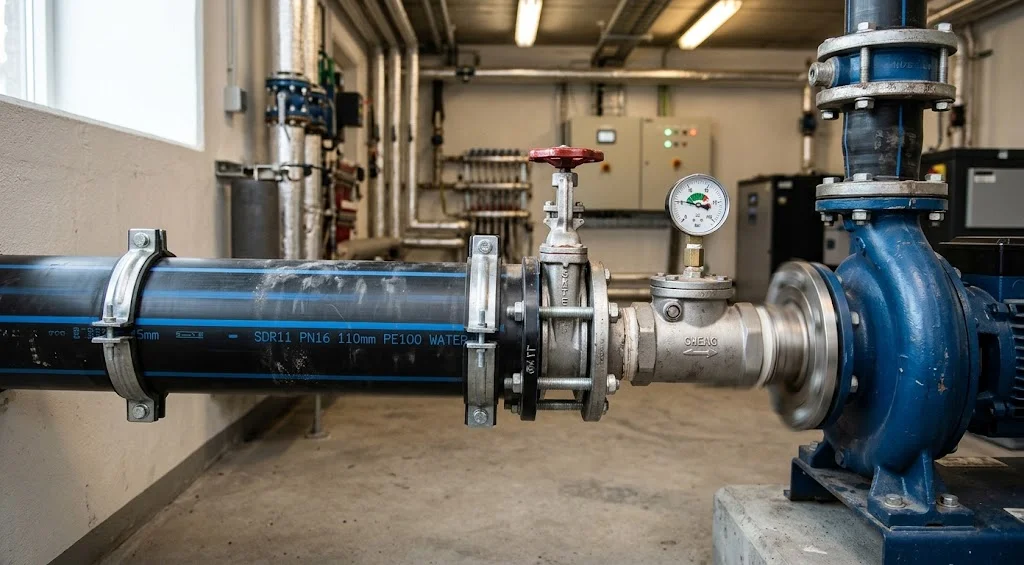
You close a tap and the wall bangs. Or you switch off the pump and hear a loud thud in the rising main. That sound is water hammer in pipes, and it is more than an annoying noise. Repeated pressure shocks can loosen supports, damage valves, and shorten the life of a plumbing system.
This guide explains what causes water hammer, how to tell it from other pipe noises, and how pipe layout and pipe choice can reduce it. It also covers simple fixes you can try before calling a plumber.
What Is Water Hammer?
Water hammer is a sudden pressure surge. It happens when moving water is forced to stop or change speed quickly. The water has momentum, so when a valve shuts fast, the moving column of water slams into it and sends a pressure wave back along the pipe. That wave can bounce between the valve and the supply and make the pipe shake and bang.
The size of the surge depends on three things:
- How fast the water was moving. Higher velocity means a bigger surge.
- How quickly the flow stops. A fast-closing valve is worse than a slow one.
- How stiff the pipe is. A very rigid pipe carries the pressure wave faster and with less damping.
In simple terms, the pressure rise grows with the water’s density, the speed of the pressure wave in the pipe, and the change in water velocity.
What Causes Pipe Banging Noise in a House?
In homes and buildings across Pakistan, the usual triggers are:
- Fast-closing taps and valves, such as quarter-turn ball valves and push-action fittings
- Washing machine and dishwasher valves, which snap shut automatically
- Float valves on rooftop tanks, which can close suddenly when the tank fills
- Pump start and stop, especially on long rising mains to a rooftop tank
- Non-return (check) valves that slam shut when the pump stops
- High water velocity, often caused by undersized pipe
- Loose pipes, which turn a small pressure wave into a loud bang
Is It Really Water Hammer? Other Pipe Noises
Not every pipe noise is water hammer. This table helps you tell them apart.
| Noise | Likely cause | First check |
|---|---|---|
| Loud bang when a tap closes | Water hammer | Which valve triggers it |
| Ticking or creaking with hot water | Pipe expansion against supports | Pipe clips and clearances |
| Whistling or hissing | High velocity at a partly closed valve | Valve position, pipe size |
| Rattling or vibration | Loose pipe clips | Support spacing |
| Thud when the pump stops | Check valve slam or pump surge | Check valve type, pump control |
Why Water Hammer in Pipes Is a Problem
A small thud may seem harmless, but repeated shocks cause damage over time. The effects include:
- Loosened pipe clips and fittings
- Leaking joints and threaded connections
- Damaged valves, taps, and float valves
- Stress on pumps and their mounts
- In severe cases, burst or cracked pipes
How Pipe Layout Reduces Water Hammer
Layout decisions made at the design stage have a large effect on surge.
- Keep water velocity moderate. Undersized pipe pushes water faster, which raises surge. Our pipe diameter flow rate formula guide shows how to size for a sensible velocity.
- Avoid long straight runs ending in a fast-closing valve. The longer the run, the more momentum there is to stop.
- Fit shock absorbers near the source of the shock. Water hammer arrestors work best close to fast-closing valves, such as at a washing machine.
- Give appliances their own branch. Separate lines for washing machines reduce the effect on the rest of the system. A pipe manifold system gives each fixture its own line.
- Support the pipes properly. Clips at the right spacing stop a small surge from becoming a loud bang. Leave room for movement on hot lines.
- Check pump and tank arrangements. On rooftop tank systems, use a slow-closing float valve and a check valve suited to the pump. See our guide to water tank plumbing pipes and fittings.
How Pipe Choice Affects Water Hammer
Pipe material matters, but it is not a cure on its own.
- Plastic pipes are less stiff than steel. A pressure wave travels more slowly in plastic, which generally means lower surge pressure than in steel pipe.
- HDPE is flexible and damps pressure waves well. It absorbs more of the shock than rigid materials.
- PVC and UPVC are more rigid. They can see higher surge pressures than HDPE, so they need a proper pressure class and good valve practice.
- Pressure class matters. Choose a pipe whose pressure rating leaves a margin for surge, not just for normal working pressure. Our guide to pipe pressure ratings, PN and SDR explains how to read them.
Ask the pipe maker what surge allowance applies to the pipe you plan to use. Do not assume that any plastic pipe can take unlimited shocks.

NewTech HDPE Pipes & Fittings
NewTech Pipes · HDPE Piping Systems
Designing a pumped line? See NewTech HDPE pipes, and ask the team which pressure class leaves a safe margin for surge on your project.
View ProductHow to Fix Water Hammer in Pipes, Step by Step
- Find the trigger. Note which tap, appliance, or pump produces the bang.
- Check the pipe supports. Tighten loose clips and add supports where pipes can move.
- Slow the valve. Replace a fast-closing valve with a slower type, and close taps gently.
- Fit a water hammer arrestor. Install it close to the fast-closing valve or appliance.
- Check the pump and check valve. Make sure the pump stops smoothly and the check valve does not slam.
- Check the pipe size. If velocity is high, a larger pipe may be needed.
- Check the supply pressure. Very high pressure makes surges worse. A pressure-reducing valve may help.
- Call a plumber. If banging continues, get the system inspected before pipes or valves are damaged.
Water Hammer in Larger Systems: Tube Wells, Irrigation and Pumped Mains
In a house, water hammer is mostly a noise and wear problem. In larger systems it can be far more serious. Long pumped mains, tube-well rising mains, and irrigation lines carry more water at higher pressure, so the energy in a surge is much greater. A pump trip or a fast valve closure can send a strong pressure wave along a long pipeline.
For these systems, do not rely on rules of thumb. Ask a qualified engineer to check surge pressure, valve closing times, and the need for air valves or surge protection. Then select a pipe class that comfortably covers both normal pressure and the expected surge.
Example: Banging Noise From a Rooftop Tank Line
Take a three-storey house with a rooftop tank filled by an electric pump. Each time the pump switches off, there is a loud thud in the rising main. The cause is often a check valve that closes abruptly as the flow reverses.
The fix is to inspect the check valve and replace it with a slow-closing type, check the pump controls, and make sure the pipe is properly clipped. This is an illustrative example. A real diagnosis needs a site inspection.
How to Prevent Water Hammer in a New Build
- Size pipes for peak demand so velocity stays moderate.
- Use well-made fittings and joints. Poor joints fail first under repeated shocks. See our guide to PVC pipe joint leaks.
- Choose the right pressure class with a margin for surge.
- Plan for arrestors near washing machines and other fast-closing valves.
- Clip the pipes correctly.
- Buy certified pipe. Choose pipe and fittings from a manufacturer registered with PSQCA.
Conclusion
Water hammer in pipes is caused by flow stopping too fast, and layout and pipe choice both change how bad it gets. Keep velocity moderate, support the pipes, protect fast-closing valves with arrestors, and choose a pressure class that leaves a margin for surge. Plastic pipe, and HDPE in particular, helps, but good design matters more than material alone.
Planning a plumbing or pumping system? Contact Newtech Pipes to discuss the right pipe class and fittings for your project.