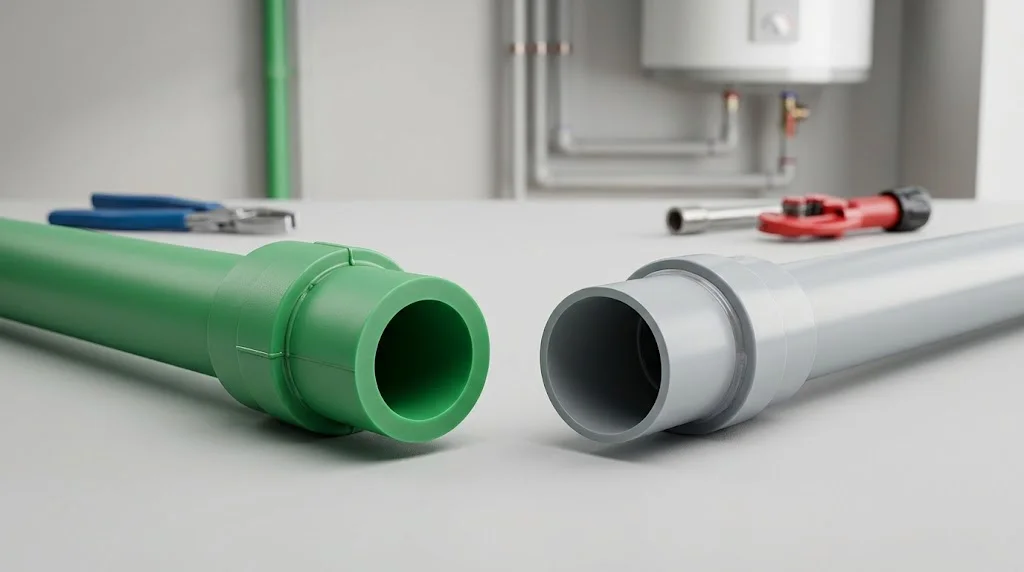
You are renovating two bathrooms and a kitchen in Lahore. The plumber says PPR. A neighbour who redid his house last year says CPVC, and sends you a photo of his grey pipes. Both are plastic, both are sold for hot water, and both quotes look reasonable. Which one is right?
A full disclosure first: Newtech manufactures PPRC pipe and fittings, and we do not make CPVC. That is an obvious bias, so we have done what we would want from any supplier. We checked the ratings against published standards bodies, we say where CPVC genuinely wins, and we avoid claims we cannot support. The result is a practical comparison of PPRC vs CPVC for Pakistani homes, apartment buildings and light commercial projects.
The short answer
For most Pakistani homes and buildings, PPRC is the practical default for hot water: it is made in metric sizes, widely stocked by many local and imported brands, and joined by socket heat fusion. CPVC is a sound material with real strengths, including lower thermal expansion, a larger bore for the same outside diameter, and solvent-cement joining with no fusion machine. It makes most sense for particular layouts, higher-temperature lines or specific project specifications.
The rest of this guide shows where that answer comes from, so you can decide for your own project.
What each pipe actually is
PPRC (polypropylene random copolymer, often written PP-R) is a rigid polypropylene pipe for hot and cold water inside buildings. It is covered internationally by ISO 15874, and manufacturers also reference the German DIN 8077 and 8078 standards for dimensions. Joints are made by socket heat fusion: pipe and fitting are heated together with a welding iron and pushed together, creating one continuous piece of plastic. If you want the detail on ISO 15874 application classes, see our
pipe standards guide.
CPVC (chlorinated polyvinyl chloride) is ordinary PVC that has been chlorinated, which raises the temperature it can withstand. For residential hot and cold water the relevant standard is ASTM D2846, which defines copper-tube-size (CTS) tubing at SDR 11. Heavier CPVC pipe for industrial use follows ASTM F441 in Schedule 40 and 80 iron-pipe sizes (IPS). Joints are made with CPVC-specific solvent cement, which chemically softens and welds the surfaces together.
Two things stand out already. The systems come from different standards families, and they are joined in completely different ways.
Temperature and pressure: the comparison that trips people up
Both pipes are sold as hot-water pipes, but the headline temperatures hide how they are actually rated.
The Plastics Pipe Institute (PPI) states that CPVC systems are pressure-rated for operation up to 200 °F (93 °C), and that SDR 11 CPVC tubing is rated for 400 psi at 73 °F (23 °C) and 100 psi at 180 °F (82 °C). Pressure capacity falls steadily as the water gets hotter: published CPVC derating tables give 200 psi at 140 °F (60 °C).
PPRC is rated differently. ISO 15874 uses
application classes, each with a temperature profile over a 50-year design life, and assigns a design pressure to each combination of class and pipe series. Class 1 covers hot water at 60 °C and Class 2 covers 70 °C.
| Pipe |
About 23 °C (cold) |
About 60 °C |
About 70 to 82 °C |
| CPVC, CTS SDR 11 (ASTM D2846) |
400 psi, about 27.6 bar |
200 psi, about 13.8 bar |
100 psi, about 6.9 bar at 82 °C |
| PPRC PN 20 (S 2.5, SDR 6), one manufacturer’s PP-R declaration |
PN 20 label |
10 bar (Class 1) |
8 bar at 70 °C (Class 2) |
How to read the table honestly:
- The “93 °C” and “95 °C” numbers are not comparable. Both materials survive hot water, but the pressure they can carry at that temperature is much lower than the cold rating. Always ask for the pressure at your operating temperature.
- The walls are not the same. SDR 11 CPVC has a much thinner wall than a PN 20 PPRC pipe (SDR 6), so the pressure figures are not a like-for-like contest of the plastics themselves. They are ratings of two different products.
- For ordinary house plumbing, both are comfortably adequate. Typical domestic hot water temperatures and mains or tank pressures sit well within either rating. The difference matters mainly for boilers, solar thermal loops, recirculation lines and tall buildings.
For PPRC pressure by class, always read the manufacturer’s datasheet. Our
PPRC hot water guide goes through ratings and sizes for the Pakistani market.
NewTech PPRC Buyer’s Guide
NewTech Pipes · PPRC Piping Systems
Weighing PPRC against CPVC? Read NewTech’s PPRC guide to PN-16, PN-20 and PN-25 ratings and what drives pipe cost before you ask for quotes.
Read Guide
Joining and installation
CPVC: solvent cement. Cut, deburr, clean, apply cement and push together. There is no flame and no machine, which makes small jobs quick. But the details matter: CPVC needs CPVC-specific cement (to ASTM F493) and it must never be swapped for ordinary PVC cement. Joints need curing time before pressure testing, and the cement needs ventilation.
PPRC: socket fusion. A welding iron heats the pipe and fitting to around 260 °C, and a trained plumber joins them in seconds. The result is a joint of the same material as the pipe. It needs a fusion machine, correct heating times and clean alignment, but fusion equipment and trained fitters are common in Pakistan because PPRC is the established standard for indoor hot water here.
Both methods give permanent joints, and both fail in the same way: through poor workmanship. A rushed solvent joint, an under-heated fusion joint or a joint made on dirty pipe is where leaks begin. What matters most is whether your installer is trained in the system you choose.
Thermal expansion: where CPVC wins
All plastic pipe expands when hot water runs through it. The two materials expand by very different amounts.
- CPVC has a coefficient of linear expansion of about 3.4 × 10⁻⁵ in/in/°F in manufacturer data, which is roughly 0.06 mm per metre per degree Celsius.
- PP-R expands at about 0.15 mm per metre per degree Celsius, which is two to three times as much.
On a 10-metre run heated from 20 °C to 70 °C, our calculation gives about 75 mm of growth for PPRC and about 30 mm for CPVC. Where pipes run exposed along a wall or in a rooftop line, that difference means fewer and smaller expansion loops for CPVC. It is a real advantage.
It does not remove the need for design. Both materials need loops, offsets or flexible sections, and supports must allow movement rather than clamping the pipe tight. Our
thermal expansion guide shows how to do it. In concealed chases inside walls, where pipes are free to move, the difference matters far less.
Bore and flow: another point for CPVC
The pressure table above hints at it: CPVC SDR 11 has a thin wall, and thin walls leave more room inside. At the same outside diameter of 25 mm, SDR 11 gives a wall of about 2.3 mm and a bore of about 20.5 mm. A PN 20 PPRC pipe (SDR 6) has a wall of about 4.2 mm and a bore of about 16.7 mm. That is about 50% more flow area for the CPVC, in a like-for-like outside diameter.
Two cautions apply. CPVC is not actually sold in a 25 mm metric size in its residential CTS range (sizes follow copper tube), so this is a theoretical comparison. And PPRC is also made in thinner series for cold lines. For hot water you usually want the thicker PN 20 series, so the bore penalty is real, and designers sometimes step up one pipe size to compensate.
Water quality, chemicals and fire
Both materials resist corrosion and scale, which is why they replace GI so effectively (see our
GI to PPRC conversion guide). PPI lists resistance to chlorine and chloramine disinfectants as a general advantage of plastic plumbing, relevant to municipal water.
CPVC is chemically resistant and is widely used for hot corrosive liquids. It does need care with the products that touch it: manufacturers publish compatibility lists for thread sealants, cements and other chemicals, so use only what the maker approves.
Fire protection is a separate category. CPVC is also used in fire sprinkler systems, but that is a listed, purpose-made product line. A plumbing-grade pipe of either material should not be used as a sprinkler line.
Availability and standards in Pakistan
This is where the practical difference is biggest.
PPRC is sold by a large number of local and imported brands in metric sizes, with a deep range of fittings, valves, clips and brass-threaded adaptors available in most cities. Plumbers know the system, and spare fittings are easy to find.
CPVC is available, but the market looks different. Online trader listings for Karachi show imported and local CPVC sold mainly as Schedule 80 grey pipe in half-inch to 2-inch sizes. That is the heavy-wall industrial range, not the thin-wall CTS tubing common in American homes. The practical risks:
- Mixed size systems. CTS and IPS sizes are not interchangeable, so mixing brands or ranges can leave you with fittings that do not match.
- Unclear standards. Many offers do not state the standard (ASTM D2846 or F441) or the pressure rating at temperature, so ask for both.
- Cement compatibility. Use the cement recommended for the pipe and brand.
- Spares and support. Check that the fittings, valves and cement you will need later can still be bought locally.
A good CPVC supply chain is entirely possible. It simply needs more checking than PPRC does.
Cost: compare the whole installed system
We could not find reliable, current, like-for-like public prices for CPVC against PPR in Pakistan. Listings mix pipe types, sizes, units and brands, so any single “PPR vs CPVC price” figure would be misleading, and we will not invent one.
For reference, Newtech’s own published
PPRC price guide puts residential 20 to 32 mm PN 20 pipe at roughly Rs. 330 to 1,000 per metre. Prices move with raw material and the exchange rate, so treat them as a starting point and check the current list.
To compare fairly, get dated written quotes for the same job and add up:
- Pipe, by the same length and size.
- Fittings, which are often the larger share of a plumbing bill.
- Valves and adaptors for the taps and heater connections.
- Cement or consumables, and a fusion machine or its rental.
- Labour rates for a plumber trained in that system.
- Expansion loops, insulation and supports.
- Wastage and spares.
A slightly cheaper pipe that needs a plumber you cannot find, or fittings you cannot get, is not cheaper.
Which one fits which job?
| Situation |
Likely choice |
Why |
| Home bathrooms, kitchen and geyser lines |
PPRC PN 20 |
Standard, widely stocked, easy to repair |
| Apartment risers and long exposed hot runs |
Either, with expansion design |
CPVC expands less; PPRC is easier to source and service |
| Solar water heater and recirculation loops |
PP-R or CPVC, rated for the actual temperature |
Check the class or pressure at operating temperature |
| Hot corrosive process fluids |
CPVC (or another suitable material) |
CPVC chemical resistance, subject to compatibility checks |
| Site with no fusion equipment and small repairs |
CPVC may be convenient |
No machine needed, but use the correct cement |
| Fire sprinklers |
Listed fire-protection systems only |
Not an ordinary plumbing choice |
| Cold water only |
uPVC |
Lower cost than either |
Five mistakes to avoid
- Judging by the maximum temperature. Ask for pressure at your hot-water temperature.
- Mixing systems. Do not combine CPVC from different size standards or use PVC cement on CPVC.
- Ignoring expansion. Both need loops and free-moving supports.
- Skipping the standard. A hot-water pipe quote without the standard and pressure rating is incomplete.
- Trusting a colour. Grey is not proof of CPVC, and green is not proof of PPRC. Check the marking.
Conclusion: choose the system you can install and service well
PPRC and CPVC are both genuine hot-water materials. CPVC offers lower thermal expansion, a larger bore and solvent joining. PPRC offers a mature local supply chain, fusion joints that become part of the pipe, and standard ISO 15874 ratings by temperature class. For most homes in Pakistan, that availability and serviceability makes PPRC the practical default. For a specialist line or a project specification that calls for CPVC, buy it with a clear standard, a pressure rating at temperature and a supplier who can support it.
Whichever you choose, ask for the number, the standard and the pressure at your operating temperature, and then check the marking on the pipe in your hand.