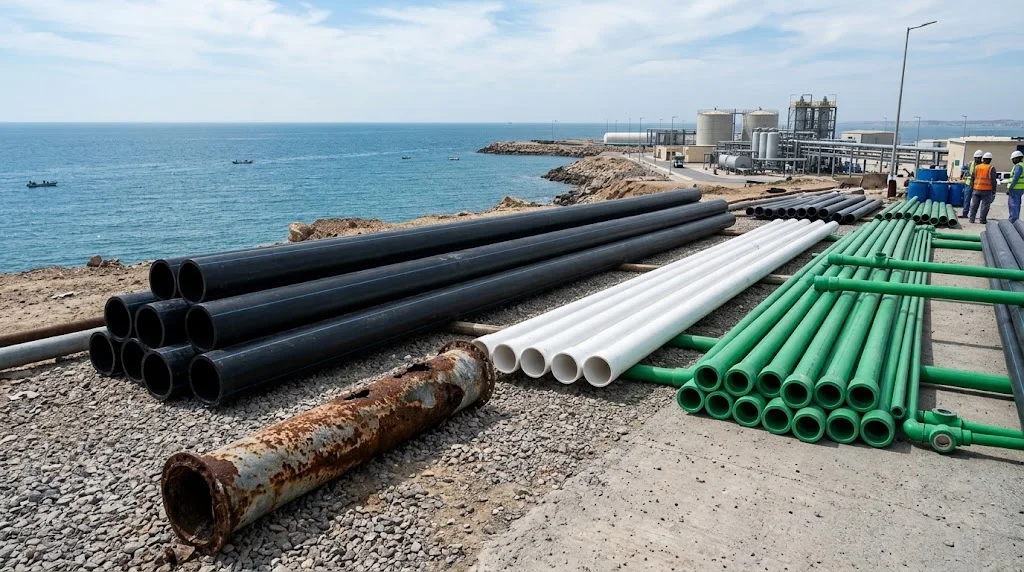
Walk through an older building near Karachi’s coast and you will see the same story told in rust: a flaking GI elbow under a balcony, a green crust on a brass valve, a tap that runs brown after a few days without pressure. Salt does this. It rides in on the sea breeze, settles on every metal surface, and quietly eats through the pipes you expected to last for decades.
If you are building or renovating near the Arabian Sea, in Karachi, Gwadar, Thatta, Sujawal or Badin, choosing corrosion resistant pipes for coastal areas is less about brand names and more about knowing where the salt attacks. This guide covers the three coastal threats, how each common pipe material responds, the fitting mistakes that undo good pipe, and a checklist you can hand to your contractor.
Why the coast is harder on pipes than inland Pakistan
People often lump “coastal corrosion” into one problem. It is really three, and each one points to a different solution.
1. Salt air and humidity on outside surfaces
Sea spray leaves chloride salts on every exposed surface. Mixed with humidity, they speed up corrosion in unprotected metal. The American Galvanizers Association notes that the corrosion rate of zinc coatings can range from about 0.1 micrometres a year indoors to more than 10 micrometres a year in some industrial or marine environments. It also says warmer climates make coastal air more aggressive and that structures within roughly 250 feet (about 75 metres) of the shore may see heavy spray or splash.
Here is the part many owners miss: the Galvanizers Association of Australia points out that sheltered surfaces that rain never washes can corrode faster in marine air, because the salts build up. Think of pipes under balconies, inside ducts, behind cladding and in meter boxes.
A simple, purely illustrative calculation shows the stakes. An 85-micrometre zinc coating (typical of heavy structural galvanising; plumbing pipe may be thinner) losing 10 micrometres a year would be gone in under nine years. That is not a forecast for your building, only a reminder that coastal conditions can compress a “30-year” pipe into a short service life.
2. Saline groundwater and soil
Buried pipes face a second problem: salty ground. Seawater intrusion in the Indus Delta is well documented. Dawn has reported research by the National Institute of Oceanography finding that nearly 80 percent of shallow groundwater sources in the delta region exceed the WHO limit of 500 mg/L total dissolved solids. In May 2026 Dawn also reported local leaders in Thatta, Sujawal and Badin estimating that around 85 percent of groundwater there had turned saline (that figure is their estimate, not an official measurement).
For anyone laying water lines, tube-well rising mains or desalination feeds in these areas, salinity is not a footnote. Chloride-rich water and soil attack steel and standard brass from the outside and the inside.
3. Heat and sunlight
Coastal Sindh is hot and bright. Heat speeds up corrosion chemistry, and ultraviolet light degrades unprotected plastics. That matters when you choose pipe for rooftops, boundary walls, pump houses and open trenches.
GI pipe near the sea: the first to fail
Galvanised iron (GI) was the default for generations. Near the coast it is the material most likely to disappoint: the zinc coating is consumed by salt-laden moisture, rust starts at threads and cut ends, and rust scale narrows the bore and discolours water. We cover the general GI versus HDPE comparison in Why HDPE Pipes Are Replacing GI Pipes in Pakistan, so here is the coastal-specific point: threaded joints, supports and brackets are where a GI system fails first, and every failure is a leak you will have to find and fix.
Mixing metals makes it worse. When two different metals touch in the presence of a salty electrolyte, the less noble one corrodes faster. A GI nipple screwed into a brass valve in a humid, salty shaft is a textbook case.
HDPE vs GI Pipe Guide
NewTech Pipes · HDPE Piping Systems
Replacing rusted GI near the coast? See HDPE and GI side by side, from corrosion resistance and fused joints to flow over time, before you choose a pipe.
Corrosion resistant pipe options, compared
Three plastic systems dominate corrosion-proof plumbing in Pakistan. Each has a job.
HDPE (PE100): best for buried lines, long runs and the harshest exposure
Polyethylene does not rust. The Plastics Pipe Institute’s Handbook of Polyethylene Pipe says PE has been used for marine applications since the early 1960s, including outfalls, river and lake crossings, and fresh and salt-water intakes, and that immunity to galvanic corrosion is a major reason engineers pick it. Large HDPE lines have been used for seawater intake and outfall at desalination plants; the Minjur plant in India, for example, uses a 1,600 mm HDPE intake line. Borealis reports that a Canadian outfall originally planned in steel was changed to PE100 because of corrosion and maintenance concerns.
Why it works near the sea:
- No rust, no pitting, no need for coatings or cathodic protection.
- Butt-fusion and electrofusion joints create leak-free, monolithic runs, so there are fewer joints where salt water can seep in.
- Flexibility absorbs ground movement, which helps in soft, wet coastal soils.
- Black PE100 contains carbon black, which protects against sunlight; Borouge notes that PE100 is also lighter than seawater, which makes marine installation methods possible.
What to watch: HDPE is for cold water, not hot. It expands noticeably with temperature, needs fusion equipment and trained crews, and can be scratched during handling, which matters for marine work. Always check the pressure rating (PN class) for your service temperature. Newtech manufactures HDPE pipe from PE100 to ISO 4427; see HDPE Pipes & Fittings and our water distribution guide.
uPVC: practical for cold water, drainage and low-cost runs
uPVC is chemically resistant to sodium chloride solutions, so salt air and saline water do not eat the pipe the way they eat steel. It is light, easy to join with solvent cement, and common for cold-water mains, drainage and sewerage.
What to watch: uPVC is not for hot water, becomes more brittle under heavy impact and prolonged strong sunlight, and its pressure rating depends on the class you buy. Shade exposed runs, or protect them with paint or insulation as the manufacturer recommends.
PPRC: best for hot and cold water inside the building
PPRC is resistant to salts and does not corrode, scale or pit. Heat-fusion joints are strong and clean, and PPRC handles both hot and cold lines, which makes it a strong choice for coastal apartments and villas.
What to watch: standard PPRC is generally not UV-stabilised, so keep it out of direct sunlight or cover it. Allow for thermal expansion on hot lines. Confirm Newtech’s current PPRC size range on the PPRC page before quoting dimensions.
Quick comparison
| Material | Salt air (outdoors) | Buried in saline soil | Hot water | Typical coastal use |
| HDPE (PE100) | Good (carbon-black stabilised) | Excellent | No | Water mains, tube-well lines, industrial, seawater intake (specialist design) |
| uPVC | Good chemically; shade from sun | Good | No | Cold water, drainage, sewerage |
| PPRC | Good chemically; keep out of sun | Not typical | Yes | Indoor hot and cold plumbing |
| GI | Poor; coating consumed over time | Poor | Limited | Avoid in new coastal work |
The weak link: fittings, valves, clamps and supports
The best plastic pipe can still fail early if you fit it with the wrong hardware. Standard brass is vulnerable to dezincification, the selective loss of zinc, particularly in chloride-rich water; dezincification-resistant (DZR) brass is the safer choice where a brass valve is unavoidable. Stainless steel is better, but grade matters: 304 can pit in salt spray and direct seawater contact, while 316 is the usual coastal specification.
These points come from valve and fitting suppliers, so confirm the grade with the manufacturer’s datasheet for your exact valve.
In practice:
- Prefer all-plastic fusion or electrofusion joints over threaded metal transitions.
- Where a valve is needed, specify DZR brass or 316 stainless, or a plastic valve for cold water.
- Use stainless or coated clamps and brackets, not plain galvanised ones, and keep dissimilar metals from touching.
- Seal threaded transitions properly and keep them accessible for inspection.
Practical installation tips for coastal sites
- Map the exposure first. Is the pipe buried, on a rooftop, in a shaft, or within about 75 metres of the shore? Pick material per zone, not per project.
- Bury where you can. Buried HDPE or uPVC avoids UV and spray; ensure bedding is free of sharp stones and, if backfill is highly saline, rely on plastic joints rather than metal couplings.
- Protect exposed plastic. Shade or cover uPVC and PPRC from direct sun; use black PE100 for open-air HDPE runs.
- Design for expansion. Sun-heated rooftop lines move more than you expect. Use expansion loops or properly spaced supports.
- Hold the pressure test. Test the line at the specified pressure, hold it, and log the result before backfilling.
- Flush new lines. Salt, dust and construction debris should be flushed out before commissioning.
- Keep records. Note pipe class, batch and fitting types for later maintenance. Use certified, ISO 9001-2015 and PSQCA-registered products and keep the paperwork.
Saline water and seawater: what changes
Moving brackish or seawater is a different job from moving potable water. Polyethylene’s corrosion immunity is why it is widely chosen for seawater intakes and outfalls, including for desalination. Pakistan’s own coast is moving in this direction: the 1.2 million gallons per day Gwadar seawater desalination plant is one visible example of demand for saline-water infrastructure.
But seawater work is specialist engineering. Intake depth, ballasting, tidal loading, biofouling, surge pressures and pressure derating all need to be designed by an engineer. For buildings, farms and small industrial sites using saline groundwater, HDPE or uPVC for the water side is a sound starting point, but check the PN class with the manufacturer.
Quick answer: which pipe is best for coastal areas?
For most coastal projects, HDPE (PE100) is the most corrosion resistant choice for buried and outdoor cold-water lines, uPVC suits cold-water and drainage runs, and PPRC suits hot and cold water inside the building. Avoid GI, and pair any plastic pipe with DZR brass, 316 stainless or plastic fittings.
Checklist to give your contractor:
- Zone the site: buried, outdoor, indoor, within 75 m of shore.
- Choose material by zone and by temperature.
- Confirm PN class and sizes with the manufacturer.
- Specify fittings and supports, not just pipe.
- Shade or cover plastics that see direct sun, unless they are UV-stabilised black PE100.
- Pressure test and flush before handover.
Need help matching pipe to your site? Talk to our team, or see our Karachi supply page.
Conclusion
The sea is patient. Salt air, saline soil and strong sun do not attack a pipe all at once; they work slowly at the weakest point until it gives. The good news is that you can design that weak point away. Choose plastics that cannot rust, match each material to its zone, and treat fittings and supports as part of the system.
Do that, and the green crust and brown water stay in old buildings, not in yours.