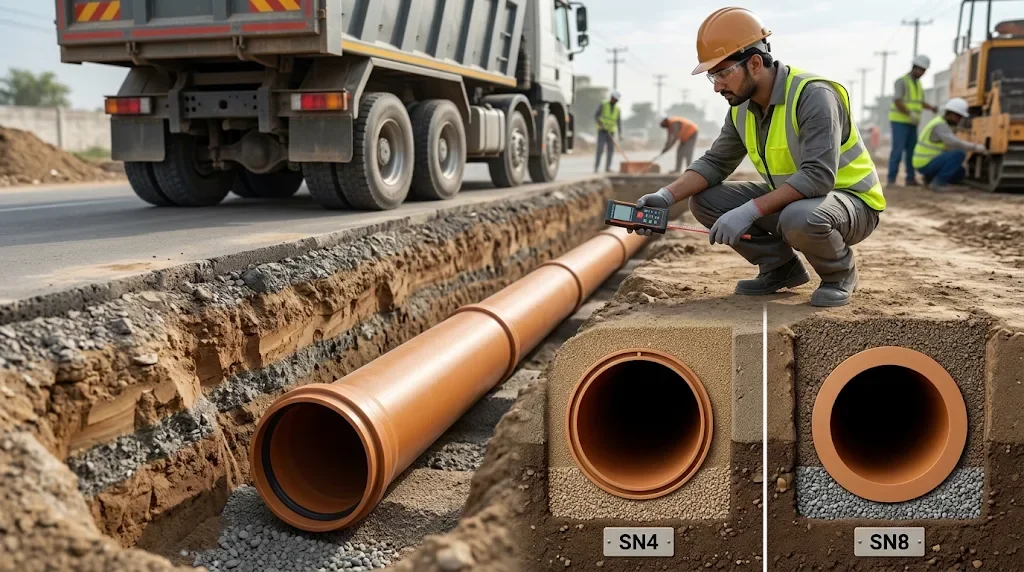
A new sewer line passes its air test. The trench is backfilled, the road is paved, and the contractor goes home. Eighteen months later, a CCTV camera is pushed down the line and finds the pipe squeezed into an oval, its sides pushed in by the soil and the traffic above it. Nothing leaked on test day. The pipe simply was not stiff enough for the way it was buried.
That is the problem ring stiffness exists to describe. Underground, a gravity sewer is not a pressure pipe. It is a ring holding up the weight of the ground, the road and the vehicles on it. This guide explains what SN4 and SN8 mean, how they are measured, how to choose between them, and how to check that your installation is doing its part.
For the wider choice between uPVC and HDPE for sewerage, our overview post on plastic pipes for sewerage and drainage in Pakistan is the place to start. This article goes deeper on stiffness.
The short answer
Ring stiffness (SN) is a buried pipe’s resistance to being squashed out of round, measured in kN/m². SN4 pipe has a minimum ring stiffness of 4 kN/m² and SN8 pipe 8 kN/m². SN4 is the common class for normal depths, soils and traffic when the trench is built well. SN8 gives a wider margin for deeper trenches, heavy traffic, weaker ground or sites where bedding quality is uncertain. The class only works as part of the installation, so the final choice belongs in a structural design check, not a rule of thumb.
What ring stiffness actually means
Imagine squeezing a plastic ring between two flat plates. A stiff ring barely changes shape. A thin one flattens easily. Ring stiffness puts a number on that resistance.
- Where the number comes from. ISO 9969 is the test method. A cut length of pipe is compressed between parallel plates at a steady speed while force and deflection are recorded. Ring stiffness is then calculated from the force needed to produce a 3% diametric deflection.
- What it is not. It is not a pass-or-fail limit that says a pipe must never deflect more than 3%. The 3% point is simply where the stiffness is measured.
- The units. Ring stiffness is stated in kN/m². An SN8 pipe has a minimum ring stiffness of 8 kN/m².
- What it depends on. Stiffness rises with the stiffness of the material and, much more sharply, with the thickness of the wall relative to the diameter. In engineering terms, pipe stiffness is proportional to the material modulus times the wall’s second moment of area, divided by the diameter cubed. Wall thickness enters as a cube, so a modest increase in wall gives a large increase in stiffness.
- What it is not related to. Ring stiffness has nothing to do with pressure rating. A gravity sewer pipe is not a pressure pipe, and SN classes should never be confused with PN ratings.
EN 1401-1:2019, the European standard for PVC-U non-pressure underground drainage and sewerage, specifies four stiffness classes: SN2, SN4, SN8 and SN16.
SN, SDR and wall thickness
For solid-wall PVC-U sewer pipe, the stiffness class is delivered through wall thickness. A higher SN means a smaller SDR, and so a thicker wall for the same diameter. The usual pairings are SN2 with SDR 51, SN4 with SDR 41 and SN8 with SDR 34.
The minimum wall thicknesses below come from a Belgian certification of PVC-U sewer pipe to EN 1401-1:2019+A1:2023, and are consistent with another manufacturer’s published EN 1401 table:
Nominal size (DN/OD) | SN2 (SDR 51) | SN4 (SDR 41) | SN8 (SDR 34) |
110 mm | not listed | 3.2 mm | 3.2 mm |
125 mm | not listed | 3.2 mm | 3.7 mm |
160 mm | 3.2 mm | 4.0 mm | 4.7 mm |
200 mm | 3.9 mm | 4.9 mm | 5.9 mm |
250 mm | 4.9 mm | 6.2 mm | 7.3 mm |
315 mm | 6.2 mm | 7.7 mm | 9.2 mm |
400 mm | 7.9 mm | 9.8 mm | 11.7 mm |
Two practical lessons come from the table:
- The wall is the stiffness. A 315 mm SN8 pipe has a wall about 1.5 mm thicker than SN4, which is about 20% more material and a much stiffer ring. That is why SN8 costs more per metre.
- At 110 mm, SN4 and SN8 share a 3.2 mm minimum wall in these tables. Below a certain size the minimum practical wall governs, so check the maker’s stiffness data rather than assuming a visible difference.
The pipes are also normally supplied with rubber-ring socket joints, and sewer pipe made to EN 1401 is typically orange-brown. Check your own supplier’s marking and colour against the standard cited in your specification.
Why the soil matters as much as the pipe
A buried flexible pipe does not carry its load alone. The British Standards committee for EN 1401-1 states the principle directly: deformation in buried pipelines is resisted by the pipe’s ring stiffness together with support from the native soil and the compacted sidefill in the trench.
That has three consequences:
- Deflection is the design check. The designer sets a maximum long-term deflection. In the UK it is typically 6% for adoptable sewers and 5% for highway works. In North America, the PVC pipe industry (Uni-Bell) cites a long-term limit of 7.5%, while treating reverse curvature, at around 30% deflection, as the point of structural failure.
- Soil quality changes the answer. The same pipe at the same depth deflects less in well-compacted granular sidefill than in loose or soft ground. Engineers capture this with a soil stiffness value (E′ in the US method).
- Loads come from two places. The weight of the soil above the pipe, and live loads such as trucks and rollers. Live loads matter most at shallow cover, so shallow is not automatically safe.
The UK committee’s advice for typical gravity drains is useful context: when installed in accordance with EN 1610, SN4 pipe is the class they advise to achieve the necessary long-term resistance to deformation, and SN2 should only be used after a structural design calculation. That is advice for UK conditions, not a Pakistani rule, but it shows how much the installation standard and the class work together.
SN4 or SN8: how to decide
There is no single depth at which SN4 “becomes” SN8. Manufacturers publish burial ranges under stated assumptions. One example, from a Lebanese manufacturer of EN 1401 pipe, gives SN4 as suitable for direct burial from 0.9 m to 6 m and SN8 from 0.6 m to 9 m, in each case for an expected average deflection under 8%. Notice that SN8 is also approved at shallower cover: its extra stiffness helps against traffic loads close to the surface.
Uni-Bell also makes a pointed observation: many sewer utilities have set depth limits for PVC arbitrarily, and the right approach is a calculation of the long-term deflection for the actual embedment, loads and pipe.
Use the table below as a framework for the conversation with your engineer, not as a substitute for a design check:
Factor | Leans towards SN4 | Leans towards SN8 (or higher) |
Cover depth | Moderate depth in good ground | Deep trenches, or very shallow cover under roads |
Traffic | None or light (footpaths, gardens, quiet residential streets) | Carriageways, heavy construction vehicles, roller and crane loads |
Ground | Stable, granular, easy to compact | Soft, organic or loose soils; high groundwater; unstable trench walls |
Bedding control | Close supervision and testing | Uncertain compaction or limited supervision |
Diameter | Smaller pipes with good embedment | Larger pipes, where ring flexibility and handling matter more |
Consequence of failure | Low | High: major roads, access-limited lines, long-life networks |
Our view, not a standard: where supervision on site is uncertain, SN8 buys back some margin that poor compaction would otherwise take. It does not replace good bedding.
What a structural check looks at
A design engineer checking a buried sewer typically considers:
- the long-term stiffness of the pipe, which is lower than the short-term SN because plastics creep;
- the soil modulus of the bedding, sidefill and native soil;
- depth of cover and trench width;
- soil weight and traffic surcharge;
- groundwater, which affects both soil stiffness and flotation.
The European method is EN 1295-1 and BS 9295 is a UK guide to the structural design of buried pipes. For your project, ask your design engineer which method the specification cites.
Where ring stiffness is won or lost on site
Ring stiffness is a property of the pipe. Deflection is a property of the installation. These steps decide the outcome:
- Bed the pipe on a uniform granular layer so it is supported along its length, not on rocks or hard spots.
- Haunch and compact the sidefill in layers. The soil beside the pipe provides the support that stops the ring from ovalising, so this is where compaction matters most.
- Keep the trench stable and dry. Groundwater softens bedding and can float empty pipe.
- Use the right trench width, wide enough to place and compact embedment around the pipe.
- Protect the pipe during compaction. Keep heavy plant off the pipe until it has enough cover, and keep boulders and debris out of the backfill.
- Assemble joints carefully. Clean the spigot and socket, lubricate the rubber ring as the maker directs, and push the spigot to the insertion mark.
The EN standard for laying and testing drains and sewers is EN 1610. Our overview post’s installation checklist covers the practical steps in more detail.
Checking the pipe after it is buried
Because deflection is the evidence that the pipe and the trench are working together, many municipal specifications elsewhere require a deflection check after backfill:
- Mandrel test. A go/no-go mandrel is pulled through the pipe. Specifications in several US cities set the maximum at 5% of the original internal diameter and require the test no sooner than 30 to 60 days after final backfill, so the pipe has time to settle. One city accepts 7.5% for stormwater pipes.
- Laser profiling with CCTV. A laser profiler on a CCTV camera measures the actual shape of the pipe along its length and can find ovality, cracks and joint problems. Its use in post-installation testing is growing among municipalities.
- Leakage tests. Air or water tests prove the joints, and manholes are tested separately. Deflection and leakage tests answer different questions, so a pipe needs both.
These examples come from North American practice. In Pakistan, follow the test regime in your project specification and with the owner’s engineer. The principle is the same: do not rely on the air test alone.
Five mistakes to avoid
- Treating SN as a pressure rating. It is not.
- Choosing by depth alone. Soil, traffic and bedding quality all change the answer.
- Assuming SN8 fixes bad bedding. A stiffer pipe still needs good sidefill.
- Skipping the marking check. Look for the size, wall thickness, SN class and standard printed on the pipe.
- Testing leakage but not shape. Air tests do not reveal deflection.
Conclusion: choose the class, then protect it
SN4 and SN8 are not good and better. They are two points on a scale of resistance to ring deformation, and the right one depends on the load above the pipe and the support around it. Pick the class with your design engineer, write it on the purchase order with the standard and the size, and then build the trench so the pipe has the support it was designed for.
For sizes, materials and sewerage design beyond stiffness, see our overview of plastic pipes for sewerage and drainage. To discuss your project, talk to our team with your pipe sizes, trench depths and ground conditions.
Frequently Asked Questions
Q1.What does SN4 mean on a sewer pipe?
N4 is a ring stiffness class. It means the pipe has a minimum ring stiffness of 4 kN/m², measured by compressing a pipe section between plates (ISO 9969) and calculating stiffness from the force needed to deflect it by 3%.
Q2.What is the difference between SN4 and SN8?
SN8 pipe has twice the minimum ring stiffness of SN4 (8 against 4 kN/m²) and a thicker wall for the same diameter. It resists more load from soil and traffic before deforming.
Q3.Is SN8 always better than SN4?
Not always. SN8 gives more margin, but it costs more per metre and is not needed everywhere. Choose by depth, traffic, soil and installation quality, and confirm with a structural check.
Q4.How deep can SN4 sewer pipe be buried?
It depends on the soil, bedding, traffic and the designer’s deflection limit. One manufacturer publishes 0.9 m to 6 m for SN4 and 0.6 m to 9 m for SN8 under stated assumptions. Do not treat that as a universal limit; ask for a design check.
Q5.Is ring stiffness the same as a pressure rating?
No. Ring stiffness describes resistance to external load on a buried gravity pipe. A pressure rating (PN) describes resistance to internal pressure. Gravity sewer pipes are not designed for pressure.
Q6.How is ring stiffness tested?
By ISO 9969. A short length of pipe is compressed between two flat plates at a constant speed and the force and deflection are recorded. Ring stiffness is calculated from the force needed for 3% diametric deflection.
Q7. How do I check a sewer pipe after installation?
Use a deflection check (a mandrel or a laser profiler with CCTV) after backfill has settled, plus air or water leakage tests. Many municipal specifications elsewhere limit deflection to 5%, but follow the limit in your own specification.