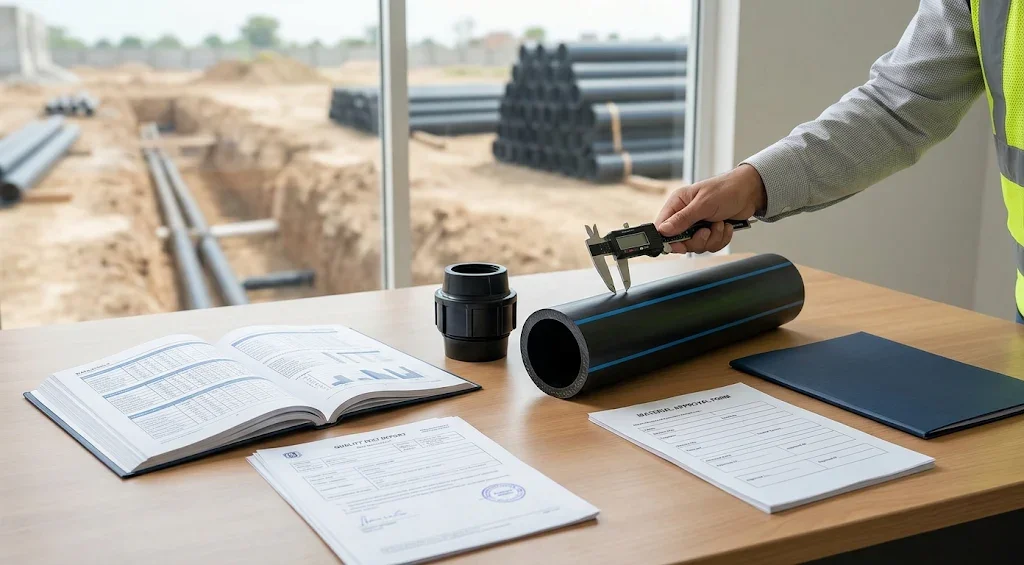
A truck carrying 110 mm HDPE pipes arrives at a housing society project in Rawalpindi on Monday morning. The contractor is prepared, and the trench is ready for installation. However, the site engineer raises one important question: “Where is the approval?”
For Pipe Supply for Housing Societies, quality and competitive pricing are important, but formal material approval is equally essential. Without it, the truck remains at the gate, workers are left waiting in the trench, and the entire project schedule begins to fall behind.
Scenes like this are common wherever pipe is supplied to organised projects. Housing societies and public agencies rarely accept pipe on price and reputation alone. They buy against a specification, and that specification has to be proved on paper, and often with a physical sample, before a single length goes into the ground.
This guide explains the documents, samples and approvals involved, so you can prepare once and move faster. It is written for suppliers, contractors, consultants and procurement teams. It is a general guide. Every society and agency has its own forms and rules, so always follow the project’s own tender or specification documents.
Why Approval Matters as Much as Price
In construction, the formal package of documents and samples sent for review is called a submittal. It is how the design team confirms that a product meets the contract specification before it is delivered or installed. Done properly, it prevents rejected materials, rework and delays.
Pipe makes this especially important. Once a pipeline is buried, you cannot easily inspect it again. A wrong wall thickness or a missing certificate discovered after installation can mean digging up finished work. That is why engineers ask for proof first.
If you have already read our guide on comparing pipe quotations fairly, you know price is only one filter. Approval is the gate that decides whether even the best price can actually be delivered.
Housing Societies vs Government Projects: What Changes?
The logic is the same in both: prove that the pipe meets the specification. The route is different. The table below shows typical differences. Treat it as a starting point and confirm the exact rules for your project.
Aspect | Housing society (typical) | Government / public project (typical) |
Who approves | The society’s engineering or procurement team, often with an appointed consultant | The procuring agency and the engineer or consultant named in the bidding documents |
Supplier status | Often an approved-vendor list kept by the society | Eligibility and prequalification criteria stated in the bidding documents |
Governing rules | Internal policy and the project specification | Public procurement rules plus the bidding documents |
How a winner is chosen | Commercial evaluation against the specification | Evaluated bid: conforming to the criteria, with the lowest evaluated cost |
Paper trail | Submittals, delivery inspection records | Formal evaluation and award records; some agencies publish them online |
Approved-vendor lists deserve a note. As we explained in our post on manufacturer warranty and after-sales support, these lists are usually maintained by the society itself, not declared by suppliers. If a supplier says it is approved, ask for the approval letter or check with the society’s vendor-approval office.
For public projects, the definition in Pakistan’s procurement rules matters. A “lowest evaluated bid” is a bid that most closely conforms to the evaluation criteria in the bidding document and has the lowest evaluated cost. In plain words, the bid must pass the specification first. Only then does price decide.
The Approval Journey, Step by Step
Exact steps vary, but most projects follow a pattern like this.
1. Read the specification and bill of quantities
Start with the bidding or tender documents. Note the material, diameter, pressure class (SDR or PN), required standard, joint type, and any listed documents. Everything you submit later will be checked against these lines.
2. Get on the vendor or prequalification list
Some projects ask for prequalification before you can quote or supply. Typical items are a company profile, quality certificates, evidence of previous supply, and registration or eligibility documents named in the tender.
3. Submit a material approval request
This is the formal request to the engineer or consultant. Sample forms in use on construction projects ask for a description of the material, attached literature, current test certificates and samples. The engineer then marks a response, usually approved, approved with comments, or rejected.
4. Send samples
Where the project requires it, a physical sample of the pipe, and sometimes fittings, goes with the request. More on this below.
5. Respond to review comments quickly
Comments are normal. A missing page, a different standard edition, or a request for a clearer datasheet can all appear. A fast, complete reply often saves more time than any other step.
6. Verification testing
Some projects send representative samples to an approved laboratory to verify them. Others rely on the manufacturer’s test reports. Check which applies, and keep your own batch records ready either way.
7. Deliver exactly what was approved
Pipe on site should match the approved sample and documents: same material, grade, wall thickness, markings and manufacturer. Substitutions usually need a fresh approval.
8. Close out
Keep the approved submittal, delivery notes, test certificates and warranty papers together. They become the project’s evidence if a question arises years later.
The Document Pack: A Practical Checklist
Use this as a base list, then add or remove items based on the tender.
Document | Why it is asked for | Practical tip |
Company profile and references | Shows capacity and supply history | List comparable projects with scope, not just names |
ISO 9001 certificate | Shows a quality management system | Check the certificate is current and covers the product |
PSQCA licence or registration | Shows conformity where the product is under the Pakistan Standards certification scheme | Quote the licence number and verify the product category |
Technical data sheet | Lets the engineer check size, SDR/PN, material and standard | Match the wording used in the specification |
Compliance statement | Compares each specification clause with your product | Use a clause-by-clause table, with “complies” and the evidence |
Test reports | Proof of quality for the product or batch | Make sure the batch or product family named is the one supplied |
Catalogue and drawings | Show fittings, dimensions, joint types | Include the fittings that will be used with the pipe |
Manufacturer authorisation (if a dealer submits) | Shows the dealer is allowed to supply the product | Attach the manufacturer’s own certificates too |
Warranty or support letter | Shows after-sales commitment | State what is covered and how claims are handled |
Tender eligibility documents | Required by the bidding documents | Follow the checklist in the tender exactly |
What PSQCA and ISO Do (and Do Not) Prove
Buyers sometimes treat all certificates as the same thing. They are not.
- ISO 9001 certifies that a company runs a quality management system. It is valuable, but it is about the system, not a guarantee for every length of pipe.
- PSQCA certification marks apply to products under Pakistan’s compulsory scheme. Reports on the compulsory list have included items such as PVC pressure pipes for cold potable water, polyethylene pipes for water supply and polypropylene pipes. The list changes, so check the current one.
- Who holds the licence: under the certification marks scheme, the licence is held by the manufacturer. If a dealer is submitting, ask for the manufacturer’s licence details, not a dealer’s own claim.
- Standards such as ISO 4427, ISO 1452 and ISO 15874 define what the pipe must meet. Our guide to pipe standards explained covers each one.
Our separate article on PSQCA and ISO 9001 certification goes deeper into these.
Samples: Send Them as If They Will Be Judged
A sample is often the first physical impression the consultant gets. Treat it that way.
- Follow the quantity and length asked for. If the tender is unclear, ask in writing and keep the reply.
- Label every sample with manufacturer, size, SDR/PN, material, batch number and the project name.
- Cut and present cleanly. A clean cross-section lets the engineer see wall thickness and finish.
- Include fittings if they are part of the specification, so pipe and fittings are reviewed together.
- Keep a matching retained sample and photograph the set. If a question comes later, you can compare.
- Attach the test report for the same batch or product family.
Common Reasons Approvals Get Delayed or Rejected
- The submitted datasheet does not match the specification wording, such as a different SDR, PN or standard.
- Test reports are old, unreadable, or for a different product.
- A certificate has expired, or covers a different product.
- The compliance statement says “as per specification” without evidence.
- The sample is unlabeled, or differs from the product offered.
- A dealer submits documents without manufacturer authorisation.
- Comments from the engineer are answered slowly or only partly.
- Delivered pipe does not match the approved sample.
Keep Delivered Pipe Matching the Approved Pipe
Approval is not the finish line. Many disputes start at delivery, when the pipe on the truck differs from the pipe in the file. Protect yourself with a simple habit: check that the printed markings, batch number and dimensions match your delivery note and test certificate before the truck leaves.
For on-site checks, our guides to identifying substandard pipes and HDPE pipe testing explain what to look for. Both help you spot a mismatch early.
Technology That Makes Approvals Smoother
You do not need complex software, but a few digital habits help a lot.
- A shared digital library with one folder per project: datasheets, certificates, test reports, approvals. Use consistent file names so nothing is missing under time pressure.
- Submittal tracking. Larger projects often manage submittals in project software that tracks status and deadlines. Even a simple spreadsheet of what was sent, when, and the response works.
- Batch traceability. Record batch numbers against delivery notes and test reports so any pipe on site can be traced to its paperwork.
- AI assistance, carefully. An AI tool can help draft a clause-by-clause compliance table from a specification. Treat it as a first draft only, and verify every line against your real data and certificates.
- Online records. Many public agencies now publish evaluation reports online, which helps suppliers understand how bids are assessed.
Plan the Timeline, Not Just the Price
Approval time is part of the project schedule. We cannot give a standard duration, because it depends on the agency, the consultant and how complete your submission is. What you can control is preparation:
- Collect the specification and document list before quoting.
- Prepare the document pack while the quotation is under review.
- Submit as early as the contract allows.
- Track every comment and reply the same day.
- Confirm delivery only after written approval.
A Quick Checklist You Can Keep
- Specification and BOQ read and understood
- Vendor or prequalification requirements met
- Document pack complete, current and matched to the specification
- Compliance statement prepared with evidence
- Samples labelled, with a retained duplicate
- Test reports tied to the supplied batch
- Written approval received before delivery
- Delivered pipe checked against the approved sample and papers
Conclusion
Supplying pipe to a housing society or a government project is less about who shouts the lowest price and more about who can prove, clearly and quickly, that the pipe meets the specification. The documents, the sample and the approval are not obstacles. They are how everyone on the project agrees that the right pipe is going into the ground.
Prepare well, answer comments fast, and deliver exactly what was approved. Do that and the truck keeps moving, the crew keeps working, and the next project becomes easier to win.
Planning a housing society or public-sector project? Share your specification with the [NEWTECH team](/contact-us/) and ask for a document pack and sample plan. You can also browse the [2026 pipe catalogue](/pipe-catalogue-pakistan/) to match products to your tender. (Note for editor: make these two links live on the website.)