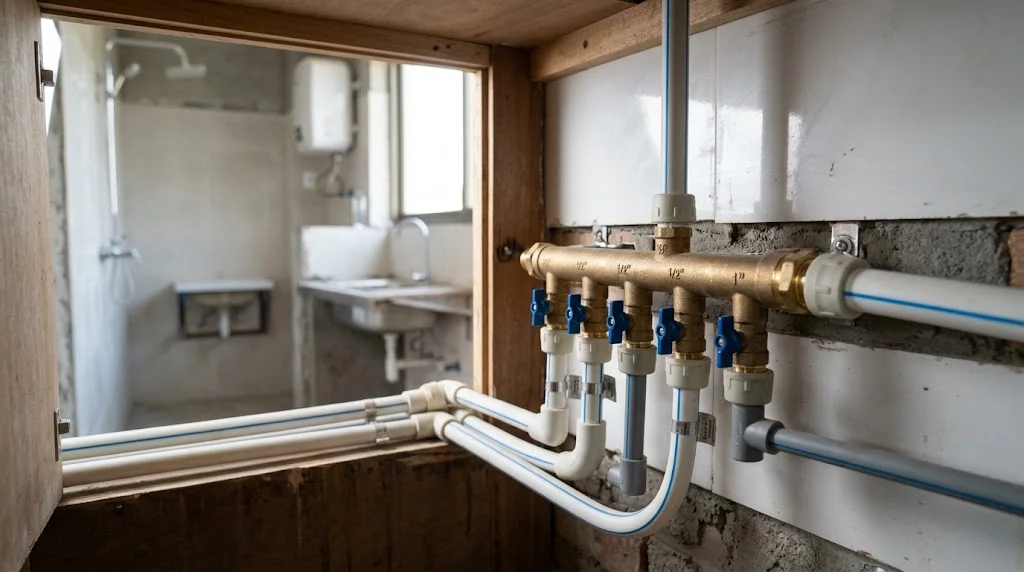
Most plumbing jobs in Pakistan follow the same pattern: one main pipe runs through the house and tees off to each bathroom and kitchen. It works, but it also hides many joints inside walls and makes a single leak hard to isolate. A pipe manifold system offers a different layout. It sends a separate line from one central point to every fixture.
This guide explains what a manifold is, how manifold plumbing distribution works, its pros and cons, and when it is worth using.
What Is a Pipe Manifold System?
A manifold is a central distribution block. Water comes in through one inlet and leaves through several outlets. Each outlet feeds a single fixture or a single group of fixtures, such as a bathroom.
This is often called a home-run or parallel layout. Every fixture has its own dedicated pipe running back to the manifold. Many manifolds also include a valve on each outlet, so you can shut off one fixture without stopping water to the rest of the building.
How Manifold Plumbing Distribution Works
Water enters the building through the main inlet and reaches the manifold. From there, each outlet runs straight to its fixture. There are no tees along the way.
This table compares the two common layouts.
| Feature | Trunk-and-branch | Manifold (home-run) |
|---|---|---|
| Layout | One main line with tees to each fixture | One dedicated line per fixture |
| Joints in walls | Many | Few or none |
| Isolating one fixture | Shut off a zone or the main | Close that outlet’s valve |
| Pressure when several fixtures run | Can drop | Usually steadier |
| Pipe length | Shorter | Longer |
| Planning and cost | Simpler and cheaper | More planning and cost |
Benefits of a Manifold Plumbing System
- Easy isolation. You can close one outlet to fix a tap or flush tank without cutting water to the whole house.
- Fewer hidden joints. Joints are the usual weak points. A manifold system moves most of them to one accessible spot.
- Steadier pressure. Because each fixture has its own line, using a shower and a tap together causes less of a pressure swing.
- Faster troubleshooting. A leak or fault is easier to trace to one line.
- Neat layout. Valves and outlets sit together and can be labelled.
Drawbacks to Consider
A manifold system is not always the right choice.
- More pipe. Each fixture needs its own run, so you need more pipe and more wall or floor space.
- Higher cost. The manifold, valves, and extra pipe add to the budget.
- Needs space. The manifold needs an accessible cabinet or shaft.
- Needs good planning. Poor sizing can still cause weak flow at the far end.
- Hot water wait. Long runs from the heater can mean a longer wait for hot water. Keep the manifold close to the fixtures or heater, and insulate hot lines.
When Should You Use a Pipe Manifold System?
A manifold system works well in:
- Apartments and multi-storey buildings with many bathrooms
- Hotels, hospitals, and hostels, where one room’s problem should not affect others
- Large homes with several bathrooms and a kitchen
- Projects where concealed joints are a concern
- Underfloor heating and similar systems that need separate circuits
A simple trunk-and-branch layout may be enough for a small house with one bathroom and one kitchen. It is cheaper and quicker to install.
In many Pakistani homes, water comes from an overhead tank under gravity, which gives only modest pressure. A manifold does not add pressure. Size the inlet and branch pipes carefully so the far fixtures still get a good flow. Our guide to water tank plumbing pipes and fittings explains how the tank connection affects the system.
Pipe Materials for Manifold Systems
Manifold systems can use several pipe types, and the right choice depends on the water and the temperature.
- PPRC: A common choice for hot and cold water, with heat-fusion joints that form a tight connection. See our PPRC pipes and fittings.
- UPVC: Suitable for cold water lines.
- Other materials: Some systems use cross-linked polyethylene (PEX) tubing. Confirm what your fittings and supplier support.
Whatever you choose, make sure the pipe, fittings, and manifold share the same pressure rating and are made to be used together. Our guide to pipe pressure ratings, PN and SDR explains how to read them. Ask the supplier whether a manifold fitting is available for your pipe range.

NewTech PPRC Pipes & Fittings
NewTech Pipes · PPRC Piping Systems
Planning a manifold layout for hot and cold water? See NewTech PPRC pipes and fittings, built for water systems that run under high and low temperatures.
How to Plan a Manifold System
Careful planning prevents most problems.
- Draw the layout. Mark the manifold position and the route of each line to its fixture.
- Place the manifold centrally. Choose a spot that is close to fixtures and easy to reach.
- Size the inlet for peak demand. It must feed several fixtures at once.
- Size each branch for its fixture. Do not oversize small lines.
- Fit a valve on every outlet. Add a main valve on the inlet as well.
- Label every line. You will thank yourself later.
- Plan for more pipe. Manifold layouts use more pipe, so allow for it in your estimate. Our pipe quantity guide for house construction can help.
- Test before closing walls. Pressure test every line and fix leaks before you cover the pipes.
- Insulate hot lines. This reduces heat loss on longer runs.
Common Manifold Mistakes
- Placing the manifold where nobody can reach it
- Undersizing the inlet pipe
- Skipping valves on outlets
- Mixing pipes and fittings with different pressure ratings
- Leaving lines unlabelled
- Closing walls before testing
- Forgetting to insulate hot lines
Conclusion
A pipe manifold system gives each fixture its own line, which means easier isolation, fewer hidden joints, and steadier pressure. It costs more and uses more pipe, so it suits larger homes, apartments, hotels, and hospitals better than a single-bathroom house. Plan the layout, size the pipes, match the pressure ratings, and test before covering the work.
Planning a plumbing project? Contact Newtech Pipes to discuss pipe and fittings for your layout.