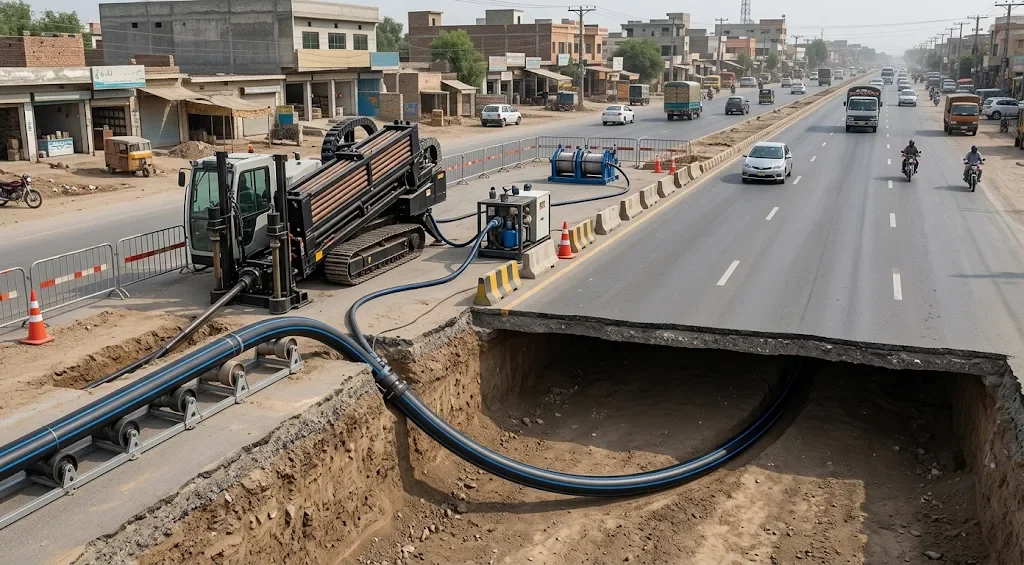
A new 110 mm water main has to reach a housing block on the far side of a six-lane road. Open-cut means closing lanes, breaking asphalt, shoring a deep trench, diverting traffic and then repairing the road, usually while shopkeepers and commuters wait. The alternative is to send the pipe underneath, without opening the surface at all.
That alternative is horizontal directional drilling (HDD), and it is no longer exotic in Pakistan. Gas utilities already use it: SSGC undertook a 42-inch gas pipeline crossing under the Indus upstream of Kotri Barrage by HDD, and SNGPL has tendered HDD crossings under canals in Punjab. Those are steel gas lines, but the same logic applies to HDPE water, pressure sewer and conduit lines. The Plastics Pipe Institute (PPI) notes that HDPE is the most commonly installed pipe by HDD.
HDD is not always the right answer, though. Sometimes a trench is cheaper, safer and simpler. This guide helps you decide, and shows what to check in the pipe, the ground and the contractor before you commit. For a general overview of no-dig methods, see our earlier post on pipe pulling and trenchless technology; this one focuses on the decision.
The short answer
HDD makes sense when you must cross something you cannot or should not open (a road, railway, canal or river), when the route is deep or long enough that trenching becomes costly or risky, and when the ground can be drilled and kept open. Open-cut usually wins in open ground, on short shallow runs and where many service connections are needed. For HDD, choose fused PE100 HDPE pipe with enough wall thickness to survive the pull as well as the pressure.
How HDD installs an HDPE pipe
The process has three stages, and the details explain most of the risks later in this guide.
- Pilot bore. A drill rig pushes a steerable head along a designed path, tracked electronically, from an entry point to an exit point.
- A backreamer pulls back through the pilot hole and enlarges it. PPI says typical over-sizing is 1.2 to 1.5 times the pipe diameter, so a 110 mm pipe needs a bore of roughly 132 to 165 mm. Drilling fluid, usually bentonite clay in water, cools the cutter, carries cuttings out and helps hold the hole open.
- The pre-fused pipe string is attached behind the reamer through a swivel and pulled into the bore. Pullback speed typically ranges from one to several feet per minute, which is roughly 0.3 to 1 metre or more per minute.
On the entry side, the pipe has to be fused into one long string and laid out in line, so site space matters as much as the rig itself.
When HDD makes sense
- Crossings you cannot open. Highways, motorways, railways, canals, nullahs and rivers, where closing or cutting the crossing is difficult or not permitted.
- Sensitive surfaces. Busy commercial streets, landscaped areas, paved society roads and new carriageways you do not want to cut.
- Deep or long routes. Where a deep trench would need heavy shoring and dewatering.
- High traffic cost. Where lane closures and diversions cost more than the drilling.
- Pipelines in tight rights of way. HDD needs little working space compared with a long open trench, although it still needs entry and exit areas.
When it does not
- Short crossings in open ground. A simple trench is usually cheaper.
- Unsuitable ground. PPI says the geotechnical study should look for rock, gravelly soils, loose deposits, hardpan and groundwater. Loose gravel, cobbles and boulders can make a bore difficult to steer or keep open.
- Unknown utilities. Drilling blind through unmapped lines is a safety risk. PPI advises locating buried structures within about 3 m of the path for mini-HDD and about 7.5 m for maxi-HDD, and exposing crossing lines to confirm their depth.
- Shallow cover. HDD pipes are usually installed deeper than open-cut pipes so drilling fluid does not break out at the surface.
- Tight grade control. Gravity lines with strict slope tolerances are generally easier in a trench (our judgement, not a rule from the sources below).
Mini-HDD or maxi-HDD?
PPI separates the two by scale. The figures are approximate:
| Type | Pipe size | Length | Depth | Typical use |
| Mini-HDD | Up to about 300 mm (12 in) | Hundreds of feet | Up to about 4.6 m (15 ft) | Local distribution, utility crossings in towns |
| Maxi-HDD | Up to 1,200 mm (48 in) or more | Thousands of feet | Up to about 60 m (200 ft) | Rivers, motorways, long transmission crossings |
When a contractor quotes, ask which class of rig they will use and whether it fits your size, length and depth.
Why HDPE is the pipe for HDD
HDD pulls the pipe through the ground under tension, and then leaves it under the ground for decades. HDPE copes with both:
- Fused joints that carry the pull. PPI describes the fused joint as leak-free with a design tensile capacity equal to that of the pipe. A pre-fused string can be pulled in as one piece.
- The low bending stiffness lets the pipe follow the drill path. PPI says a DR 11 pipe can be cold-bent to about 25 times its outside diameter (some manufacturers limit it to 40 to 50 times to reduce ovaling), far tighter than any drill path requires.
- Scratch tolerance. PPI cites this as a reason PE has been used for river crossings.
- Corrosion resistance under the ground, with no coating to damage in the bore.
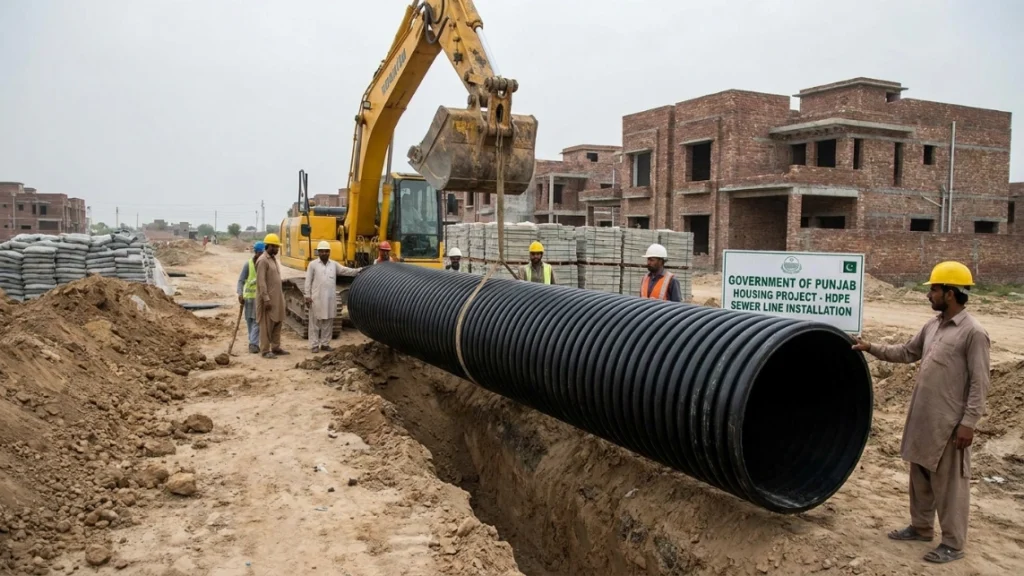
Other plastics are poor fits. uPVC and PPRC pipes joined by solvent cement or sockets are not designed for pulling loads, and our own sewerage guide lists uPVC as not recommended for trenchless installation. In stony ground, ask whether a scratch-resistant PE100-RC grade is available: some manufacturers state their RC pipes are approved for trenchless laying under the PAS 1075 specification.
Sewerage & Drainage Pipe Guide
NewTech Pipes · uPVC & HDPE Piping Systems
Planning an underground crossing? Compare uPVC and HDPE sewer pipe, including which one suits trenchless installation, in NewTech’s sewerage guide.
Choosing the SDR: pipe wall for pressure and for the pull
PPI makes a point many buyers miss: during HDD, the pipe often meets its maximum lifetime load during pullback, not in service. The pipe must satisfy three things at once: the operating pressure, the long-term soil and water loads, and the installation pull. A pipe that is fine for pressure alone may still be too thin for the pull.
PPI’s guidance on the allowable pull uses the formula: safe pull force = safe pull stress × pipe wall cross-section. For PE4710 (the North American high-performance PE grade, comparable in class to PE100), the typical safe pull stress for a 12-hour pull is 1,330 psi, which is about 9.2 MPa, at 80 °F (27 °C). Applying it to minimum wall thicknesses gives indicative figures:
| Pipe | Wall | Safe pull force (about) | Roughly |
| 63 mm SDR 11 | 5.8 mm | 9.6 kN | 1.0 tonne-force |
| 63 mm SDR 17 | 3.8 mm | 6.5 kN | 0.7 tonne-force |
| 110 mm SDR 11 | 10.0 mm | 28.8 kN | 2.9 tonne-force |
| 110 mm SDR 17 | 6.6 mm | 19.7 kN | 2.0 tonne-force |
| 160 mm SDR 11 | 14.6 mm | 61.2 kN | 6.2 tonne-force |
| 160 mm SDR 17 | 9.5 mm | 41.2 kN | 4.2 tonne-force |
These are our own calculations with PPI’s stress value, so treat them as illustrations. PPI itself tells designers to consult the pipe manufacturer for the actual figure for a specific compound, because the allowable stress depends on the grade, the pull time and the temperature. For a mini-HDD pipe at depth, PPI also notes that SDR 17 should generally be limited to about 3 m cover, although 4.6 m can be acceptable, because thinner walls resist external collapse pressure less well.
The pull: where jobs succeed or fail
The pull force is a negotiation between friction, buoyancy and the path. Five practical points come from PPI’s guidance:
- The pipe floats. PE has a density close to water, and drilling fluid is heavier than water, so an empty pipe floats against the roof of the bore, which raises friction. Most major pullbacks fill the pipe with water as it enters the bore.
- Rollers help. PPI quotes friction coefficients of about 0.5 for pipe dragging on the ground and 0.1 on rollers, and about 0.3 inside a lubricated bore.
- Bends multiply the force. The capstan effect amplifies tension around curves. Even small unplanned path corrections add up: in PPI’s own mini-HDD example, unplanned corrections raised the estimated pull by about 74%.
- Monitor and limit the pull. PPI advises recording axial tension, pulling at constant speed, and using a breakaway link with swivel set at the pipe’s safe pull force, rounded down by 5 to 10%.
- Keep the fluid flowing. Loss of circulation can lock up the pipe and overstress it.
After the pull
HDPE stretches temporarily under tension. PPI advises pulling the leading end out about 3 to 4% longer than the crossing, which is 9 to 12 m extra on a 300 m bore, and waiting for the pipe to recover and reach ground temperature, usually overnight, before cutting it to length. In Pakistani summers, that thermal wait matters, because a pipe string baked in the sun on the laydown area will contract as it cools underground. Pressure-test before and after the pull as the specification requires.
A practical planning checklist
- Commission a geotechnical study before design. PPI calls it the first step in the project.
- Locate and prove existing utilities, and expose crossings.
- Get permissions from the owner of the road, railway, canal or river (requirements vary by authority; confirm with the relevant department).
- Design the path with the largest practical curve radius, and entry and exit points at similar levels.
- Select pipe for pressure, service loads and the pull, and have the manufacturer confirm the allowable pull.
- Plan space for the fused string. Coils need much less laydown space than straight lengths, as our coil vs straight length guide
- Fuse and test carefully; see our HDPE testing guide and butt-fusion machines.
- Manage drilling fluid (mixing, recycling, disposal) and plan for breakouts to the surface.
- Require as-built drawings showing the actual drill path, so the line is not hit later.
- Vet the contractor. For its 12 and 24 inch HDD crossings at Bibi Nani in Balochistan, SSGC asked for a valid PEC licence in category C-2 with relevant specialisations, FBR registration, relevant HDD experience and quality and safety certifications. Large owners ask for proof, and you should too.
HDD against the other trenchless options
“Trenchless” covers more than HDD. The right method depends on whether you are laying a new line or fixing an old one.
| Method | Best for | Watch-outs |
| HDD | New lines and crossings under roads, rivers, canals | Ground conditions, pull force, drilling fluid |
| Open-cut | Open ground, short and shallow runs, many connections | Traffic, restoration, shoring |
| Pipe bursting | Replacing an old pipe in place, with the option to upsize | Host pipe must break up; nearby utilities |
| Sliplining (relining) | Rehabilitating a sound but leaking pipe | Reduces hydraulic capacity; annulus usually grouted |
For definitions, NASSCO describes bursting as breaking the old pipe outward while a new pipe is pulled in, with the ability to upsize, and sliplining as inserting a smaller pipe into the old one, with some loss of capacity. If your problem is an old failing line rather than a new crossing, those methods, not HDD, are the ones to price.
Comparing costs fairly
We do not quote prices, because they depend heavily on bore length, diameter, ground and rig. What matters is what you compare:
- What HDD adds: mobilising the rig and mud system, bore length and diameter, thicker-walled (lower SDR) pipe, fusion and testing, and the risk of a failed or re-drilled bore.
- What HDD can save: lane closures and diversion, road cutting and restoration, deep trench shoring and dewatering, and delays.
Ask each bidder for a delivered, restored and risk-allowed price, and ask what happens if the first bore fails. A cheap quote with no contingency is not cheap.
Tools that are changing HDD
Nothing about HDD is high-tech for its own sake, but a few tools reduce guesswork. Electronic tracking steers the bore head along a designed path. PPI offers its BoreAid software for preliminary pull-force and collapse checks on PE pipe, though it stresses that qualified professionals must design the work. Pull-force logging and breakaway links protect the pipe. Mud recycling and solids-control systems, which appear in SSGC’s HDD scope, keep fluid use and disposal manageable. These tools improve control, but they do not replace the geotechnical study.
Conclusion: choose HDD for the crossing, not the fashion
Trenchless pipe installation with HDD earns its place where the surface is expensive to disturb and the ground can be drilled. It does not make every project cheaper. Decide with a geotechnical study, a pipe selected for the pull as well as the pressure, a contractor who can show relevant experience, and a price that includes restoration and risk.
If you are planning an HDD crossing in HDPE, talk to our team with your bore length, depth, diameter, operating pressure and ground conditions, so we can discuss suitable PE100 pipe and wall thickness.