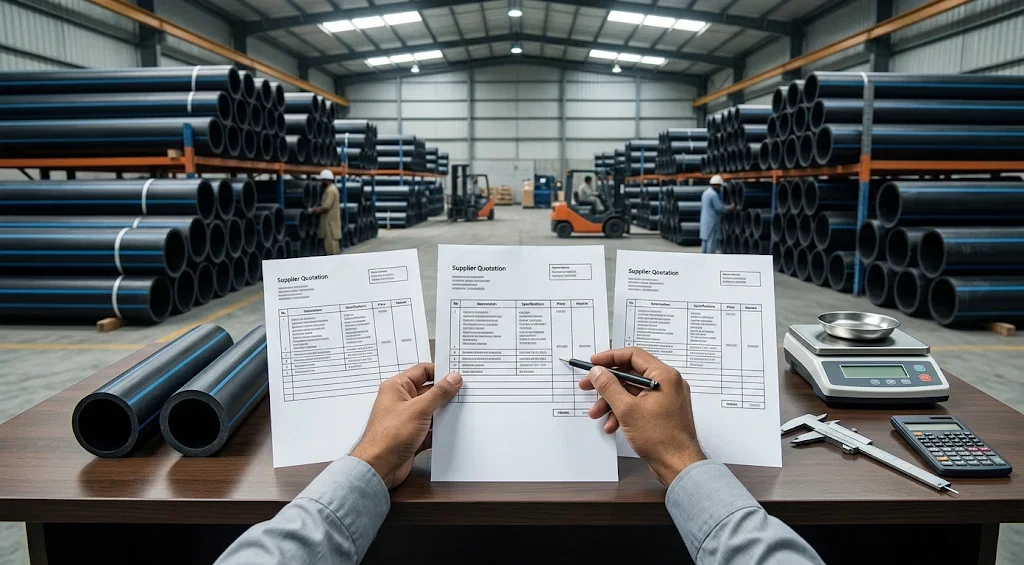
Three quotations are on a contractor’s desk in Faisalabad. The pipe is 110 mm HDPE for a water supply line. Supplier A quotes the lowest price. Supplier B is a bit higher. Supplier C is higher still. The decision looks easy: pick A, save money, move on.
Six months later, the line is joint-heavy, repairs are frequent, and the “saving” has disappeared into excavation and downtime. The three quotes were never really for the same pipe.
This is the most common mistake in pipe buying. A price per meter looks like a fair measure, but it hides everything that decides what you actually get. This guide shows you how to read a quotation the way a procurement professional does, and how to build a comparison that is genuinely fair.
Why Price per Meter Misleads
A price per meter answers only one question: how much for one length of something called “pipe”? It says nothing about:
- how thick the wall is
- how much pressure it can safely carry
- what material and grade it is made from
- which standard it follows
- what is and isn’t included in the price
Two pipes with the same outside diameter can differ enormously inside. That is why a quotation is only comparable once the specification is identical. Until then, you are comparing numbers, not products.
Lock the Specification Before You Look at the Price
Think of this as the same-spec test. Before comparing any rates, confirm all five points match across quotes:
- Material and grade (for example PE100 HDPE, uPVC, PPRC)
- Outside diameter and wall thickness
- Pressure rating (SDR, PN or class)
- Standard the pipe is made to
- Supply form (coil or straight length, and the length)
If even one item differs, the price is not comparable yet. Ask the supplier to re-quote against your specification.
SDR and wall thickness: the biggest hidden variable
SDR (Standard Dimension Ratio) is simply the outside diameter divided by the wall thickness. For the same diameter, a lower SDR means a thicker wall. As one procurement guide puts it, for the same outside diameter, a lower SDR usually means a thicker wall and stronger pressure performance. pages
Here is what that means for a 110 mm pipe:
- SDR 11: wall of about 10.0 mm
- SDR 17: wall of about 6.6 mm
Both are “110 mm pipe”. But using a typical HDPE density of about 0.95 g/cm³, my own estimate is roughly 3.0 kg per meter for SDR 11 and roughly 2.0 kg per meter for SDR 17. One pipe contains about half as much material again. It would be strange if both cost the same.
Compare by weight when thickness differs
Here is a hypothetical example (the prices are illustrative only):
| Supplier A | Supplier B | |
|---|---|---|
| Pipe | 110 mm, SDR 17 | 110 mm, SDR 11 |
| Quoted price | PKR 1,300 / m | PKR 1,650 / m |
| Approx. weight | 2.0 kg/m | 3.0 kg/m |
| Price per kg | PKR 650 | PKR 550 |
Supplier B looks 27% more expensive per meter, yet costs less per kilogram of pipe. More importantly, they are not the same product. If your design calls for SDR 11, Supplier A’s cheaper quote is simply non-compliant.
The lesson: when thickness differs, price per meter tells you nothing. Price per kg can reveal whether a “cheap” quote is cheap because it is efficient or because it is thin.
The standard behind the pipe
Ask which standard the pipe is made to, and for what grade. For HDPE pressure pipe, buyers commonly see ISO 4427; for uPVC, ISO 1452; for PPR, ISO 15874. If you want a plain-language explanation of each, read our guide to pipe standards explained. A quotation that says only “ISO certified” without naming the standard and the product it covers should prompt a follow-up question.
Read the Paper Behind the Price
A fair comparison includes proof. Two suppliers can quote the same SDR on paper, but only one may be able to back it up.
Ask each supplier for:
- Test reports for the batch or product family being offered (see what HDPE pipe tests actually measure)
- Certification details such as ISO 9001 and, where applicable, product-level approvals like PSQCA registration with a number you can verify
- Pipe markings: manufacturer, material grade, SDR or PN, standard and batch information should be printed on the pipe
- Raw material information: whether the pipe is made from virgin resin
A supplier who answers these questions quickly and clearly is giving you valuable information about how they work. For on-site checks once the pipe arrives, our guide on identifying fake or substandard pipes is a useful companion.

HDPE Pipe Testing Guide
NewTech Pipes · HDPE Piping Systems
Quote says “tested”? Learn what hydrostatic, melt flow and density tests measure, and how to match a test report to your batch before you accept a price.
Read GuideCompare What Is Included (and What Is Not)
This is where many “cheap” quotes quietly change shape. Build a simple table and tick each item for each supplier.
| Item | Supplier A | Supplier B | Supplier C |
|---|---|---|---|
| Taxes (included or extra?) | |||
| Freight to site | |||
| Unloading at site | |||
| Price validity (days) | |||
| Payment terms | |||
| Delivery schedule | |||
| Fittings quoted? | |||
| Quantity tolerance | |||
| Warranty / claim process | |||
| Test certificates supplied |
Typical traps:
- Tax and freight left out. One quote says “ex-factory”, another says “delivered to site”. The first is not cheaper; it is incomplete.
- Short validity. A very low rate valid for only two days is a pressure tactic, not a price.
- Fittings missing. The pipe is cheap, but elbows, tees and reducers were never quoted. They must also match the pipe’s SDR or pressure class.
- Vague quantity. “Approximately 5,000 m” can hide a wide tolerance.
Think in Total Installed Cost
Pipe is rarely the most expensive part of a pipeline. Excavation, labour, jointing, testing and repair costs often outweigh the pipe price itself. A cheaper pipe that fails early costs far more than the saving.
When comparing, ask:
- Does the joining method suit the pipe? (butt fusion, electrofusion, solvent cement, mechanical)
- Are compatible fittings available from the same source?
- What happens if there is a defect? Who inspects, replaces, and how fast?
- How long is the expected service life for the stated application?
Honestly stated, this is partly judgement rather than hard data. But asking the question moves you from “cheapest today” to “best value over the project’s life”.
What Government and Formal Tenders Already Know
Formal procurement rules in Pakistan do not simply pick the lowest number. Under the Public Procurement Rules, the lowest evaluated bid is defined as a bid most closely conforming to the evaluation criteria and other conditions in the bidding document, having the lowest evaluated cost. tevta
In plain words: the bid must meet the specification first, and only then does price decide. You can apply the same logic to a private project. Disqualify non-compliant quotes first, then compare costs among the ones that remain. (Rules differ by province and agency, so check the ones that apply to your project.)
Using Technology to Make Comparison Easier
You do not need expensive software to compare quotes well, but modern tools help:
- A shared spreadsheet with fixed columns (diameter, SDR, standard, price, price per kg, inclusions) forces every quote into the same shape.
- An AI assistant can read several PDF quotations and pull out line items into your table. Treat its output as a draft and always check the numbers against the originals, because extraction errors happen.
- A standard RFQ template sent to every supplier produces comparable replies from the start. This is the single most effective habit.
- Digital records of test certificates and batch markings make later claims far easier to settle.
Technology speeds up the work, but the thinking still has to be yours. A tidy spreadsheet comparing mismatched products only makes a wrong decision look professional.
A Simple RFQ That Gets Comparable Quotes
Send every supplier the same request. Include:
- Material and grade
- Outside diameter and SDR/PN (or wall thickness)
- Standard required
- Length or coil form, and total quantity per size
- Required fittings, with quantities
- Delivery location and required date
- Documents required (test reports, certificates)
- Request to state taxes, freight and validity clearly
The better your request, the less room there is for apples-to-oranges answers.
Red Flags to Watch For
- A price far below every other quote, with no explanation
- Refusal or delay in sharing test reports or certificates
- Unmarked or poorly marked pipe
- “Same as the other pipe” without stating SDR or standard
- Pressure to confirm today
- Specification changes after you accept the quote
One low quote is not proof of wrongdoing. Sometimes a supplier simply has stock or a better process. But a low price should always be explained, never just accepted.
A Quick Checklist You Can Keep
- Same material, grade, diameter, SDR/PN and standard on every quote
- Price per meter and price per kg both calculated
- Taxes, freight, unloading, validity and payment terms compared
- Fittings quoted and matched to pipe class
- Test reports and certificates requested
- Warranty and claim process understood
- Non-compliant quotes removed before comparing price
Conclusion
A fair comparison is not about finding the highest quality at any cost or the lowest price at any risk. It is about making sure every number on your desk describes the same thing. Fix the specification, convert thickness differences into weight, check the paperwork, compare what is included, and think about the cost of the whole installed system.
Do this, and the “cheapest” supplier will sometimes still win, but for reasons you can defend. And when a pricier quote is the right one, you will know exactly why.
Ready to compare on equal terms? Send your specification to the NEWTECH team and request a clear, line-by-line quotation, or browse the 2026 pipe catalogue to prepare your RFQ.