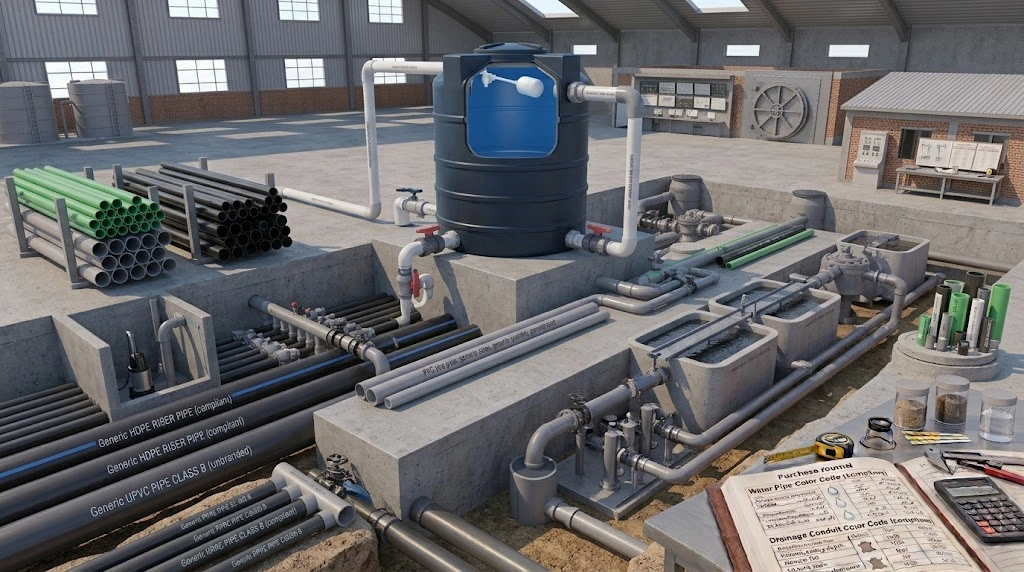
Most plumbing issues in Pakistani homes do not begin at the taps — they often originate from the tank connections. A leaking overflow pipe, a float valve that fails to shut off properly, or an undersized inlet pipe that fills an overhead tank too slowly are common problems plumbers deal with. In many cases, these issues result from selecting the wrong water tank pipe fittings during installation. Whether you are planning water tank plumbing for a rooftop overhead tank or an underground/boring storage tank, the required pipe sizes, fitting types, and materials can differ significantly from standard room-to-room plumbing. This guide explains what overhead tank plumbing pipes and underground tank connections require, along with how to correctly size and select fittings to avoid unnecessary repairs or replacements later.
Why Tank Plumbing Needs Its Own Planning
A water tank sits at the junction of two systems: the incoming supply (from a motor, borewell, or municipal line) and the outgoing distribution network feeding the house. Both sides carry different pressure conditions — the inlet side often runs on pump pressure while the outlet side relies on gravity from an elevated tank — and each needs fittings rated and sized for that specific job. Getting the inlet undersized means a slow-filling tank and pump strain; getting the outlet undersized means poor pressure at upper-floor taps. Because tank connections are also where leaks are most visible (and most annoying to fix on a rooftop or underground chamber), it’s worth specifying these fittings deliberately rather than using whatever pipe happens to be left over from the rest of the job.
Overhead Tank Plumbing: What Every Connection Needs
A typical rooftop overhead tank has four essential connections, each requiring a different fitting:
Connection | Typical Fitting | Typical Size |
Inlet (from motor/pump) | Ball valve or float valve with tank nipple | 3/4″ to 1″ (20mm–25mm) |
Outlet (to house distribution) | Tank nipple with union and gate/ball valve | 1″ to 1.25″ (25mm–32mm) |
Overflow | Straight tank nipple, no valve (must stay open) | 1″ to 1.5″ (25mm–40mm) |
Drain/scour (for cleaning) | Tank nipple with ball valve, positioned at tank base | 3/4″ to 1″ (20mm–25mm) |
The float valve on the inlet line is one of the most common failure points in overhead tank plumbing. A worn-out or undersized float valve can cause the tank to overflow continuously or shut off too early, reducing water supply. Selecting a float valve that is rated for your actual line pressure, rather than relying only on pipe diameter, helps prevent both issues.
Underground and Boring Tank Plumbing: What’s Different
Underground tanks — whether fed by a borewell, tube well, or municipal line — have a different set of priorities than overhead tanks. Because the pump has to lift water up rather than relying on gravity, the suction and delivery lines need to be sized to minimize friction loss, and a foot valve with a strainer is essential on the suction side to prevent the pump from losing prime and to keep debris out of the system. Underground tank chambers also need a properly sealed manhole cover and, in areas with a high water table (common in parts of Punjab and Sindh), a chamber built to resist water ingress from outside — a poorly sealed underground tank can end up contaminated by surrounding groundwater regardless of how good the plumbing inside it is.
Choosing Pipe Material for Tank Connections
HDPE, PPRC, and UPVC each suit different parts of a tank plumbing system:
Material | Best Used For | Why |
HDPE | Underground suction/delivery lines, borewell risers | Coiled, fewer joints underground, flexible enough to handle ground movement without cracking |
UPVC | Overhead tank inlet, outlet, overflow, and drain lines | Rigid, easy to fit rooftop tank nipples and unions, cost-effective for above-ground exposed runs |
PPRC | Not typically used for tank connections | Reserved for hot/cold water distribution inside the house rather than tank plumbing itself |
UPVC is the standard choice for the visible plumbing around an overhead tank because it’s easy to work with using solvent cement joints on a rooftop, while HDPE’s coil form and flexibility make it better suited to underground runs where fewer joints mean fewer potential leak points below ground.

Newtech HDPE Compression Fittings
Newtech Pipes · HDPE Pipes & Fittings
Explore Newtech HDPE compression fittings and learn more about the types, applications, and installation tips for underground tank and borewell connections.
View ProductSizing Your Water Tank Pipe Fittings Correctly
Undersizing is the most common mistake in tank plumbing. As a general guide for a typical residential setup: a single-family home with one overhead tank usually needs a 1-inch (25mm) inlet line if fed by a motor, a 1 to 1.25-inch outlet line to maintain adequate pressure at upper floors, and an overflow pipe sized at least as large as the inlet — undersizing the overflow is a common oversight that causes water to back up rather than drain safely when the float valve fails. For larger homes, plazas, or housing society common tanks, these sizes typically scale up to 1.5 or 2 inches; a plumber or supplier can confirm exact sizing against your tank capacity and the number of connected outlets.
Fittings You’ll Need Beyond Straight Pipe
- Float valve (ball cock) — controls the inlet automatically based on water level
- Tank nipple — the threaded fitting that passes through the tank wall itself, available in UPVC or brass
- Foot valve with strainer — required on underground/borewell suction lines to maintain pump prime and filter debris
- Union joint — placed near the tank connection so fittings can be removed for maintenance without cutting pipe
- Non-return valve (NRV) — prevents backflow on delivery lines, especially where multiple tanks or pumps are connected
Installation and Maintenance Tips to Prevent Leaks at Tank Connections
- Always use a union joint near tank nipples so a faulty float valve or fitting can be replaced without disturbing the rest of the line
- Apply PTFE tape or approved thread sealant on all threaded tank nipple connections — this is the single most common leak point on rooftop tanks
- Support horizontal pipe runs on a rooftop with clamps every few feet to prevent sagging, which stresses joints over time
- Inspect the overflow pipe periodically — a blocked overflow is often the real cause of a tank that appears to be “overflowing” from the lid
- For underground tanks, check the manhole seal annually before monsoon season to prevent surface water intrusion
When to Call a Plumber vs Handling It Yourself
Replacing a worn float valve or resealing a threaded tank nipple is within reach for a handy homeowner with basic tools. However, sizing a new tank’s inlet/outlet system from scratch, working with underground suction lines and foot valves, or diagnosing why an overhead tank fills slowly despite adequate pump pressure usually benefits from a plumber’s assessment — incorrect sizing or valve selection at this stage is expensive to correct later once pipe is fixed in place on a rooftop or buried underground.
Conclusion
Water tank plumbing is a small part of an overall installation, but it’s where most avoidable leaks and pressure complaints originate — usually from undersized fittings, a worn float valve, or the wrong material choice for the job. Sizing inlet, outlet, and overflow lines correctly, and using UPVC for overhead runs and HDPE for underground suction and delivery lines, solves most of these issues before they start. Newtech Pipes, an ISO 9001:2015-certified and PSQCA-registered manufacturer, supplies both UPVC and HDPE pipe and fittings suited to tank plumbing across residential and commercial projects in Pakistan.