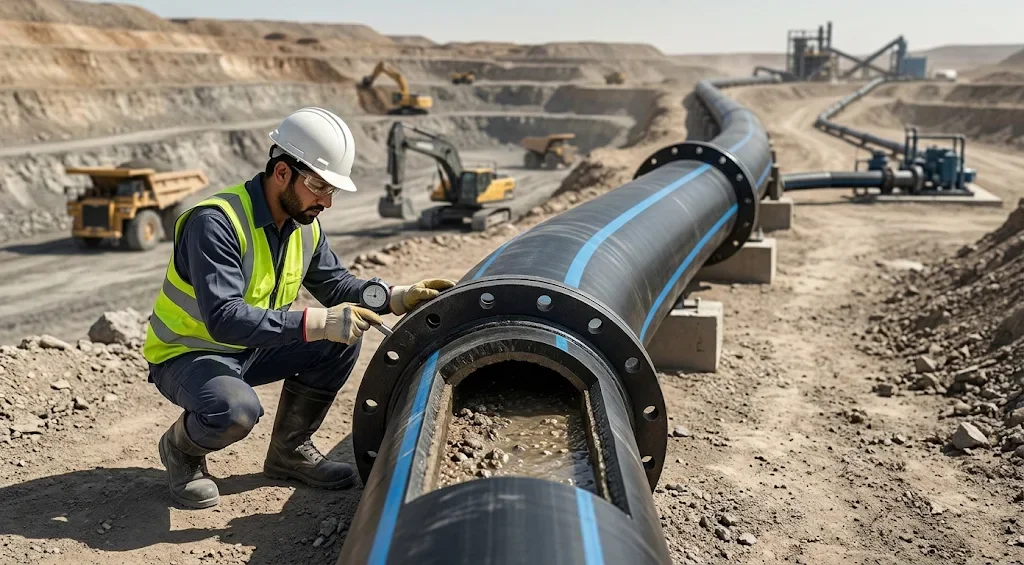
The pit floor is quiet until the pump stops. Rain and seepage keep adding water, and within hours the lowest bench becomes a pond. Somewhere else on the site, a tailings line that was fine last quarter starts to weep at a joint. Neither problem looks dramatic on a drawing. Both are expensive on a Monday morning.
Mining pipelines carry three very different fluids: clean water pumped out of a pit, process water moved between plants, and abrasive slurry full of ground rock. That is why “use HDPE” is only the first half of a specification. The second half is where wear, joints and pressure are decided.
Pakistan’s mining sector is in the news. The Express Tribune reported that the Pakistan Minerals Investment Forum is scheduled for 12 and 13 November, and Balochistan’s chief secretary told Dawn that a Rs94 billion water pipeline is under construction to supply Reko Diq, Chagai and surrounding areas. Reports also say Barrick has been reviewing Reko Diq’s timeline since February 2026, so schedules are uncertain. Whatever the timing, arid sites need dependable water and slurry lines, and the pipe choice decides how often an operation stops.
Three Pipelines, Three Different Jobs
Before choosing a pipe, name the job. The stresses are different.
Line type | What stresses the pipe | What to focus on in the specification |
Dewatering | Pump pressure, frequent starts and stops, uneven ground, moving lines, sun | Pressure rating against pump head, flexible routing, flanged pump connections |
Process and raw water | Long runs, steady pressure, temperature | PN and SDR, fused joints, continuous lengths |
Slurry and tailings | Abrasion, velocity, settling, blockages, surges | Wall thickness with wear allowance, velocity, internal weld bead, bends |
Why HDPE Keeps Showing Up in Mines
The Plastics Pipe Institute describes polyethylene pipe as long established in mining, from process water and tailings to dewatering. It points to heat-fused joints that form a continuous, monolithic line, and to flexibility, abrasion resistance and leak-free joints. Manufacturers also note that polyethylene is chemically stable across a wide pH range. One supplier states pH 2 to 12.
In practical terms, HDPE does not rust, it is lighter to handle than steel, and long lengths can be fused and moved across rough ground. Those are real advantages in remote sites. But HDPE is not magic. It wears, it softens with heat, and a poor joint fails like any other. The rest of this guide covers the three issues that matter most.
Abrasion: What the Pipe Wall Really Faces
Sliding-bed wear vs impact wear
In a slurry line, heavier particles often slide along the bottom of the pipe, called the invert, and grind the wall slowly. This is sliding-bed wear, and it is where HDPE performs well. One manufacturer’s guide says HDPE suits fine, low to moderate concentration slurries, which is the wear mode that dominates tailings lines. Coarse, sharp particles hitting bends are a different problem and need careful design.
Laboratories compare materials using methods such as the Darmstadt test, where a tilting pipe section moves an abrasive slurry back and forth, and rotating drum tests. An older Bulk Solids Handling paper that tested pumped-slurry pipes and bends reported HDPE lasting about four times as long as steel under that test’s conditions. Treat any such number as test-specific, because every slurry is different.
Velocity: the Goldilocks problem
If the slurry moves too slowly, solids settle and block the line. If it moves too fast, wear accelerates. One guide suggests running roughly 0.3 to 0.5 m/s above the critical velocity, which often lands in a 1 to 3 m/s window, but it stresses that the number is specific to each slurry. Designers use methods such as the Durand equation, and they need your real data: particle size, concentration and density.
Wear allowance: pay for the wall you will lose
A slurry pipe is not sized for pressure alone. Because the bore slowly wears, a lower SDR (thicker wall) is often chosen as a deliberate wear reserve, much like a corrosion allowance on steel. Ask your designer to state the pressure wall and the wear allowance separately.
The hidden culprit: weld beads
A conference paper from the University of Western Australia’s Australian Centre for Geomechanics found that weld beads in HDPE slurry pipe can cause localised wear and extra energy use, and that standard nominal pipe sizes limit how closely velocity can be optimised. Practical takeaways: control the internal bead, and check that the nominal size gives a sensible velocity.
If wear is still too high
- Increase wall thickness (lower SDR).
- Consider multi-layer abrasion-resistant pipe. One manufacturer reports about 85 per cent less wall loss than standard PE100 in its own test. Ask for test evidence.
- Consider UHMWPE for very abrasive duties; the same paper discusses it as an alternative.
- Plan maintenance. Some operators rotate pipe sections to spread wear around the pipe. Ask your designer whether this suits your layout.
Pressure: Pump Head, Surge and Temperature
Start with the pump
Pipe rating (PN or pressure class, set by material and SDR) must cover the pump’s maximum head, including shut-off head, with a margin. Our guide on choosing HDPE for construction projects explains how SDR relates to pressure.
Surge is where lines get hurt
Pump trips and valve closures create pressure surges. HDPE copes with transients better than rigid pipe, but not without limit. Under AWWA C901 and C906, recurring surge is allowed up to 0.5 times the pressure class, and occasional surge up to 1.0 times, so total pressure may reach 1.5 and 2.0 times the pressure class respectively. Those factors belong to those US standards and their pressure classes. ISO-based PN designs have their own rules, so get a calculation for your system. Australia’s PIPA recommends a detailed surge and fatigue analysis where such conditions occur. For background, read our post on water hammer.
Heat lowers the rating
HDPE’s pressure capability drops as temperature rises, which is why ratings include service-temperature factors. Surface lines in a hot Pakistani summer, or lines carrying warm process fluid, need a derating check. One manufacturer notes that a white outer layer reduces pipe wall temperature. Ask your supplier for the derating table for the exact grade, and see our note on thermal expansion.
Joints: Where Mining Pipelines Succeed or Fail
- Butt fusion is the default. It creates a continuous line with no gasket to leak. Quality depends on a trained operator, a calibrated machine, clean ends, correct temperature, pressure and cooling time, and records for each joint. Our HDPE welding guide covers the basics.
- Control the bead. As noted above, an internal bead can drive local wear in slurry service. Ask about bead management.
- Flange adapters connect to everything else. A polyethylene stub end, a backing flange and a gasket join HDPE to valves, pumps and steel pipe, and can be taken apart for maintenance, as Australia’s PIPA technical note describes. Specify the flange standard, gasket and bolt tightening procedure.
- Mechanical couplings are sometimes used on temporary or frequently moved dewatering lines. Check their pressure and pull-out ratings before using them. See also our comparison of compression and butt-fusion joints.
- Electrofusion suits repairs in tight spots where a fusion machine cannot be set up.
Routing and Installation on a Mine Site
- Allow for movement. Above-ground PE expands and contracts with temperature. Use anchors and guides and avoid pulling the line tight.
- Protect the pipe. Keep it away from sharp rock and vehicle traffic, and use sleeves or ramps at crossings.
- Plan the high and low points. Place air release at high points on water lines, and drain or flushing points at low points on slurry lines so solids can be cleared after shutdown.
- Respect bend radius and supplier handling rules, especially in coils. See coils vs straight lengths.
- Test before commissioning. Pressure-test the fused line before it goes into service.
Dewatering Lines: Special Cases
Dewatering lines look simple, but they have quirks that catch teams out.
- Moving lines. As the pit deepens, lines are extended and moved. Plan for flanged or mechanical connections at known break points so a section can be taken out without cutting pipe.
- Staged pumping. Deep pits often pump in stages. Each stage may need its own pressure class, so do not rate the whole line for the highest head unless it makes sense.
- Suction lines. Suction side pipe sees negative pressure. Check the supplier’s data on collapse and vacuum resistance for the chosen SDR instead of assuming a pressure rating covers it.
- Floating lines. Polyethylene is lighter than water, so empty pipe floats. That helps on ponds and sumps, but it also means lines can lift or drift unless anchored or ballasted.
Conditions That Matter in Pakistan
Many mineral areas are remote, hot and dusty, with long supply routes. That changes a few practical choices. Continuous coil or long straight lengths reduce the number of joints on a long run, but check what transport and handling equipment the site can manage. Heat strengthens the case for a temperature derating check and for expansion allowance. Trained fusion operators may not be on site, so plan training or a qualified contractor early. And because spare parts can take time to arrive, order flanges, gaskets and repair couplings with the main supply.
Technology and Smarter Maintenance
You do not need a digital twin to run a better pipeline. A few habits go a long way.
- Trend the basics. Flow, pressure and pump motor current show blockages and wear-related changes early.
- Measure the wall. Check thickness with an ultrasonic gauge at bends, welds and the invert at planned intervals, and keep the readings.
- Keep digital fusion records. Data-logging fusion machines store joint parameters. Link them to a joint number on a pipeline map.
- Use AI as an assistant. A tool can flag unusual pressure or flow trends and help you plan inspections, but confirm findings with field measurements.
What to Put in Your Specification
- Duty: dewatering, process water or slurry, with flow, pump head and operating temperature.
- Slurry data (if relevant): particle size, concentration, density and expected velocity.
- Pipe: material grade, SDR or PN, and the wear allowance stated separately.
- Standard: name the product standard and ask for compliance evidence.
- Joints: fusion procedure, operator qualification, bead requirements and joint records.
- Connections: flange standard, gaskets, bolts and any mechanical couplings.
- Surge and temperature: the surge calculation and derating basis.
- Documents: test reports and batch traceability. See HDPE pipe testing.
Common Mistakes
- Sizing a slurry pipe for pressure only.
- Ignoring velocity, so solids settle or wear races ahead.
- Treating all joints as equal and skipping fusion records.
- Forgetting surge when a pump trips.
- Forgetting summer heat on surface lines.
- Leaving no flushing or drain points.
- Never measuring wall thickness after commissioning.
Conclusion
HDPE earns its place in mines because it is flexible, corrosion-free and can be fused into a continuous line. But the best pipe on paper still needs the right wall, the right joints and the right pressure margin. Name the duty, check the slurry, allow for wear, control the joints and plan for surge and heat.
Do that, and the next time a pump stops, the problem will be a pump, not a pipeline.
Planning a mining, dewatering or slurry line? Share your duty, pump head and slurry data with the [NEWTECH team](/contact-us/) or review the [2026 pipe catalogue](/pipe-catalogue-pakistan/). (Editor’s note: make these links live, and confirm which sizes and pressure classes of the DuraPE series you can supply before publishing.)
Frequently Asked Questions
Q1.Is HDPE pipe good for slurry?
Yes for the right slurry. It performs well with fine, low to moderate concentration slurries where wear is mainly sliding-bed. Coarse, sharp or very dense slurries need a thicker wall, an abrasion-resistant design or another material. Ask your designer to check your slurry data.
Q2.How long will an HDPE slurry pipe last?
It depends on the slurry, velocity, wall thickness and operating conditions, so no single number is honest. Design the wall with a wear allowance and measure wall thickness at intervals to track real wear.
Q3.Which joint is best for mining pipelines?
Butt fusion is the usual choice for a continuous, leak-free line. Use flange adapters at pumps, valves and steel pipe, and electrofusion for repairs. Control the internal bead in slurry lines.
Q4.How do I connect HDPE to pumps and valves?
Use a polyethylene stub end with a backing flange and gasket. This allows the joint to be taken apart for maintenance. Follow the flange standard and the bolt tightening procedure.
Q5.What pressure rating do I need for a dewatering line?
Start with the pump’s maximum head, then add margin for surge and check temperature derating. Get a surge calculation and the supplier’s derating table for the exact grade.
Q6.Can HDPE handle acidic mine water?
Polyethylene is chemically stable across a wide pH range, and one supplier states pH 2 to 12. Check the actual chemistry, temperature and any solvents with the manufacturer.
Q7. Can I run HDPE pipe above ground in the sun?
Yes, with carbon-black UV-stabilised pipe. Plan for expansion with anchors and guides, and check pressure derating in hot weather