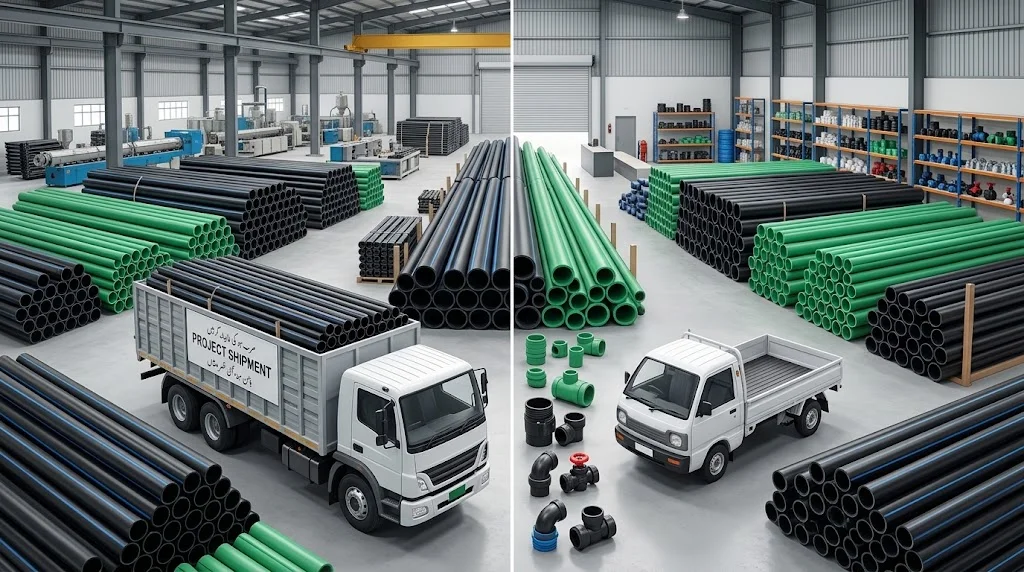
Imagine receiving two quotations for the same project: 4,000 m of PE100 pipe for a housing-scheme phase. Both suppliers claim to be “ISO certified.” One is a local dealer located just a few kilometres from the project site, while the other is the manufacturer’s sales office in Islamabad. Their prices, delivery commitments, and supporting documentation differ considerably. This is why buyers often consider whether to buy pipes directly from manufacturer rather than relying on a dealer.
Which one should you trust? For large buyers the honest answer is that it depends on what you are buying, how fast you need it and what you have to prove afterwards. This guide sets out the trade-offs so you can decide with a clear head.
A word of transparency: Newtech supplies large projects directly and also sells through a network of authorised dealers. We have no interest in telling you one route is always right, so we have tried to describe both fairly, including where a dealer is the better choice.
The short answer
Buy directly from the manufacturer when the order is large, scheduled or specification-critical, or when you must submit batch test reports. Buy through an authorised dealer when you need smaller quantities quickly, mixed items in one delivery, or local stock and credit. Many large buyers use both: bulk pipe direct, top-ups and fittings from a dealer.
As a starting point, Newtech’s own PPRC price guide suggests going direct for projects of around 500 m or more. Treat that as a rule of thumb, not a hard limit. The right threshold depends on the pipe type, the size and the distance to site.
How pipe actually reaches you
Most pipe in Pakistan moves through a chain: manufacturer, then distributor, then dealer, then contractor or end user. The roles are often used loosely, but a useful way to separate them, as described in Newtech’s dealer guide, is this:
- A distributor buys larger volumes directly from the manufacturer, holds stock across a city or region, and may supply smaller dealers.
- A dealer usually runs a single retail or trade counter and sells to contractors, plumbers, housing societies and individual buyers.
Each step holds stock, carries credit risk and handles the pipe. That adds cost, but it also adds a service: stock near the site, small quantities and credit. The question is not whether the chain is good or bad. It is which parts of it you actually need.
Buying directly from the manufacturer: what you gain
One accountable party. The maker controls the grade, SDR, wall thickness and marking, so a quote can be tied to a named standard. If a batch fails, there is no one in between to pass the problem along.
Batch traceability and test reports. Pipe carries a batch code, and a test report is only useful if it matches the batch you received. Direct buyers can ask for the report that belongs to their production run. Newtech’s Karachi supply page says mill test certificates and compliance documentation are provided with bulk orders for tender submission. Our HDPE testing guide explains how to read such a report.
Technical support at specification stage. Choosing the pressure class, SDR and compatible fittings is easier with the people who make the pipe, before the order is placed rather than after.
Consistency across phases. On multi-phase housing and utility projects, material ordered months apart must still match on wall thickness and pressure rating. A single source scheduled over time makes that easier.
Special requirements. Specific lengths, coil sizes, marking and packing can be agreed at source.
Price, with a caution. Going direct removes a trading layer, but it does not automatically make the delivered price lower. Minimum quantities, freight and payment terms all count. Compare the delivered cost, not the ex-factory rate.
Buying directly: what to watch
- Minimum order and lead time. Newtech’s Karachi page quotes typical delivery of bulk industrial orders within 7 to 10 working days for in-stock sizes. Made-to-order sizes and specials take longer, so plan your programme around the real figure for your sizes.
- Payment terms. Advance, staged or credit terms differ between suppliers and orders. Agree them in writing before you commit.
- Freight and unloading are yours to plan. Check truck access, lifting equipment and storage space before delivery day.
- Top-ups. A small mid-project shortfall is slow to fix from a factory. Keep a local source for it.
- A pipe manufacturer rarely supplies every valve, adaptor and brass fitting your job needs.
Buying through a dealer: what you gain
- Stock near the site. Same-day or next-day collection beats waiting for a factory truck.
- Small and mixed orders. Pipe, fittings, cement and valves in one transaction.
- Local relationships. Credit accounts, quick exchanges of small items and a counter you can visit.
- Local advice, from a counter team trained on the product.
Buying through a dealer: what to watch
- An extra margin. That is the normal cost of the service above, not a flaw.
- Storage and handling. Pipe left in direct sun, bent, or stacked badly in a yard is a risk, and so is old stock that has been mixed with new.
- Mixed batches and missing test reports are more common at the counter than at the factory.
- Unauthorised sellers. Fake and substandard pipe is a real concern in Pakistan, as our guide to identifying fake pipes A dealer is not the problem; an unauthorised one can be.
How to check a dealer is authorised
- Ask for a manufacturer’s authorisation letter. Tender documents often require one anyway.
- Ask the manufacturer’s sales team to confirm the dealer’s name and city.
- Check the invoice comes from a sales-tax-registered business.
- Read the marking and batch code on the pipe, and ask for the matching test report.
- Check the PSQCA licence number against PSQCA’s online licence search (confirm the current address on psqca.com.pk).
Direct vs dealer, side by side
Factor | Direct from manufacturer | Authorised dealer |
Delivered price | No trading layer, but minimums, freight and terms apply | Includes dealer margin; often better for small orders |
Quantity | Best for large, planned orders | Flexible, from a few lengths upward |
Speed | Lead time depends on sizes in stock | Often same or next day if in stock |
Batch traceability | Strongest: reports tied to your production run | Varies; ask for batch codes and reports |
Technical support | Direct access at specification stage | Depends on dealer training |
Payment | Terms agreed per order | Often credit-friendly for local accounts |
Delivery | Planned freight; you arrange unloading | Local delivery or collection |
Mixed items | Pipe and own-brand fittings | Pipe, fittings, valves and consumables together |
Tender papers | Manufacturer documents straight from source | Needs a manufacturer’s authorisation letter |
The paperwork large buyers actually need
Paperwork is where the choice often gets decided. Pakistani procurement documents show what is typically expected:
- Manufacturer’s authorisation. The Punjab standard bidding document template for goods includes a Manufacturer’s Authorization Form, and a national bank’s procurement documents list a valid manufacturer’s authorisation as a required annexure. If you buy through a dealer for a tender, the dealer needs one.
- Active taxpayer status. The same bank documents ask for proof of active status on FBR’s Active Taxpayer List. FBR sales tax return guidance also states that credit for input tax is allowed only where purchases are made from a sales-tax-registered person who is active on the list. So check your supplier’s status on either route, and confirm the position with your tax advisor.
- A PSQCA licence and an ISO 9001 certificate for the manufacturer; see our certification guide.
- A batch test report that matches the batch on your pipe.
- A delivery challan showing quantities, sizes and batch codes.
- Written warranty and replacement terms.
Procuring agencies set their own requirements, so read the bidding document for your project.
Which route for which buyer?
Buyer and job | Likely best route | Why |
Developer, kilometres of HDPE for a housing phase | Direct | Volume, scheduled deliveries, batch reports |
Contractor with a multi-phase scheme | Direct framework supply, dealer for top-ups | Consistent material plus local fixes |
Government or utility tender | Direct, or an authorised dealer with a manufacturer’s authorisation | Documents decide eligibility |
Builder fitting out one villa or a few flats | Dealer | Small quantities, mixed fittings, quick delivery |
Farm project with a few coils | Dealer, unless the volume is large | Local stock and delivery |
Urgent repair on a live project | Dealer | Speed beats margin |
Eight questions to ask any supplier
- Are you the manufacturer, a distributor or a dealer, and can you show authorisation?
- Which standard and edition is the pipe made to, and what are the PE grade, SDR and PN?
- Can I see a test report that matches the batch I will receive?
- What are the minimum order and the lead time for my sizes?
- What are the payment terms, and how long is the price valid?
- Who arranges freight and unloading, and what access do you need?
- Will I receive a sales tax invoice, and is your business active on the FBR list?
- What happens if a batch fails or arrives damaged?
Red flags
- A price far below the market for “the same pipe”, with no explanation.
- No batch codes on the pipe, or no invoice.
- A seller who will not name the manufacturer.
- “Factory direct” claims with no factory address, and no one willing to confirm it.
- Pipe stored in direct sun, or lengths with visibly different wall thickness.
A correct-looking quote is not proof. The marking on the pipe and the matching report are.
Conclusion: buy for the delivered price and the proof, not just the rate
Buying pipes directly from the manufacturer suits large, planned, specification-critical orders where batch reports and technical support matter. A dealer suits small, urgent or mixed orders where local stock and credit matter. For most large projects the best answer is a mix: bulk pipe direct, with an authorised dealer for top-ups and fittings.
Whichever route you choose, compare delivered prices, insist on a batch-matched test report, and check authorisation and tax status before you pay.
If you are planning a large order, contact our sales team with your sizes, SDR and quantities for a delivered quotation.
Frequently Asked Questions
Q1. Is it cheaper to buy pipes directly from the manufacturer?
Not always. Direct supply removes a trading layer, but minimum quantities, freight and payment terms still apply. Compare the delivered price for your quantity, not the headline rate.
Q2.What is the minimum order to buy direct?
It varies by manufacturer, pipe type and size. Newtech’s PPRC price guide suggests going direct for projects of about 500 m or more, but confirm the minimum for your sizes with the sales team.
Q3.How do I know a pipe dealer is authorised?
Ask for a manufacturer’s authorisation letter, ask the manufacturer to confirm the dealer, check the invoice and the batch code on the pipe, and check the PSQCA licence number.
Q4. Can I get batch test reports through a dealer?
Often yes, if the dealer holds them, but traceability is easier direct. Ask for the report that matches the batch code on your delivery before you accept it.
Q5. What documents do government tenders ask for?
Procuring agencies commonly ask for a manufacturer’s authorisation when the bidder is a dealer, and proof of active status on FBR’s Active Taxpayer List. Requirements differ by agency, so read your bidding document.
Q6. Does buying direct guarantee genuine pipe?
No. “Factory direct” is a claim, not proof. Check the marking, batch code, PSQCA licence and a matching test report on any route.
Q7. Can I buy in bulk direct and top up through a dealer?
Yes, and many large buyers do. Keep the same manufacturer, grade and SDR for top-ups so wall thickness and pressure class match the main order.