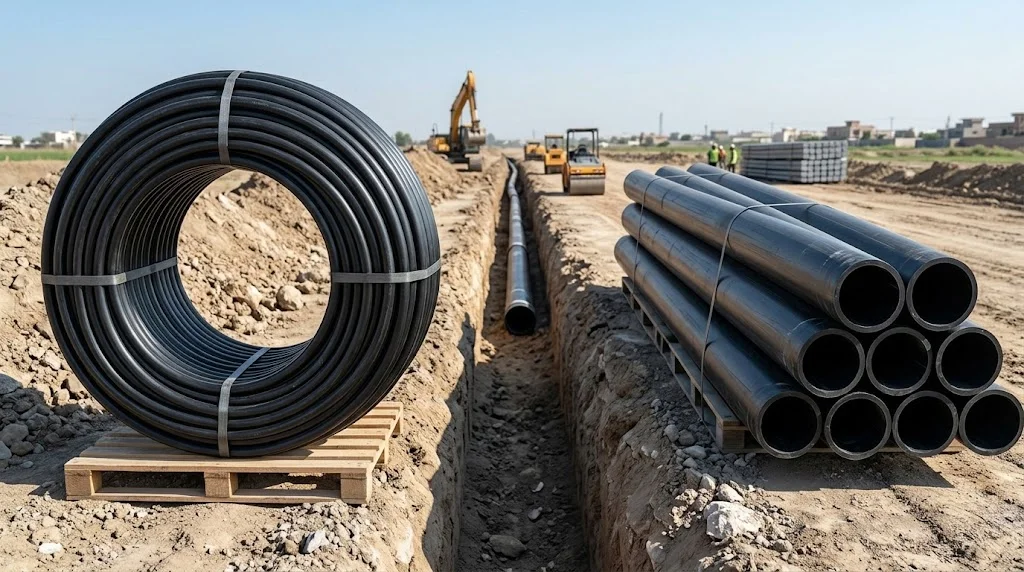
Two buyers purchase the same PE100 pipe on the same day. One needs 800 m of 63 mm pipe for a pipeline across a field near Faisalabad, while the other requires a 160 mm main line for a housing development in Lahore. When asked whether they prefer coils or straight lengths, each buyer gives a different answer, and both choices are equally suitable for their specific project.
The choice between an HDPE pipe coil and a straight length looks like a logistics detail. It is not. The form you order decides how many joints you make, how round the pipe ends are when you fuse them, how many people it takes to move the pipe, and whether the truck can even reach your site. This guide explains how to choose, with the numbers to check your own order against.
The short answer
Order coils for small diameters and long, mostly straight runs, generally up to about 63 mm and sometimes up to 90 mm. Order straight lengths of 6 m or 12 m for 110 mm and above, and whenever the pipe will be fused or electrofused joint by joint. Between roughly 90 mm and 180 mm, both forms exist and the joining method usually decides.
Industry guidance draws the line in the same place. The PE100+ Association lists free-standing coils up to 180 mm and straight lengths from 90 mm upward, and the PPI Handbook of Polyethylene Pipe describes polyethylene as coiled in diameters through 6 inches. Newtech’s own sizing guide describes the typical Pakistani pattern the same way: coils of 50 to 200 m for diameters up to about 90 mm, and 6 m or 12 m straight lengths for 110 mm and above.
What you are actually choosing between
A coil is one continuous length of pipe wound around a core, strapped, and usually shipped on a pallet. A straight length (often called a stick) is a cut length, normally 6 m or 12 m, supplied in bundles.
The pipe itself is the same: same PE100 compound, same SDR, same wall, same pressure rating. What changes is the number of joints, the roundness of the pipe ends, and how you handle and transport it. ISO 4427-2:2019 has separate clauses for coiled pipe and for lengths, so quote the clause from the edition named on your contract.
Where the line falls by size
| Pipe size | Usual form | What to know |
| 20 to 63 mm | Coil | Few joints, fast laying, best for long runs |
| 75 to 90 mm | Coil or straight | Coils get heavy and stiff; decide by joint method |
| 110 to 180 mm | Mostly straight | Some makers coil these, but ends arrive oval and hard to uncoil |
| Above 180 mm | Straight only | Too stiff to coil |
Sources: PE100+ Association, PPI Handbook of Polyethylene Pipe, and Newtech’s sizing guide. Exact limits vary by manufacturer.
The case for coils: far fewer joints
A joint is where time and risk collect. Each one needs preparation, heating or curing, cooling, a record and a test, and each is a place a leak can start. Coils cut the count dramatically.
Here is a 1,000 m run in each form:
| Form | Pieces needed | Joints along the run |
| 6 m straight lengths | 167 | 166 |
| 12 m straight lengths | 84 | 83 |
| 50 m coils | 20 | 19 |
| 100 m coils | 10 | 9 |
On a farm or irrigation line, that is the difference between fusing 83 joints in a field and fusing nine. With coils, joints fall at valves, tees and connections, where you need a fitting anyway.
Two cautions on usable length. The first and last metre or so of a coil can be deformed by the strapping, so allow for cutting it off. And joints are not eliminated, only reduced, so you still need the right fitting range for your pipe size.
The catch with coils: ovality and coil-set
A coil is pipe bent in a circle for its whole length. That bend squashes the pipe slightly out of round (ovality) and leaves it with a curve it wants to keep (coil-set). Neither is a defect in the pipe material, but both affect how the pipe jointed on site.
The standard leaves coil ovality to you. ISO 4427-2:2019 sets a maximum out-of-roundness for straight pipe at the point of manufacture, for example 1.5 mm at 63 mm, 2.2 mm at 110 mm and 3.2 mm at 160 mm. For coiled pipe, it says the maximum out-of-roundness is specified by agreement between the manufacturer and the end-user. An order that says nothing about coil ovality has no ovality limit to reject against.
Fittings need round pipe. Electrofusion couplers and compression fittings grip the pipe all the way round. As one example, the Australian PIPA electrofusion guideline, as summarised by a pipe supplier, accepts ovality of up to 1.5% of the pipe size for pipe below 315 mm, which is about 1.65 mm on 110 mm pipe. Follow the fitting maker’s instructions for your own limit. That is tighter than the factory limit for straight 110 mm pipe, so coiled ends usually need re-rounding clamps during jointing, and the end of each coil is worth cutting back to sound pipe.
Coil-set grows with time and heat. The longer a coil sits wound up, especially through hot days, the more curve it keeps. PPI’s guidance on coiled conduit makes the same point, and recommends using the oldest stock first. In Pakistani summers, store coils flat, in shade and off hot ground, and rotate stock.
Pipe Standards Guide: ISO 4427
NewTech Pipes · HDPE Piping Systems
Writing a purchase order? Read NewTech’s guide to ISO 4427, ISO 1452 and ISO 15874 and what each standard covers before you name one.
The case for straight lengths: round ends, easy handling, easy counting
Straight pipe leaves the extruder round and square-cut, within the ISO limits above, so it suits electrofusion and butt fusion with the least preparation. It is easy to count, store and cut to fit, it has no coil-set, and it is the only practical form for large diameters.
The costs are more joints, longer pieces to transport, and heavier individual lengths. This table shows approximate weights for PE100 at the standard SDR walls (our own calculation, using a density of about 0.95 g/cm³):
| Size | SDR 17 | SDR 11 | Practical unit |
| 63 mm | 0.67 kg/m | 0.99 kg/m | 100 m coil: about 67 or 99 kg |
| 90 mm | 1.36 kg/m | 2.0 kg/m | 100 m coil: about 136 or 200 kg |
| 110 mm | 2.04 kg/m | 2.98 kg/m | 12 m length: about 24 or 36 kg |
| 160 mm | 4.27 kg/m | 6.34 kg/m | 12 m length: about 51 or 76 kg |
Ask your supplier for actual weights, since walls, tolerances and packaging vary.
6 m or 12 m?
The choice between a 6 m and a 12 m length is mostly about the site and the truck:
- 12 m halves the number of joints (83 against 166 on 1,000 m) and suits long, open trench routes with machinery to lift pipe. It needs a long trailer, a clear approach and lifting equipment for larger sizes.
- 6 m suits narrow lanes, tight sites and hand handling: a 6 m length of 110 mm SDR 17 weighs about 12 kg, and SDR 11 about 18 kg, so two people can place it. It also loads more easily on smaller vehicles.
Before you order 12 m pipe, ask your transporter whether a 12 m load can reach the site, especially inside housing schemes or older urban streets.
Bending, laying and handling
Both forms can be bent in the trench, within limits. Using the PPI Handbook guidance as quoted by a pipe maker, the minimum cold bending radius is about 20 times the outside diameter for DR 7 to 9 walls, 25 times for DR 11 to 13.5, and 27 times for DR 17 to 21. For 63 mm SDR 11 pipe that is about 1.6 m, and for 110 mm SDR 17 about 3.0 m. If a fitting or flange sits in the bend, the radius opens to about 100 times the diameter, so keep fittings on straight sections.
A coil laid in a trench wants to snake. Use a stand or trailer to unroll it, let it relax in warm weather or pull it through straightening equipment, and secure it before backfill.
Safety. Coiled pipe holds a lot of stored energy. A pipe-maker’s handling guide advises moving palletised coils with a forklift, storing coils flat, and never cutting all the strapping at once. Cut bands one at a time, with the coil restrained, and keep people clear.
Pakistan-specific points
Heat. Black pipe in direct summer sun gets hot and soft, and coil-set increases. Keep coils shaded, store them flat, and avoid stacking too high. After laying, let the pipe come to ground temperature before final tie-ins, as manufacturers advise, because it contracts as it cools. Our thermal expansion guide explains the effect for plastic pipe in general.
Roads and transport. Coils nest and stack compactly, which helps with small diameters. Long straight lengths are bulky for their weight. Check access, turning space and unloading equipment with the transporter before you confirm 12 m pipe.
Equipment and fittings. Coils in small sizes are usually joined with compression or electrofusion fittings, so confirm those fittings exist in your pipe size and your pressure class. Butt fusion on 63 mm and above needs a machine of the right size range; see our butt-fusion machines. If you plan to electrofuse coiled pipe, budget for re-rounding clamps.
Which form for which project?
| Project | Likely best form | Why |
| Drip and micro-irrigation laterals, 20 to 32 mm | Coil | Long runs, almost no joints |
| Farm main line, 50 to 90 mm | Coil | Few joints, quick laying |
| House and plot service connections, 20 to 63 mm | Coil | One continuous run to each connection |
| Housing society branch lines, 63 to 110 mm | Coil to 90 mm, straight at 110 mm | Match form to size and joint method |
| Distribution mains, 125 to 315 mm | Straight lengths | Cannot be coiled practically |
| Fusing every joint with electrofusion, 90 to 180 mm | Straight lengths | Round ends, no re-rounding |
| Road or river crossings by trenchless methods | Coil, if the rig and site allow | Less laydown space than a long fused string |
| Stock for resale, 90 to 180 mm | Straight lengths | Easy to count, cut and store |
What to write on your purchase order
Because the standard leaves coil ovality and length to agreement, the order should carry the details:
- Standard and edition, for example ISO 4427-2:2019, with PE grade (PE100) and SDR or PN.
- Form: coil or straight length.
- Coil length and core diameter (ask the supplier what they offer).
- Maximum coil ovality, as a number in mm or as a percentage.
- Straight length: 6 m or 12 m, checked against your transport and site.
- Packing: capped ends, strapping, pallets and the number of coils per load.
- Marking and documents: batch code on the pipe and a matching test report. See our HDPE pipe testing guide for how to read it.
Prices follow from these lines. For benchmark rates by size, see our price list, and for wall and pressure choices, our sizing guide.
Five mistakes to avoid
- Ordering coils for large diameters because “fewer joints” sounds better. Large coils are stiff, oval and hard to handle.
- Not specifying coil ovality. The standard will not do it for you.
- Ordering 12 m pipe for a site the truck cannot reach.
- Forgetting fittings. Check that fittings exist in your coil size and pressure class.
- Leaving coils in the sun for weeks. Coil-set and ovality grow, and jointing gets harder.
Conclusion: order for the joints, the handling and the truck
Coils win where the bore is small and the run is long, because they remove most of the joints. Straight lengths win where the pipe is large, where every joint is fused, or where the site and the roads demand pieces you can carry and place. In the middle band, let the jointing method and the access decide.
Whichever you choose, put the form, the length, the grade and the SDR on the purchase order, and add a coil ovality limit if you are ordering coils. That one line prevents most of the disputes this decision causes.