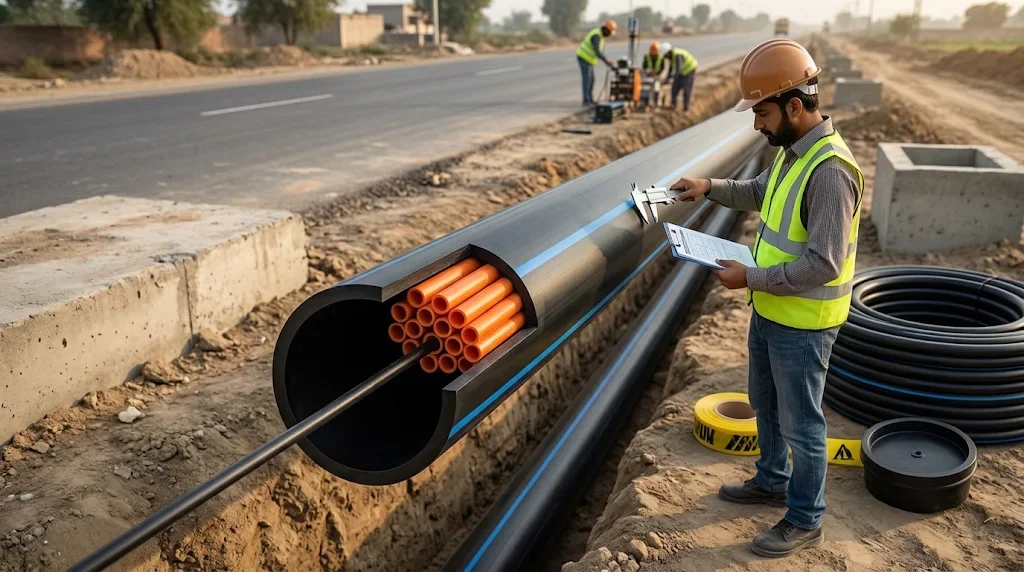
In May 2026, the Pakistan Telecommunication Authority’s Peshawar zonal office wrote to the authorities about repeated fibre cuts in Upper and Lower Chitral. It linked many of the cuts to road and development work in the area, and asked contractors, operators and project teams to coordinate before anyone breaks ground. The result of such cuts is something most of us have felt: a blank phone screen, a dead video call, a shop that cannot process payments.
A fibre cable is thin and delicate. What keeps it alive underground is the pathway around it. That pathway is a duct, and the decision about which duct to buy is made months before anyone sees a cable reel. This guide explains what to put in that decision, so your specification protects the network and leaves room for the next cable.
Why Fibre Needs a Duct in the First Place
You can bury armoured fibre directly in the ground, and sometimes that is the right call. But a duct gives you three advantages that direct burial does not.
- Protection: a continuous HDPE tube shields the cable from moisture, stones, soil movement and light mechanical damage.
- Replaceability: if a cable fails or needs an upgrade, you pull or blow the new one through the existing duct instead of digging up the road again.
- Capacity: a spare duct, or several microducts in one trench, lets you add cables later at a fraction of the original excavation cost.
Pakistan’s need for this is growing. The Express Tribune reported that the country has roughly 234,752 km of deployed optical fibre, made up of about 77,851 km long-haul and 156,901 km metro. The News reported in July 2026 that fibre-based home connections rose from 1.9 million in 2024 to 5.1 million within two years. Profit reported that the government abolished right-of-way charges on laying fibre. More fibre means more trenches, and more trenches mean more ducts to specify correctly.
A Duct Is Not a Water Pipe
This is the point that trips up many first-time buyers. HDPE water pipe is a pressure product, made to standards such as ISO 4427 and rated in PN and SDR. A telecom duct is a non-pressure product. It does not carry fluid under pressure; it carries a cable, and it must resist crushing, bending and friction instead.
That is why duct standards are different. ASTM F2160 covers solid-wall HDPE conduit with controlled outside diameter, with or without ribs, sized to iron pipe size (IPS), for non-pressure protection of fibre optic and power cables. International specifications often point to EN or IEC 61386-24 for conduits buried underground, and to Telcordia GR-356 for telecom conduit, innerduct and accessories. A Saudi utility specification, for example, lists ASTM F2160, ASTM F2176 for mechanical couplings, ASTM D3350 for the polyethylene material and GR-356 together. You do not need to cite every standard, but you do need to name one and ask the supplier to show compliance.
If you want a plain-language overview of water-pipe standards for comparison, see our guide to pipe standards explained.
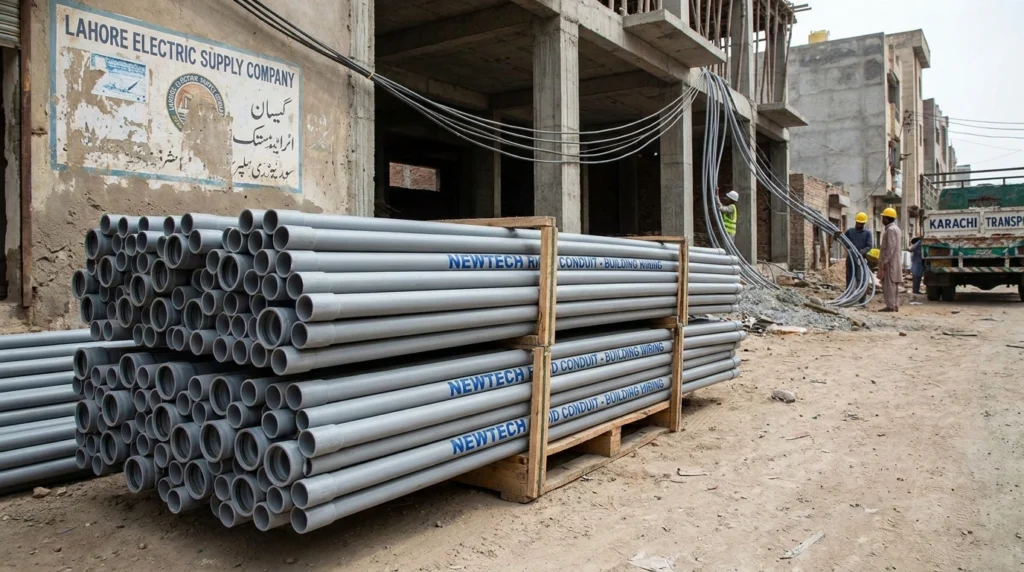
HDPE & PVC Conduit Guide
NewTech Pipes · Electrical Conduit Systems
Protecting cable underground? See NewTech’s conduit guide to PE100 HDPE conduit in 20 to 110 mm sizes, including smooth-bore double-wall options for cable pulling.
The Specification Checklist
A good duct specification fits on half a page. Here is what belongs on it.
1. Duct type and construction
State whether you want solid-wall smooth-bore duct, ribbed duct or double-wall corrugated duct. Smooth-bore duct is the usual choice for pulled cable, because friction is lower and the surface is consistent. Corrugated duct is often used where the cable will not be pulled hard or where flexibility in the trench matters. Say which one you need.
If you plan to blow cable in, ask about lubricated or silicone-core duct. India’s telecom standards body describes permanently lubricated HDPE ducts as a co-extruded two-layer duct, with an HDPE outer layer and a solid permanent lubricant inner layer, for installing cable by blowing. One European manufacturer’s datasheet quotes a coefficient of friction below 0.1 for its silicone-core duct. Treat such numbers as manufacturer claims and ask for test evidence.
2. Size: match the duct to the cable, not the catalogue
Write down the outside diameter of the cable you plan to install, then specify an inside diameter with comfortable clearance. A duct that is too tight raises pulling tension, and a duct that is too large wastes money and trench space. For future capacity, decide how many ducts or microducts the route needs on day one.
3. Wall thickness and installation method
Wall thickness should match how the duct will be installed. Direct burial in open trench, ploughing and horizontal directional drilling (HDD) each put different loads on the duct. One manufacturer’s datasheet separates ducts suited to direct burial from thinner ducts meant for protected pathways. Tell the supplier the method and ask them to recommend the wall.
4. Material and resin
Ask for virgin HDPE with carbon black for UV protection, and ask for the material classification on the datasheet (ASTM D3350 is common). Request test results such as density, melt flow rate and carbon black content. Our article on HDPE pipe testing explains what these tests tell you.
5. Pull tape or rope and lubrication
Specify a factory-installed pull rope or tape, and ask about pre-lubrication. Sequentially marked tape also helps because it shows how far a cable has travelled and where a blockage is.
6. Marking and colour
The duct should carry durable printed identification: manufacturer name, size, date and a reference code. Many specifications also ask for marking at regular intervals, such as a high-voltage caution on power ducts. Colour is usually set by the network operator or project, so write the colour into the order. Microducts in a bundle are often colour-coded for easy identification.
7. Length and delivery form
Duct comes in coils, reels or straight lengths. Continuous lengths mean fewer joints, which reduces weak points. Note that ovality and curvature are normal in coiled HDPE conduit, so agree acceptable limits. Our guide to coils vs straight lengths helps you choose.
8. Joints, accessories and documents
List couplings, end caps, duct plugs, spacers, warning tape and tracer wire in the same order. Ask for test reports, batch numbers and compliance statements. Where a product certification applies, read our note on PSQCA and ISO 9001 certification.
| Specification line | What to write | Why it matters |
| Standard | Name one (for example ASTM F2160 or EN/IEC 61386-24) | Gives a test basis you can enforce |
| Construction | Smooth-bore, ribbed or corrugated; plain or silicone-core | Controls friction and pulling or blowing length |
| Size | Outside and inside diameter against cable OD | Avoids tight pulls and wasted space |
| Wall | Thickness or SDR for the install method | Resists crushing in burial or HDD |
| Material | Virgin HDPE, carbon black, material class | Durability and UV resistance |
| Marking and colour | Printed ID; colour by operator | Traceability and route identification |
| Delivery | Coil or reel length; ovality limits | Fewer joints, easier handling |
| Documents | Test reports, batch numbers | Proof of what was supplied |
Pull It or Blow It? Duct vs Microduct
Traditional fibre networks use larger ducts, typically 40 to 110 mm in PVC or HDPE, and the cable is pulled or jetted in. A newer approach uses bundles of small microducts, often 14 to 20 mm, laid first. Lightweight micro cables are blown in later with compressed air. A Hexatronic whitepaper reports blowing speeds of up to about 150 m per minute with this method.
Which is better? It depends on the project.
- Large single ducts suit trunk routes, road crossings and places where heavier cable will be pulled.
- Microduct bundles suit access networks and fibre to the home, where the network will grow cable by cable.
- Both can be combined: a large HDPE duct carrying a bundle of microducts.
Decide this early, because it changes the duct size, the lubrication and even the installation team you need.
Installation Rules Your Specification Should Mention
A great duct can still be ruined on site. Write these points into the contract documents.
- Walk the route first. Check bends, crossings, manholes and obstacles. Plan pull points and slack before ordering cable.
- Respect bend radius. The Fiber Optic Association recommends a minimum bend radius of 20 times the cable diameter under tension and 10 times after installation. Use long-radius sweeps rather than tight elbows. One municipal specification limits total bends to 45 degrees in any one section of conduit.
- Control pulling tension. Outside-plant cable is commonly rated for roughly 600 lbf, but check the cable datasheet. Use a swivel and a breakaway link.
- Prove every duct. Pull a mandrel through each duct before the cable goes in. Guides from Corning and others suggest a mandrel of about 80 to 85 per cent of the duct inner diameter. Clean the duct with a brush or swab if needed.
- Seal the ends. Cap or plug open duct ends to stop water, mud and rodents getting in.
- Mark the route. Use warning tape above the duct and tracer wire or markers where possible. Bury depth should follow your authority’s and project’s requirements. For reference, one US city specification asks for at least 36 inches (about 0.9 m) of cover, but this is an example, not a Pakistani rule.
- Test after installation. Test every fibre with an OTDR and keep the results.
Our general guide to underground pipe installation mistakes applies to ducts too, especially trench bedding and backfill.
Pakistan-Specific Conditions to Plan For
- Third-party excavation. The PTA’s Chitral letter and the 2022 flood cuts both point to the same risk: someone digs without knowing a cable is there. During the 2022 floods, the PTA said trenches dug to drain water caused several fibre cuts in Sindh. Tracer wire, warning tape and as-built records help.
- Coordination before digging. Share route drawings with road, utility and highway teams before construction starts.
- Heat and sun. Store coils in shade and keep sealed ends covered, because black HDPE heats quickly and sun exposure is hard on stored ducts.
- Hilly, rocky and remote routes make long continuous lengths and robust walls more valuable. Our article on HDPE in harsh environments adds detail.
- Floods and monsoon. Plan sealed joints and drainage at manholes so water does not collect inside ducts.
Technology and Trends Worth Knowing
- Microduct and blown fibre keep growing because they let operators add capacity without new trenches.
- Digital records. Record GPS coordinates, photos, batch numbers and test results for every duct run. It makes repairs and future upgrades quicker.
- AI-assisted checking. An AI tool can compare a supplier’s datasheet with your specification and flag missing items. Treat it as a first pass and verify every line against the actual documents.
- 5G and fibre-to-the-home demand is pushing more fibre to towers and homes, which increases demand for duct routes. Plan spare capacity now.
Common Specification Mistakes
- Writing “HDPE pipe, 63 mm” with no standard, wall or purpose.
- Buying water-pipe SDR without checking the inside diameter against the cable.
- Forgetting lubrication or pull tape.
- Skipping the mandrel test.
- Leaving duct ends open.
- Mixing duct sizes along a route.
- Ignoring ovality in coiled duct.
- Not recording batch numbers and test reports.
A Starter Specification You Can Adapt
This is an illustration. Change every item to match your project and authority requirements.
- Duct: solid-wall HDPE telecom duct to [named standard], smooth bore, [plain / silicone-core].
- Size: [OD] mm outside diameter, [wall or SDR], suitable for [cable OD] mm cable.
- Material: virgin HDPE with carbon black, material class stated on the datasheet.
- Supply: [coil / reel] of [length] m, factory pull tape installed.
- Marking: manufacturer, size, date, batch number and standard; colour [colour].
- Accessories: couplings, end caps, spacers, warning tape and tracer wire as listed.
- Documents: test reports and compliance statement with each batch.
- Installation: mandrel proving, bend radius control and sealed ends before cable installation.
Conclusion
A fibre cable is the part people notice. A duct is the part that protects it. The choice you make on a specification sheet can decide whether a future repair is a quick pull or a trench through a busy road.
Specify the standard, match the size to the cable, choose a wall for the installation method, ask for the paperwork, and insist on proving every duct before cable goes in. Do that, and your duct will be doing its job quietly for years.
Planning a telecom or cable duct project? Share your cable size, route type and installation method with the [NEWTECH team](/contact-us/), or review the [2026 pipe catalogue](/pipe-catalogue-pakistan/) for available HDPE products. (Editor’s note: make these links live, and confirm which duct types NEWTECH supplies before publishing.)