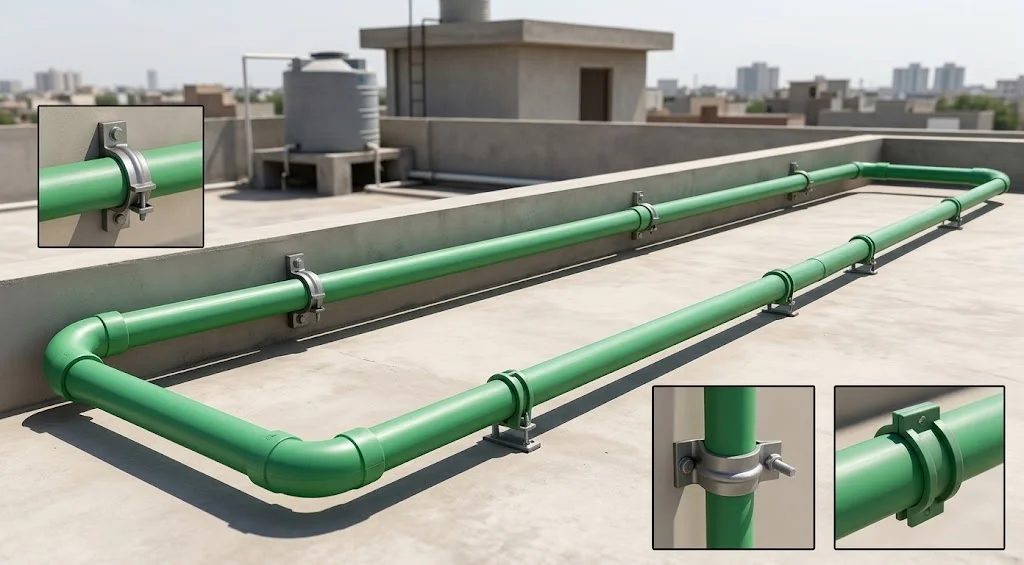
A plastic pipe that fits perfectly in the morning can look bowed by afternoon. In a hot climate, the sun and the air both push pipes to grow and shrink every day. This movement is called thermal expansion of plastic pipes, and if you ignore it, it pulls joints apart, bends pipes, and cracks fittings.
This guide explains how much plastic pipe moves, why hot weather makes it worse, and how expansion loops, clips, and good fixing practice keep a system safe. It is written for plumbers, contractors, and project owners in Pakistan.
What Is Thermal Expansion in Plastic Pipes?
All materials grow when they get warmer and shrink when they cool. Plastic pipe does this far more than metal. A plastic pipe expands several times more than steel and many times more than copper for the same temperature change.
If a pipe is free to move, the growth is harmless. If it is fixed rigidly at both ends, the pipe has nowhere to go. It bows sideways, pushes on fittings, and puts stress on joints. Over many hot and cold cycles, that stress causes leaks and cracks.
How Much Do Plastic Pipes Expand?
The movement depends on the pipe material, the length of the run, and the temperature change. You can estimate it with a simple formula:
Expansion (mm) = coefficient x length (m) x temperature change (°C)
The coefficient is different for each plastic. These are typical approximate values, in mm per metre per °C:
| Pipe material | Typical coefficient |
|---|---|
| PVC and UPVC | About 0.05 to 0.08 |
| PPRC | About 0.15 |
| HDPE | About 0.12 to 0.20 |
Always confirm the exact value with the pipe manufacturer’s data.
Example (illustrative): A 10 m UPVC pipe on a rooftop sees a 40°C swing between a cool night and a hot, sunny afternoon. Using a coefficient of 0.06, the pipe grows by 0.06 x 10 x 40 = 24 mm. A 10 m PPRC hot water line that goes from 20°C to 70°C grows by about 0.15 x 10 x 50 = 75 mm.
Why Pipes in Hot Weather Face More Movement
Hot climates make the problem bigger in three ways.
- Larger temperature swings. In Pakistan, the difference between a cool night and a summer afternoon can be large.
- Direct sun on the pipe. A pipe in the sun can be much hotter than the surrounding air.
- Hot water inside the pipe. Solar water heater lines and geyser pipework add heat from the inside.
The result is more movement, more often. Exposed rooftop lines, building risers, and surface-laid pipes see the most.
PVC Pipe Expansion: What to Watch For
PVC and UPVC are rigid, so they do not snake like softer pipes. Instead, expansion shows up in other ways:
- Pipes pushing out of a socket or pulling away from a joint
- Cracked fittings at fixed points
- Stress at elbows and tees on long runs
- Visible bowing on long, exposed runs
Long straight UPVC runs, such as rooftop lines and exterior risers, need a plan for movement. Do not clamp a pipe rigidly and hope for the best. Our guide on UPVC pipe UV fading also explains how sun exposure ages exposed pipe.
PPRC and HDPE: Different Pipes, Different Behaviour
PPRC carries hot water, so it sees large temperature changes from the water itself. Hot lines need expansion allowance and proper clips. See our PPRC pipes for hot water systems guide for temperature ratings and sizes.
HDPE expands a lot but is flexible. When laid on the surface, it can snake slightly in the heat. That is normal and often intended. In a buried trench, soil keeps temperature steadier, so movement is much smaller.
Expansion Loop Pipe: Types and When to Use Them
An expansion loop pipe is a bend added to a straight run so the pipe has room to grow. The bend absorbs the movement instead of the joints. There are three common forms:
- Natural offsets and changes of direction. A normal elbow or bend in the pipe route can absorb movement if the legs are long enough and not restrained.
- L-bends and Z-bends. A deliberate offset in the pipe route that lets each leg flex.
- U-loops. A U-shaped loop added to a straight run when no other bend is available.
Use a loop when a long straight run cannot absorb movement by itself. Typical cases are long hot water mains, rooftop lines, and exterior risers.
The required leg length depends on the pipe diameter, the expected movement, and the pipe’s stiffness. Do not guess. Use the pipe manufacturer’s chart or ask your designer to size it. If there is no room for a loop, a slip-type expansion joint made for the pipe material is another option.
Clips and Fixing Tips for Plastic Pipes
How you fix the pipe matters as much as the loop. There are two kinds of fixing:
- Fixed (anchor) clips hold the pipe firmly at one point. They force the movement to go in a known direction, toward a loop or a free end.
- Sliding (guide) clips hold the pipe in line but let it slide. They stop sagging without stopping growth.
Follow these tips:
- Do not clamp tightly across a fitting. A fitting held rigid on both sides cracks under stress.
- Let the pipe slide through guide clips. Do not tighten them hard.
- Place anchors on purpose. Put them where you want the movement to start, not at random.
- Support at the right spacing. Plastic pipe sags more when hot, so supports need to be closer on hot lines. Check the manufacturer’s spacing guidance.
- Use clips made for plastic pipe. Sharp edges on metal clamps can damage the surface.
- Leave room at the ends. Do not jam a pipe tight into a wall or a fixed object.
Installing in Hot or Cold Weather
The temperature when you install matters.
- In hot weather, the pipe is already long. It will shrink as it cools, so allow for that pull.
- In cold weather, the pipe is short. It will grow in summer, so leave extra room.
- Cut and fit pipes at normal working temperature when you can. This keeps movement balanced in both directions.
- For socket joints, push the pipe fully into the socket following the manufacturer’s instructions. Do not leave the pipe on the edge of the socket.
Store pipes in shade before use. Our guide on PVC pipe storage and handling covers hot-weather storage.
Protecting Pipes in Hot Weather
Beyond expansion, heat and sun affect plastic pipe in other ways.
- Shade or cover exposed runs where you can.
- Paint exposed UPVC with a light, water-based paint.
- Insulate hot water lines to reduce heat loss and temperature swing.
- Keep pipes away from heat sources such as boilers and flues.
Rooftop tank lines are a typical trouble spot. Our guide to water tank plumbing pipes and fittings explains the layout.
Common Thermal Expansion Mistakes
- Fixing a long run rigidly at both ends
- Clamping pipes tightly over fittings
- Leaving no room for movement at walls and corners
- Ignoring the sun on exposed pipe
- Using one clip type for everything
- Installing without thinking about the season
- Skipping expansion loops on long hot water mains
How to Plan for Expansion: A Quick Checklist
- Find the longest straight runs and the highest temperature swing.
- Estimate the movement with the formula and the manufacturer’s coefficient.
- Decide where it will go. Use natural bends, loops, or joints.
- Place anchors and guides so movement goes where you want it.
- Use proper clips and check support spacing.
- Protect exposed pipe from sun and heat.
- Buy certified pipe from a manufacturer registered with PSQCA.
Conclusion
Thermal expansion of plastic pipes is predictable, and you can plan for it. Estimate the movement, give the pipe room through loops, offsets, or joints, and fix it with the right mix of anchor and sliding clips. In hot climates, protect exposed runs from the sun and avoid rigid fixing across fittings.
Planning a plumbing or irrigation system? Contact Newtech Pipes to discuss the right pipe and fixing for your project.
Frequently Asked Questions
Q 1. Do plastic pipes expand in hot weather?
Yes. Plastic pipes grow when they get warmer and shrink when they cool. The movement is larger than in steel or copper, and it increases with pipe length and temperature swing.
Q2. How much does a PVC pipe expand?
It depends on the length and the temperature change. As a rough guide, a 10 m UPVC pipe with a 40°C swing can grow by around 20 to 30 mm. Check the manufacturer’s coefficient for an exact figure.
Q3.What is an expansion loop in plumbing?
An expansion loop is a bend or U-shaped section added to a straight pipe run. It gives the pipe room to grow and shrink without stressing joints and fittings.
Q4. Should I fix plastic pipes tightly with clips?
Not tightly. Use fixed clips only at chosen anchor points, and sliding guide clips elsewhere. Tight clamps over fittings or along the whole run cause stress and cracks.
Q5. Does buried pipe expand as much as exposed pipe?
No. Soil keeps the temperature steadier, so buried pipe sees much less movement than an exposed pipe in the sun.