PVC pipes can become damaged long before installation begins, often due to unnoticed cracks, scratches, or deformation during storage and handling. Proper
PVC Pipe Storage and Handling helps prevent damaged materials, leaking joints, and unnecessary project delays without adding significant costs. This practical guide explains how to inspect pipes, unload them safely, stack them correctly, protect them from sunlight and extreme temperatures, and store fittings and solvent cement properly to ensure the pipes remain in good condition until installation.
The advice applies to rigid PVC and UPVC pipe used for water supply, drainage and sewerage. HDPE and PPRC follow different rules, so check the manufacturer’s own guide for those.
Why PVC Pipe Storage Handling Matters on Site
PVC is rigid and strong, but it is not indestructible. It becomes more brittle in cold weather and softer in strong heat. A hard knock, a dragged length or a sharp stone can leave a gouge that later becomes a weak point.
Damage to the socket or spigot matters most, because the joint depends on those surfaces being clean and true. A chipped socket or an oval pipe end can leak even when the cement or sealing ring is applied perfectly. Replacing a damaged length in a buried line costs far more than the length itself.
Step 1: Inspect the Delivery Before You Unload
Check the load before the truck leaves. Note any damage on the delivery receipt, because claims are much harder once the pipe is off the vehicle.
- Count the lengths and match sizes and pressure classes to the order
- Read the print line for size, class, standard and manufacturer name
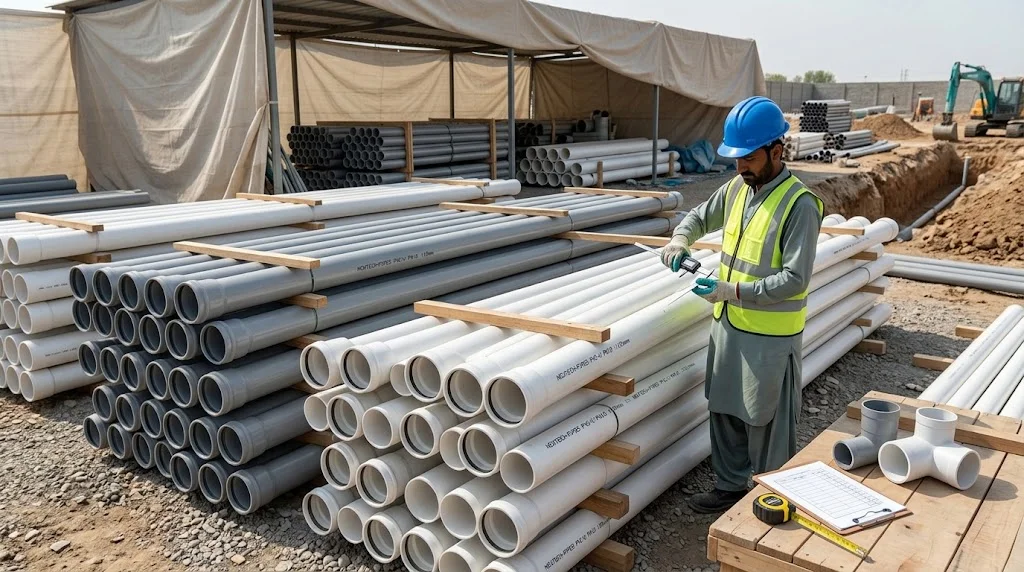
- Look along each length for cracks, deep scratches, flattened sections and chipped ends
- Check that sockets are clean and round, and that rubber rings, where used, are present and undamaged
- Keep the delivery note and batch details for your records
Print markings tell you what you have received. If you are unsure whether a batch is genuine, read our guide on
how to identify fake pipes before you accept it. Photograph any damage you find, so the record is clear if the supplier needs evidence.
Step 2: Unload Without Dropping, Dragging or Throwing
Never throw pipe from a truck or drag it over rough ground. Lift lengths by hand or with soft slings, and lower them gently onto the stack area. Two people should carry long lengths so the middle does not sag and the ends do not strike the ground.
If you must roll pipes down timber skids, control the speed and keep them from hitting each other or hard surfaces. Do not use bare chains or wire rope, because they can cut into the wall. Keep sockets and spigot ends away from sharp edges, nails and concrete corners.
NewTech UPVC Pipes & Fittings
NewTech Pipes · UPVC Piping Systems
Once your site storage is sorted, browse NewTech UPVC pipes and fittings for water supply and drainage projects across Pakistan.
View Product
Step 3: Choose and Prepare the Storage Area
A good storage area is flat, firm, clean and shaded. The table below covers the main points.
| Site condition |
What to do |
| Ground |
Level, firm and free of stones, nails and other sharp debris |
| Water |
Raise the stack on timber bearers where the site floods or turns muddy in the monsoon |
| Sun |
Store in shade, or cover with light-coloured, opaque sheeting that lets air circulate |
| Heat |
Keep pipes away from exhausts, heaters, hot metal and reflective metal fences |
| Traffic |
Fence the area off from vehicles, excavators and other moving plant |
Keep different sizes and pressure classes in separate stacks, and label each one. That stops the wrong class from reaching the trench.
How Do You Stack PVC Pipes? An On-Site Pipe Stacking Guide
Stack pipes in layers on flat timber bearers, not directly on the ground and not on points or loose bricks. Bearers should be wide enough to spread the load and spaced closely enough that the pipe cannot sag. Many manufacturers publish bearer spacing of about 1.5 metres or less, so confirm the figure for your pipe.
Place the sockets at alternate ends of each layer, with the sockets protruding beyond the stack. This puts the weight on the pipe barrel, not on the sockets, and keeps the stack level.
| Stacking point |
Good practice |
Why it matters |
| Bearers |
Continuous timber, evenly spaced |
Stops sagging and ovality |
| Sockets |
Alternate ends, protruding |
Weight rests on the barrel |
| Height |
Keep stacks low; about 1.5 m is a common limit, less in heat |
Protects the bottom layer |
| Sides |
Vertical stakes or side supports |
Stops pipes rolling or collapsing |
Do not nest small pipes inside larger ones, and do not place heavy items on top of the stack. Keep stacks lower for large-diameter or thin-wall pipe and in hot weather, because warm PVC deforms more easily under load.
Protecting PVC Pipe From Sun, Heat, Rain and Cold
Prolonged sunshine fades PVC and, over time, roughens the surface. Our guide to
UPVC pipe UV fading explains what that looks like and how to prevent it. For storage, shade is the simplest fix.
If you cover the stack, use light-coloured, opaque sheeting and leave the sides open for airflow. A black tarpaulin wrapped tightly around the pipes traps heat and can distort them. Avoid resting pipes against metal that heats up in the sun.
Rain rarely harms the pipe itself, but mud and standing water do. Raise stacks off wet ground and keep pipe ends free of soil, because dirt in a socket ends up inside the joint.
Cold changes the risk. PVC is more sensitive to impact when temperatures drop, which matters in northern areas in winter. Handle lengths gently, do not drop them, and avoid striking cold pipe hard when cutting.
Handling Fittings, Rubber Rings and Solvent Cement
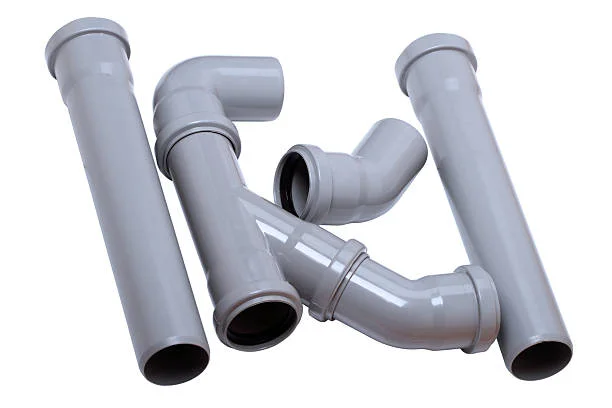
Keep fittings in their boxes or bags until you need them, so sockets stay clean and round. Store rubber sealing rings in a cool, shaded place away from oil, grease and fuel. Dirt in a socket is a common cause of weak joints.
Solvent cement and primer are flammable, so store them sealed, in a cool, ventilated place away from heat, sparks and open flame. Check the date on the can and follow its instructions. Our article on
PVC pipe joint leaks shows how poor cement handling leads to failed joints.
Moving Pipe Around the Site and Between Yards
Pipe often moves twice: from the supplier to a site yard, then from the yard to the trench. Secure loads firmly so lengths cannot slide or bounce, and tie them so sockets do not rub against each other. Pad any chains, straps or rope where they touch the pipe, and keep the load free of loose tools and steel offcuts.
For long or large-diameter lengths, lift with wide soft slings at balanced points, not with hooks in the pipe ends. If you use a forklift, pad the forks and support the lengths along their full width. Never lever a pipe with a steel bar or drag a load of pipes behind a vehicle.
Carry shorter lengths by hand with the pipe horizontal, and keep the sockets clear of your feet and nearby kerbs. When pipe leaves the stack, move only what the crew will install that day, so fewer lengths lie loose beside the trench.
Final Checks Before Installation
Check stored pipe once more at the point of use. Inspect every length for these problems.
- Cracks, splits or deep gouges anywhere on the barrel
- Flattened or oval sections, especially in pipe that was stacked high
- Chipped, cracked or dirty sockets and spigots
- Heavy fading, chalking or a rough surface from long sun exposure
- Anything unclear on the print line
Cut out or reject damaged sections rather than installing them. A rejected length costs far less than a repair after backfilling. Mark rejected lengths clearly so nobody uses them by mistake.
Storage and Handling on Pakistani Sites
Site conditions in Pakistan add a few risks. Summer heat can be intense, monsoon rain floods yards, and a busy housing society site may have several contractors sharing one storage area. Plan the yard before the pipe arrives, and name one person to control it.
Use the oldest stock first, so no batch sits in the sun for months. Look for pipe that states the standard it is made to, such as ISO 1452 for UPVC pressure pipe, from a manufacturer registered with
PSQCA, and follow that manufacturer’s own handling guide. Industry bodies such as the
Plastic Pipe and Fittings Association also publish PVC design guides that include a pipe storage section.
Keep a simple stock register for the yard. Record the date received, size, class and batch details for each delivery, and note where it is stacked. If a defect shows up later, the register lets you trace the batch and raise the issue with the supplier quickly.
Common PVC Pipe Storage and Handling Mistakes
- Throwing or dragging pipes during unloading
- Stacking pipes directly on rough ground or stones
- Stacking too high, which crushes or deforms the bottom layer
- Leaving pipes in direct sun for months with no cover
- Wrapping stacks in unventilated black plastic
- Mixing sizes and pressure classes in one stack
- Leaving sockets and spigots dirty, chipped or unprotected
- Storing solvent cement near heat or in an unsealed can
Conclusion
Good PVC pipe storage handling comes down to a few habits: inspect on delivery, unload gently, store on a flat, shaded base, and stack with supported, alternating sockets. Following this on-site pipe stacking guide protects pipe from impact, heat, cold and contamination, so the walls and joints you paid for arrive intact. Newtech Pipes, an ISO 9001:2015-certified and PSQCA-registered manufacturer, supplies
UPVC pipe and fittings for water supply and drainage projects across Pakistan. For handling advice on a specific order,
contact the Newtech team.