If your hot water system is leaking, warping, or losing pressure within two years, the pipe material — not the installer — is almost certainly the problem. Pakistan’s construction sector grew at 6.4% in FY2023 (Pakistan Bureau of Statistics), and thousands of housing society projects in Lahore, Islamabad, and Karachi are specifying hot water systems today that will be expected to last 25+ years. The wrong pipe choice will cost you in repairs, callbacks, and project reputation.
PPRC pipe hot water system installations have become the go-to solution for contractors and developers who cannot afford failures. Yet many projects still suffer from incorrect SDR selection, poor heat-fusion technique, and counterfeit polypropylene pipe that carries no certification. This post covers what you actually need to know: temperature ratings, correct pipe sizing, how to read pressure ratings, and installation practices that will keep your system performing in Lahore’s summer and Islamabad’s winter alike. By the end, you’ll know exactly which PPRC specification your project demands.
What Is PPRC Pipe and Why Does It Dominate Hot Water Systems in Pakistan?
PPRC stands for Polypropylene Random Copolymer — a thermoplastic with a molecular structure specifically engineered for thermal stability. Unlike standard PP homopolymer, the random copolymer variant distributes ethylene molecules unevenly through the chain, which raises flexibility, impact resistance, and crucially, long-term temperature endurance.
Why contractors across Pakistan have moved to PPRC:
The shift away from galvanized iron (GI) and uPVC in hot water applications is not a trend — it is a technical inevitability. GI pipes corrode from inside, depositing iron oxide into domestic hot water within 7–10 years in Faisalabad’s hard-water conditions. uPVC begins softening above 60°C, which makes it unsuitable for any solar water heater or gas geyser application. PPRC has no such limitations.
In Pakistan’s climate — which ranges from 45°C summer ambient in Multan to sub-zero nights in Murree — PPRC delivers consistent performance because it is chemically inert, non-corrosive, and rated for decades of thermal cycling. Bahria Town Islamabad, DHA Lahore, and Green Gulberg projects have specified PPRC exclusively for internal hot water distribution since the mid-2010s.
PPRC is also approved under PSQCA standards and meets DIN 8077/8078 specifications for hot and cold water pressure pipes. If your project is going through WASA inspection or PEC review, you need pipes that carry these certifications — not just a label that claims them.
PPRC Pipe Temperature Rating: What the Numbers Actually Mean
Continuous Operating Temperature vs. Peak Temperature
The two most important thermal specs on any PPRC pipe are:
- Continuous Operating Temperature (COT): The temperature at which the pipe can run indefinitely over its designed service life (typically 50 years per ISO 15874).
- Peak Temperature: The short-duration maximum the pipe can withstand without permanent deformation.
Standard PPRC pipe (PN20 or SDR 6) is rated as follows under ISO 15874:
| Temperature Class | Continuous Temp | Peak Temp | Typical Application |
|---|---|---|---|
| Class 1 | 60°C | 80°C | Domestic hot water (geyser) |
| Class 2 | 70°C | 95°C | Floor heating, solar thermal |
| Class 4 | 70°C | 90°C | Combi boiler systems |
| Class 5 | 90°C | 110°C | Central heating, radiators |
Most residential projects in Pakistan — solar water heater to bathroom tap — fall under Class 1 or Class 2. For central heating pipe Pakistan applications involving radiators or fan coil units, Class 5 (PN25) is the minimum specification you should be quoting.
How SDR Rating Affects Temperature Performance
SDR (Standard Dimension Ratio) is the ratio of pipe outer diameter to wall thickness. A lower SDR means a thicker wall, higher pressure capacity, and better high-temperature performance.
- SDR 11 (PN10): Cold water distribution, not rated for hot water above 20°C service pressure
- SDR 7.4 (PN16): Standard domestic hot water up to 60°C
- SDR 6 (PN20): Hot water systems up to 70°C continuous
- SDR 5 (PN25): Central heating, high-temp solar, industrial loops
Specifying SDR 11 on a rooftop solar loop that hits 80°C on a Multan afternoon is one of the most common — and costly — specification errors on Pakistani projects.
PPRC Pipe Sizes Available in Pakistan and How to Choose the Right One
Standard Sizes and Their Applications
PPRC pipe is manufactured in metric outer diameters. NEWTECH produces PPRC Pipes & Fittings from 20mm to 110mm. Here is how sizes map to application:
| Pipe Size (OD) | Wall Thickness PN20 | Flow Rate (L/min approx.) | Recommended Application |
|---|---|---|---|
| 20mm | 3.4mm | 12–18 | Single bathroom hot water branch |
| 25mm | 4.2mm | 20–30 | 2–3 bathroom hot water supply |
| 32mm | 5.4mm | 35–50 | Floor-level distribution, small commercial |
| 40mm | 6.7mm | 60–85 | Hotel floor risers, apartment building |
| 50mm | 8.3mm | 100–140 | Commercial buildings, central heating loops |
| 63mm | 10.5mm | 160–220 | Large commercial, industrial hot water |
| 75mm | 12.5mm | 230–310 | High-rise riser mains |
| 90mm | 15.0mm | 330–440 | District heating, industrial process |
| 110mm | 18.3mm | 480–620 | Central plant distribution mains |
For a standard 4-bedroom house in Lahore with two bathrooms and a kitchen hot water line, 25mm PN20 for the main run and 20mm for branch connections is the right specification. Oversizing wastes money; undersizing causes velocity noise, hammer, and premature fitting failure.
⚙️ Expert Insight from NEWTECH
One of the most frequent mistakes we see on housing society projects — including several in Rawalpindi and Bahawalpur — is using PN10 (SDR 11) PPRC on hot water lines to save 15–20% on pipe cost. At 60°C with 6 bar pressure, an SDR 11 pipe is operating outside its de-rated capacity. The system may hold for 2–3 years before micro-fissures appear at the fittings. By that point, the contractor has handed over and the developer carries the liability. Spend the difference on PN20 — it is not optional on any hot water circuit above 50°C.
How to Read a PPRC Pipe Marking and Verify Quality
Every legitimate PPRC pipe carries markings extruded directly into the pipe body. A blank or label-only pipe is a red flag. Here is what a compliant pipe marking looks like and what each element means:
Example marking: NEWTECH | PPRC | 25mm | SDR 6 | PN20 | ISO 15874 | DIN 8077 | PSQCA | Made in Pakistan
- PPRC or PP-R: Confirms material type (not PP homopolymer)
- Diameter: Outer diameter in mm
- SDR / PN: Wall thickness class and pressure rating
- ISO 15874: International standard for PP pressure pipe systems
- DIN 8077/8078: German standard widely adopted in Pakistan and Gulf markets
- PSQCA: Pakistan Standards & Quality Control Authority certification
If a pipe you are buying in Karachi’s pipe market or Gujranwala’s hardware district does not show ISO 15874 and PSQCA on the pipe body, do not use it on any hot water application. PSQCA-uncertified PPRC has been found in several Peshawar and Faisalabad markets with wall thicknesses 10–15% below stated specifications (PSQCA Market Surveillance Report, 2022).
Polypropylene Hot Water Pipe: Installation Best Practices for Pakistani Conditions
Heat Fusion (Socket Welding) — The Correct Process
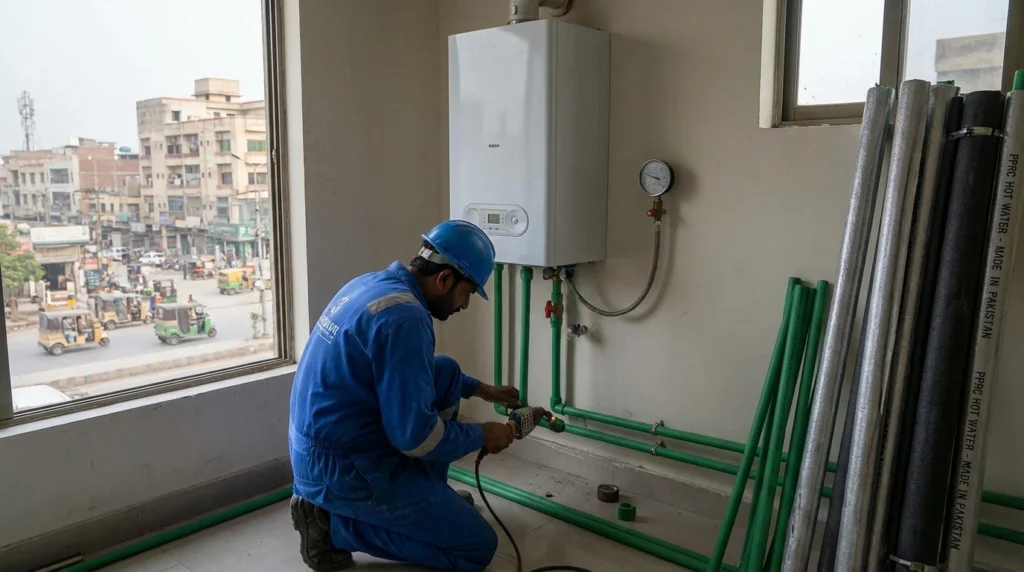
PPRC pipes are joined by heat-fusion welding, which creates a homogeneous molecular bond stronger than the pipe wall itself when done correctly. The process uses a polyfusion welding machine (also called a PPRC welding iron) set to 260°C ± 10°C.
Correct socket welding steps:
- Cut pipe square — a diagonal cut creates incomplete fusion and a likely leak point
- Clean both pipe end and fitting socket with isopropyl alcohol
- Heat pipe end and fitting socket simultaneously for the specified time (see table below)
- Remove from welding iron simultaneously, push together with a straight axial motion — no twisting
- Hold still for the cooling time — movement during cooling is the #1 cause of weak joints
Heat fusion time guide (ISO 15874):
| Pipe Size | Heating Time | Assembly Time | Cooling Time |
|---|---|---|---|
| 20–25mm | 5 sec | 4 sec | 2 min |
| 32–40mm | 8 sec | 6 sec | 4 min |
| 50–63mm | 12 sec | 8 sec | 6 min |
| 75–90mm | 18 sec | 10 sec | 8 min |
| 110mm | 25 sec | 15 sec | 10 min |
Thermal Expansion Compensation
PPRC has a linear thermal expansion coefficient of 0.15mm/m·°C — roughly 5× higher than copper. On a 10-meter hot water run that cycles from 20°C to 70°C, you are managing 75mm of linear expansion. In Pakistan’s tall residential buildings (Karachi high-rises, Islamabad apartment towers), uncompensated PPRC risers will buckle fittings within 2–3 years.
Install expansion loops or sliding sleeve brackets every 1.5–2 meters on hot water mains. This is non-negotiable in any building over 3 floors.
Insulation Requirements
In Pakistan’s climate, uninsulated hot water PPRC pipes lose 4–8% of delivered heat energy per meter of pipe run (ASHRAE 90.1 benchmarks applied to Pakistan’s climate zones). Insulate all hot water runs in unheated spaces, ceiling voids, and external walls with minimum 20mm closed-cell polyethylene foam — this is standard on all DHA and Bahria Town M&E specifications.
Central Heating Pipe Pakistan: PPRC vs. Alternative Materials
Pakistan’s central heating market — particularly in high-end residential developments in Islamabad, Lahore, and now increasingly in Multan and Faisalabad — presents a specific set of demands. Central heating circuits run at 70–90°C flow temperatures with 60–80°C return temperatures, under pressures of 4–6 bar.
Here is a direct comparison of the main pipe options:
| Material | Max Temp (Continuous) | Pressure Rating | Lifespan | Corrosion | Installation | Relative Cost |
|---|---|---|---|---|---|---|
| PPRC PN25 | 95°C | 25 bar | 50+ years | None | Heat fusion | Medium |
| Copper | 250°C | High | 50 years | Moderate (Pakistan water) | Soldering | High |
| GI Steel | 120°C | High | 15–25 years | High (Pakistan water) | Threading | Medium |
| uPVC | 60°C | Limited | 25 years | None | Solvent cement | Low |
| PEX | 95°C | 10–16 bar | 50 years | None | Compression/crimp | High |
| NEWTECH PPRC PN25 | 95°C | 25 bar | 50+ years | None | Heat fusion | Medium |
For central heating pipe Pakistan projects, PPRC PN25 delivers the best combination of thermal performance, longevity, corrosion resistance, and local availability. Copper is technically superior in extreme conditions but costs 3–4× more per meter in current Karachi and Lahore market pricing, and skilled copper soldering labor is increasingly scarce.
According to a 2023 HVAC market report by Engineering Council of Pakistan affiliates, PPRC now accounts for over 60% of new central heating pipe installations in commercial projects across Punjab — a significant shift from GI steel dominance just 10 years ago.
Common PPRC Hot Water System Failures and How to Prevent Them
Failure 1: Joint Leaks at Fittings (Most Common)
Cause: Incorrect heating time, contaminated pipe surface, or pipe movement during cooling. Prevention: Follow ISO 15874 fusion times exactly. Use alcohol wipe before fusion. Brace the joint for full cooling time.
Failure 2: Pipe Sagging Between Supports
Cause: Insufficient support spacing. PPRC is softer than metal at elevated temperatures. Prevention: Support spacing should not exceed 0.5m for 20–25mm pipe carrying 70°C water. For 50mm+, maximum 0.8m spacing.
Failure 3: UV Degradation on Exposed Sections
Cause: Standard PPRC contains no UV stabilizers. Sunlight degrades PP polymer within 12–18 months. Prevention: All external or roof-level PPRC runs must be lagged or painted with UV-resistant coating. This is especially critical in Lahore and Multan where UV intensity is extreme from April to September.
Failure 4: Using Cold Water Grade Fittings on Hot Lines
Cause: Cost-cutting. PN10 fittings on PN20 pipe creates the weakest point in the system. Prevention: Match fitting PN rating to pipe PN rating throughout. Never mix pressure classes on the same circuit.
Conclusion
Selecting the right PPRC specification is not complicated — but it requires discipline. The difference between a system that lasts 50 years and one that fails in 3 often comes down to three decisions: correct SDR/PN rating for your operating temperature, proper heat-fusion technique, and purchasing pipe that carries genuine PSQCA and ISO 15874 certification.
Your four takeaways:
- Use PN20 (SDR 6) minimum for domestic hot water; PN25 (SDR 5) for central heating above 70°C
- Follow ISO 15874 heat fusion times precisely — heating time errors are the #1 cause of joint failure
- Install expansion loops on all hot water mains longer than 3 meters in heated buildings
- Verify every pipe carries ISO 15874 and PSQCA markings on the pipe body — not just a sticker
If your next project involves a PPRC pipe hot water system in Pakistan — whether a 200-unit housing society in Islamabad, a hotel in Lahore, or an industrial process loop in Faisalabad — the specification decisions you make today determine your maintenance costs for the next two decades.
FAQ SECTION
Q1: What is the maximum temperature a PPRC pipe can handle in a Pakistan hot water system?
Standard PPRC PN20 (SDR 6) pipes are rated for continuous operation at 70°C and peak temperatures up to 95°C under ISO 15874. For central heating systems in Pakistan running at 80–90°C, you must specify PN25 (SDR 5). Using lower-rated pipe above its temperature limit causes micro-cracking and premature failure at fittings.
Q2: Which PPRC pipe size is best for a 3-bedroom house hot water system in Lahore?
For a standard 3-bedroom house in Lahore with two bathrooms, specify 25mm PN20 PPRC for the main hot water supply line and 20mm PN20 for individual branch connections to fixtures. This sizing delivers adequate flow rate (20–30 L/min) while keeping velocity below 2 m/s to prevent water hammer and noise.
Q3: How long do PPRC pipes last in Pakistan’s climate?
Properly installed PPRC pipes certified to ISO 15874 and used within their rated temperature and pressure range have a designed service life of 50 years. In Pakistan’s climate — including Multan’s extreme heat and Islamabad’s winter cold cycles — correctly specified PPRC significantly outlasts GI steel (15–25 years) and uPVC (25 years) in hot water applications.
Q4: What is the difference between PN10, PN16, PN20, and PN25 PPRC pipe?
PN (Pressure Nominal) ratings indicate maximum working pressure in bar at 20°C. For hot water, the de-rated capacity at 70°C is what matters: PN10 is for cold water only; PN16 suits hot water up to 60°C; PN20 handles domestic hot water up to 70°C; PN25 is required for central heating pipe Pakistan applications and solar thermal systems above 70°C.
Q5: Is PPRC pipe PSQCA certified in Pakistan and why does it matter?
Yes — genuine PPRC pipe for hot water systems should carry PSQCA certification marked directly on the pipe body, not just on packaging. PSQCA certification ensures wall thickness, material grade, and pressure rating meet Pakistan’s national standards. A 2022 PSQCA market surveillance report found non-certified PPRC in several markets with wall thickness 10–15% below stated values — a serious safety risk.
Q6: Can PPRC pipe be used for central heating and radiators in Pakistan?
Yes, but only PN25 (SDR 5) PPRC rated to Class 5 under ISO 15874 — designed for continuous 90°C and peak 110°C service. This polypropylene hot water pipe grade is suitable for radiator loops, fan coil unit connections, and underfloor heating manifolds. Using PN20 or lower on a central heating circuit operating above 70°C will cause progressive fitting failure and leakage within 2–4 years.