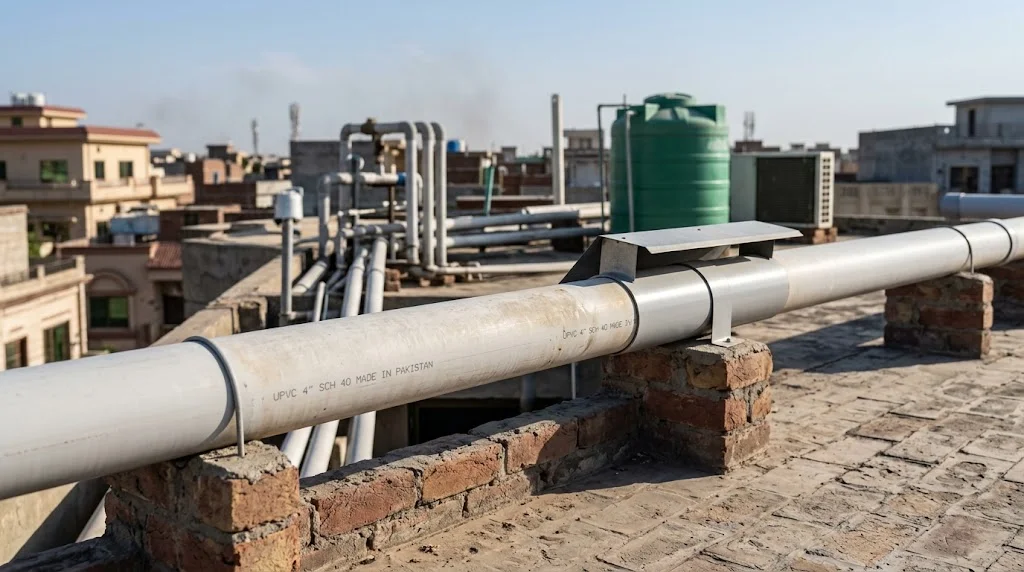
A UPVC pipe that’s gone from bright grey or white to a chalky, faded tone after a few years in the sun isn’t just looking worse — it’s a visible sign of a chemical process happening beneath the surface. UPVC pipe UV fading is common on exposed runs across Pakistan’s climate, where intense summer sun in cities like Multan, Karachi, and Lahore accelerates a breakdown process most buyers never think about until the pipe starts chalking, cracking, or weakening at the surface. This guide explains what actually causes UV degradation in UPVC, how to tell cosmetic fading from a structural problem, and the practical pipe sun damage prevention steps that extend the service life of any exposed UPVC run.
Why UPVC Fades and Degrades Under UV Exposure
UPVC, like most plastics, contains polymer chains that are vulnerable to the ultraviolet component of sunlight. UV radiation has enough energy to break molecular bonds at the pipe’s surface, a process called photodegradation. This breaks down the pigment responsible for the pipe’s color first — which is why fading is usually the earliest visible sign — and, left unaddressed over years, can progress to surface chalking (a powdery residue that rubs off when touched) and eventually micro-cracking as the degraded surface layer becomes brittle. The degradation is generally limited to the outer surface layer rather than penetrating the full pipe wall, but that surface layer is also where the pipe’s weather-resistance and impact strength are concentrated, so prolonged, unmitigated exposure does gradually reduce the pipe’s resilience.
Cosmetic Fading vs. Structural Degradation: How to Tell the Difference
Not all color change signals a serious problem, and it’s worth distinguishing the two:
- Cosmetic fading — a gradual dulling or lightening of color with a smooth surface that hasn’t become chalky or brittle. This is largely an aesthetic issue and doesn’t significantly affect the pipe’s pressure rating or structural performance.
- Chalking — a powdery white residue visible when the surface is wiped or rubbed. This indicates the surface resin layer has begun breaking down and UV protection additives are being consumed; it’s a signal to monitor the pipe more closely, though it doesn’t necessarily mean immediate failure.
- Surface micro-cracking or brittleness — small surface cracks, especially visible when the pipe is flexed slightly, indicate more advanced degradation. At this stage, the pipe’s impact resistance has measurably declined, and replacement or protective measures should be considered sooner rather than later.
Why This Matters More in Pakistan’s Climate
Pakistan’s high UV index, particularly across Punjab and Sindh during summer months, accelerates photodegradation faster than in more temperate climates. Exposed above-ground UPVC runs — on rooftops, along building exteriors, or in open agricultural and irrigation layouts — face years of cumulative UV exposure that buried or shaded sections never experience. Combined with high surface temperatures, which can also soften PVC slightly and make it marginally more susceptible to UV-driven chain breakdown, above-ground UPVC pipe in Pakistani conditions generally needs more deliberate UV protection than the same pipe would require in a milder climate.
How Manufacturers Build In UV Resistance
Most UPVC compound intended for outdoor or above-ground use includes UV stabilizer additives — commonly titanium dioxide (TiO2) or other light-stabilizing compounds blended into the resin during manufacturing. These additives work by absorbing or reflecting UV radiation before it can break down the polymer chains at the surface, significantly slowing the degradation process compared to unstabilized compound. The concentration and quality of these additives vary by manufacturer and product grade, which is one reason pipe from different suppliers can show noticeably different fading rates even under identical sun exposure — a detail that’s often not obvious from a basic product description and is worth asking about specifically for any pipe destined for long-term above-ground use.
NewTech Electrical Conduit Pipes & Fittings
NewTech Pipes · Electrical Conduit Piping Systems
Planning UPVC runs above ground? See NewTech conduit pipes, non-metallic protection for cables and conductors with good insulation.
Practical Pipe Sun Damage Prevention Steps
- Choose UV-stabilized UPVC grades specifically for any run that will remain exposed above ground long-term, rather than assuming standard-grade pipe performs the same
- Bury or route pipe underground wherever practical — this is the most effective protection since UV exposure essentially stops once the pipe is covered
- Apply protective coatings or cladding on exposed rooftop or exterior runs where burying isn’t an option — PVC-compatible paint or insulation cladding both reduce direct UV exposure
- Use shading where feasible — running exposed pipe along a shaded wall face or under an overhang reduces cumulative UV dose significantly compared to full sun exposure
- Inspect exposed runs periodically for chalking or surface cracking, especially pipe that’s been in service for several years, so protective measures can be added before degradation progresses to a structural concern
When Fading Pipe Needs Attention vs. When It’s Just Cosmetic
A pipe showing mild color change with a smooth, intact surface generally doesn’t need action beyond routine monitoring. A pipe showing chalking should be inspected more closely and is a reasonable candidate for a protective coating or cladding to slow further degradation. A pipe showing visible micro-cracking or brittleness — particularly on pressure lines — warrants a closer structural assessment, since this stage indicates meaningful loss of the surface layer’s protective and strength-contributing properties, and replacement planning is the safer path for critical lines at this point.
Conclusion
UPVC pipe UV fading starts as a cosmetic issue but can progress to measurable surface degradation if left unprotected on long-term exposed runs, particularly under Pakistan’s intense summer sun. Choosing UV-stabilized compound, burying pipe where practical, and adding protective coatings or shading on unavoidable above-ground sections are straightforward steps that meaningfully extend service life. Newtech Pipes, an ISO 9001:2015-certified and PSQCA-registered manufacturer, produces UPVC pipe formulated with UV-stabilizing additives suited to Pakistan’s climate for both residential and industrial above-ground applications.