Why This Comparison Matters at Municipal Scale
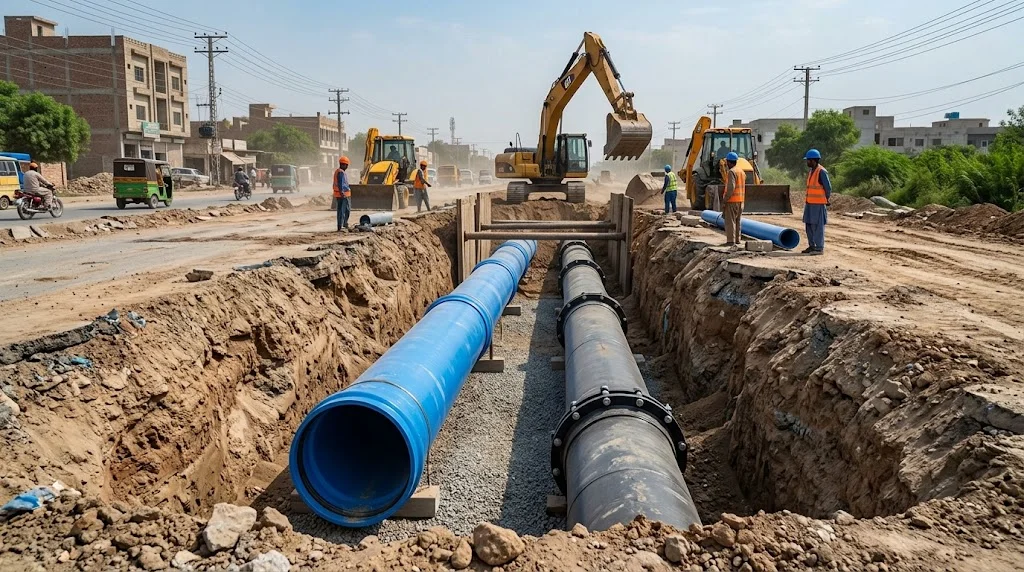
Residential and small commercial plumbing decisions rarely hinge on PVC-versus-metal debates anymore — PVC has largely won that space on cost and corrosion resistance. Municipal water supply networks are different: pipe diameters are larger, project budgets run into significant capital expenditure, service life expectations stretch to 50+ years, and a failure under a major road or in a dense urban network carries far higher repair and disruption costs than a residential leak. At this scale, the choice between PVC and ductile iron affects total project cost, maintenance burden, and network reliability for decades, which is why the decision deserves a genuine material comparison rather than a default to whatever’s traditionally been specified.
Material and Strength Comparison
| Property | PVC (PVC-U, C900-grade or equivalent) | Ductile Iron |
|---|---|---|
| Tensile strength | Lower than ductile iron | Significantly higher — ductile iron has considerably greater tensile strength |
| Flexibility | Rigid, minimal flexibility | Rigid but tougher under impact loading |
| Corrosion resistance | Excellent — immune to the electrochemical corrosion that affects metal pipe | Requires protective linings and coatings (cement mortar, epoxy, polyurethane) to resist corrosion over time |
| Weight | Significantly lighter | Much heavier per linear meter |
| Typical service life | Commonly cited at 50+ years for water supply applications with proper installation | Often rated similarly long with proper linings and cathodic protection where needed |
Ductile iron’s raw mechanical strength is its clearest advantage — it withstands higher external loading and impact without protective bedding in the way PVC sometimes requires. PVC’s advantage is that it doesn’t corrode at all under normal water supply conditions, removing an entire failure mode that ductile iron must be actively protected against through linings and coatings.
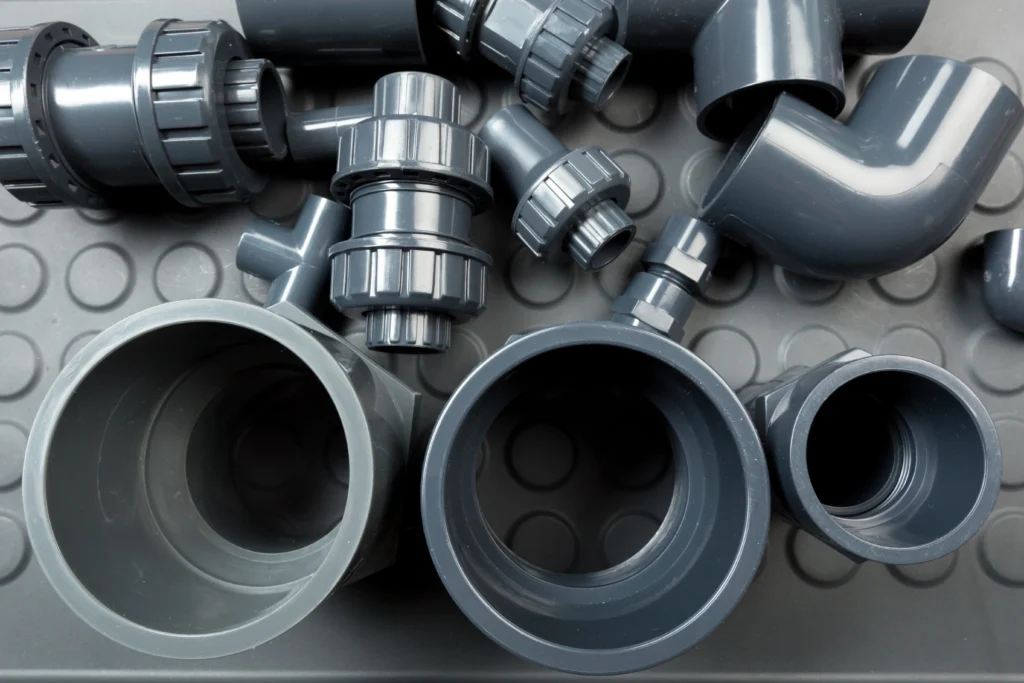
NewTech UPVC Pipe & Fittings
NewTech Pipes · UPVC Piping Systems
Weighing PVC for a municipal water network? See NewTech UPVC pipes and fittings for water supply, built to resist rust and corrosion.
View ProductInstallation Differences That Affect Project Cost
PVC’s light weight is one of its biggest practical advantages on a municipal project: lengths can be handled, transported, and joined with far less heavy equipment and labor than ductile iron, which typically requires cranes or heavy lifting equipment even for moderate diameters. This translates into faster installation timelines and lower labor costs for PVC on most projects, particularly where trenching conditions make heavy equipment access difficult — though getting those joints right matters just as much as the material choice, as our piece on PVC pipe joint leaks and solvent cement mistakes explains. Ductile iron’s installation advantage shows up in situations requiring higher external load resistance — under roadways with heavy traffic loading, or in soil conditions with significant ground movement, ductile iron’s strength margin can reduce the need for the more careful bedding and backfill PVC installations typically require to avoid deflection or cracking under load.
Corrosion and Soil Conditions: Where Each Material Performs Better
Pakistan’s varied soil and water conditions make this comparison especially relevant. In areas with aggressive or corrosive soil chemistry, or where stray electrical currents near industrial or urban infrastructure can accelerate metal corrosion, PVC’s complete immunity to electrochemical corrosion is a significant long-term maintenance advantage — ductile iron in such conditions requires ongoing monitoring of its protective coating and, in severe cases, cathodic protection systems to prevent premature failure. In stable, non-aggressive soil without unusual loading conditions, this advantage matters less, and the decision shifts more toward cost and installation logistics.
Cost Considerations for Municipal Budgets
PVC generally has a lower material cost per meter than ductile iron at comparable diameters, and its lighter weight further reduces transport and installation costs — a meaningful factor on large-diameter municipal mains where total pipe tonnage directly drives freight and handling expense. Ductile iron’s higher upfront cost is sometimes offset in project evaluations by its higher load-bearing capacity, which can reduce the need for more expensive bedding, encasement, or deeper burial in challenging soil or traffic-load conditions. A genuine cost comparison for a specific project should account for installed cost — material, transport, labor, and any special bedding requirements — rather than comparing per-meter material price alone.
When PVC Is the Stronger Choice
- Standard municipal water supply mains in stable soil conditions without unusual external loading
- Projects where transport logistics or limited heavy-equipment access favor lighter materials
- Networks in corrosive soil or water chemistry where avoiding metal corrosion risk is a priority
- Budget-constrained projects where lower material and installation cost is a deciding factor
When Ductile Iron Is the Stronger Choice
- High-traffic roadway crossings or areas with significant external loading requirements
- Large-diameter transmission mains where ductile iron’s strength margin reduces bedding complexity
- Projects where local contractor expertise and established practice strongly favor ductile iron installation
- Situations requiring fire-flow or pressure ratings at the upper end of what standard PVC classes support — see our HDPE Pipe Pressure Rating guide to PN ratings and SDR for how pressure class and wall thickness relate to each other across plastic pipe materials generally
Conclusion
PVC and ductile iron each bring genuine advantages to municipal water supply projects — PVC on cost, weight, and corrosion immunity; ductile iron on raw mechanical strength and load tolerance in demanding conditions. The right choice depends on project-specific factors like soil chemistry, traffic loading, diameter, and budget rather than a universal preference for one material. Newtech Pipes, an ISO 9001:2015-certified and PSQCA-registered manufacturer, supplies PVC pipe suited to municipal water supply applications across Pakistan, backed by the quality documentation engineers need to evaluate it against alternative materials for a specific project.