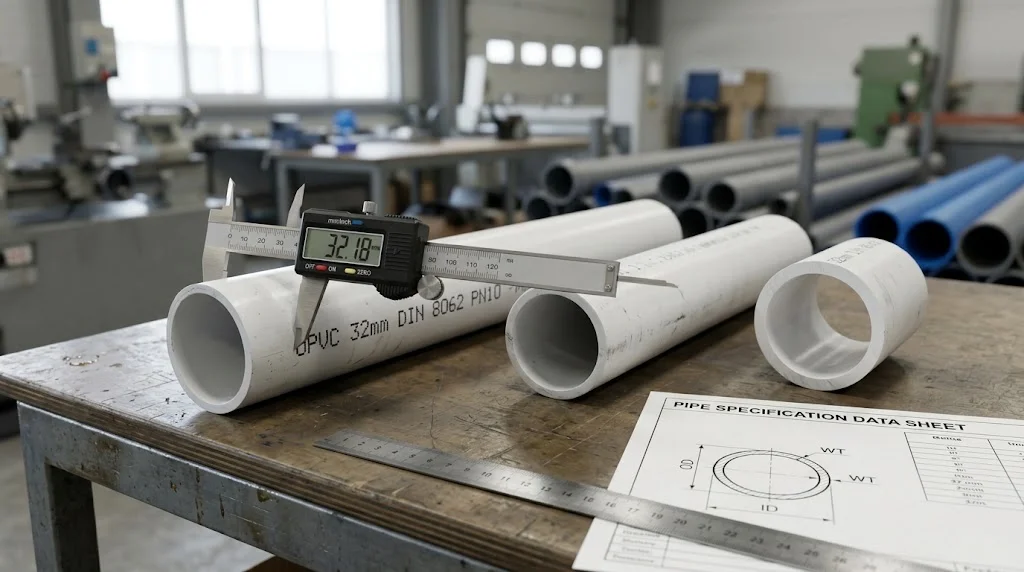
You ask for a one-inch PVC pipe, measure it, and the pipe is not one inch wide anywhere. This confuses plumbers, contractors, and buyers every day. The reason is simple. PVC pipe nominal diameter is a name for the size, not a real measurement.
This guide explains actual vs nominal pipe size, how inch and millimetre sizing differ, and how to measure a pipe so you order the right pipe and the right fittings.
What Does PVC Pipe Nominal Diameter Mean?
“Nominal” means “in name only.” The nominal diameter is a label that identifies a pipe size. It is close to the real size, but it is not the exact outside or inside measurement.
Think of it like a shirt size. A “medium” tells you the general size, but not the exact chest measurement.
Actual vs Nominal Pipe Size: Why They Differ
Older pipe sizes were named after the inside diameter of the pipe. Over time, wall thickness changed to suit different pressures, but the names stayed the same. Today, a pipe’s nominal size is a fixed label, while the real measurements depend on the pipe’s standard and wall thickness.
Three measurements matter:
- Outside diameter (OD): The width across the outside of the pipe.
- Wall thickness: How thick the pipe wall is.
- Inside diameter (ID): The width of the opening that water flows through.
For a given pipe, the relationship is: ID = OD − 2 x wall thickness.
Inch Sizes and Their Actual Outside Diameters
Inch-based sizing (nominal pipe size, or NPS) uses a fixed outside diameter for each nominal size. The outside diameter stays the same even when the wall changes. This table shows common examples.
| Nominal size | Actual OD (inch) | Actual OD (mm) |
|---|---|---|
| 1/2 in | 0.840 | 21.3 |
| 3/4 in | 1.050 | 26.7 |
| 1 in | 1.315 | 33.4 |
| 1-1/2 in | 1.900 | 48.3 |
| 2 in | 2.375 | 60.3 |
| 4 in | 4.500 | 114.3 |
So a 1-inch pipe has an outside diameter of 1.315 inches. Its inside diameter depends on the wall, and is smaller still.
Metric Sizes: The System Used for UPVC Pressure Pipe
Many UPVC pressure pipes are sold by outside diameter in millimetres. Common sizes include 20, 25, 32, 40, 50, 63, 75, 90, 110, and 160 mm. Here the nominal size is the outside diameter itself, which makes the label closer to the real measurement.
In the market, people often still use inch names for these pipes. This table shows how the names typically line up. It is an indicative guide only.
| Market name | Typical metric OD | NPS actual OD |
|---|---|---|
| 1/2 in | 20 mm | 21.3 mm |
| 3/4 in | 25 mm | 26.7 mm |
| 1 in | 32 mm | 33.4 mm |
| 2 in | 63 mm | 60.3 mm |
| 4 in | 110 mm | 114.3 mm |
The two systems are close but not the same. A 4-inch NPS pipe is 114.3 mm, while a 110 mm metric pipe is slightly smaller. Do not assume they are interchangeable. Confirm sizes against the supplier’s catalogue. You can find Newtech’s range on the pipe catalogue page and the UPVC pipe and fittings page.

NewTech PVC Pipes & Size Catalogue
NewTech Pipes · PVC Piping Systems
Check sizes before you order. Browse the NewTech Catalogue 2026 for PVC pipe size charts, technical data and application guidelines.
Why Wall Thickness Changes the Inside Diameter
For a given nominal size, the outside diameter is fixed, but the wall can vary. A thicker wall gives a higher pressure rating and a smaller inside diameter.
- In the inch system, wall thickness is described by schedule, such as Schedule 40 and Schedule 80.
- In the metric system, wall thickness follows the pressure class (PN) or SDR.
Here is a simple example. Imagine a pipe with a 63 mm outside diameter and a 3 mm wall. Its inside diameter is 63 − (2 x 3) = 57 mm. A thicker-walled pipe with the same 63 mm outside diameter would have a smaller opening. This is an illustration only. Always use the real wall thickness from the datasheet.
If you want to understand PN and SDR in more depth, see our guide to pipe pressure ratings.
How to Measure a PVC Pipe Correctly
Follow these steps on site:
- Measure the outside diameter. Use calipers, or wrap a tape around the pipe and divide the circumference by 3.14.
- Match the OD to a size chart. This tells you the nominal size and whether it is inch or metric.
- Measure the wall thickness. Check the cut end with calipers.
- Calculate the inside diameter. Use ID = OD − 2 x wall thickness.
- Read the markings. Look for size, class, and standard printed on the pipe.
Never measure the inside diameter and use it as the size name. You will pick the wrong pipe.
Which Size Matters: Fittings, Ordering or Flow?
Different jobs use different measurements:
- Fittings and joints: These depend on the outside diameter. A socket fitting must match the pipe’s OD.
- Ordering: Use the nominal size, together with the standard and pressure class.
- Flow and sizing: These depend on the inside diameter. Our pipe diameter flow rate formula guide shows how.
- Reading specs: Our guide on how to read a pipe datasheet shows where each size appears.
Common Pipe Sizing Mistakes
- Treating the nominal size as a real measurement
- Mixing inch and metric pipe with fittings from the other system
- Sizing flow on the outside diameter instead of the inside diameter
- Ignoring wall thickness when comparing pipes
- Ordering by size alone, without the pressure class
- Measuring the inside of a pipe and calling it the pipe size
Conclusion
PVC pipe nominal diameter is a label, not a measurement. Measure the outside diameter first, find the nominal size from a chart, check the wall thickness, and calculate the inside diameter when you need flow. Keep inch and metric systems separate, and confirm sizes with your supplier. Not sure which size you need? Contact Newtech Pipes to match pipe and fittings to your project.