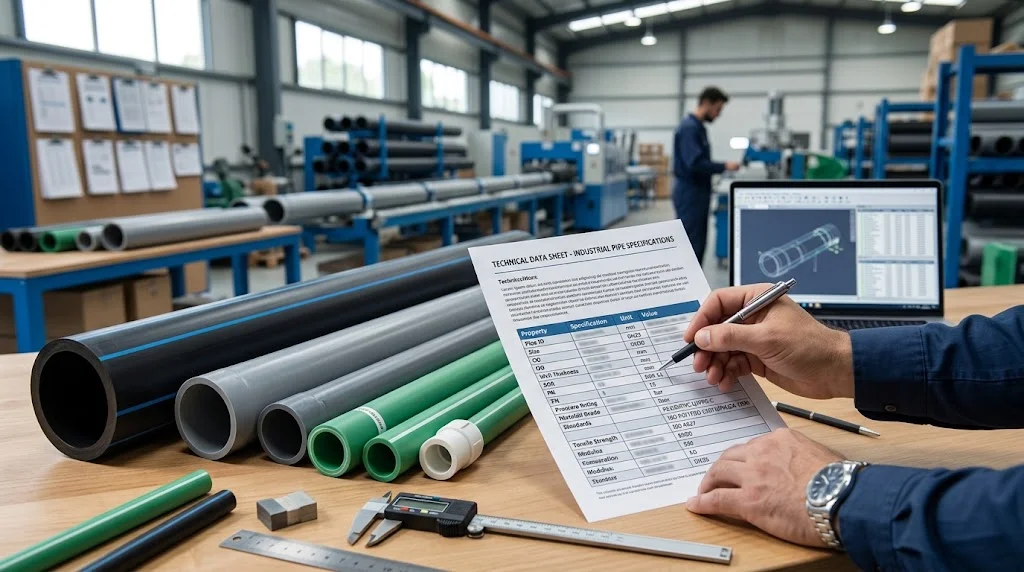
Most pipe purchasing decisions are often based on price and size, but the datasheet is the document that tells you exactly what you are buying. Yet, many buyers simply skim through it without understanding the technical details. Knowing how to read a pipe datasheet helps turn a page of numbers, specifications, and standard references into a clear understanding of a pipe’s actual capabilities, including its pressure rating, temperature limits, and compliance with the standards required for your project — the same compliance question we cover from a certification angle in our PSQCA & ISO 9001 Pipe Certification guide. . This guide explains each section of a typical technical datasheet for HDPE, PVC, and PPRC pipes, helping you compare different quotes based on technical value rather than price alone.
Why the Datasheet Matters More Than the Price List
A price list tells you what a size costs. A datasheet tells you what that size is actually made of, tested to, and rated for — and two pipes at the same nominal diameter and price point can have meaningfully different performance if their underlying material grade or wall thickness differs. For procurement teams working on tenders, housing society projects, or industrial installations, the datasheet is the document that should decide whether a quote meets the project’s technical requirement, not just its budget line. Treating the datasheet as an afterthought is how underweight or mismatched pipe ends up specified into a project that actually calls for a higher-rated class.
The Core Sections of a Pipe Datasheet
While layout varies by manufacturer, a complete technical specification sheet for plastic pipe typically includes the same core sections:
- Material designation — the exact polymer grade (e.g., PE100, PE80, PVC-U, PPRC Type 3)
- Dimensional data — outside diameter (OD), wall thickness, and the SDR or pipe class
- Pressure rating — the PN (Pressure Nominal) class and the temperature/pressure conditions it applies to
- Mechanical and physical properties — values like Minimum Required Strength (MRS), tensile strength, and impact resistance
- Standards references — the ISO, ASTM, or PSQCA standard the pipe is manufactured and tested against
- Marking and traceability information — what’s printed on the pipe itself and how batches are tracked
Material Designation: What PE100, PE80, and PVC-U Actually Mean
The material grade on a datasheet isn’t just a label — it determines the pipe’s baseline strength before wall thickness or pressure class are even factored in. PE100 and PE80 both refer to HDPE compound grades, but PE100 has a higher Minimum Required Strength (MRS) rating than PE80, meaning a PE100 pipe can achieve the same pressure rating with a thinner wall than an equivalent PE80 pipe — or a higher pressure rating at the same wall thickness. For PVC, “PVC-U” (unplasticized PVC) indicates the rigid, non-plasticized form used in pressure and drainage pipe, distinct from flexible PVC compounds used in unrelated non-pressure applications. For PPRC, the “Type 3” designation refers to the random copolymer grade commonly used for hot and cold water plumbing. If a datasheet doesn’t clearly state the material grade, that’s a gap worth questioning before ordering.
Dimensional Data: OD, Wall Thickness, and SDR Explained
HDPE pipe is sized by its outside diameter (OD) — a pipe labeled 110mm genuinely measures 110mm across the outside, regardless of wall thickness or pressure class. From that fixed OD, the Standard Dimension Ratio (SDR) — the ratio of outside diameter to wall thickness — determines both the wall thickness and, combined with the material grade, the pressure rating. A lower SDR number means a thicker wall relative to diameter and a higher pressure rating. PVC and PPRC datasheets typically list wall thickness directly alongside the pipe’s nominal size and class, following a similar logic even though the labeling convention differs slightly between materials. For a closer look at how diameter and class translate into the right choice for a plumbing project, see our guide to choosing the right pipe size for house plumbing When comparing two datasheets, check that diameter, wall thickness, and SDR or class are all stated together — diameter alone tells you nothing about the pipe’s actual pressure capacity.
NewTech MDPE Pipes
NewTech Pipes · MDPE Piping Systems
Check NewTech MDPE pipes against the datasheet points above, from material grade and wall thickness to test data, before you order.
Pressure Rating Data: What PN Class Actually Tells You
The PN (Pressure Nominal) value on a datasheet states the pipe’s rated working pressure in bar, typically referenced at a standard temperature (commonly 20°C for HDPE and PPRC). A PN16 pipe is rated for 16 bar continuous working pressure under those reference conditions — but that rating can change at higher operating temperatures, which is why PPRC datasheets in particular often include a temperature de-rating table showing how the allowable pressure drops as water temperature rises. Our HDPE Pipe Pressure Rating guide to PN ratings and SDR breaks down how PN class and SDR relate to each other in more detail. A datasheet that states a PN value without specifying the reference temperature and standard it was tested against is giving you an incomplete picture, since the same nominal PN can mean different real-world performance depending on those conditions.
Mechanical and Physical Property Values
Beyond pressure rating, a thorough datasheet lists mechanical properties that indicate how the material behaves under stress, including:
- Minimum Required Strength (MRS) — the long-term hydrostatic strength classification (e.g., MRS 10 MPa for PE100, MRS 8 MPa for PE80)
- Tensile strength and elongation at break — indicators of the material’s ductility and resistance to cracking
- Impact resistance — relevant for pipe handling and installation in cold conditions, where brittleness increases
- Density and melt flow index (MFI) — quality-control indicators used to verify consistent compound formulation batch to batch
These values are rarely the first thing buyers look at, but they’re what a lab uses to verify that a batch of pipe actually matches its stated grade — which is also why asking for batch-specific test data, not just a generic company datasheet, matters on larger orders.
Standards References: Reading the Fine Print
A credible datasheet names the specific standard the product is manufactured and tested against — for example, ISO 4427 for PE pressure pipe, ISO 1452 for PVC-U, or the relevant PSQCA specification number for the Pakistani market. A standard reference without a specific number (just “ISO certified” with no standard named) is a weaker claim than one that cites the exact specification, since different ISO standards cover very different test requirements. When a project specification names a particular standard, checking that the datasheet cites the same one — not just a generally similar one — avoids a compliance mismatch discovered only during inspection or approval.
Red Flags: What’s Missing From a Datasheet Should Concern You
- No stated material grade (just “HDPE” or “PVC” with no PE100/PE80 or PVC-U distinction)
- A PN or pressure rating with no reference temperature or standard stated
- No MRS, tensile, or impact data — only dimensional information
- A standard reference with no specific number (e.g., “ISO certified” rather than “ISO 4427”)
- No batch or production date traceability, making it impossible to tie a specific delivery back to test records
How to Use a Datasheet When Comparing Suppliers
When two quotes list the same nominal size and price, request the datasheet for each and compare material grade, SDR or wall thickness, PN rating with its reference conditions, and the exact standard cited — not just the headline numbers. If one supplier’s datasheet is noticeably thinner on technical detail than another’s, that gap itself is informative: a manufacturer with nothing to hide in its test data generally provides more of it, not less. For larger orders, pairing the datasheet with a batch-specific test certificate gives the clearest picture that what’s being delivered actually matches what’s on paper.
Conclusion
A pipe datasheet contains everything needed to verify that a quoted price matches an actual, specified performance level — material grade, dimensions, pressure rating, mechanical properties, and the standard it’s tested against. Learning to read these sections turns a page of technical jargon into a practical comparison tool for evaluating suppliers. Newtech Pipes, an ISO 9001:2015-certified and PSQCA-registered manufacturer, provides complete technical datasheets for its HDPE, PVC, PPRC, and MDPE product lines so buyers can verify specifications before placing an order rather than after.