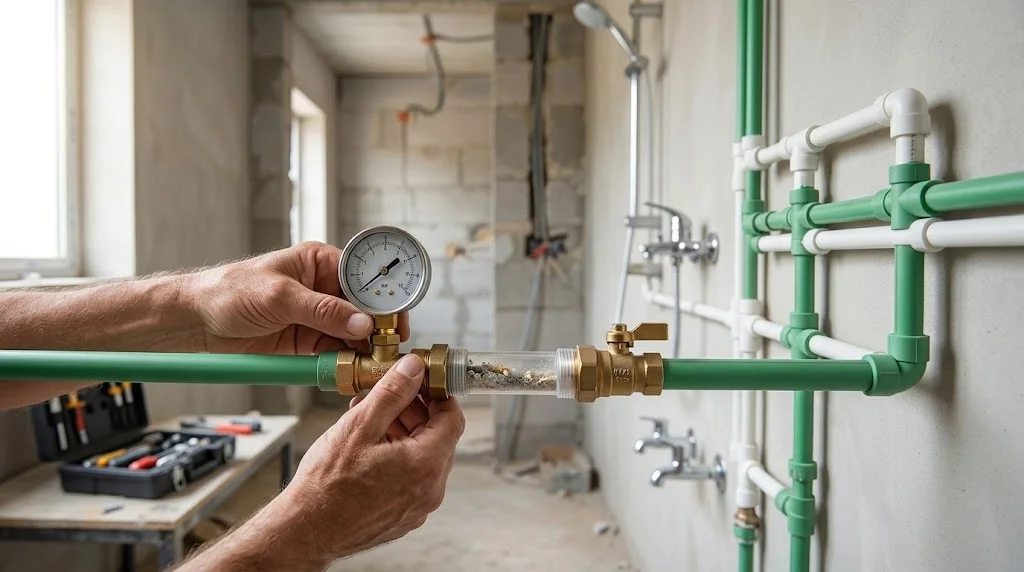
You move into a new house, turn on the shower, and get a weak trickle. The plumbing is brand new, so it should work perfectly. In reality, low water pressure in house plumbing is common in new builds, and the cause is often inside the pipes: wrong size, restrictive fittings, leftover debris, or a joint that narrowed the bore.
This guide explains the pipe-related causes of weak water flow in a new house, then shows a simple step-by-step way to find the problem before you call a plumber or break any walls.
Low Pressure or Low Flow? Start With the Right Question
People use “low pressure” for two different problems.
- Low pressure: The water has little force even when only one tap is open. This points to a supply issue, such as low tank height, a weak pump, or a partly closed main valve.
- Low flow: The tap runs well alone but weakens when a second fixture opens. This usually points to pipe size, long runs, or restrictive fittings.
A quick test tells you which one you have. Open one tap fully and check the flow. Then open a second tap or the shower. If the first tap drops sharply, the pipe system cannot carry enough water for two fixtures at once. That is a flow problem, and it is usually pipe-related.
Weak Water Flow Causes: Pipe-Related Problems in a New Build
1. Undersized pipes
The most common cause is a main line that is too small for the number of fixtures it feeds. A 20 mm line can serve one bathroom but struggle when it feeds three. Use our pipe diameter flow rate formula guide to check whether your pipe can carry the flow you need.
A word of caution: a bigger pipe does not create more pressure. It reduces friction loss, so more water reaches the fixtures. Our article on whether increasing pipe size increases water pressure explains this in detail.
2. Too many fittings, bends, and long runs
Every elbow, tee, and valve adds resistance. A long run with many 90-degree bends loses much more pressure than a short, straight one. Two 45-degree elbows usually lose less flow than one 90-degree elbow. If the route from the tank to the farthest bathroom is long and twisted, expect weaker flow at the end.
3. Reduced bore at the joints
A joint can narrow the pipe from the inside.
- Solvent cement joints: Too much cement can leave a bead or blob inside the pipe.
- Heat fusion joints: Overheating can push melted material into the bore. Our PPRC installation guide covers fusion mistakes in detail.
A few narrowed joints on a long line can add up to a big loss in flow.
4. Construction debris and blocked strainers
New pipework often holds leftovers from the build: cutting swarf, sealant tape, solvent cement drips, sand, or small stones. These collect at valves, strainers, and fixture inlets. If the weak flow started on day one, debris is a prime suspect.
5. Partly closed or restrictive valves
A main valve that is not fully open is a common mistake after commissioning. Some valves also have a smaller inside bore than the pipe, which restricts flow even when fully open. Check every valve between the tank or meter and the problem fixture.
6. Air locks at high points
Air can get trapped at high points in the line, especially after filling a new system. It blocks the flow, causes sputtering at the tap, and can reduce flow noticeably. Opening taps in sequence, from the lowest to the highest, often clears it.
7. One shared line for many fixtures
In a trunk-and-branch layout, one main pipe feeds many fixtures through tees. When several fixtures run together, pressure at the far end drops. A separate line to each bathroom can help. Read how a pipe manifold system spreads the demand.
8. Old pipe connected to a new system
If your new plumbing connects to an old GI service line, rust and scale can restrict the flow before it reaches your new pipes. Replacing the old section may be the real fix. See our guide on how to convert GI pipe to UPVC or PPRC.
Non-Pipe Causes to Rule Out
Before you blame the pipes, rule out these:
- Tank height: In gravity systems, pressure depends on how high the tank sits above the fixture. As a rule of thumb, each metre of height gives roughly 0.1 bar. A tank only a short way above the top-floor shower gives very little pressure.
- Pump or booster: A pump that is undersized or not switching on correctly can cause weak flow.
- Municipal supply: Low supply pressure from the network affects every house on the street.
- Clogged aerators or shower heads: Scale and debris often block the small holes.
- Filters: A clogged filter or strainer restricts the whole system.
Our guide to water tank plumbing pipes and fittings explains how the tank connection affects pressure.
How to Diagnose Low Water Pressure in House Plumbing, Step by Step
- Check the pattern. Is every fixture weak, or only one? A single weak fixture points to a local blockage. All fixtures weak points to the main line or the supply.
- Do the two-tap test. Open one tap, then a second. A big drop means a flow problem in the pipes.
- Check every valve. Make sure the main valve and each branch valve are fully open.
- Clean the end points. Remove and clean the aerators, shower head, and any inline strainers.
- Check the tank and pump. Look at the tank level, the tank height, and the pump operation.
- Flush the line. Open the lowest tap fully for a few minutes to push out debris.
- Clear air. Open taps from the lowest to the highest to release trapped air.
- Measure the pressure. A simple pressure gauge on an outdoor tap or a test point shows the actual pressure. Compare it with what the tank height should give.
- Inspect for leaks. Look for damp patches, a running meter with all taps closed, or sounds in the wall.
- Compare pipe size with demand. If everything above checks out, the pipe may be too small for the load.
This table links common symptoms to likely causes.
| Symptom | Likely pipe-related cause | First check |
|---|---|---|
| Weak flow from day one | Debris or narrowed joints | Flush and clean strainers |
| Drops when a second tap opens | Undersized or shared line | Two-tap test, check pipe size |
| Only the top floor is weak | Air lock or low tank height | Clear air, check tank height |
| Spluttering at taps | Trapped air | Open taps lowest to highest |
| One fixture weak | Blocked aerator or branch valve | Clean the outlet, check the valve |
Example: A Three-Bathroom House in Lahore
Take a new three-bathroom house with an overhead tank. A single 20 mm line leaves the tank and feeds all three bathrooms and the kitchen. The owner finds that the top-floor shower is fine when nothing else is running, but the flow collapses when the kitchen tap and the ground-floor shower open together.
This is a flow problem, not a pressure problem. The tank height is the same in both cases, but one small line is carrying all the demand. The fix is to check the main line size against the demand, and consider a larger main or separate lines for each bathroom. This is an illustrative example, not a design.
How to Prevent Low Water Pressure in a New House
Good planning saves expensive repairs later.
- Size the main line for peak demand, not average use.
- Keep the route short and simple. Avoid unnecessary bends.
- Use quality joints. Follow the correct cement or fusion procedure to avoid narrowing the bore.
- Flush before commissioning. Clear all debris from new pipework.
- Pressure test before closing walls. Check for leaks and restrictions.
- Buy certified pipe. Choose pipe and fittings from a manufacturer registered with PSQCA.
When to Call a Plumber
Call a professional if you have checked valves, outlets, and the tank, and the problem remains. Also call one if you suspect a hidden leak, a blocked section behind a wall, or a main line that needs replacing. A plumber can measure flow and pressure, and recommend the right pipe size.
Conclusion
Low water pressure in house plumbing is rarely a mystery. Start by working out whether you have a pressure problem or a flow problem, then check valves, outlets, the tank, and the pipes in order. In a new build, undersized lines, restrictive fittings, narrowed joints, and leftover debris are the usual pipe-related causes.
Frequently Asked Questions
Q 1. What causes low water pressure in a new house?
The most common pipe-related causes are undersized pipes, too many bends, debris left from construction, partly closed valves, trapped air, and joints that narrow the bore. Tank height and pump problems can also be to blame.
Q2. How do I check if my pipes are too small?
Open one tap, then a second. If the first drops sharply, the line cannot carry the combined flow. Compare the pipe size with the flow your fixtures need.
Q3.Will a bigger pipe increase my water pressure?
Not by itself. A bigger pipe reduces friction loss, so more water reaches your fixtures, but it does not add pressure. Pressure comes from tank height or a pump.
Q4. Can debris cause weak water flow in new plumbing?
Yes. Cutting swarf, sealant, cement drips, and sand can block valves, strainers, and fixture inlets. Flushing the lines and cleaning the outlets often fixes it.
Q5. Does tank height affect water pressure?
Yes. In a gravity system, each metre of height gives roughly 0.1 bar of pressure. A tank placed only slightly above your top-floor fixtures will give weak pressure.