Picture a guesthouse in the Galiyat hills in peak summer. The water tank on the roof is empty, and the owner is paying for a tanker. A few hundred metres below, in the same village, a tap bursts its fitting every few weeks because the water arrives with far too much force.
Same hillside, two opposite problems: too little water at the top, too much pressure at the bottom. This is the quiet challenge of piping in the mountains. Gravity is doing most of the work, and a pipe that behaves perfectly on the plains can fail quickly on a slope. This guide explains how hills change the rules, which pipe material and pressure class suit them, and the design details (valves, tanks, air release, jointing) that decide whether a mountain water line lasts for decades or leaks every winter.Why Hills Change Everything
Water pressure in a closed pipe depends on height. As a rule of thumb, every 10 metres of vertical drop adds roughly 1 bar of pressure. That means a pipe running down a 150 m slope can see around 15 bar at its lowest point once the taps are shut, even though the source is only a small spring. Online design notes for gravity systems make this point clearly: the worst case is the closed condition, when taps and valves are shut and the pipe is full. In that situation the full static head is applied, whatever the flow was a moment before. Design for that case, not for the flowing case. Hills bring other stresses too:- Air. Air collects at high points and can block flow completely.
- Surge. Closing a valve or stopping a pump sends a pressure wave through the line. Our guide to water hammer explains the mechanism.
- Cold. Snow and freezing nights can stop supply or burst pipes. During heavy snowfall in Murree, the Rawalpindi Water and Sanitation Agency has sent staff and tankers to help after supply was disrupted.
- Ground movement. Slopes shift, and this region is seismically active.
- Access. Many routes are footpaths, not roads. Every kilogram of pipe has to be carried.
The Problem on the Ground: Murree and Galiyat
Murree and Galiyat draw much of their water from springs and catchments, and demand rises sharply in the tourist season. Press reports over the years describe summer shortages, dry springs, and old pipelines damaged in several places so that water is lost on the way. A 2012 report linked shortages to power cuts, because part of the supply depends on electric pumping. A January 2026 report described supply suspended for several days in parts of Murree, and a March 2026 report said Murree WASA had increased daily supply after it was set up. The lesson for anyone planning a private or community scheme is practical, not political: water here is scarce, the terrain is hard on pipes, and a leaking or badly designed line wastes the little that is available. A good pipe system is part of water security.Which Pipe for Hilly Areas?
Quick answer: for the main line in hilly terrain, PE100 HDPE pipe with fused joints is generally the strongest choice, because it is flexible, light, corrosion-free and can be rated for high pressure. Use uPVC and PPRC mainly for building plumbing and lower-pressure branches, and pick the pressure class from the highest static head the line will see, not the average.HDPE: the mountain workhorse
HDPE suits slopes for several reasons:- It bends to the terrain. Long pipe can follow contours without a fitting at every turn.
- It is light. Carrying pipe by hand is realistic. A Plastics Pipe Institute project report on a Himalayan pipeline in Himachal Pradesh noted that lightweight HDPE reduced the demand for labour where transport was difficult.
- Fused joints hold. A butt-fused joint is as strong as the pipe, which matters when the ground moves. HDPE is also described as well suited to dynamic soils, including earthquake-prone areas.
- No corrosion, no coating. Steel needs external coating and lining. HDPE does not.
Pressure class: choose by the worst case
The pressure rating (PN) must be higher than the maximum static head plus any surge. As an example, PE100 SDR11 pipe is rated at 16 bar, which equals roughly 160 m of head. A line dropping 120 m has a static head of about 11.8 bar, so a PN16 pipe leaves some margin, but a 180 m drop does not. Two cautions:- Temperature lowers the rating. Polyethylene loses pressure capacity as it warms, and pipe left exposed to strong sun on a slope can get warm. Check the manufacturer’s temperature de-rating before choosing a class for exposed sections.
- Margin for surge. If the line is pumped or has quick-closing valves, include surge in the calculation. Our article on pipe standards (ISO 4427, ISO 1452, ISO 15874) explains what each rating covers.
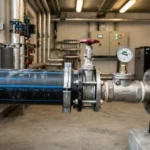
Water Hammer Guide
NewTech Pipes · Pipeline Design
Steep slope or pumped line? See how a closing valve sends a pressure surge through a pipe, and how layout and pipe choice reduce the shock.
Read GuideuPVC and PPRC: where they fit
uPVC is rigid and has a lower pressure tolerance than HDPE, so it is better for building plumbing, drainage and low-head branches. PPRC is excellent for hot and cold water inside buildings. On a mountain scheme, a common pattern is HDPE for the long transmission main and PPRC or uPVC inside the hotel, school or house.Taming the Pressure: Break Pressure Tanks and Valves
What if the drop is higher than any pipe you can use? You break the pressure. A break pressure tank (BPT), also called an interruption chamber in some guides, is a small open tank placed partway down the slope. Water enters with an air gap, drops to atmospheric pressure, and leaves through a new pipe, so the static pressure is reset to zero at that point. Gravity-flow design guides say a BPT is built when the static pressure would otherwise exceed the pipe’s rating. Float valves can control the inlet and prevent wastage when nobody is drawing water. Pressure reducing valves (PRVs) do a similar job inside a closed pipe. They are compact, but they need correct selection, are often imported, and need maintenance. A half-closed gate valve is not a substitute, because it will still pass full static pressure when the flow stops. Rule of thumb: use a BPT where space allows and the scheme is remote, since it has no moving parts to fail except a float valve. Use PRVs for house connections and where a tank is not practical.Air: The Silent Enemy of Hill Pipelines
When a pipeline crosses a ridge, air gets trapped at the crest and can choke the flow, even if there is plenty of head. Design guidance for gravity systems suggests:- Avoid U-shaped profiles wherever the route allows, because they trap air and sediment.
- Fit air valves at high points, so trapped air escapes and the line can fill properly.
- Fit a vacuum breaker or air valve where the pipe could drain and draw in air.
- Use a larger pipe in the critical high section to reduce friction there.
Jointing and Installation on Slopes
Fusion first. Butt fusion or electrofusion gives a leak-free, restrained joint, which is valuable where the ground may move. Carrying a portable HDPE butt-fusion machine to a site is often easier than hauling heavy alternatives. Our butt-fusion guide explains the process. Mechanical joints (compression fittings, flanges) suit tie-ins to valves, tanks and small-diameter branches. Read the comparison in compression vs butt-fusion fittings. Coils or straight lengths? For small diameters, long coils reduce the number of joints and are easier to carry. Larger sizes come in straight lengths. See HDPE coils vs straight lengths. Trench and cover. Bed the pipe on sand or fine soil with no sharp rocks. In cold areas, burying below the local frost depth protects the line. Ask the project engineer for the frost depth at your site. Anchor the pipe. On steep slopes, backfill carefully and add anchors or concrete blocks at bends, valves and tanks as the design requires, so the pipe cannot creep downhill.Smarter Mountain Water: Modern Tools That Help
Technology is useful here, as long as it is simple enough to maintain:- Route and profile survey. Drones and GPS can produce an accurate long section of the route. The elevation profile is the main data a gravity-flow design needs.
- Hydraulic modelling. Free tools such as EPANET can model pressure and flow along a profile, show where static head exceeds the pipe rating, and test different pipe sizes before anyone buys material.
- Pressure and flow loggers. Low-cost loggers can show night-time pressure and flag leaks early. A line that wastes water in a dry hill town is expensive.
- Solar-powered pumping and remote monitoring. Where pumping is required, solar power reduces dependence on grid outages. Keep it modest: add sensors only where someone will read them.
A Practical Checklist Before You Buy Pipe
- Survey the route and record start and end elevations.
- Calculate maximum static head (about 1 bar per 10 m of drop).
- Pick the pipe class with a margin for surge and temperature.
- Decide where to break pressure with BPTs or PRVs.
- Mark high points for air valves and low points for washouts.
- Choose jointing and equipment that can reach the site.
- Plan for cold: burial depth, drain valves, and insulation for exposed pipe.
- Pressure-test and flush before commissioning.
- Keep records: route map, valve locations and test results.
Common Mistakes in Mountain Water Lines
- Choosing pipe by the flowing pressure instead of the closed-valve pressure.
- Skipping air valves at the high points.
- Using a partly closed valve to “reduce pressure”.
- Leaving pipe exposed to sun and frost with no protection.
- Buying uncertified pipe. In the mountains, a failure is hard and expensive to reach. Read how to identify fake or substandard pipes.
- Skipping a pressure test because the road is long.