Every year, thousands of tonnes of substandard pipes enter Pakistan’s construction supply chain — unmarked, uncertified, and priced just low enough to tempt a procurement manager under budget pressure. According to the Pakistan Standards and Quality Control Authority’s 2022 market surveillance report, over 35% of sampled plastic pipe products in the open market failed minimum PS specification requirements for wall thickness, pressure rating, or raw material quality.
The consequence is not just a failed test. Substandard pipes fail in service — under roads, inside walls, below housing society foundations — and when they do, the cost of remediation multiplies the original procurement saving by a factor of ten or more. The contractor faces liability. The developer faces complaints. The end user loses water.
PSQCA certified pipes in Pakistan carry verified conformance to national standards. ISO 9001:2015 certification tells you the manufacturer’s production system is controlled, traceable, and audited. This article explains what each certification means in practice, how to read the markings on a certified pipe, which certifications matter for which project types, and what questions to ask a supplier before you sign a purchase order.
What Does PSQCA Certification Actually Mean for Pipe Products?
| PSQCA certification means the pipe product has been tested by Pakistan Standards and Quality Control Authority and confirmed to meet the relevant Pakistan Standard specification — covering raw material grade, wall thickness tolerances, pressure ratings, and physical properties. The PSQCA mark on a pipe is a government-backed conformance claim, not a self-declaration. |
The Pakistan Standards and Quality Control Authority operates under the Ministry of Science and Technology and administers the PS mark licensing scheme for manufactured products. For plastic pipes, the relevant standards include PS 3580:1994 for uPVC pressure pipes, with equivalent standards for HDPE, PPRC, and MDPE pipe categories.
To earn and maintain PSQCA certification, a manufacturer must submit pipe samples from each product line for independent laboratory testing, pass dimensional and pressure testing to PS specification, allow PSQCA factory inspections, and maintain production records that demonstrate ongoing conformance. The PSQCA mark can be revoked if surveillance testing finds non-conformance — so the mark on a current production batch is meaningful evidence of current compliance.
For buyers in Lahore, Karachi, Islamabad, or Faisalabad procuring pipes for WASA-connected housing societies, municipal water supply networks, or public sector infrastructure, PSQCA certification is not optional — it is a tender specification requirement. WASA Pakistan’s standard supply specifications reference PSQCA marking as a mandatory prerequisite for pipe supply to network projects.
NEWTECH Pipes carries PSQCA certification across its HDPE DuraPE series, uPVC pressure pipes, and PPRC product lines — covering the full range from 20mm domestic fittings to 630mm large-diameter HDPE mains.
What Is ISO 9001:2015 and Why Does It Matter for Pipe Quality?
| ISO 9001:2015 is the international standard for quality management systems. A pipe manufacturer with ISO 9001 certification has been audited by an independent body and confirmed to operate controlled production processes with documented procedures, raw material verification, non-conformance management, and regular management review — ensuring consistent product quality batch to batch. |
The critical distinction between PSQCA and ISO 9001 is what each certifies. PSQCA certifies the product — the pipe itself must meet specification. ISO 9001 certifies the process — the manufacturer’s system for producing pipes consistently must be controlled and auditable. You need both for full assurance.
A manufacturer can pass a PSQCA product test with a specially prepared sample while running a production line that uses recycled or off-spec raw materials in regular batches. ISO 9001 prevents this by requiring documented incoming material inspection, traceability of raw material lots to finished product batches, and regular internal audits of production processes.
For contractors in Rawalpindi, Multan, or Gujranwala working on projects where specification documents require ISO 9001 compliance — which is standard in DHA, Bahria Town, and large commercial development contracts — sourcing from a non-certified manufacturer creates a procurement compliance risk that can result in material rejection during site inspection.
NEWTECH’s ISO 9001:2015 certification is maintained through annual third-party surveillance audits. Every NEWTECH pipe batch carries a production lot code traceable back to the raw material delivery it was manufactured from — a direct output of the ISO 9001 traceability requirement. See NEWTECH’s manufacturing technology page (note: link to /technolgy/) for details of the production quality controls.
PSQCA, ISO 9001, PEC, and International Standards: What Each Covers
| Pakistan’s pipe procurement involves multiple certification layers: PSQCA marks product conformance to national standards, ISO 9001 certifies the manufacturer’s quality system, PEC approval enables supply to PEC-licensed construction projects, and international standards like ISO 4427 and ISO 4437 define technical specifications for HDPE water and gas pipes. Each serves a different function. |
The table below maps each certification to its issuing body, scope, procurement requirement, and the risk of buying from a supplier that lacks it.
| Certification / Standard | Issuing Body | What It Covers | Who Requires It | Risk if Absent |
| PSQCA Mark | Pakistan Standards & Quality Control Authority | Product conformance to Pakistan Standard (PS) specifications — raw material, dimensions, pressure ratings, testing | WASA, NHA, housing authorities, public sector procurement | Rejected at site, tender disqualification, full batch rejection |
| ISO 9001:2015 | Accredited third-party certification body (e.g., SGS, Bureau Veritas) | Quality management system — production process control, traceability, non-conformance procedures, customer satisfaction | Export buyers, ISO-compliant contractors, international project specs | No QMS evidence, process inconsistency risk, limited export market access |
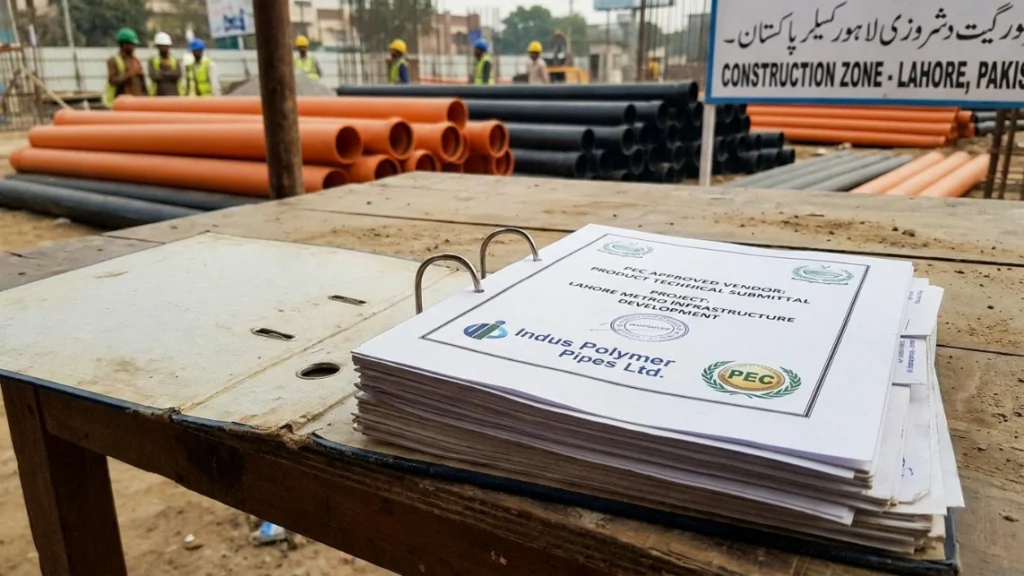
| PEC Approval | Pakistan Engineering Council | Manufacturer registration for engineering product supply to PEC-licensed projects | PEC-registered contractors on infrastructure, housing, government projects | Cannot supply to PEC-compliant projects — major tender exclusion |
| ISO 4427 (HDPE) | International Organization for Standardization | Dimensions, pressure ratings, SDR values, material grades (PE80/PE100) for water supply HDPE pipes | Water utilities, irrigation authorities, industrial procurement | No verified pressure rating guarantee — safety and lifespan risk |
| ISO 4437 (MDPE/gas) | International Organization for Standardization | MDPE pipe specs for gas distribution — pressure class, material, jointing | SNGPL, SSGC, gas utility contractors | Cannot be used on gas networks — regulatory non-compliance |
| ASTM D2513 | ASTM International | Thermoplastic gas pressure piping systems — US/international standard adopted by some Pakistan industrial buyers | Multinational companies, export-oriented industrial projects | Specification mismatch on international-spec projects |
Note: NEWTECH Pipes holds PSQCA certification, ISO 9001:2015 certification, and PEC approval. Products are manufactured to ISO 4427 for HDPE water pipes, ISO 4437 for MDPE gas pipes, and DIN 8075 for uPVC pressure pipes. See the full product catalogue (note: link to /pipe-catalogue-pakistan/) for standard references by product line.
| Expert Insight from NEWTECH
The most costly mistake we see contractors make in Pakistan is buying uncertified pipes because they are PKR 15 to 30 per metre cheaper. On a 5,000-metre housing society water supply network, that saving is PKR 75,000 to 150,000. But when WASA rejects the batch on inspection — and they will, if your pipes lack PSQCA marking — you are relaying the entire network with certified pipe, at full contractor cost, under a delivery deadline. We have seen projects in Lahore and Islamabad lose three to four weeks and hundreds of thousands of rupees this way. Second point: ISO 9001 certification is not a piece of paper a manufacturer buys once and frames on the wall. It requires a surveillance audit every year by an accredited certification body. Ask your supplier for their current certificate with the validity date. If it expired 18 months ago, it is not current certification — it is lapsed certification, which means the QMS has not been independently verified in over two years. |
How to Read Pipe Markings to Verify PSQCA Certified Pipes in Pakistan
| Every PSQCA certified pipe in Pakistan must display specific markings on the pipe body at regular intervals: manufacturer name, product standard reference, nominal diameter, pressure class or SDR value, material grade, and the PSQCA mark number. Pipes without all required markings do not carry valid PSQCA certification, regardless of what the supplier claims. |
Reading pipe markings correctly lets you verify certification at point of delivery — before a single metre is installed. Here is what to look for on each pipe type.
HDPE pipe markings — what a PE100 PSQCA certified pipe shows
A correctly marked HDPE pipe to ISO 4427 and PSQCA standards displays: manufacturer name and location, the material designation PE100 or PE80, the nominal outside diameter in millimetres, the SDR value which determines wall thickness and pressure rating, the standard reference ISO 4427, the production date code, and the PSQCA licence number. An SDR 11 pipe in PE100 carries a maximum allowable operating pressure of 16 bar at 20 degrees Celsius — and that pressure rating is only valid for pipe manufactured to the dimensional tolerances ISO 4427 specifies.
NEWTECH’s HDPE DuraPE series (note: link to /hdpe-pipes/) carries all required markings on every pipe length, with SDR options from SDR 6 to SDR 26 covering pressure classes from 4 bar to 25 bar across diameters from 20mm to 630mm.
uPVC pipe markings — Class B through E
uPVC pressure pipes in Pakistan are classified by working pressure: Class B at 3 bar, Class C at 6 bar, Class D at 9 bar, and Class E at 12 bar. Each class has defined wall thickness requirements under PS 3580:1994. A correctly marked PSQCA-certified uPVC pipe shows the class designation, nominal diameter in inches or millimetres, the PS 3580 reference, manufacturer name, and PSQCA mark. Class C pipe sold as Class E pipe — a common substitution in uncertified supply — has 30 to 40% less wall thickness than specified and will fail under operating pressure.
Which Projects in Pakistan Require PSQCA Certified Pipes — and Which Certifications Matter
| WASA projects, NHA road crossings, public sector housing, PEC-licensed construction contracts, and any project tendered by a government authority require PSQCA certified pipes as a condition of supply. Housing society projects by DHA, Bahria Town, and similar developers typically require ISO 9001 certification from the manufacturer as an additional procurement condition. |
Municipal and utility projects
WASA Lahore, WASA Faisalabad, KWSB Karachi, and municipal water authorities across Pakistan specify PSQCA marking as a mandatory supply condition in their tender documents. This applies to HDPE mains pipes, uPVC distribution pipes, and fittings. Projects in Multan, Bahawalpur, and Islamabad under PHED (Public Health Engineering Department) follow the same requirement. Supplying uncertified pipe to a WASA project is a tender violation — not a quality preference.
Private housing and commercial development
Bahria Town, DHA Islamabad, DHA Lahore, DHA Karachi, Green Gulberg Lahore, and comparable master-planned developments maintain approved supplier lists and procurement specifications that require both PSQCA and ISO 9001 certification. These developers have been burned by substandard pipe failures inside completed buildings — failed PPRC joints, uPVC pipes cracking under thermal cycling — and their specifications now reflect that experience. NEWTECH is an approved supplier for major housing society projects across Pakistan (note: link to /pipe-manufacturers-lahore/) and maintains the certification documentation these projects require.
Gas distribution — MDPE and SNGPL requirements
SNGPL and SSGC gas distribution networks use MDPE pipes to ISO 4437 and ASTM D2513 for underground gas service lines. Gas pipe supply requires not just PSQCA marking but specific material certification confirming PE80 or PE100 grade resin and compliance with gas-rated pipe specifications. The consequences of substandard gas pipe failure are categorically different from water pipe failure. NEWTECH’s MDPE pipe range (note: link to /mdpe-pipes/) is manufactured to ISO 4437 and supplied with material certification for gas utility applications.
What Questions to Ask a Pipe Supplier Before You Buy in Pakistan
| Before purchasing pipes in Pakistan, ask the supplier for their current PSQCA licence number and certificate, their ISO 9001 certificate with current validity date, their PEC registration number, the applicable product standard for the pipe you are buying, and the production lot traceability system. A supplier who cannot produce all five in writing should not be your supplier. |
A purchase order for pipes is not just a transaction — it is a liability document. If the pipes fail and your contract requires certified material, the procurement record is what determines whether the cost of remediation falls on the manufacturer, the supplier, or you. Protecting yourself requires asking the right questions upfront.
- Request the PSQCA licence number and verify it at psqca.com.pk. PSQCA maintains a public registry of licensed manufacturers. If the supplier’s name is not on the registry for the product category, the mark on the pipe is either expired or counterfeit.
- Request the ISO 9001 certificate showing the issuing certification body and validity date. Confirm the certificate covers the product line you are purchasing — a certificate for manufacturing process only, not pipe production, does not give you the assurance you need.
- Request the PEC registration number if your project operates under PEC-licensed contracts. PEC maintains an approved manufacturers and suppliers list (AMSL) that your contractor is responsible for consulting.
- Ask for the product standard reference for the specific pipe size and pressure class you are ordering. A supplier who cannot tell you whether their 110mm uPVC pipe is manufactured to PS 3580:1994 or a generic in-house specification is not a reliable source.
- Ask for a material test certificate showing the resin grade used in production. For HDPE, confirm PE100 or PE80 designation. Pipes manufactured from recycled or off-grade resin will not meet SDR pressure ratings regardless of what the marking says.
- For large orders, request a factory visit or third-party inspection. Reputable manufacturers welcome this. Manufacturers using substandard raw materials do not.
NEWTECH provides all certification documentation with every order — PSQCA licence confirmation, ISO 9001 certificate, PEC approval, and product-specific test reports. Request a full documentation package when you contact NEWTECH’s sales team (note: link to /contact-us/).
PSQCA Certified Pipes vs Uncertified Pipes: The Real Cost Difference in Pakistan
| Certified pipes typically cost 8 to 20% more per metre than uncertified alternatives at equivalent nominal size. But when uncertified pipes cause failures, rework, or tender rejection, the total cost of the uncertified option routinely exceeds the certified option by a factor of 5 to 15 times. Certification is not a premium — it is cost protection. |
The price premium on PSQCA certified pipes reflects real inputs: virgin-grade resin rather than recycled material, controlled wall thickness within tolerance, pressure testing of each production batch, factory inspection overhead, and the administrative cost of maintaining certification. These are not arbitrary charges — they are the cost of the performance guarantee the certification represents.
According to Pakistan Engineering Council data cited in their 2023 construction quality report, plumbing and piping failures account for approximately 18% of post-completion defect claims in residential construction projects in Pakistan. The majority of these failures trace back to substandard pipe material — specifically uPVC pipe with walls below Class specification and PPRC fittings manufactured without controlled fusion zone geometry.
For a developer in Islamabad completing a 200-unit housing society, a plumbing failure in 10% of units creates remediation costs — wall opening, pipe replacement, plastering, painting, and inconvenience settlements — that dwarf the original pipe procurement saving.
How NEWTECH’s Certifications Protect Your Project from Day One
| NEWTECH Pipes holds PSQCA certification, ISO 9001:2015 quality management certification, and PEC approval — covering its full range of HDPE, uPVC, PPRC, and MDPE pipes. Every production batch is traceable to raw material source, and full certification documentation is supplied with every order. This documentation package satisfies tender requirements for WASA, DHA, Bahria Town, and PEC-licensed projects. |
NEWTECH has been manufacturing pipes in Pakistan since 1998 — over 25 years of continuous production under certification frameworks that have been independently audited throughout. The certifications are not recent additions to improve marketability; they are embedded in the production system that has served major projects across Lahore, Karachi, Islamabad, Rawalpindi, Multan, Faisalabad, Sialkot, and Bahawalpur.
Completed project references include Bahria Town water supply networks, Green Gulberg infrastructure, DHA Islamabad and DHA Lahore piping systems, and municipal water projects in multiple cities. In each case, NEWTECH’s certified pipe documentation was supplied as part of the as-built project record.
For contractors and developers sourcing pipes for the first time from NEWTECH, the process is straightforward. Request a quote specifying pipe type, diameter, pressure class, and quantity (note: link to /contact-us/). NEWTECH will provide pricing alongside the full certification documentation package — PSQCA, ISO 9001, PEC, product standard reference, and available test reports. You get the price and the paper trail in the same response.
Certified Pipe Is Not the Expensive Option — It Is the Only Defensible One
Every project that specifies PSQCA certified pipes in Pakistan is doing so because someone, somewhere, learned the hard way what happens when uncertified material enters a water network, a housing society wall, or a gas distribution line. The standard exists because the failures happened.
Four things to take away. First, PSQCA certification confirms the pipe meets Pakistan’s national product standard — dimensions, pressure rating, material grade — and is the minimum requirement for any WASA, municipal, or public sector project. Second, ISO 9001:2015 certification confirms the manufacturer operates controlled production processes that deliver consistent quality batch to batch — not just on the sample sent to the lab. Third, always verify certification directly: check the PSQCA licence on psqca.com.pk, confirm the ISO 9001 certificate validity date, and request full documentation before your purchase order is issued. Fourth, the price premium on certified pipe is real and it is worth every rupee — the cost of pipe failure in a completed project is always higher.
Frequently Asked Questions
1. What does PSQCA certified pipes mean in Pakistan?
Answer: PSQCA certified pipes in Pakistan carry the Pakistan Standards and Quality Control Authority mark, confirming the product has been independently tested and meets the relevant Pakistan Standard specification for dimensions, wall thickness, pressure rating, and material grade. The PSQCA licence number on the pipe is verifiable at psqca.com.pk. Pipes without this mark have not passed Pakistan’s national product conformance requirements.
2. Is ISO 9001 certification important when buying pipes in Pakistan?
Answer: ISO 9001:2015 certification confirms that a Pakistan pipe manufacturer operates a verified quality management system — including raw material inspection, production process control, non-conformance management, and traceability. It complements PSQCA product certification by ensuring consistent batch-to-batch quality. Major project specifications from DHA, Bahria Town, and international buyers typically require ISO 9001 in addition to PSQCA marking.
3. What is PEC approval for pipe suppliers in Pakistan?
Answer: Pakistan Engineering Council approval authorises a pipe manufacturer to supply to PEC-licensed construction projects — which includes most formal infrastructure, housing, and commercial contracts in Pakistan. PEC maintains an Approved Manufacturers and Suppliers List. Contractors working under PEC-licensed agreements are required to source from approved manufacturers. Buying from a non-PEC-approved supplier on such projects creates a contract compliance violation.
4. How do I verify if a pipe supplier in Pakistan is PSQCA certified?
Answer: Verify PSQCA certification by checking the PSQCA online registry at psqca.com.pk for the manufacturer’s licence number and product category. Also check the physical pipe markings — a valid PSQCA pipe must show the manufacturer name, product standard, nominal diameter, pressure class, and PSQCA licence number on the pipe body. Ask the supplier for their current certificate showing the licensed product range and validity dates.
5. Which pipe standard applies to HDPE water supply pipes in Pakistan?
Answer: HDPE water supply pipes in Pakistan are manufactured to ISO 4427, which specifies dimensions, SDR values, material grades (PE80 and PE100), and pressure ratings. The relevant Pakistan Standard under PSQCA for HDPE pipes references ISO 4427 requirements. An SDR 11 pipe in PE100 material carries a 16 bar maximum allowable operating pressure at 20 degrees Celsius under this standard. Always confirm the SDR value matches your system operating pressure before ordering.
6. Why are PSQCA certified pipes more expensive than uncertified pipes in Pakistan?
Answer: PSQCA certified pipes cost more because they are manufactured from virgin-grade resin, maintain controlled wall thickness within specification tolerances, undergo batch pressure testing, and carry factory inspection overhead. The premium is typically 8 to 20% over uncertified alternatives. Uncertified pipes manufactured from recycled or off-grade resin save that margin upfront but create failure risk that, when it materialises, costs 5 to 15 times the original saving in remediation.