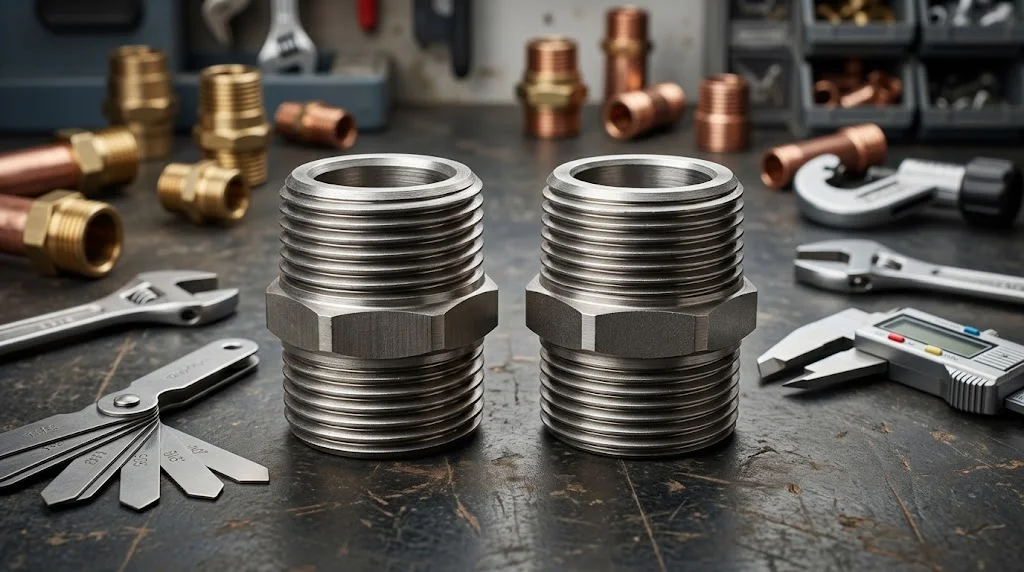
You pick up a threaded fitting that looks like it matches. It screws in, you wrap some tape around it, and a week later it drips. In most cases the cause is a thread mismatch. The BSP vs NPT thread question trips up plumbers, contractors, and buyers every day, because the two threads look almost the same but are not compatible.
This guide explains how the two standards differ, which one you will meet in Pakistan, how to identify them, and what to do when you have to connect one to the other. If you want more practical plumbing guides, browse the Newtech Pipes blog.
What Is the Difference Between BSP and NPT Threads?
BSP stands for British Standard Pipe. NPT stands for National Pipe Taper, an American standard. Both are used to join pipes and fittings, but they are built differently.
| Feature | BSP | NPT |
|---|---|---|
| Origin | British standard, widely used outside North America | American standard |
| Thread angle | 55° | 60° |
| Thread shape | Rounded crests and roots | Flat crests and roots |
| Types | Parallel (BSPP) and tapered (BSPT) | Tapered only |
| Common markings | G, R, Rp | NPT |
The thread angle is the key difference. A 55° thread and a 60° thread cannot seat against each other properly, even when the sizes look the same.
BSPP, BSPT and NPT: The Three Threads You Will Meet
BSPP (parallel): The thread keeps the same diameter along its length. It does not seal on the threads. Instead, it seals with a washer, bonded seal, or O-ring at the face of the fitting.
BSPT (tapered): The thread narrows along its length, and the seal forms as the threads tighten against each other. PTFE tape or sealant helps fill small gaps.
NPT (tapered): Works the same way as BSPT, but with a 60° angle and flat thread peaks. It also relies on tape or sealant to seal.
The takeaway is simple. Parallel threads seal at a washer. Tapered threads seal by wedging together. Knowing which you have decides how you seal it.
Pipe Thread Standard in Pakistan: BSP or NPT?
In everyday plumbing in Pakistan, BSP is the thread most plumbers meet. It appears on fittings, valves, and tank connectors. NPT mostly appears on imported equipment, such as some pumps, pressure gauges, and filters made for the American market.
So a single job can contain both. A locally bought valve may be BSP, while an imported pump may be NPT. Never assume the pipe thread standard Pakistan suppliers use will match the equipment in your hand. Check the label or the datasheet first. Our guide on how to read a pipe datasheet shows where thread information usually appears.
Thread Sizes: Why “Close” Is Not Compatible
Nominal sizes like 1/2 inch and 3/4 inch exist in both standards. For some sizes, even the number of threads per inch is the same. That is why the mismatch is easy to miss. This table shows a few common sizes.
| Nominal size | BSP threads per inch | NPT threads per inch |
|---|---|---|
| 1/4 in | 19 | 18 |
| 1/2 in | 14 | 14 |
| 3/4 in | 14 | 14 |
| 1 in | 11 | 11.5 |
At 1/2 inch and 3/4 inch, the pitch matches, but the angle and thread form do not. At 1/4 inch and 1 inch, even the pitch differs. In both cases the threads can start to turn together and feel fine for a turn or two, then bind or leak.
Can You Mix BSP and NPT Threads?
No. BSP and NPT are not directly interchangeable. When you force them together, the thread flanks do not make proper contact, so the joint relies on tape and tightening instead of a correct seal.
The usual results are:
- A slow leak that appears days or weeks later
- Damaged or stripped threads
- A cracked female fitting, especially in plastic
If you must connect the two, use a proper adapter with the right thread on each end. Do not force a fit and add more tape.
How to Identify BSP and NPT Threads
Follow these steps on site:
- Read the markings. Look for G, R, Rp, BSP, or NPT on the fitting or on the equipment’s datasheet.
- Use a thread pitch gauge. It measures threads per inch and helps you match the pitch.
- Measure the outside diameter. Use calipers on male threads and compare with a thread chart.
- Check whether the thread is tapered. If the thread narrows toward the end, it is BSPT or NPT.
- Test by hand. A correct thread turns smoothly for several turns by hand. If it binds early, stop and re-check.
- Ask the supplier. For imported equipment, confirm the thread type before you order the fitting.
Threaded Fittings on Plastic Pipe: Avoiding Cracks
Plastic threads are less forgiving than metal. A few habits prevent cracked fittings:
- Do not over-tighten. Hand-tight plus a small extra turn is usually enough. Follow the fitting maker’s guidance.
- Use PTFE tape sparingly. A few wraps in the direction of tightening is enough.
- Be careful with tapered male threads in plastic female fittings. The taper acts like a wedge and can split the fitting.
- Support the pipe. Do not let the weight of valves or equipment hang on the thread.
For choosing between joint types on small lines, read our guide to compression fittings vs threaded fittings. For tank connections, see water tank plumbing pipes and fittings. You can also browse our UPVC pipe and fittings and PPRC pipes and fittings.
NewTech UPVC Fittings
NewTech Pipes · UPVC Piping Systems
Joining plastic pipe? See how NewTech UPVC fittings, which join by push-fit or solvent cement, compare with threaded metal fittings.
Common Thread Mistakes
- Assuming two threads match because they are the same nominal size
- Forcing an NPT fitting into a BSP port
- Using PTFE tape to fill a gap caused by a wrong thread
- Over-tightening threaded plastic fittings
- Using tape on a BSPP joint that should seal with a washer
- Not checking imported equipment before ordering fittings
Conclusion
The BSP vs NPT thread difference comes down to angle, thread form, and sealing method. BSP is common in Pakistani plumbing, NPT often arrives on imported equipment, and the two should never be forced together. Identify the thread first, use the right adapter when you must mix them, and avoid over-tightening plastic fittings.
Need help matching fittings to your pipe system? Contact Newtech Pipes and our team can advise on the right fittings for your project.