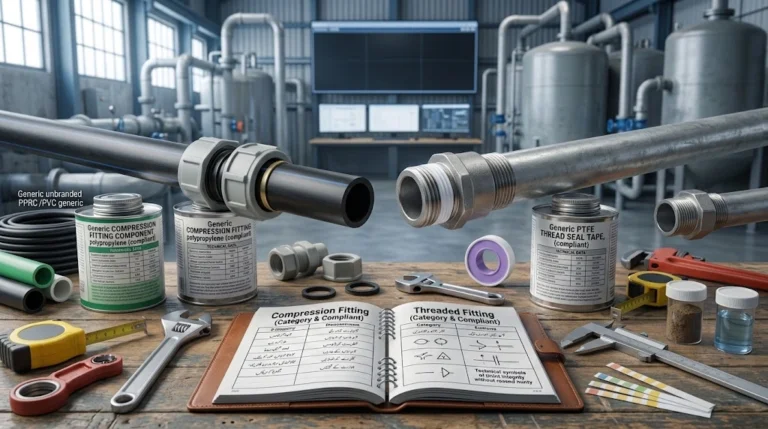
Small-diameter pipe runs — such as irrigation laterals, small water supply branches, and repair sections — often require choosing between two common jointing methods: compression fittings and threaded fittings. Both are designed to move water from one point to another, but they perform differently when exposed to pressure, vibration, and repeated use. Choosing between compression fittings vs threaded fittings is not simply about using whatever is available at the local hardware shop; selecting the wrong fitting for the application is a common reason small pipe joints begin to leak within the first year.
This guide breaks down how each type actually works, where each one holds up best, and how to choose correctly for small-diameter PE, PPRC, or metal pipe runs on a Pakistani plumbing or irrigation project.

Neither type is universally “better” — the right choice depends heavily on pipe material, application, and how often the joint may need to be accessed again.
How Compression Fittings Work
Compression Fittings join pipes without requiring threading, welding, or solvent cement. The pipe end is inserted into the fitting body, after which a nut is tightened to compress a ring, commonly known as an olive or ferrule, against the pipe’s outer surface to create a watertight seal. Since the seal is created through mechanical compression rather than adhesive or threaded connections, compression fittings can generally be tightened, loosened, and reused several times without compromising the joint. This makes them particularly useful for repair work or sections that may require future access. PP (polypropylene) compression fittings are widely used for small-diameter PE pipe in irrigation and general water supply lines because they require no special tools beyond a basic spanner, install quickly, and accommodate minor pipe misalignment better than a rigid threaded connection.How Threaded Fittings Work
Threaded fittings rely on matching male and female threads that are screwed together, typically with a thread sealant or PTFE tape applied to prevent leaks at the thread interface. The seal depends on the mechanical fit of the threads plus the sealant filling any microscopic gaps — which is why proper thread sealant application matters as much as the fitting itself. Threaded fittings are the traditional choice for galvanized iron (GI) pipe and are also common on UPVC and metal transition points, where a permanent solvent weld isn’t practical or where the joint may need to be disassembled for maintenance.
HDPE Pipes & Fittings
NewTech Pipes · HDPE Piping Systems
Planning to join PE pipe with compression fittings? Check PN ratings and SDR on PE-100, ISO 4427 pipes before you match your fittings.
View ProductCompression vs Threaded Fittings: Side-by-Side Comparison
| Factor | Compression Fittings | Threaded Fittings |
| Tools needed | Basic spanner/wrench, no special tools | Pipe wrench, thread sealant or tape |
| Installation speed | Fast, minimal prep | Slower, needs thread cutting/sealing |
| Reusability | Can often be disassembled and reused | Threads wear with repeated use |
| Best for | Small-diameter PE pipe, irrigation, quick repairs | Metal pipe, higher mechanical stress joints |
| Vibration resistance | Good, seal doesn’t rely on friction alone | Can loosen over time without thread sealant |
Which Is Better for Irrigation and Agricultural Lines
For small-diameter PE irrigation laterals, compression fittings are generally the more practical choice. Farmers and irrigation contractors frequently need to extend, repair, or reconfigure field lines season to season, and a compression joint can be opened and reassembled without needing new pipe ends cut or re-threaded. The tool-free (or basic-tool) installation also matters in field conditions where a full plumbing toolkit isn’t always on hand.Which Is Better for Indoor Plumbing and Potable Water Lines
For indoor plumbing on housing society or plaza projects, the choice depends more on the pipe material already in use. UPVC and PPRC systems typically rely on solvent-welded or heat-fused joints for the main runs, with threaded fittings reserved for transition points — such as where pipe meets a metal valve, tap, or fixture. Compression fittings are more commonly seen where a small-diameter PE branch line needs to connect into an existing system without disturbing the main pipe run, or for point-of-use connections like a water filter or geyser inlet.Installation Considerations and Common Mistakes
- Over-tightening a compression nut can deform the ferrule and actually cause a leak rather than prevent one — tighten to the manufacturer’s specified torque or “snug plus a controlled turn,” not as tight as physically possible.
- Skipping thread sealant on a threaded joint, or applying it unevenly, is one of the most common causes of slow leaks at threaded connections.
- Reusing a compression ferrule that’s already been compressed once on a different pipe can produce an incomplete seal — use a fresh ferrule for a new joint where possible.
- Mixing metric and imperial thread sizes on a threaded joint is a frequent, avoidable mistake when combining locally sourced and imported fittings — always confirm thread standard compatibility before assembly.