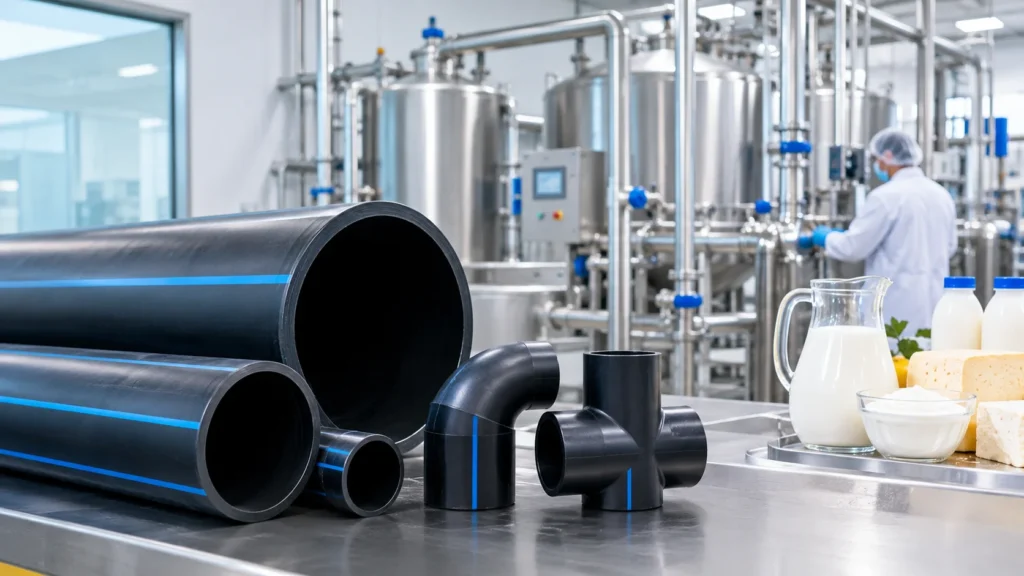
Buyers often search for “HDPE pipe food grade” and expect a simple yes or no. The honest answer is more useful. HDPE is a clean, smooth, corrosion-free material, and it suits many water and utility duties inside dairy and food plants. But “food grade” is not a label that automatically applies to every HDPE pipe, and it does not mean the pipe can carry milk.
This guide explains what food grade really means, where HDPE fits in a dairy or food plant, and which documents and limits to check before you specify it.
What Does “Food Grade” Mean for HDPE Pipe?
“Food grade” describes whether a material is approved for contact with food. Three things are easy to mix up:
- The raw material (resin): The polyethylene compound may be made from virgin material and be suitable for food contact.
- The finished pipe: Pipe made from that resin must still be produced and tested to show it is safe for its intended use.
- The whole system: Fittings, joints, and cleaning methods also affect hygiene.
Food contact approval is specific to the product and the application. A pipe made for drinking water is not automatically approved for direct contact with milk or other food products. Always ask the manufacturer for documents that match your exact use.
For reference, Newtech makes its HDPE pipes from PE100 material to ISO 4427, a standard for HDPE water supply pipe. Confirm any food-contact documentation with the team for your project.
Why HDPE Suits Many Food Plant Duties
HDPE has several features that help in food and dairy sites:
- Smooth inner surface: Water flows easily and there is less place for deposits to build up.
- No rust: The pipe does not corrode, so there are no rust particles in the water.
- Fused joints: Butt-fused joints form a continuous, leak-resistant line.
- Flexibility: The pipe handles ground movement and is easy to route around equipment.
- Chemical resistance: HDPE tolerates many common chemicals at normal temperatures.
Where HDPE Is Used in Dairy and Food Processing Plants
HDPE is strongest on utility and water lines. It is less suited to product lines and hot cleaning. This table gives a general guide.
| Duty | HDPE fit | What to check |
|---|---|---|
| Potable process water supply | Good | Drinking water approval and documents |
| Cooling and chilled water | Good | Operating temperature and pressure |
| Wastewater and effluent | Good | Chemical load and pipe class |
| Farm-side water supply to dairy sheds | Good | Pressure rating and joint method |
| Milk and product lines | Usually not | Sanitary design and food-contact approval |
| Hot cleaning and pasteurisation lines | Generally not | Temperature limits |
For milk and other product lines, plants usually rely on stainless steel sanitary piping, which is built for frequent hot cleaning and inspection.
Dairy Industry Pipe Hygiene Standards: What to Ask For
Dairy plants follow hygienic design rules, such as 3-A Sanitary Standards and EHEDG guidelines, for equipment and product-contact lines. These rules focus on smooth, crevice-free surfaces that can be cleaned in place.
Before you specify HDPE for any hygiene-sensitive duty, ask the supplier for these:
- Material certificate for the resin used
- Confirmation of the standard the pipe is made to (for example ISO 4427)
- Drinking water or food-contact approval, if your use needs it
- Batch traceability and test records
- Temperature and pressure limits for your service
- Proof of PSQCA registration and ISO 9001:2015 certification
Our guide on how to read a pipe datasheet shows what each line on a datasheet means. You can also see how we test pipe on our quality control page.
Temperature and Cleaning Chemicals
Temperature is where HDPE most often reaches its limit. Pressure ratings drop as temperature rises, and hot cleaning cycles can push a line past what HDPE is designed for. Check the working temperature of every line, not just the average.
Cleaning chemicals need the same care. Many are tolerated at normal strength and temperature, but you should confirm compatibility with the pipe manufacturer before using strong or hot cleaning solutions.
Joining and Installing HDPE for Hygiene
How the pipe is joined and handled matters as much as the material.
- Use fusion jointing. Butt fusion creates a continuous joint. Good fusion needs clean pipe ends, correct alignment, and the right heat and pressure. See our HDPE butt-fusion welding machines.
- Think about the internal bead. Butt fusion leaves a small ridge inside the pipe. On hygiene-sensitive lines, ask whether the bead is acceptable or needs to be managed.
- Keep pipe ends capped. Dirt and debris inside a stored pipe become contamination later.
- Flush before use. Clean and flush new lines, and disinfect them where your plant procedure requires it.
For wider pipe selection, see our HDPE pipes and fittings.

NewTech HDPE Pipes & Fittings
NewTech Pipes · HDPE Piping Systems
See NewTech HDPE pipes made from PE100 to ISO 4427 for water, cooling and effluent lines, and confirm food-contact documents with the team for your project.
Common Mistakes to Avoid
- Assuming every HDPE pipe is approved for food contact
- Using HDPE on hot cleaning or pasteurisation lines
- Skipping the material and compliance documents
- Leaving pipe ends open during storage
- Not flushing new pipework before commissioning
- Ignoring temperature when choosing the pressure class
Conclusion
HDPE pipe food grade is not a single yes or no. HDPE works well for water, cooling, and effluent lines in dairy and food plants, but milk lines and hot cleaning usually call for other materials. Match the pipe to the duty, ask for the right documents, and check temperature limits before you specify.
Planning a dairy or food plant project? Contact Newtech Pipes to confirm which HDPE pipes and documents suit your application.