A pipe that fails just two years into a project is often not the result of poor installation — in many cases, the real problem is that the pipe was never made from the material it was claimed to be. Fake pipes in Pakistan are not always obvious copies; they can have thinner walls than the stated size, recycled or mixed-grade material sold as virgin compound, or fittings marked with pressure ratings that were never properly tested. Learning how to identify fake pipes before they are installed underground — rather than after leaks begin — can make the difference between a system designed to last twenty years and one that requires costly re-excavation within five. This guide explains the physical checks, markings, and documentation you can verify on-site without using laboratory equipment.
Why Counterfeit and Substandard Pipes Are a Real Risk in Pakistan’s Market
Pakistan’s plastic pipe market has grown quickly, and that growth has attracted smaller, unregistered manufacturers alongside established, certified ones. Because raw HDPE, PVC, and PPRC compound is imported and priced in dollars, the temptation to cut cost by blending in recycled or off-grade resin is highest when margins are thin. The problem isn’t limited to unbranded pipe sold loose in hardware markets — it also shows up as counterfeit packaging on entirely legitimate-sounding brand names, or as genuine pipe mislabeled with a pressure class it doesn’t actually meet. Because a finished pipe looks structurally similar regardless of resin quality, the difference only becomes obvious under pressure, heat, or after a few years underground — by which point replacing it means breaking open finished work.
Five Physical Checks You Can Do On-Site
None of these require a lab. A few minutes of inspection before a delivery is accepted catches most substandard pipe:
Check | What Genuine Pipe Looks Like | Red Flag |
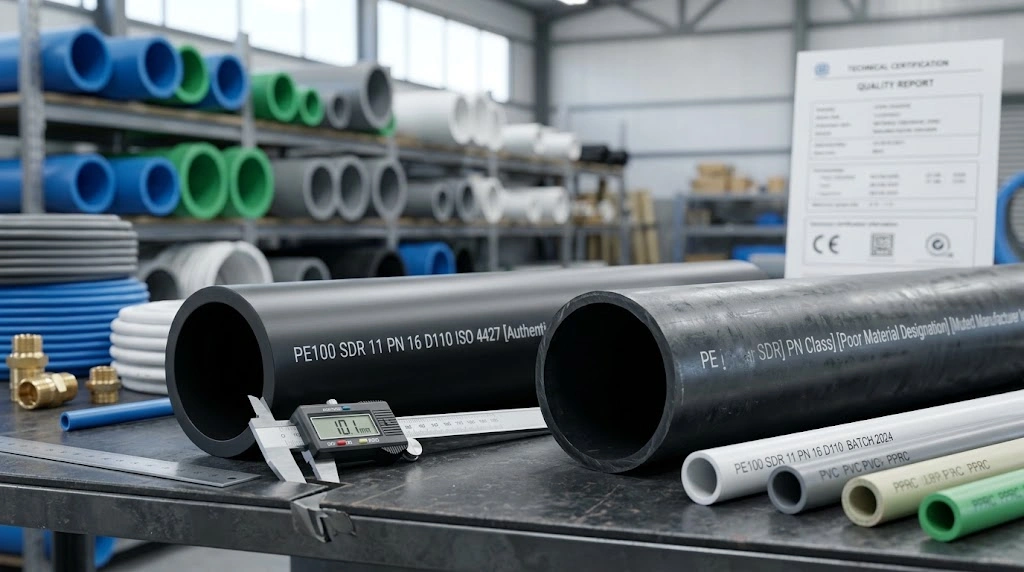
Wall thickness at a cut end | Consistent thickness matching the stated SDR/PN class, measured with calipers or a ruler | Visibly thinner at one point, or noticeably below the size chart for that diameter |
Color and surface finish | Uniform color throughout the wall, smooth inner and outer surface | Streaking, visible black specks, or a dull/chalky surface suggesting recycled content |
Flexibility and brittleness | HDPE bends without cracking at room temperature; PVC/UPVC has a clean, consistent snap when deliberately over-stressed in a scrap offcut | Cracks or splinters when mildly flexed; unusually brittle for its stated grade |
Weight for length and diameter | Matches the manufacturer’s published weight-per-meter specification | Noticeably lighter than spec for the same diameter and SDR — often means thinner walls or filler-heavy compound |
Printed markings | Continuous, legible extrusion print with size, SDR/PN class, standard reference, and manufacturer name | Faded, inconsistent, or missing print; markings that don’t match the pipe’s actual measured size |
Reading the Markings: What a Genuine Pipe Should Print on Its Body
Every properly manufactured HDPE, PVC, or PPRC pipe carries a continuous extrusion print along its length. At minimum, this should include the nominal diameter and wall thickness (or SDR/PN class), the material designation (PE80, PE100, PVC-U, PPRC), a reference to the standard it’s manufactured against, the manufacturer’s name or trademark, and — for HDPE gas or water pipe specifically — a colored identification stripe (typically yellow for gas, blue for water). If this print is missing, smudged beyond reading, or inconsistent with the pipe’s actual measured dimensions, treat it as a red flag rather than a cosmetic issue. Genuine manufacturers print this information because it’s tied to batch traceability; sellers cutting corners often skip it entirely or apply it inconsistently across a single delivery.
NewTech Pipe Catalogue
NewTech Pipes · Piping Systems Catalogue
Checking size, SDR and PN class starts with a reliable reference. Browse the NewTech range of HDPE, PVC, PPRC and MDPE pipes.
View CatalogueVerifying PSQCA and ISO Certification Claims
A PSQCA mark or ISO 9001:2015 certificate printed on packaging is only useful if it’s genuine and current. For higher-value orders, ask the supplier for a copy of their PSQCA product certification and confirm the certificate number is valid — PSQCA maintains records of certified manufacturers that can be cross-checked. Also ask for the batch-specific test report (hydrostatic pressure test, wall thickness, and material composition) rather than accepting a generic company-level certificate as proof for a specific delivery. A manufacturer confident in its material will provide this documentation without resistance; reluctance to share batch-level test data on a bulk order is itself a warning sign worth taking seriously.
Common Tricks Substandard Sellers Use
- Selling PE80 (MDPE-grade) material stamped or sold as PE100, which looks identical but has a significantly lower pressure rating
- Reducing wall thickness slightly below the stated SDR while keeping the outer diameter correct, so the pipe still fits standard fittings but has less pressure margin
- Blending recycled or reprocessed resin into virgin compound, which reduces long-term UV and stress-crack resistance even when short-term pressure tests pass
- Reprinting or reusing coils/packaging from a known brand on unrelated, unverified pipe
- Quoting a price significantly below the going market rate for a given size and class — a discount alone isn’t proof of substandard product, but it’s a reason to inspect more carefully rather than less
HDPE vs PVC/UPVC: Where the Checks Differ
The core checks above apply to both materials, but a few points are specific to each:
For HDPE Pipes
- Check for a consistent black color with even carbon black dispersion — visible streaking often indicates poor compounding
- Genuine PE100 should not crack when cold-bent to a moderate radius; brittleness at room temperature suggests a lower-grade or degraded compound
- For butt-fusion joints, ask installers to confirm a proper fusion bead forms during welding — a resin blended with too much regrind often produces a weak, uneven weld bead
For PVC and UPVC Pipes
- Check that the pipe doesn’t have a strong chemical odor, which can indicate excessive or substandard plasticizer/additive use
- Confirm the socket end (where present) has a consistent wall thickness matching the barrel — thin sockets are a common shortcut
- Verify the pipe class marking (e.g., Class B, C, or D) matches the wall thickness expected for that class, since UPVC pressure classes are wall-thickness dependent
What to Do If You Suspect You’ve Already Bought Fake Pipe
If pipe is already delivered but not yet installed, isolate the suspect batch and avoid mixing it with verified stock. Request the supplier’s batch test certificate for that specific delivery, and if one isn’t available or doesn’t match, consider an independent lab test — PCSIR and several private material-testing labs in Lahore and Karachi can test wall thickness, MFI (melt flow index), and pressure rating on a sample length. If the pipe is already installed and you’re seeing early signs of failure (weeping joints, discoloration, or brittleness at cut edges), document the installation date, batch markings if visible, and any test results before raising the issue with the supplier — this record matters both for warranty claims and, in commercial projects, for liability discussions with the contractor or developer.
Choosing a Supplier You Don’t Need to Second-Guess
The checks above are useful, but the more reliable long-term solution is sourcing from manufacturers who make batch traceability and certification available by default rather than on request. Ask a prospective supplier three direct questions before placing a bulk order: do they provide a batch-specific test certificate with every delivery, is their PSQCA certification current and verifiable, and do they operate an in-house testing lab or rely entirely on third-party spot checks after the fact. A supplier that answers all three without hesitation is generally a safer long-term source than one offering the lowest price with the least documentation.
Conclusion
Spotting fake or substandard pipe comes down to checking a handful of physical details — wall thickness, markings, weight, and flexibility — and being willing to ask for batch-level documentation rather than accepting a certificate at face value. These checks take a few minutes and cost nothing, but they can prevent a failure that’s expensive and disruptive to fix once pipe is buried or built into finished work. Newtech Pipes, an ISO 9001:2015-certified and PSQCA-registered manufacturer, provides batch-traceable test certificates with its HDPE, PVC, PPRC, and MDPE deliveries as standard practice, precisely so buyers don’t have to rely on trust alone.
Frequently Asked Questions
Ask for the batch test certificate showing the Minimum Required Strength (MRS) classification, since PE100 and PE80 look identical to the eye. A genuine PE100 pipe will also resist cold-bending without cracking, while lower-grade or recycled-blend material tends to show brittleness at the same bend radius.
Not necessarily — price alone isn’t proof of substandard pipe, since legitimate manufacturers can offer competitive pricing. However, a price significantly below the going market rate for a given size and class is a reason to inspect more carefully, not less. Ask for batch-specific test certificates and verify PSQCA/ISO documentation before accepting an unusually low quote.
Yes. Recycled or off-grade compound can often hold pressure during a brief test but fails prematurely under long-term stress, UV exposure, or temperature cycling — this is why long-term material certification matters more than a single short pressure test.
Request the PSQCA certification number, the manufacturer’s ISO 9001:2015 certificate, and a batch-specific test report covering wall thickness, hydrostatic pressure, and material composition for that particular delivery — not just a general company brochure.
PCSIR laboratories and several accredited private material-testing labs in major cities can test a pipe sample for wall thickness, melt flow index, and pressure rating. This is worth the cost on any large or safety-critical order where documentation from the supplier is unclear.