Pakistan’s urban drainage infrastructure deficit is real and measurable — WASA Lahore alone replaces or rehabilitates over 400 km of sewer lines annually, and the figure for Karachi’s drainage backlog runs into thousands of kilometres (WASA Lahore Infrastructure Report, 2023). If you’re specifying, procuring, or installing sewerage and drainage pipes in Pakistan right now, you’re doing it in a market flooded with options, some of them seriously substandard.
The core decision most contractors and developers face is straightforward: uPVC or HDPE? But the wrong answer — even by one material category — means failed pressure tests, cracked joints, WASA rejections, or a sewer line that settles and blocks within three monsoon seasons.
This guide breaks down uPVC drainage pipe sizes, HDPE sewer pipe specifications, installation requirements, and where each material wins on a Pakistani jobsite. By the end, you’ll know exactly which pipe to specify for your housing society, factory drainage network, or municipal contract — and why.
What Are Sewerage & Drainage Pipes in Pakistan Made Of Today?
Pakistani sewerage and drainage systems predominantly use uPVC (unplasticised PVC) for gravity sewer lines and HDPE for pressure sewer mains, force mains, and flexible routing. Both have replaced asbestos-cement and RCC pipes across major cities over the last two decades due to superior corrosion resistance, lower weight, and 50-year service life potential.
Until the early 2000s, reinforced concrete pipes (RCC) dominated underground drainage in Pakistan. They crack under differential settlement, corrode from hydrogen sulphide gas in sewage, and require heavy lifting equipment. The shift to plastic — specifically uPVC and HDPE — came first in housing schemes (Bahria Town Lahore pioneered large-scale uPVC sewer networks), then spread to WASA contracts in Karachi, Islamabad, Multan, and Faisalabad.
Today, PS 3580:1994 (Pakistan Standard for uPVC sewer pipes) and ISO 4427 (HDPE pipes for water and sewer) are the two reference standards WASA contract officers most frequently cite during pipe approval. PEC (Pakistan Engineering Council) approved suppliers are mandatory on government drainage contracts above a specified project value.
Why Plastic Won Over Concrete on Pakistani Projects
- Corrosion resistance: Sewage produces H₂S gas, which destroys concrete from inside. uPVC and HDPE are chemically inert to sulphuric acid concentrations found in typical municipal sewer lines.
- Hydraulic efficiency: The smooth internal bore of uPVC (Manning’s n = 0.009) vs. concrete (n = 0.013) means you can achieve the same flow with a smaller diameter — saving excavation cost.
- Speed of installation: A 6-metre uPVC pipe section weighs 12–18 kg vs. 250–400 kg for equivalent RCC — a crew of three can lay 100+ metres per day without crane support.
- Lifespan: ISO 9080 pressure testing projects 50-year minimum service life for both uPVC and HDPE at standard sewer temperatures (up to 45°C continuous).
NEWTECH’s uPVC drainage range (link: /pvc-construction/) covers Class B through Class E, from ½” to 24″ — matched directly to Pakistan’s municipal drainage specifications.
uPVC Drainage Pipe Sizes: What You Need for Each Application
uPVC drainage pipes in Pakistan are available from DN 75mm to DN 630mm. For household laterals, 110mm (4″) is the standard. Branch sewer lines use 160mm to 250mm. Main collector sewers run 315mm to 500mm. All comply with PS 3580:1994 for wall thickness (SN4 or SN8 ring stiffness classes) and joint dimensions.
Selecting the wrong uPVC drainage pipe size is one of the most common and costly mistakes on residential and commercial projects in Pakistan. Developers in Gujranwala and Sialkot frequently spec 110mm for everything — including 20-unit apartment blocks — and end up with choked lines within two years.
uPVC Sewer Pipe Size Reference Table
| Application | Recommended Diameter | Ring Stiffness Class | Typical Depth | Standard |
|---|---|---|---|---|
| Household lateral (1–5 units) | DN 110mm (4″) | SN4 | 0.6–1.5m | PS 3580 |
| Small branch line (6–20 units) | DN 160mm (6″) | SN4 | 1.0–2.0m | PS 3580 |
| Medium branch (20–80 units) | DN 200–250mm (8″–10″) | SN4/SN8 | 1.5–3.0m | PS 3580 |
| Collector sewer (80–300 units) | DN 315–400mm (12″–16″) | SN8 | 2.0–4.0m | PS 3580 |
| Main trunk sewer | DN 450–630mm (18″–24″) | SN8 | 3.0–6.0m | ISO 4435 |
| Industrial floor drain | DN 110–160mm | SN4 | 0.3–1.0m | ASTM D2680 |
SN8 (ring stiffness 8 kN/m²) is required for any pipe laid below 3 metres depth or under roads, as specified in WASA Lahore and WASA Karachi standard drawings. Using SN4 at those depths leads to pipe ovality under soil load — the joint gaps and you have infiltration.
NEWTECH’s uPVC range is manufactured at their Lahore facility and is available in both SN4 and SN8 classes. Full dimensional specs are in their pipe catalogue (link: /pipe-catalogue-pakistan/).
HDPE Sewer Pipe Pakistan: When to Choose It Over uPVC
HDPE sewer pipe is the correct choice in Pakistan when your drainage project involves: pressurised flow (pump-fed force mains), flexible routing around obstacles, high-vibration environments near roads or railways, trenchless installation (pipe bursting, horizontal directional drilling), or aggressive industrial effluent. HDPE’s PE100 grade handles up to 25 bar pressure and full vacuum.
Most gravity sewer systems don’t need HDPE’s pressure rating — but Pakistan’s fast-growing cities generate specific scenarios where uPVC simply won’t perform.
Four Situations Where HDPE Sewer Pipe Wins in Pakistan
1. Pump Station Force Mains Every low-lying neighbourhood — parts of Defence Karachi, areas of Gulberg Lahore, or Faisalabad’s industrial zones — needs sewage lifted by pump and pushed through a pressurised force main before gravity takes over. These lines run at 4–10 bar. uPVC can handle some pressure, but HDPE PE100 SDR 11 (PN16 rating) is the engineered choice, with butt-fusion joints that are stronger than the pipe wall itself.
2. Trenchless Crossing Under Roads and Railways HDD (Horizontal Directional Drilling) contractors in Islamabad, Rawalpindi, and Lahore are increasingly used to cross roads without open-cut trenches. The pipe must flex as it’s pulled through the bore. HDPE’s elongation-at-break (>350% per ISO 6259) handles this — uPVC would crack.
3. Industrial Effluent Lines Textile mills in Faisalabad, tanneries in Kasur, and pharmaceutical plants in Lahore generate effluent with pH ranging from 2 to 12. HDPE’s chemical resistance table (per ISO 10358) includes resistance to concentrated acids, alkalis, and most industrial solvents that would degrade PVC compounds over time.
4. Seismically Active Zones Peshawar, Rawalpindi, and Azad Kashmir fall in Pakistan’s seismic zones 2B–4. HDPE’s flexibility absorbs differential ground movement that cracks rigid pipe joints. This is a NEQS-relevant factor for any industrial plant in these regions.
NEWTECH’s HDPE DuraPE series (link: /hdpe-pipes/) covers 20mm–630mm, manufactured to ISO 4427, PE80 and PE100 grades, with full butt-fusion and electrofusion fitting compatibility.
Plastic Drainage Pipe Installation: What Pakistani Contractors Get Wrong
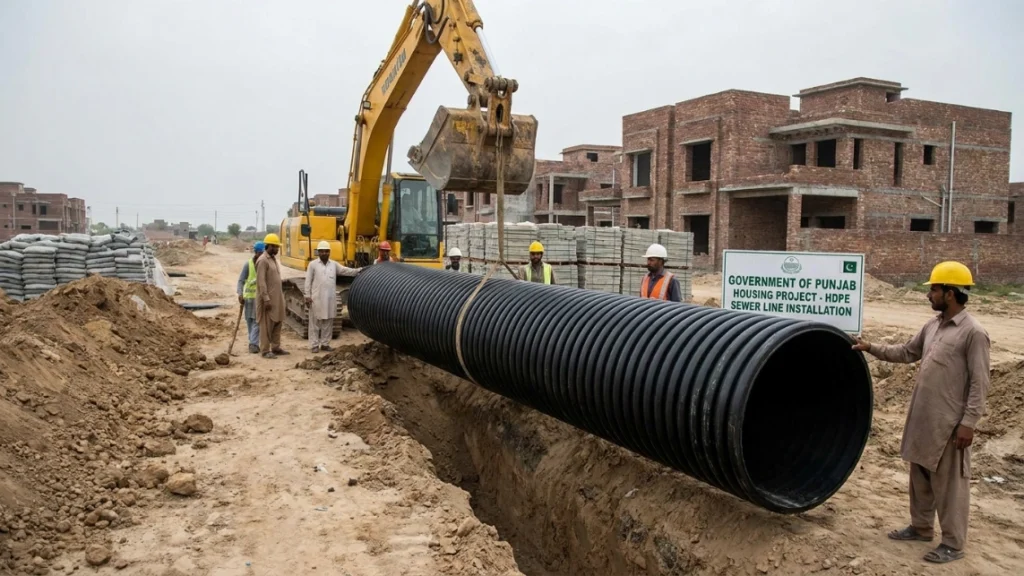
Correct installation of plastic drainage pipes in Pakistan requires proper bedding (100mm granular material below pipe), accurate gradient (minimum 1:40 for 110mm, 1:80 for 160mm), correct joint assembly, and pressure testing before backfill. Skipping bedding or laying at inadequate gradient causes blockages and joint failure within 2–3 years.
⚙️ Expert Insight from NEWTECH One of the most common installation failures we see on housing society projects — across Bahria Town, DHA, and private schemes in Multan and Bahawalpur — is uPVC sewer pipe laid directly on undisturbed soil or rock without granular bedding. The pipe doesn’t crack immediately; it ovally deforms over 12–18 months as point loads develop at the haunch. By then, the road is paved and rectification costs triple. Always specify and enforce 100mm Class II granular bedding to pipe centreline per WASA Lahore drawing SD-301.
Plastic Drainage Pipe Installation Checklist
| Step | Action Required | Tool / Material | Notes |
|---|---|---|---|
| 1. Trench Preparation | Clear to 100mm below pipe invert | Excavator + hand tools | Remove rocks, debris |
| 2. Bedding Layer | Lay 100mm granular fill (10mm clean gravel) | Compaction plate | Do not use clay soil |
| 3. Gradient Check | Set laser level to minimum fall | Dumpy level / laser | 1:40 for DN110, 1:80 for DN160+ |
| 4. Pipe Laying | Lay socket upstream, spigot downstream | Pipe hooks | Check alignment per string line |
| 5. Joint Lubrication | Apply WRAS-approved lubricant to rubber ring | Brush | No grease — degrades EPDM ring |
| 6. Haunching | Fill to pipe centreline with granular material | Spade | Compact in 150mm layers |
| 7. Surround Fill | Fill to 300mm above crown | As above | Hand compact around pipe |
| 8. Pressure Test | Air test at 50mm water gauge for 5 minutes | Air pump + gauge | No drop = pass |
| 9. Final Backfill | Compact remaining trench fill | Compactor plate | 300mm lifts |
For HDPE butt-fusion joints on pressure sewer mains, NEWTECH’s butt-fusion welding machines (link: /hdpe-pipes/) ensure joint integrity per ISO 21307 — a welding procedure specification that WASA Karachi now mandates on all PE force main contracts above DN 200mm.
How Do uPVC and HDPE Sewerage Pipes Compare Directly?
uPVC drainage pipes cost 20–35% less per metre than HDPE at equivalent diameters and are easier to join using rubber-ring push-fit connections. HDPE offers superior flexibility, higher pressure rating, and longer coil lengths for fewer joints. For gravity sewers, uPVC is the better value. For pressurised or difficult-route applications, HDPE is the correct technical choice.
Direct Comparison: uPVC vs HDPE for Sewerage in Pakistan
| Attribute | uPVC Drainage Pipe | HDPE Sewer Pipe |
|---|---|---|
| Material Grade | PVC-U (unplasticised) | PE80 / PE100 |
| Applicable Standard | PS 3580:1994, ISO 4435 | ISO 4427, DIN 8075 |
| Diameter Range | DN 75–630mm | DN 20–630mm |
| Max Operating Pressure | 6–10 bar (Class E) | Up to 25 bar (PE100 SDR 7.4) |
| Flexibility | Rigid | Semi-flexible (bends to 2.5% offset without fittings) |
| Joint Type | Push-fit rubber ring | Butt-fusion / electrofusion |
| Minimum Gradient (DN110) | 1:40 | 1:40 |
| Temperature Range | 0°C to 60°C | -20°C to 60°C |
| Chemical Resistance | Good (pH 2–12) | Excellent (pH 1–14, most solvents) |
| Trenchless Suitability | Not recommended | Full HDD / pipe-burst compatible |
| Approx. Price (DN160, per metre) | PKR 850–1,100 | PKR 1,300–1,700 |
| Lifespan | 50+ years | 50+ years |
| PSQCA Certification | Required (PS 3580) | Available (ISO 4427 basis) |
Prices are indicative 2026 market rates — confirm current rates with NEWTECH’s sales team (link: /contact-us/)
According to Pakistan Bureau of Statistics (PBS) manufacturing data (2023–24), uPVC pipe production in Pakistan exceeds 150,000 metric tonnes annually, making it the most widely available plastic pipe in the domestic market.
PSQCA and WASA Standards for Sewerage Pipes in Pakistan
All sewerage pipes used on WASA contracts in Pakistan must be PSQCA-certified under PS 3580:1994 (for uPVC) or meet ISO 4427 (for HDPE), with PEC-approved manufacturers on federal and provincial government projects. Non-certified pipes are routinely rejected on inspection and create contractor liability for replacement costs.
Pakistani public sector procurement is increasingly strict about pipe certification. PPRA (Public Procurement Regulatory Authority) rules require documentary evidence of PSQCA certification at the time of bid submission for all drainage and sewer contracts above PKR 5 million. The days of substituting cheaper, unmarked pipes after award are over — WASA field engineers in Lahore, Rawalpindi, and Islamabad now conduct random batch sampling.
What Certification Actually Checks
PSQCA testing for uPVC sewer pipes under PS 3580:1994 covers:
- Ring stiffness: SN4 = 4 kN/m², SN8 = 8 kN/m² — pipe must not deflect more than 3% under test load
- Impact resistance: Dropped weight test at 0°C (pipes installed in Islamabad winters must pass)
- Vicat softening point: Minimum 79°C for uPVC — catches substandard PVC regrind compounds
- Pipe straightness: Max deviation 0.2% of length — ensures joint alignment
NEWTECH is PSQCA certified and ISO 9001:2015 certified at its Lahore manufacturing facility. All pipes carry permanent batch markings (diameter, class, standard, manufacturer code) required for traceability on WASA projects. Visit the manufacturing technology page (link: /technolgy/) for details on production quality controls.
Sewerage Drainage Pipe Costs in Pakistan: What to Budget in 2026
In 2026, uPVC sewer pipes in Pakistan cost approximately PKR 650–1,100 per metre for DN110–DN250, and PKR 1,800–4,200 for DN315–DN500. HDPE sewer pipes cost PKR 950–1,700 per metre for DN110–DN250 and PKR 2,500–6,000 for DN315–DN500. Prices vary by region, quantity, and whether pipes are PSQCA-certified.
2026 Indicative Sewerage Pipe Prices in Pakistan (PKR per metre)
| Pipe Type | DN 110mm | DN 160mm | DN 200mm | DN 250mm | DN 315mm | DN 400mm |
|---|---|---|---|---|---|---|
| uPVC SN4 (PS 3580) | 650–780 | 850–1,000 | 1,100–1,350 | 1,550–1,850 | 2,200–2,700 | 3,200–3,800 |
| uPVC SN8 (PS 3580) | 820–980 | 1,050–1,250 | 1,350–1,650 | 1,900–2,200 | 2,700–3,300 | 3,900–4,700 |
| HDPE SDR17 (ISO 4427) | 950–1,150 | 1,300–1,600 | 1,750–2,100 | 2,400–2,900 | 3,400–4,100 | 5,000–6,000 |
| HDPE SDR11 (ISO 4427) | 1,200–1,500 | 1,650–2,000 | 2,200–2,700 | 3,000–3,600 | 4,300–5,200 | 6,400–7,700 |
Rates are ex-factory Lahore, excluding transport, fittings, and GST. Bulk pricing (500+ metres) available — contact NEWTECH directly.
Three factors push prices up significantly on Pakistani projects: remote site delivery (add 8–15% for sites more than 200km from Lahore), non-standard lengths, and rush orders during peak construction season (October–February). Plan procurement 4–6 weeks ahead for large projects.
For a housing society of 200 units using DN160 uPVC SN8 collector lines and DN110 laterals, a 1,500-metre drainage network will cost approximately PKR 1.8–2.4 million in pipes alone — before fittings, manholes, and installation labour.
CONCLUSION
Your project’s sewer and drainage system will outlast everything built above it — if you specify correctly. Get it wrong and you’re looking at road break-up, foul odours, WASA rejection notices, and rectification costs that dwarf the original pipe budget.
Here are your four actionable takeaways:
- Use uPVC (SN4 or SN8 to PS 3580) for all gravity-flow sewerage drainage pipes in Pakistan — it’s cost-effective, widely available, and PSQCA-compliant.
- Switch to HDPE PE100 wherever you have pressure (force mains, pump stations), trenchless crossings, or chemically aggressive industrial effluent.
- Never skip granular bedding or gradient checks — these two installation steps account for the majority of premature drainage failures on Pakistan housing projects.
- Insist on PSQCA-certified pipes with visible batch markings — non-certified material puts your WASA approvals and contractor liability at risk.
Whether your sewerage drainage pipes project is in Karachi, Lahore, Islamabad, or Faisalabad, material quality and installation discipline are what separate a 50-year network from a 5-year maintenance liability.
FAQ SECTION
1. What is the standard uPVC drainage pipe size for household sewerage connections in Pakistan?
The standard uPVC drainage pipe size for household lateral connections in Pakistan is DN 110mm (4 inches), conforming to PS 3580:1994. For buildings with more than five units or commercial ground floors, DN 160mm is recommended. Wall thickness depends on the ring stiffness class — SN4 for shallow depths under 2 metres, SN8 for deeper or road-crossing installations.
2. What is the price of HDPE sewer pipe in Pakistan per metre in 2026?
HDPE sewer pipe prices in Pakistan in 2026 range from PKR 950–1,500 per metre for DN 110mm and PKR 1,300–2,000 per metre for DN 160mm, depending on SDR rating, PE grade (PE80 or PE100), and whether the pipe is PSQCA or ISO 4427 certified. Bulk orders above 500 metres typically attract a 10–15% discount from certified manufacturers.
3. Which sewerage drainage pipe is better in Pakistan — uPVC or HDPE?
For gravity-flow sewerage drainage pipes in Pakistan, uPVC is better value — it’s 20–35% cheaper and easier to install with push-fit rubber ring joints. HDPE is the correct choice for pressurised force mains, trenchless installation (HDD), industrial effluent lines with aggressive chemicals, and areas with seismic risk like Peshawar or Rawalpindi. Both materials exceed 50-year lifespan when installed correctly.
4. What PSQCA standard applies to uPVC sewer pipes in Pakistan?
PS 3580:1994 is the Pakistan Standard that governs uPVC sewer pipes. It specifies ring stiffness classes (SN4 and SN8), wall thickness by diameter, joint dimensions, impact resistance at low temperature, and Vicat softening point minimum of 79°C. WASA and other public sector clients in Pakistan require PS 3580-compliant, PSQCA-certified pipes on all drainage contracts — non-certified material is rejected at inspection.
5. How deep can uPVC drainage pipes be laid in Pakistan?
uPVC drainage pipe (SN4 class) can be safely laid up to 2–3 metres deep under normal Pakistani soil conditions with proper granular bedding. For depths from 3 to 6 metres, or under roads and paved surfaces, SN8 ring stiffness class is required per WASA Lahore standard drawings. Beyond 6 metres, structural design confirmation from a PEC-registered civil engineer is recommended.
6. How long do plastic sewerage drainage pipes last in Pakistan?
Both uPVC and HDPE sewerage drainage pipes are rated for a minimum 50-year service life under ISO 9080 long-term pressure testing. In Pakistan’s climatic conditions — ground temperatures of 20–35°C in Lahore, Karachi, and Faisalabad — both materials perform well within their rated range. The actual lifespan depends on correct installation, bedding quality, and whether PSQCA-compliant pipes with correct pipe class were used from the start.