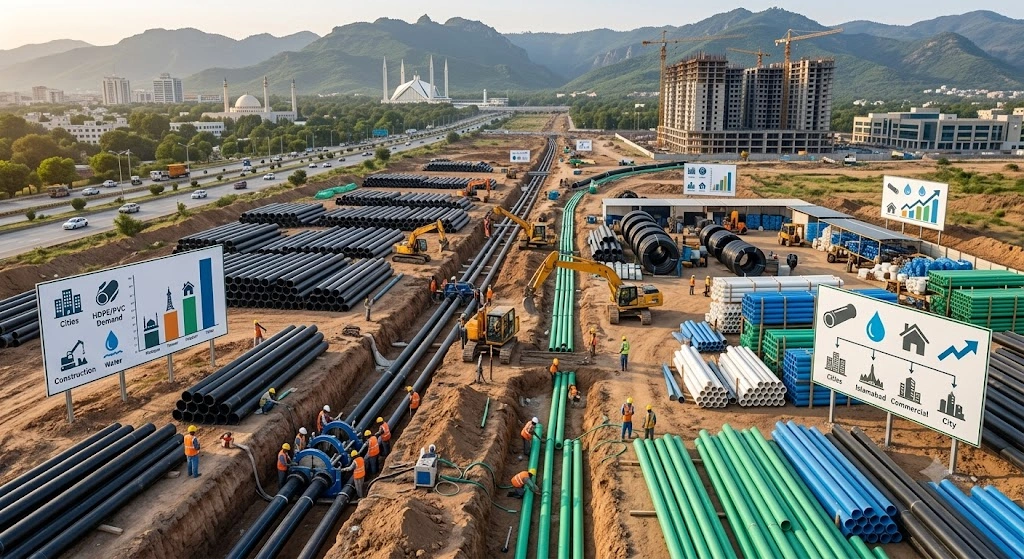
Pipe demand does not grow evenly across Pakistan; instead, it closely follows construction activity, which is heavily concentrated in a few rapidly developing urban centers. Understanding which Top cities are driving demand for HDPE and PVC pipes can help contractors, distributors, and manufacturers make more informed decisions about inventory, pricing, and expansion, rather than treating the entire national market as a single, uniform market.
This guide looks at the cities leading Pakistan’s construction and plumbing demand in 2026, the projects and trends behind that growth, and what it signals for buyers and suppliers navigating this market.
Pakistan’s Construction Sector: The Bigger Picture
Before looking city by city, it helps to understand the national trend driving all of this activity. Pakistan’s construction industry’s value-add grew sharply by 17.6% year-on-year in Q2 2025, following growth of 10.7% in Q1 2025 and 3.1% in Q4 2024. Analysts expect the sector to expand at an average annual rate of around 4.6% from 2026 to 2029, supported by investment in infrastructure, energy, education, and housing projects.
This recovery is also visible in raw material terms: Pakistan’s cement dispatches climbed to 50.58 million tons in FY26, an increase of about 8% year-on-year, driven by construction recovery and lower policy rates — a reasonable proxy for overall construction material demand, including pipe.
Government programmes including the Naya Pakistan Housing Scheme, CPEC Phase II infrastructure contracts, and the Smart City Islamabad initiative are injecting billions into construction activity nationwide. Furthermore, Pakistan’s urban population is forecast to reach 50% of the total by 2030, creating substantial demand for new housing, retail, and mixed-use developments.
Top Cities Driving HDPE & PVC Pipe Demand
Lahore
Lahore remains one of Pakistan’s most active construction markets, with continuous expansion of housing societies across Punjab. The city is at the heart of the country’s urban expansion, alongside Karachi, Islamabad, Rawalpindi, and Faisalabad, with new housing societies and commercial zones emerging every year. This translates directly into sustained demand for both PVC (drainage, internal plumbing) and HDPE (water supply mains) for new developments.
Karachi
As Pakistan’s largest city and commercial hub, Karachi drives significant demand across both residential high-rises and industrial/commercial construction. Its coastal, humid climate also increases the practical case for corrosion-resistant materials like HDPE pipe over legacy metal piping in new water supply installations.
Islamabad & Rawalpindi
The twin cities benefit directly from federal development spending and mega-infrastructure initiatives. The Smart City Islamabad initiative is one of the government programmes actively injecting investment into construction activity in the capital region, alongside continued expansion of housing sectors and commercial developments, both driving steady plumbing and drainage material demand.
Faisalabad
An established industrial and residential market with strong regional pipe brand loyalty, Faisalabad continues to see steady demand tied to both its textile-industrial base and ongoing residential growth in Punjab’s broader industrial belt.
Peshawar and Khyber Pakhtunkhwa
While smaller in overall construction volume than the Punjab and Sindh markets, KP’s urban centers are seeing growing residential development. This is supported by a regional manufacturing presence (including HDPE pipe production already established in the province) that is shortening supply chains for local buyers.
Construction Material Demand Pakistan-Wide: What’s Driving It
Beyond individual cities, several structural trends are shaping construction material demand Pakistan-wide:
Population growth and urbanization: Pakistan has a 2.4% annual population growth rate, creating consistent underlying demand for new housing, while the urban population is forecast to reach half the country’s total by 2030.
Infrastructure mega-projects: Major planned projects include CPEC Phase II infrastructure, motorway network connections, and large transit developments, all of which require significant underground utility and drainage infrastructure.
Government housing finance support: Low-cost housing finance programmes and PSDP allocations in the federal budget directly support residential construction volume.
Residential dominance in overall activity: Residential projects account for roughly 60% of total construction sector activity, with commercial and infrastructure projects making up the remainder — meaning household-scale plumbing and drainage material remains the largest single demand driver nationally.
Plumbing Industry Trends Pakistan Should Watch
A few key plumbing industry trends Pakistan buyers and suppliers should keep an eye on as we move through the rest of 2026:
Continued shift from GI to HDPE and PPRC in both new construction and renovation of older housing stock, driven by corrosion and maintenance cost concerns.
Growing certification awareness among buyers, with more contractors specifically asking for PSQCA and ISO documentation rather than accepting supplier claims at face value.
Regional manufacturing expansion, with more pipe production capacity established outside the traditional Karachi/Lahore industrial belt, shortening supply chains for buyers in secondary cities.
Infrastructure-linked demand spikes, tied to mega-project construction timelines (rail, road, housing schemes) rather than purely organic residential growth.
What This Means for Buyers and Distributors
Contractors and developers in high-growth cities should expect continued competitive supply given rising cement dispatches and construction output, but should still lock in bulk pricing where project timelines allow, given resin-linked price volatility.
Distributors evaluating new territory should weigh Faisalabad, Peshawar, and secondary Punjab cities alongside the traditional Lahore/Karachi/Islamabad focus, given the broader urbanization trend.
Homeowners and small contractors in any of these cities should prioritize certified HDPE and PVC pipe regardless of local price competition, since demand growth sometimes brings an influx of uncertified, lower-quality product into fast-growing markets.
You can review NewTech-Pipes’ quality control standards as a benchmark for what certified supply should look like regardless of which city you’re sourcing in.
Conclusion
Pipe demand in Pakistan tracks construction activity closely, and that activity remains concentrated in Lahore, Karachi, Islamabad/Rawalpindi, and Faisalabad, even as secondary cities grow their share amid nationwide urbanization. Understanding these regional patterns helps both buyers and suppliers plan more effectively than treating the market as uniform. NewTech-Pipes manufactures HDPE and PVC pipes and fittings to ISO 9001:2015 and PSQCA standards, supplying contractors and distributors across these growing markets.
Frequently Asked Question's
Lahore, Karachi, Islamabad/Rawalpindi, and Faisalabad currently drive the largest share of pipe demand nationally, reflecting their concentration of residential, commercial, and infrastructure construction activity, though secondary cities are growing as urbanization spreads.
Yes — recent data shows strong year-on-year growth in construction value-add and cement dispatches, with analysts projecting continued average annual growth through 2029, supported by infrastructure, housing, and energy sector investment.
Population growth, accelerating urbanization, government housing support, and large infrastructure projects are the main drivers, alongside a broader material shift from legacy GI pipe to HDPE, PVC, and PPRC.
Yes — while Lahore, Karachi, and Islamabad remain the largest markets, secondary cities and regional industrial centers are seeing growing residential and commercial construction as urbanization spreads beyond the traditional major hubs.
Rising construction demand generally supports stable or rising pipe pricing due to higher resin consumption and freight demand, though pricing still fluctuates more directly with global resin costs and currency movement than with local construction volume alone.