Most purchasing decisions for HDPE, PVC, or PPRC pipes in Pakistan are mainly driven by the price per meter and the expected delivery timeline. However, one important question that can determine whether a project runs smoothly for the next 20 years—manufacturer warranty pakistan terms and what support is available after the invoice has been paid—is often considered too late, sometimes only after a joint has already failed on site. Whether you are a contractor sourcing materials for a housing society, a distributor preparing seasonal stock, or a procurement officer involved in a DHA or Bahria Town development, this article explains what genuine after-sales support should include, what a fair warranty should actually cover, and how to distinguish suppliers who provide reliable long-term support from those who do not. stand behind their pipes from those who disappear after delivery.
Why After-Sales Support Matters More Than the Sale Itself
A pipe that leaves the factory correct on paper can still fail on site — from a botched butt-fusion joint, incorrect storage before installation, or a batch defect that only shows up under pressure testing. What separates a dependable manufacturer from a one-time vendor is what happens next: do they investigate, replace, and stand behind the product, or do they treat the sale as closed the moment the truck leaves the yard?
For water and gas utility lines, agricultural irrigation networks, and underground housing-society mains, a pipe failure is rarely a simple fix. Re-excavation, traffic disruption, and lost water or gas all add cost far beyond the price of the pipe itself. This is why after sales service pipes buyers should evaluate a manufacturer’s support commitment with the same seriousness as pressure ratings or wall thickness.
What a Real Pipe Manufacturer Warranty in Pakistan Should Cover
Not all warranties are equal, and a glossy warranty card means little without specifics. Before signing a purchase order, a buyer should get clear, written answers on:
- Manufacturing defect coverage — material or production faults, not damage from improper installation or handling.
- Duration — HDPE pressure pipes manufactured to PE-100 grade under ISO 4427 are typically expected to perform reliably for decades under correct operating conditions; the manufacturer’s written warranty period should be stated clearly, not left vague.
- Scope of remedy — replacement of the defective length, not just a discount on the next order.
- Claim process — who to contact, what documentation (batch number, installation records, test reports) is needed, and a realistic response timeframe.
- Exclusions — conditions like incorrect storage, UV exposure beyond rated limits, or third-party installation errors that void coverage.
A supplier who can answer all five points without hesitation, and who provides them in writing rather than verbally, is one worth taking seriously.
After-Sales Service Pipes: What Support Actually Looks Like Day-to-Day
Warranty is the formal backstop; day-to-day after-sales support is what most buyers actually interact with. In practice, this includes:
- Technical guidance during installation — help with butt-fusion parameters, fitting compatibility, or trench-bedding recommendations when something looks off on site.
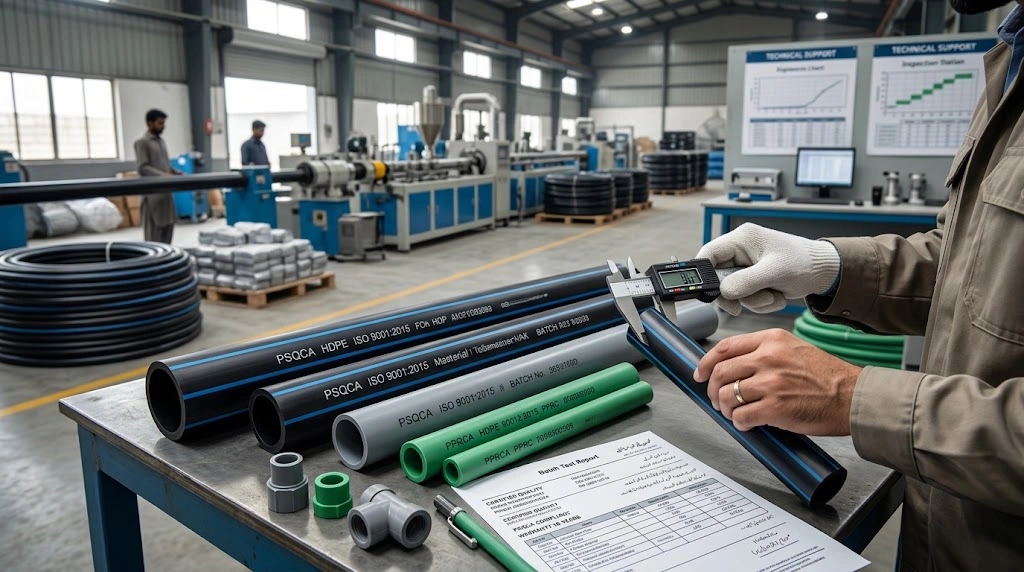
- Batch and test documentation on request — quality control certificates or lab test summaries tied to the specific delivery, not generic marketing material.
- A reachable technical contact — not just a sales representative, but someone who understands pipe specifications and can escalate a genuine defect claim.
- Consistent supply for repeat or emergency orders — critical for utility maintenance work where a matching pipe grade or fitting size is needed quickly.
Manufacturers with an in-house laboratory and documented quality-control process are generally better positioned to investigate a field complaint quickly, since they can trace a defect back to a specific production batch rather than guessing. This is also where the difference between a trading company and an actual manufacturer becomes clear: a trader reselling imported stock can usually offer a price, but rarely a lab report tied to that exact consignment or a production engineer who can explain what went wrong.
It’s also worth asking how a manufacturer handles fittings, not just pipe lengths. A joint is only as reliable as the weakest component in it, so a supplier who also produces or distributes compatible, standards-based fittings — rather than leaving buyers to source mismatched parts elsewhere — is generally in a better position to support the full system, not just one piece of it.
Warranty vs. Reality: Common Gaps to Watch For
On paper, most manufacturers and importers claim to offer warranty and support. In practice, gaps tend to show up in a few recurring places:
Area | What’s Promised | What Often Happens |
Response time | “Prompt support” | Days or weeks of follow-up before anyone visits site |
Replacement | “Full replacement” | Partial credit or discount on next order instead |
Documentation | “Full traceability” | Batch or test records not readily available |
Local presence | “Nationwide service” | No branch or technical staff near the project site |
Imported products | “Manufacturer warranty” | Claims routed through multiple intermediaries, slowing resolution |
This last point matters more than buyers often realize. Imported fittings and pipes can offer good quality, but a warranty claim may need to pass through a local distributor, then a regional office, then the original manufacturer abroad — a process that can take far longer than a defect on an active trench line can afford to wait.
How to Judge Pipe Supplier Reliability in Pakistan Before You Sign
Pipe supplier reliability in Pakistan isn’t something you can fully verify from a price quotation. A few practical checks help before committing to a bulk order:
- Ask for the ISO 9001:2015 certificate and PSQCA compliance documents directly, not just a mention of them on a website.
- Request a lab or batch test report for the specific product line you’re ordering, particularly for HDPE PE-100 pipes where pressure rating consistency matters.
- Check whether the manufacturer has physical branches or depots near your project location — a supplier with only a head-office presence may struggle to respond quickly to a field issue.
- Ask which large-scale projects they’ve supplied before, and whether utilities or developers have re-ordered from them, which is a stronger signal than a one-off sale.
- Get the warranty and support terms in writing before the purchase order is finalized, not after a problem appears.
DHA, Bahria Town, and Utility Projects: Why Approved-Supplier Status Matters
Housing societies like DHA and Bahria Town, along with utilities such as SNGPL and organizations like FWO, typically maintain approved supplier or vendor lists for pipes and fittings used on their developments. Getting onto — and staying on — these lists usually requires consistent product quality, valid certifications, and a track record of resolving issues without repeated escalation.
For a contractor or procurement officer, sourcing from a DHA Bahria approved pipe supplier isn’t just a compliance checkbox. It’s a practical shortcut: these societies have already done a version of the vetting described above, including site inspections and documentation review, before approving a manufacturer for their projects.
The same logic applies to organizations like SNGPL for gas distribution networks and FWO for large infrastructure works — both tend to work repeatedly with manufacturers who have already demonstrated consistent quality and responsive after-sales handling on earlier contracts, rather than opening every project to untested vendors. If you’re procuring for a project under one of these bodies, ask your supplier directly which of these approvals they currently hold and for how long they’ve held them, since a recently granted approval carries less weight than a multi-year relationship.
A Practical Scenario
Consider a mid-sized housing society water-supply project in Multan, where the design calls for HDPE PE-100 mains connecting to smaller PPRC distribution lines within residential blocks. Midway through installation, the contractor notices inconsistent wall thickness in one delivered coil. With a manufacturer that maintains batch traceability and a responsive technical team, the affected coil is identified by batch number, replaced within days, and installation continues without a major schedule slip. Without that documentation and support structure, the same issue could mean weeks of dispute over whether the defect was a manufacturing fault or a site-handling problem — time the project schedule rarely has to spare.
A Quick Checklist Before You Order
- Warranty terms provided in writing, with duration and exclusions clearly stated
- Manufacturing defect coverage confirmed, not just implied
- Batch and lab test documentation available on request
- A named technical contact for post-delivery issues
- Physical presence or service reach near your project site
- Track record with housing societies, utilities, or infrastructure projects
- ISO 9001:2015 and PSQCA compliance confirmed with documentation
Conclusion
A pipe manufacturer warranty in Pakistan is only as good as the documentation, response time, and technical support behind it — the price on the quotation is just the starting point. Before placing a bulk order, get warranty terms, claim procedures, and technical contacts in writing, and check the supplier’s track record with projects similar to yours. NewTech-Pipes, ISO 9001:2015 certified and manufacturing pipes and fittings in Pakistan since 2000, is one example of a supplier built around this kind of documented, traceable after-sales structure. Whichever manufacturer you choose, treat after-sales support as a core part of the purchase decision, not an afterthought.
Frequently Asked Question's
There’s no single fixed industry number, so ask the manufacturer directly for their written warranty duration and what it covers. Focus less on the number of years quoted and more on whether manufacturing defects are clearly covered and the claim process is documented, since a long warranty with vague terms offers little real protection.
Document the batch number, take photos, and contact the manufacturer’s technical team immediately rather than the sales contact alone. A reliable supplier will ask for this information and investigate against their quality-control records instead of dismissing the claim outright.
Not necessarily. Imported products can carry strong specifications, but warranty claims sometimes route through multiple intermediaries before reaching the original manufacturer, which can slow resolution. A locally manufactured product with a direct, accessible technical team can often resolve issues faster.
Ask the supplier for their approval documentation or check directly with the housing society’s procurement or vendor-approval office, since approved-vendor lists are typically maintained and updated by the society itself rather than self-declared by suppliers.
Reputable manufacturers generally build support into the price of a genuine, certified product rather than charging separately for warranty service. Be cautious of suppliers who quote unusually low prices and then treat basic support, documentation, or replacement as a paid add-on.