Ordering HDPE pipe based solely on diameter is one of the most common mistakes buyers make. The same HDPE Pipe Sizes can have significantly different pressure ratings depending on their wall thickness. Choosing the wrong specification can result in paying for more capacity than necessary or installing a pipe that cannot withstand actual operating conditions.
This guide walks through the full range of HDPE diameters used in Pakistan, explains exactly how SDR determines HDPE pipe pressure rating, and gives you a practical HDPE pipe diameter guide for matching size to application — so your next order is specified correctly the first time.
How HDPE Pipe Is Sized
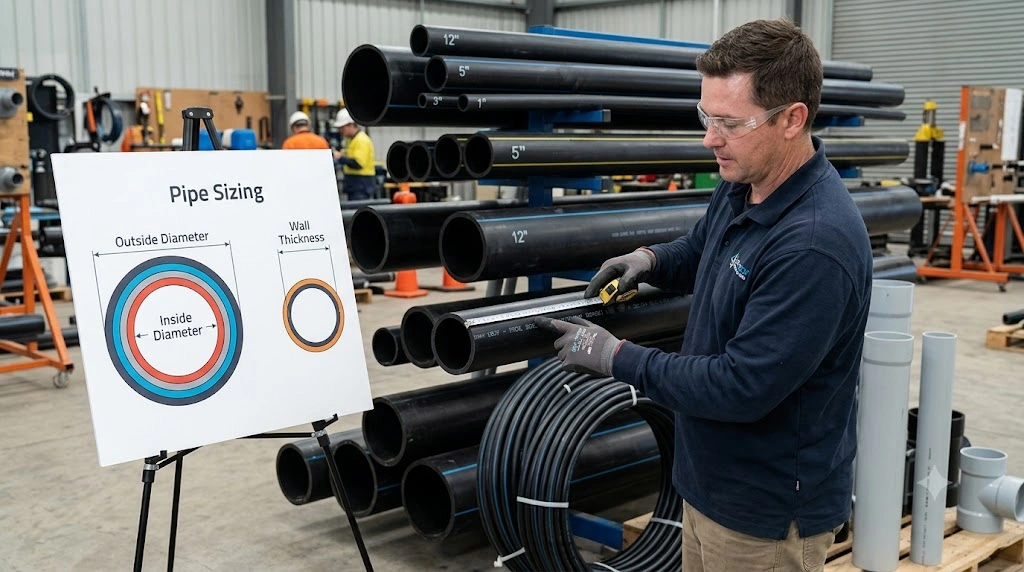
HDPE pipe is sized by its outside diameter (OD), not a nominal label the way older steel pipe sizing works. A 110mm HDPE pipe genuinely measures 110mm across the outside, regardless of wall thickness or pressure class — everything else (wall thickness, internal diameter, pressure rating) is derived from that fixed outer dimension. This matters because two pipes with the same OD can have very different wall thicknesses and therefore very different pressure capacities.
Understanding SDR and How It Sets Pressure Rating
SDR (Standard Dimension Ratio) is simply the ratio of outside diameter to wall thickness. A lower SDR number means a thicker wall relative to diameter — and a higher pressure rating. This relationship is fixed by the ISO 4427 pressure formula, which factors in the pipe’s material grade (PE80 or PE100) and a built-in safety margin.
The practical relationship for PE100 pipe at 20°C:
| SDR | PN (Pressure Rating) | Typical Application |
|---|---|---|
| SDR 6 | PN 25 | Very high-pressure industrial use |
| SDR 9 | PN 20 | High-pressure systems |
| SDR 11 | PN 16 | High-pressure municipal water, gas distribution |
| SDR 13.6 | PN 12.5 | Medium-high pressure |
| SDR 17 | PN 10 | Standard municipal water supply |
| SDR 21 | PN 8 | Medium-pressure rural supply |
| SDR 26 | PN 6 | Low-pressure distribution |
An important detail buyers frequently miss: PE100 and PE80 don’t rate the same at the same SDR. PE100 has a higher Minimum Required Strength (MRS of 10 MPa vs. 8 MPa for PE80), so an SDR 11 PE100 pipe is rated PN16, while the same SDR 11 in PE80 only rates around PN12.5.
If a quote lists an SDR and pressure rating that don’t match the PE100 table above, check the material grade first — this mismatch is a common way underweight or lower-grade pipe gets sold as if it were PE100.
HDPE Pipe Diameter Guide: 20mm to 630mm
Here’s a practical HDPE pipe diameter guide matched to common applications in Pakistan:
| Diameter Range | Typical Use |
|---|---|
| 20mm – 32mm | Household service connections, small gas/water branch lines |
| 40mm – 63mm | Larger household connections, small distribution branches |
| 75mm – 110mm | Tube well rising mains, housing society branch lines |
| 125mm – 200mm | Housing society distribution mains, larger tube wells |
| 225mm – 315mm | Municipal distribution mains, larger commercial supply |
| 355mm – 630mm | Municipal transmission mains, major utility infrastructure |
Smaller diameters (generally up to around 90mm) are typically supplied in coils of 50–200 meters, reducing the number of joints needed for a given run, while larger diameters (110mm and above) are usually supplied in straight lengths of 6 or 12 meters.
Matching Diameter to Pressure Class: A Practical Example
Consider a typical HDPE tube well rising main in the 90mm–110mm range. The correct pressure class isn’t determined by the pump’s normal running pressure alone — it needs to account for the pump’s shutoff head (the peak pressure generated when the pump runs against a closed or restricted line), which is typically higher than steady-state operating pressure.
This is why engineers commonly step down one SDR class from what steady pressure alone would suggest, building in margin for pressure surges rather than sizing to average operating conditions.
Common Sizing Mistakes to Avoid
Assuming diameter alone determines pressure capacity. Two pipes with the same OD can have very different SDR and therefore very different pressure ratings.
Confusing PE80 and PE100 pressure tables. The same SDR rates differently depending on material grade — always confirm the grade before comparing quotes.
Sizing only to steady operating pressure. Pump shutoff head and surge conditions often exceed normal running pressure, and pipe should be rated accordingly.
Overspecifying SDR “to be safe.” A lower SDR than the application needs adds unnecessary cost without a real safety benefit if the correct class was already calculated properly.
Standards and Certification to Check
Before accepting delivery of any HDPE pipe, confirm:
PSQCA certification mark, confirming compliance with the relevant Pakistan Standard.
ISO 4427 conformance for water applications (ISO 4437 for gas-grade pipe).
PE grade and SDR both clearly stamped on the pipe, not just one or the other — since PN rating only makes sense with both figures together.
Manufacturer’s ISO 9001:2015 certification, reflecting consistent quality control across production batches.
You can review NewTech-Pipes’ quality control standards as a reference for the documentation a certified manufacturer should provide.
How to Specify HDPE Pipe Correctly
When requesting a quote, always specify three things together, not just diameter:
Outside diameter (OD) in mm
Material grade (PE80 or PE100)
SDR or PN rating, matched to your actual operating pressure including surge/shutoff considerations
A complete, correctly specified order looks like: “110mm PE100 SDR17 (PN10)” — not just “110mm HDPE pipe,” which leaves the pressure class ambiguous and open to substitution.
Conclusion
Correctly specifying HDPE pipe sizes means always pairing diameter with material grade and SDR/PN rating together — diameter alone tells you nothing about pressure capacity. Getting this right, including accounting for pressure surges like pump shutoff head, is what prevents both overspending and premature pipe failure. NewTech-Pipes manufactures HDPE pipes and fittings across the full diameter and pressure class range to ISO 4427 and PSQCA standards, giving contractors and engineers a certified option correctly matched to their project’s specification.
Frequently Asked Question's
HDPE pipe is manufactured in diameters ranging from around 20mm up to 630mm and beyond for major transmission mains, though the sizes most commonly used in residential and agricultural projects fall between 20mm and 200mm.
Match the SDR/PN rating to your system’s actual operating pressure, including any pressure surges (such as a pump’s shutoff head), rather than just the steady running pressure. Consulting your utility or an engineer for the exact figure is recommended for critical applications.
SDR 11 has a thicker wall relative to its diameter than SDR 17, giving it a higher pressure rating (PN16 vs PN10 for PE100). Lower SDR numbers always mean thicker walls and higher pressure capacity, at a correspondingly higher cost.
Generally yes, since PE100 offers a higher pressure rating at the same SDR, or the same pressure rating at a thinner wall. Most modern water supply specifications now default to PE100 for this efficiency advantage.
This isn’t generally recommended purely for “safety,” since it adds unnecessary material cost. It’s better to correctly calculate your required pressure class, including surge conditions, and specify the appropriate SDR rather than overbuilding without a defined reason.