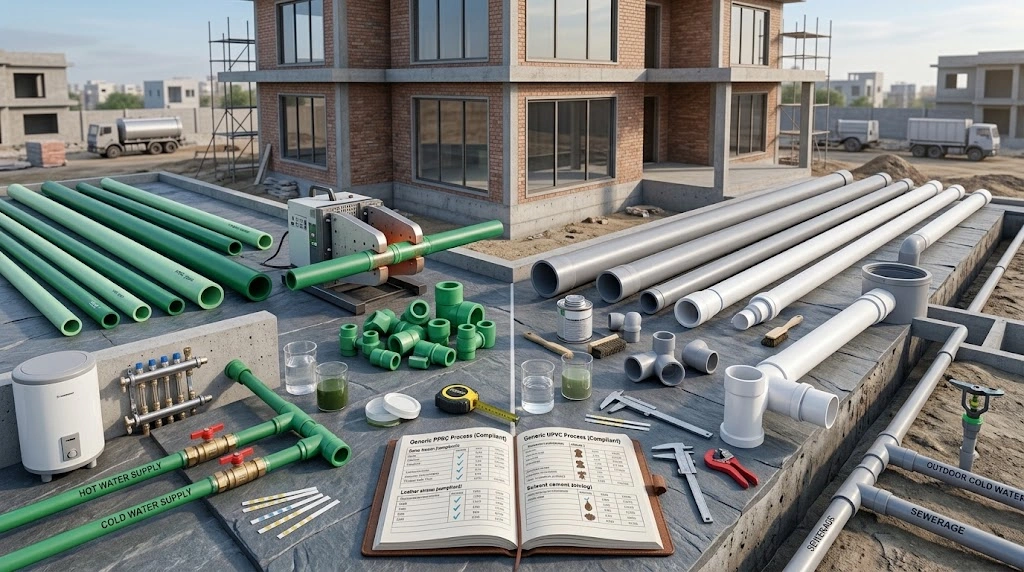
If you’re planning plumbing for a new home in Lahore, Karachi, Multan, or anywhere else in Pakistan, you may be wondering about the PPRC vs UPVC pipe best choice for home. Although these two plastic pipes can look similar, they are designed for different applications and perform differently on site. Both are widely available across Pakistan and are commonly recommended by contractors, but the right option depends on where and how the pipe will be used.
The real question with PPRC vs UPVC pipes isn’t which material is “better” overall. It’s which one is built for the job you need done. PPRC pipes are engineered for pressurized hot and cold water lines inside the house. UPVC pipes are built for cold water supply, drainage, and outdoor runs. Get this match wrong, and you risk anything from a shortened pipe life to a failed joint under a geyser line.
This guide breaks down how each material performs under everyday Pakistani conditions, so you can settle on the best pipe for home plumbing in Pakistan for your specific project.
What Are PPRC Pipes?
PPRC stands for Polypropylene Random Copolymer, also written PP-R — a plastic developed specifically for pressurized plumbing. Its “random copolymer” structure gives it better impact resistance and flexibility across a wider temperature range than ordinary polypropylene, which is exactly what a hot water line running inside a wall needs.
PPRC pipes and fittings are typically manufactured in sizes from 20mm to 160mm, covering everything from a single bathroom feed to a building’s main riser. The pipes join through heat fusion welding: the pipe end and fitting are heated on a fusion machine until the plastic softens, then pressed together. As the joint cools, the two surfaces fuse into one continuous piece of plastic — no glue, no rubber seal, and no mechanical joint to loosen over time.
Because of this, PPRC has become the default choice for concealed hot and cold water supply lines in Pakistani homes, especially where pipes are buried in walls or under floor screed and a leaking joint would mean breaking tiles to fix.
What Are UPVC Pipes?
UPVC (Unplasticized Polyvinyl Chloride) is a rigid form of PVC that skips the plasticizers used in flexible PVC, which is what gives it the strength and weatherproofing contractors rely on. It was developed in Germany in the 1960s as a replacement for galvanized steel and cast iron pipe, and it has held that role in Pakistan’s construction industry for decades.
UPVC pipes join using solvent cement — sometimes called “PVC glue” on site. The pipe and fitting surfaces are primed, coated with cement, and pushed together, forming a chemical bond as the solvent evaporates. It’s fast, needs no power tools or fusion machine, and is the standard method for drainage, sewerage, and cold-water agricultural lines.
Where UPVC struggles is heat. Standard-grade UPVC starts to soften and lose pressure capacity well below the temperatures a PPRC pipe tolerates, which is why you won’t see it specified for geyser lines or hot water distribution — only for cold water supply, waste, and vent systems.
PPRC vs UPVC Pipes: Key Differences at a Glance
The table below summarizes how the two materials compare on the factors that matter most when specifying pipe for a home plumbing project.
Feature | PPRC Pipes | UPVC Pipes |
Material | Polypropylene Random Copolymer (PP-R) | Unplasticized Polyvinyl Chloride |
Best for | Hot & cold pressurized water supply, heating lines | Cold water supply, drainage, sewerage, irrigation |
Temperature tolerance | High — rated for hot water service, short-term up to ~95°C | Lower — intended for cold to moderately warm water only |
Jointing method | Heat fusion welding (no glue or rubber seal) | Solvent cement or rubber-ring joints |
Typical service life | 50+ years under normal conditions | 50+ years under normal conditions |
UV / outdoor exposure | Best used indoors/concealed; not designed for direct sun | Needs UV-stabilized grade for prolonged outdoor exposure |
Installation equipment | Requires a fusion welding machine and trained operator | Simple hand tools and solvent cement |
Newtech sizes available | 20mm to 160mm | Wide range across pressure & drainage series |
Pressure Ratings and Temperature: What the PN Numbers Mean
Both PPRC and UPVC pipes are sold by PN class — “Pressure Nominal” — printed on the pipe as PN 10, PN 16, PN 20, or similar, indicating the maximum working pressure the pipe is rated for at a reference temperature. A higher PN number generally means a thicker pipe wall relative to its outer diameter, which raises both the pressure rating and the price.
For PPRC, the PN class also interacts with temperature: the same pipe rated for a given pressure at 20°C carries a lower safe working pressure once the water running through it gets hot, which is why manufacturers publish pressure-temperature charts rather than a single number. Newtech’s PPRC range is built to handle water up to around 95°C for short periods, with continuous hot-water service comfortably covering typical residential geyser and boiler temperatures.
UPVC’s PN classes, by contrast, are calculated for cold-water service. Don’t assume a UPVC pipe rated for a given pressure in cold water can carry the same pressure once temperatures rise — it can’t. Using UPVC on a hot line is one of the more common mistakes flagged by consultants inspecting failed installations. If your project consultant has specified a PN class, always confirm whether it’s rated for hot or cold service before ordering pipe.
Installation: Heat Fusion vs Solvent Cement
The two materials aren’t just chemically different — they’re installed differently, which affects labor cost and schedule.
PPRC installation requires a fusion welding machine, a trained operator, and correct heating and cooling times for each pipe diameter. Get the timing wrong and the joint can look fine on the outside while being weak internally, so it’s worth confirming your plumber has proper fusion equipment and real experience, not just a heat gun.
UPVC installation uses solvent cement and needs almost no special equipment beyond a pipe cutter and deburring tool, which is part of why it remains popular for drainage and sewerage work where long pipe runs need to be laid quickly. The tradeoff is that solvent-cement joints depend on correct primer and cement application — a rushed joint is a common source of the slow leaks that show up months after handover.
Cost: Upfront Price vs Long-Term Value
On a per-meter basis, PPRC pipe, fittings, and fusion labor typically cost more than an equivalent UPVC cold-water line, largely because of the fusion machine and skilled labor involved. For a bathroom or kitchen hot-water run, that gap is usually a small part of the total plumbing budget, and the leak-free joint reduces the risk of a costly rework once tiling is finished.
UPVC keeps upfront costs down on the larger-volume, lower-pressure parts of a system — drainage stacks, sewer lines, rainwater downpipes, and outdoor or agricultural cold-water runs — where fast installation and lower material cost matter more than heat tolerance.
Best Pipe for Home Plumbing in Pakistan: Matching Material to the Job
Rather than picking one material for an entire house, most contractors and plumbing consultants in Pakistan now mix both, based on what each line actually carries:
- Hot water supply to geysers, kitchens, and bathrooms: PPRC, for its heat tolerance and fusion-welded, leak-free joints.
- Cold water risers and distribution inside concealed walls: PPRC is increasingly preferred here too, since it avoids relying on glued joints hidden inside the structure.
- Drainage, sewerage, and vent stacks: UPVC, for cost-efficiency and ease of installation on non-pressurized lines.
- Outdoor cold-water runs, tube wells, and irrigation: UPVC, using UV-stabilized grades where pipe will sit in direct sunlight — a real consideration in the intense summer heat of cities like Multan and Faisalabad.
Framed this way, the best pipe for home plumbing in Pakistan usually isn’t a single material — it’s the right material for each part of the system, chosen with the project’s pressure, temperature, and sun exposure in mind.
What to Check Before You Buy PPRC or UPVC Pipes
- PSQCA compliance: Pakistan Standards and Quality Control Authority certification indicates the pipe has been tested against recognized national standards.
- Manufacturer’s quality system: Look for ISO 9001:2015 certification, which points to consistent production controls rather than one good batch.
- Matching pipe and fittings: Use pipe and fittings from the same manufacturer and series wherever possible — mismatched wall thickness or fitting dimensions are a common cause of failed joints.
- The right PN class for the job: Confirm the pressure and temperature rating against your project’s actual operating conditions, not just the cheapest option on the shelf.
- After-sales support: A manufacturer with local technical support can help resolve installation questions before they turn into leaks.
Conclusion
There’s no single winner in the PPRC vs UPVC pipes debate — the two materials are built for different jobs. PPRC’s heat tolerance and fusion-welded joints make it the stronger choice for hot and cold water supply lines, while UPVC’s cost-efficiency and easy installation suit drainage, sewerage, and outdoor cold-water runs. The best pipe for home plumbing in Pakistan is usually a combination of both, matched carefully to pressure, temperature, and exposure conditions on your project. Newtech Industries, an ISO 9001:2015-certified and PSQCA-registered manufacturer producing PPRC and UPVC pipes since 2000, is a resource worth consulting when specifying pipe for your next plumbing project.
Frequently Asked Questions
Not directly through fusion welding or solvent cement, since the two materials don’t bond chemically or thermally to one another. If a project needs to transition between them — for example, from an indoor hot-water PPRC line to a UPVC drain — use a proper transition fitting or union designed for mixed-material connections, and confirm compatibility with your plumbing consultant first.
Yes. PPRC pipe is non-toxic and doesn’t leach chemicals into water passing through it, which is why it’s widely used for potable hot and cold water supply in homes across Pakistan. Its smooth internal surface also resists scale buildup, helping maintain water flow and quality over the pipe’s service life.
UPVC is typically used for the cold-water line running from a rooftop tank to the house, since it’s a low-pressure gravity feed rather than a heated line. If that tank also feeds a solar or electric geyser, the hot-water branch downstream of the geyser should switch to PPRC.
Exact pricing depends on pipe diameter, PN class, and current raw material rates, which shift with international polymer prices. As a general rule, PPRC pipe and fittings cost more per meter than equivalent UPVC due to the fusion-welding equipment and labor involved, though the gap narrows for smaller residential diameters. Contact a manufacturer directly for current rates.
Yes, but only UV-stabilized UPVC grades should be used where pipe is exposed to direct sunlight. Standard UPVC can become brittle with prolonged UV exposure, particularly in high-sun cities like Multan and Karachi, so confirm the UV rating before installing UPVC pipe on rooftops or exposed outdoor runs.