If you’ve ever had to wait six to eight weeks for imported HDPE pipe fittings to clear customs while your project remained on hold, you already know the true cost of depending on overseas suppliers. HDPE Pipe fittings pakistan buyers need for water, gas, and irrigation networks have traditionally been sourced from Europe or East Asia, bringing long lead times, currency fluctuations, and unpredictable freight charges in addition to the fitting’s actual price. This is the gap that PLAST-1, NewTech’s locally manufactured range of HDPE butt-fusion fittings, was designed to address. In this article, you’ll discover what butt-fusion fittings do, how local manufacturing compares with imported options in terms of quality and cost, and what factors to consider before choosing a supplier for your next project. For a broad
Pipe Fittings 101 guide.
Why the Fitting Matters as Much as the Pipe
A pipeline is only as strong as its weakest joint. HDPE pipe systems are prized for their leak resistance, but that reputation depends entirely on how well the fittings — elbows, tees, reducers, end caps, and flange adapters — are fused to the pipe. A poorly manufactured fitting, even when installed correctly, can introduce a weak point that fails months or years later, usually underground where a repair means excavating an entire section of pipe.
This is why fitting quality deserves the same scrutiny buyers usually reserve for the pipe itself. Two fittings can look identical on a shelf and still perform very differently under sustained pressure, temperature swings, or soil movement — differences that only show up after installation.
Imported vs. Locally Manufactured HDPE Fittings
For decades, most HDPE fittings used in Pakistan were imported, largely because few local manufacturers had invested in the specialized molding and fusion equipment the process requires. That’s changed. Here’s how the two options generally compare:
Factor | Imported Fittings | Locally Manufactured Fittings (e.g., PLAST-1) |
Lead time | Weeks (shipping, customs clearance) | Typically days, ex-factory or ex-stock |
Cost | Higher (freight, duties, currency risk) | Lower landed cost, PKR-stable pricing |
After-sales support | Limited; replacement parts also imported | Direct factory access for replacements and technical queries |
Standards compliance | Varies by origin country; needs verification | Manufactured to match ISO 4427-aligned pipe specifications |
Customization for local project needs | Often fixed catalog, minimal flexibility | Easier to adjust sizing/runs for local project timelines |
Neither option is automatically “better” for every situation, as some specialty fittings or uncommon sizes may still be more readily available from international suppliers. However, for standard butt-fusion fittings used in water supply, gas distribution, and irrigation projects, locally Manufactured hdpe fittings are increasingly narrowing the performance gap while also addressing the higher costs and longer lead times associated with imports.
How PLAST-1 Fittings Are Made
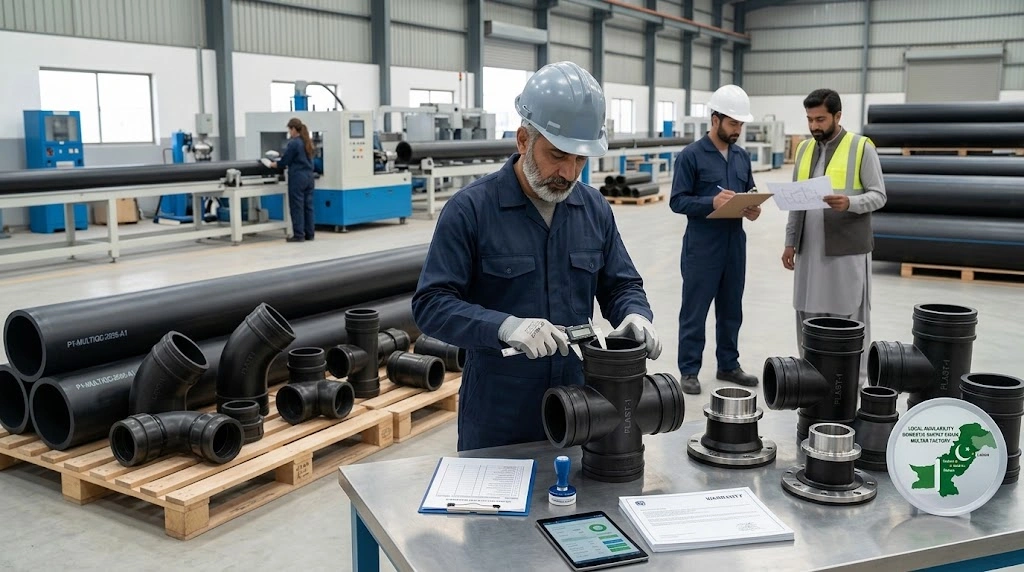
PLAST-1 is NewTech’s in-house brand of HDPE butt-fusion fittings, manufactured in Pakistan rather than sourced from overseas. The fittings are produced from PE100-grade polyethylene raw material — the same base material standard used for NewTech’s HDPE Pipes & Fittings range — which matters because mismatched materials at a joint are a common source of long-term fusion weakness.
Butt-fusion fittings work by heating the mating faces of the pipe and fitting to a controlled temperature, then pressing them together under set pressure until they cool into a single homogeneous joint using an HDPE butt-fusion welding machine. The quality of that joint depends on wall thickness consistency, dimensional accuracy, and material purity in the fitting itself — all things that are easier to control and verify when the manufacturer is producing to the same in-house standards as the pipe it will be joined to. For a step-by-step look at the process, see our HDPE butt-fusion welding guide.
Compatibility with PE80 and PE100 Pipe Systems
One practical advantage of sourcing fittings from the same manufacturer as your pipe is compatibility assurance. HDPE pipe systems are typically specified as PE80 or PE100 grade, and while most butt-fusion fittings are designed to work across compatible grades, mismatched wall thickness or SDR (Standard Dimension Ratio) between pipe and fitting can create fusion problems that aren’t visible until pressure-testing — or worse, after the line is buried.
When fittings and pipe come from a single, ISO 9001:2015-certified source, contractors spend less time cross-checking specification sheets from two different suppliers and have one point of contact if a compatibility question comes up mid-project.
Cost and Project Timeline Impact
For a mid-sized housing-society water supply project or a gas utility trenching job, fitting lead time is often the hidden bottleneck. A contractor can have pipe, labor, and trenching equipment ready to go and still lose weeks waiting for a shipment of imported fittings to clear port and customs — time that adds directly to project overheads and can trigger penalty clauses on fixed-deadline contracts.
Locally manufactured fittings remove that variable. Because PLAST-1 fittings are produced and stocked domestically, procurement teams can plan around a Pakistan-based lead time instead of an international shipping and clearance window, and pricing isn’t exposed to exchange-rate swings the way imported components are.
Which Projects Benefit Most
Locally manufactured HDPE fittings are particularly well suited to:
- Water utility and housing-society networks where standard fitting sizes are used in high volume and consistent, repeat supply matters more than one-off specialty parts.
- Gas distribution lines, where fitting availability directly affects how quickly a contractor can meet a utility’s installation schedule.
- Agricultural and irrigation projects, particularly tube-well and drip-irrigation systems, where budgets are tighter and import costs are harder to absorb.
- Infrastructure projects with fixed deadlines, where an unpredictable customs delay on imported fittings poses a real financial risk.
How to Verify Fitting Quality Before You Buy
Whether you choose imported or locally manufactured fittings, a few checks apply either way:
- Ask for the raw material grade (PE80 vs PE100) and confirm it matches your pipe specification.
- Check for ISO 9001 & PSQCA certification on the manufacturing facility, not just a compliance label on the box.
- Request a sample fusion joint test report if you’re specifying fittings for a large or safety-critical project (e.g., gas distribution).
- Confirm dimensional consistency — ask whether fittings are batch-tested for wall thickness and SDR consistency.
- Clarify after-sales support — who do you call if a batch arrives with a defect, and how quickly can it be replaced?
A supplier who answers these questions clearly, with documentation, is generally a safer long-term partner regardless of where the fittings are made.
Conclusion
Fitting quality determines how long an HDPE pipe system actually performs in the field, and the shift toward locally manufactured options like PLAST-1 reflects a broader move in Pakistan’s piping industry toward faster, more cost-predictable procurement without compromising on material standards. Whatever you ultimately choose, verify the raw material grade, certification, and after-sales support before committing to a supplier. NewTech-Pipes, ISO 9001:2015-certified and manufacturing pipe and fittings from the same Pakistan-based facility since 2000, is one option worth including in that comparison — browse the full HDPE Pipes & Fittings range to get started.
Frequently Asked Question's
When produced to the same PE80/PE100 material standards and tested for dimensional consistency, locally manufactured fittings can perform comparably to imported ones. The key factor isn’t country of origin — it’s whether the manufacturer follows consistent quality control and uses compatible raw material grades.
Compression fittings join pipes mechanically using a nut, seal, and gripping ring, making them faster to install without special equipment. Butt-fusion fittings create a permanent, heat-fused joint that generally offers higher long-term pressure resistance, which is why larger-diameter water and gas lines often specify butt-fusion.
Compatibility depends on matching PE grade and SDR (wall thickness ratio) between the pipe and fitting. It’s best to confirm these specifications with the supplier before mixing pipe and fitting brands on a project.
Most delays come from a combination of production lead time abroad, sea freight duration, and customs clearance — which together commonly add several weeks to a project timeline, even before the fittings reach a local warehouse.
Generally yes, because locally manufactured fittings avoid international freight charges, import duties, and currency-exchange markups. The exact savings depend on fitting size, order volume, and current shipping costs for the imported alternative.