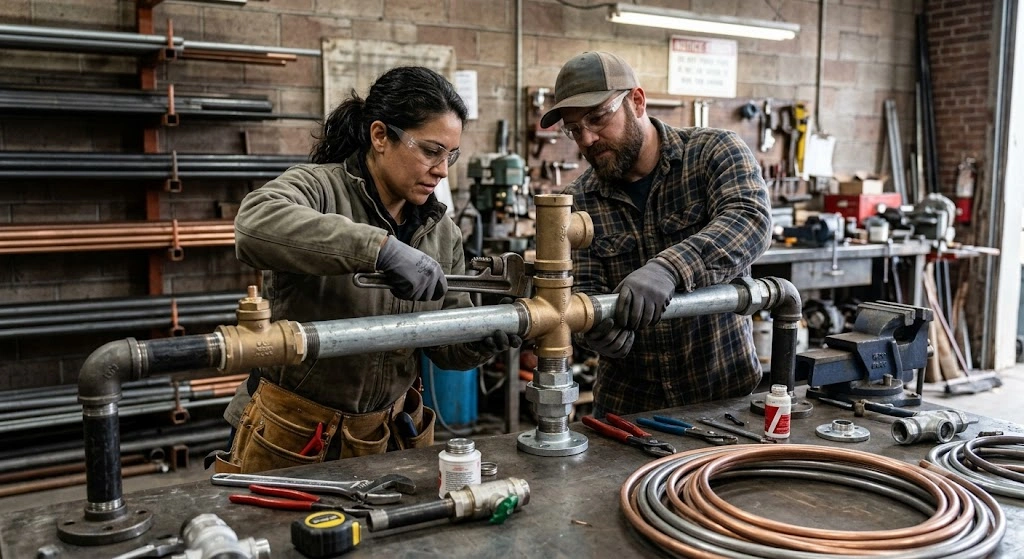
Most plumbing and pipeline failures don’t start with the pipe itself—they often occur at the joints. This Pipe Fittings 101 HDPE & PVC guide has been created because choosing the wrong fitting, or incorrectly installing the right one, is among the most common and preventable causes of leaks, blockages, and premature system failures in Pakistani construc
Whether you’re routing HDPE for a tube well main or PVC for household drainage, this guide walks through the main fitting types, what each one is actually for, and how to avoid the mismatches that quietly cause problems later.
Why Fitting Choice Matters as Much as Pipe Choice
A pipe is only as reliable as its weakest joint. Fittings have to match:
The pipe material — HDPE fittings and PVC fittings aren’t interchangeable, since jointing methods differ completely.
The pressure class — a fitting rated below the pipe’s pressure class becomes the system’s weak point, regardless of how good the pipe itself is.
The application — a fitting suited for drainage isn’t Researching pressure rated water supply, even in the same material.
HDPE Pipe Fittings Guide: Types and Uses
This HDPE pipe fittings guide covers the three main jointing approaches used with HDPE pipe:
Butt-Fusion Fittings
Used for joining two pipe ends directly, heated and pressed together to form a continuous, seamless connection. Common for long, straight runs of larger-diameter pipe — transmission mains, tube well rising mains — where no separate fitting material is needed at all, just the pipe ends themselves.
Electrofusion Fittings
Fittings with an embedded heating coil that fuses to the pipe when an electric current passes through it via a control box. Ideal for:
Branch connections and tee-offs from a main line
Repairs and tie-ins where a butt-fusion machine’s clamping setup isn’t practical
Elbows, reducers, and end caps in smaller-diameter systems
Compression Fittings
Mechanical fittings that clamp onto the pipe without any heat at all. These are fast to install and don’t require specialized equipment, making them common for:
Small-diameter household service connections
Temporary or easily accessible connections
Situations where fusion equipment isn’t available on-site
A practical rule: for permanent, high-pressure, buried connections, fused joints (butt-fusion or electrofusion) are generally preferred over compression fittings, since fusion produces a joint with no mechanical parts that can loosen over time.
PVC Fittings Uses: Types and Applications
Common PVC fittings uses fall into two broad jointing categories:
Solvent Cement (Glued) Fittings
The most common PVC jointing method — a chemical bond forms between pipe and fitting when solvent cement is applied to both surfaces. Typical fittings in this category include:
Elbows (45° and 90°) — for direction changes in drainage and plumbing runs
Tees — for branch connections
Couplers — for joining two straight pipe lengths
Reducers — for stepping down pipe diameter along a run
End caps — for sealing off unused branches
Rubber-Ring (Push-Fit) Fittings
Used mainly for larger-diameter buried sewer and drainage mains, where slight flexibility at the joint helps accommodate ground movement without stressing a rigid glued connection. Common in uPVC drainage pipe systems for housing society and municipal sewerage projects.
Quick Reference: Fitting Types by Application
| Application | Recommended Fitting Type |
|---|---|
| Tube well rising main (HDPE) | Butt-fusion for main runs, electrofusion for branches |
| Household water connection (HDPE) | Compression or electrofusion |
| Household drainage (PVC) | Solvent cement |
| Underground sewer main (PVC) | Rubber-ring push-fit |
| Repairs/tie-ins on existing HDPE line | Electrofusion |
Common Fitting Mistakes to Avoid
Mixing pressure classes — using a lower-rated fitting on a higher-rated pipe creates a weak point regardless of the pipe’s own strength.
Wrong jointing method for the application — using solvent cement fittings on a buried, ground-movement-prone sewer main instead of rubber-ring joints, increasing crack risk over time.
Incompatible material grades — attempting to electrofuse a fitting to pipe from a different material grade (e.g., PE80 fitting on PE100 pipe) without confirming fusion parameter compatibility.
Skipping proper solvent cement application — uneven or insufficient cement coverage on PVC joints is one of the most common causes of slow leaks in drainage systems.
Ignoring bead/joint inspection — for fused HDPE joints, an irregular fusion bead is a visible warning sign that shouldn’t be backfilled without addressing it first.
Standards and Certification to Check
Whichever fitting type your project uses, verify:
PSQCA certification mark, confirming compliance with the relevant Pakistan Standard for the specific fitting type and material.
Matching pressure/SDR rating between pipe and fitting — never assume compatibility just because the diameter matches.
Manufacturer’s ISO 9001:2015 certification, reflecting consistent quality control across production batches for both pipe and fittings.
Compatible fusion parameters for electrofusion fittings, confirmed against both the fitting and pipe manufacturer’s specifications.
You can review NewTech-Pipes’ quality control standards as a reference for the documentation a certified manufacturer should provide for both pipe and fittings.
How to Choose the Right Fitting for Your Project
Confirm pipe material first — HDPE and PVC fittings are never interchangeable.
Match the pressure/stiffness class of the fitting to the pipe, not just the diameter.
Consider burial and ground movement — rubber-ring or fused joints for buried, hard-to-access lines; solvent cement or compression fittings for accessible, lower-stress connections.
Source pipe and fittings from the same certified manufacturer where possible, reducing the risk of compatibility issues between different suppliers’ tolerances.
Conclusion
Choosing the right fitting is just as important as choosing the right pipe — a mismatched or poorly installed fitting becomes the system’s weakest point regardless of pipe quality. This pipe fittings 101 overview should help you match the correct jointing method to your specific HDPE or PVC application before you start ordering. NewTech-Pipes manufactures HDPE pipes and fittings alongside PVC pipes, giving contractors matched, certified components for reliable joints across every application.
Frequently Asked Question's
Butt-fusion joins two pipe ends directly using a heater plate, ideal for long straight runs. Electrofusion uses a fitting with an embedded heating coil to join pipe and fitting, better suited for branch connections, tie-ins, and repairs.
Common PVC fittings uses include elbows for direction changes, tees for branch connections, couplers for joining straight lengths, and reducers for diameter changes — all typically joined using solvent cement for indoor and accessible drainage runs.
No. HDPE and PVC use completely different jointing methods — heat fusion versus solvent cement or mechanical clamping — and their fittings are not interchangeable between the two materials.
Failures usually come from installation errors rather than the fitting itself — poor facing, incorrect heater temperature, rushed cooling time, or mismatched material grades between pipe and fitting are the most common causes.
For a permanent, pressurized tube well rising main, electrofusion or butt-fusion is generally preferred for long-term reliability. Compression fittings are more suited to smaller, easily accessible connections where fusion equipment isn’t practical on-site.