Choosing the wrong jointing method for an HDPE pipeline can result in more than unnecessary costs—it may cause a failed pressure test, a rejected utility inspection, or a leak that becomes costly and difficult to access once the pipeline is buried. The Compression Fittings vs Butt-Fusion Fittings decision is important for nearly every HDPE project in Pakistan, ranging from a single household water connection to a multi-kilometre gas distribution main. The most suitable option ultimately depends on factors such as pipe diameter, operating pressure, and the expected joint performance throughout the pipeline’s service life or dealership.
This guide walks through how each method works, where each one is required or restricted under common Pakistani utility standards, and how to decide which fits your specific job. Whether you’re a contractor pricing a housing-society water line or a distributor stocking fittings for gas service connections, understanding this HDPE joint methods comparison will save you rework and help you spec the job correctly the first time.
What Compression Fittings Are and How They Work
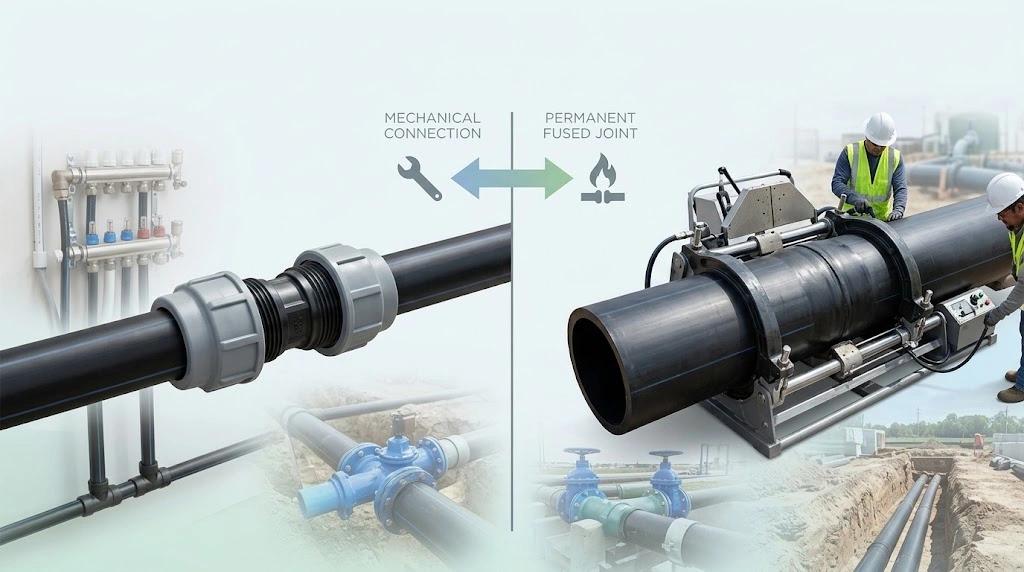
Compression fittings connect HDPE pipes mechanically instead of using heat fusion. A typical compression fitting consists of a body, a compression ring (also known as an “olive”), and a nut that tightens around the end of the pipe. This creates a secure grip and seal without melting or heating the pipe material.
Key characteristics:
- No electricity or heat source required — the joint is made with hand tools or a torque wrench
- Reusable in many designs — some compression fittings can be disassembled and reused, unlike a fused joint
- Fast to install — a single connection can be made in minutes, which matters on service-connection work where dozens of joints happen in a day
- Size range — compression fittings and clamp saddles are generally used on smaller-diameter HDPE and MDPE pipe, commonly from around 16mm up to 110mm OD (up to roughly 200mm for clamp saddles), and are rated for pressures suitable for typical drinking-water and low-to-medium-pressure service applications
Because the joint relies on mechanical compression rather than a homogeneous weld, correct torque and pipe preparation (a clean, square-cut pipe end) matter more than they might appear to. An under-tightened compression joint is one of the more common causes of slow leaks on small-diameter service lines.
What Butt-Fusion Fittings Are and Why Joint Quality Matters
Butt-fusion fittings work on a completely different principle. Two clean, matched pipe (or fitting) ends are heated on a heater plate until the material reaches melting temperature, then pressed together under controlled pressure and held until the joint cools. Done correctly, the result isn’t really a “joint” in the traditional sense — it’s a continuous piece of HDPE, with the fused zone often as strong as, or stronger than, the pipe wall itself.
This is why butt fusion is the default method for:
- Larger-diameter pipe, typically from 63mm up through 630mm
- Higher-pressure systems, including most municipal water mains and gas distribution lines
- Permanent, buried infrastructure where a joint failure years later would be extremely costly to access and repair
Because the weld quality depends entirely on process control — correct heater plate temperature, fusion pressure, alignment, and cooling time — butt fusion is normally done with a calibrated fusion machine and a trained operator, not by hand. NewTech’s HDPE Butt-Fusion Welding Machines are built for exactly this kind of controlled, repeatable process. A poorly executed butt-fusion joint (misaligned pipe ends, insufficient cooling time, contaminated pipe surface) can look acceptable visually but fail under pressure, which is why utilities and PEC-supervised projects often require documented welder qualifications and joint records — see this HDPE Butt-Fusion Welding Guide for the step-by-step process and common mistakes to avoid.
Compression Fittings vs Butt Fusion Fittings: Side-by-Side Comparison
Factor | Compression Fittings | Butt-Fusion Fittings |
Typical size range | ~16mm–110mm (up to 200mm for clamp saddles) | 63mm–630mm |
Equipment needed | Hand tools / torque wrench | Calibrated butt-fusion welding machine |
Skill/training required | Basic training | Trained, often certified operator |
Installation speed | Fast — minutes per joint | Slower — includes heating and cooling cycle |
Joint strength | Mechanical seal, dependent on correct torque | Homogeneous weld, effectively part of the pipe |
Reusability | Often reusable/adjustable | Permanent — cannot be disassembled |
Typical use case | Service connections, meter takeoffs, small branch lines, low-to-medium pressure | Mains, trunk lines, gas distribution, high-pressure or large-diameter systems |
Common standard reference | ISO 4427 (compatible with PE80/PE100 pipe) | ISO 4427, DIN 8075 |
Neither method is universally “better” — each is engineered for a different part of the system. Most real projects, especially larger ones, use both: butt-fusion fittings for the main pipeline and compression fittings for individual service connections and takeoffs.
Where Each Method Is Required (Not Just Preferred)
On gas distribution networks, the choice between these two pipe jointing methods is not simply a matter of convenience—it is often determined by utility specifications. Pressure mains generally require butt fusion or electrofusion, while Compression Fittings are typically limited to smaller-diameter, lower-pressure service connections. Water utility and WASA-supervised projects follow a similar approach: trunk and distribution mains are usually joined using fusion welding, whereas individual household connections more commonly use compression fittings because they are quicker to install and provide easier access for future maintenance.
This matters practically: specifying compression fittings on a pressure main to save installation time isn’t a shortcut — on a regulated utility project, it’s typically a non-compliant joint that will fail inspection, and on any project it introduces a mechanical joint into a system engineers specifically design around continuous, welded pipe runs.
Cost and Lead-Time Considerations
Fitting cost is often forgotten in early project budgeting, but it typically adds a meaningful share — commonly in the range of 15–35% — on top of the pipe material cost, depending on how many connections the layout requires. The two jointing methods differ in where that cost shows up:
- Compression fittings usually carry a higher per-unit cost for the fitting itself relative to pipe size, but installation is fast and needs no specialised equipment rental, which keeps labour cost down on jobs with many small connections — think hundreds of household service takeoffs across a housing scheme.
- Butt-fusion fittings are generally more cost-efficient per joint at larger diameters, since a single fused connection can span a large pipe cross-section, but the job requires a calibrated fusion machine (owned or rented) and a trained operator, which adds fixed cost regardless of how many joints are made that day.
For budgeting purposes, it’s worth pricing fittings into the bill of quantities from day one rather than treating them as an afterthought once the pipe order is placed — a common and costly mistake on Pakistani project sites where the pipe rate gets quoted but the connection hardware doesn’t.
A Practical Example: A Housing-Society Water Supply Project
Consider a mid-sized housing-society development on the outskirts of Lahore, laying a new water distribution network across several phases. The project engineer specifies HDPE PE100 pipe for the main distribution lines — 110mm and 160mm diameter — running from the overhead tank through the site.
For these mains, butt-fusion fittings are the correct choice: the lines are buried, under continuous pressure, and any future leak would mean digging up a paved road inside a live housing scheme. But for the individual household service connections branching off the main — hundreds of small 20mm–32mm takeoffs — compression fittings and saddle clamps make more sense. They install quickly without heat equipment on-site at each house, and if a meter or connection ever needs to be serviced, the fitting can be worked on without cutting into the fused main line.
This is a typical real-world split: fusion for the backbone, compression for the branches. Getting this mix right on the bill of quantities from the design stage avoids expensive re-ordering mid-project.
FISH Compression Fittings in Pakistan: What to Look For
Not all compression fittings on the market are made to the same standard, and this is one area where buyers should look closely before ordering in bulk. Genuine compression fittings compatible with PE80 and PE100 pipe under ISO 4427 use specific ring and body tolerances designed to grip HDPE Pipes & Fittings without over-stressing the pipe wall — a mismatch here is a common cause of field leaks that get blamed on “bad pipe” when the fitting was actually the problem.
NORMA Group’s FISH compression fittings, distributed exclusively in Pakistan through NewTech-Pipes, are one option engineered specifically for HDPE and MDPE pipe across the 16mm–110mm (200mm for clamp saddles) range, built to resist chemical etching and UV degradation over the life of the connection. When evaluating FISH compression fittings Pakistan availability or any compression fitting brand, ask the supplier for the specific pressure rating, confirm ISO 4427 compatibility with your pipe grade (PE80 vs PE100), and check that the fitting size genuinely matches your pipe’s outside diameter rather than assuming compatibility across brands.
How to Decide Which Method Fits Your Project
A few practical questions can settle most compression fittings vs butt fusion fittings decisions quickly:
- What’s the pipe diameter? Below roughly 110mm, compression is often viable; above that, butt fusion is generally the only practical option.
- What’s the operating pressure and is this a utility-regulated line? Gas mains and most water trunk lines require fusion; check the relevant utility specification before defaulting to compression for cost or speed.
- Will this joint need future maintenance access? If a connection may need to be reopened (a meter, a branch takeoff), compression’s reusability is an advantage.
- Is this permanent, buried, high-consequence infrastructure? If a failure would be costly or dangerous to access later, the homogeneous strength of a fused joint is usually worth the extra installation time.
- Do you have access to a calibrated fusion machine and a trained operator? If not, and the job calls for fusion, budget for renting equipment or hiring a specialist crew rather than improvising with mechanical fittings outside their rated range.
For a broader look at fitting types beyond just these two jointing methods, see NewTech’s Pipe Fittings 101 Guide, which also covers electrofusion and PVC fittings.
Conclusion
There’s no single “better” option in the compression fittings vs butt fusion fittings debate — the right joint method depends on pipe diameter, pressure, and how permanent the connection needs to be. Compression fittings earn their place on smaller service connections where speed and future access matter; butt fusion is built for mains and high-pressure lines where a continuous, welded joint is worth the extra installation step. NewTech-Pipes, as an ISO 9001 & PSQCA Certification-verified manufacturer producing both its own PLAST-1 butt-fusion fittings and distributing NORMA Group’s FISH compression fittings, supplies both jointing systems to standard, so contractors can spec the right method for each part of a project rather than compromising on either.
Frequently Asked Question's
Only on small-diameter, low-pressure service connections — most gas utility specifications restrict compression fittings to connections below roughly 63mm at pressures under 2 bar. Pressure mains require butt fusion or electrofusion. Always confirm against the relevant utility’s technical specification before installing.
For their intended use, yes — a correctly made butt-fusion joint becomes a continuous, homogeneous piece of HDPE, generally as strong as the pipe itself. Compression fittings rely on mechanical grip and sealing, which is reliable within their design range but isn’t the same as a welded joint.
No heating equipment is needed — basic hand tools or a torque wrench are usually sufficient, along with a proper pipe cutter for a clean, square end. This is why compression fittings are popular for fast service-connection work compared to butt fusion, which requires a calibrated welding machine.
Yes, and it’s common practice — many projects use butt-fusion fittings for the main pipeline and compression fittings for individual service connections and branch takeoffs. What matters is using each method within its correct diameter and pressure range, not choosing one method exclusively.
FISH compression fittings and clamp saddles, distributed in Pakistan by NewTech-Pipes, cover polyethylene pipe from approximately 16mm up to 110mm outside diameter (up to around 200mm for clamp saddles), compatible with PE80 and PE100 pipe conforming to ISO 4427.