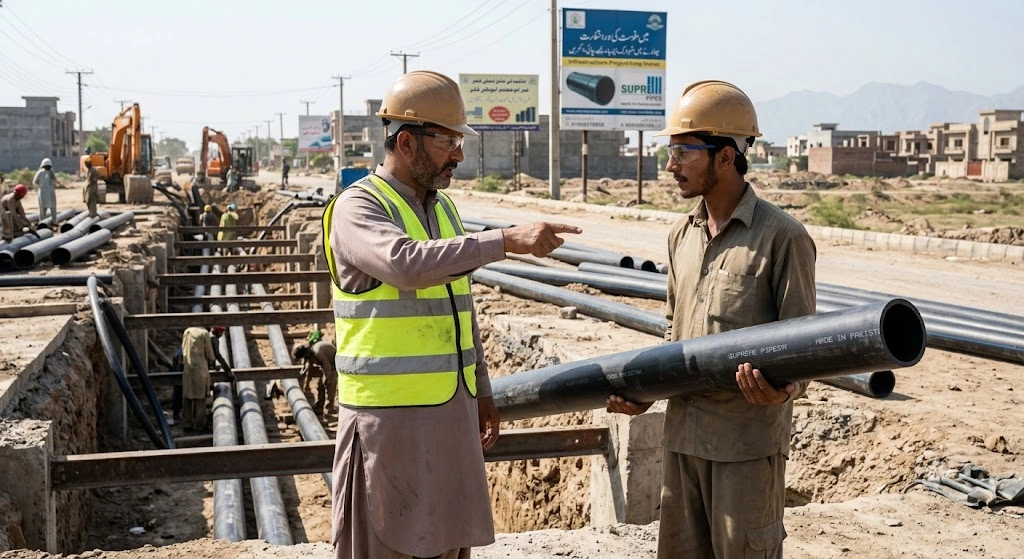
Pakistan s pipe industry has quietly emerged as one of the more resilient areas of the country’s manufacturing sector, continuing to remain stable despite years of wider economic uncertainty. Understanding the reasons behind this resilience — and identifying where growth is actually concentrated — is important for contractors planning bulk purchases, distributors considering new markets, and anyone looking to understand the recent changes in pipe availability and pricing.
This guide looks at what’s driving growth across the plastic pipe industry Pakistan-wide, how the pipe manufacturing sector Pakistan relies on, and where the real opportunities and risks sit heading into the rest of 2026.
Why Pakistan’s Pipe Industry Is Growing
Several structural forces are converging to drive sustained demand:
Construction sector recovery: Pakistan’s construction industry value-add grew sharply by 17.6% year-on-year in Q2 2025, and registers an impressive overall recovery of 5.73% for the FY2025-26 period (rebounding from a modest 1.14% in the previous fiscal year).
Rising cement dispatches: A reliable proxy for overall construction material demand, cement dispatches climbed 7.21% to 50.52 million tons in FY26, driven directly by construction recovery, lower policy rates, and easing inflation.
Urbanization: Pakistan’s population reached approximately 252 million during FY25-26. With the urban population forecast to reach half the country’s total by 2030, the demand for residential housing, municipal water supply, and drainage infrastructure remains structurally high.
Infrastructure mega-projects: Major projects funded under the Public Sector Development Program (PSDP) — which allocated PKR 1 trillion for FY25-26 (with over PKR 682 billion earmarked for infrastructure) — are driving bulk demand. These include highways, metro transit systems, and water supply projects that require massive underground utility networks.
Aging infrastructure replacement: Older housing stock and municipal lines running legacy GI pipes are reaching the end of their service lives and are being replaced with modern, corrosion-free plastic alternatives.
The Plastic Pipe Industry Pakistan Relies On
The plastic pipe industry Pakistan relies on today encompasses several material categories, with each one designed to meet specific applications and requirements:
| Material | Primary Applications |
| PVC | Drainage, sewerage, cold water plumbing |
| HDPE/MDPE | Water supply mains, tube wells, gas distribution |
| PPRC | Indoor hot and cold water plumbing |
| PP (Polypropylene) | Various industrial and specialty applications |
This segment offers lightweight, corrosion-resistant, and cost-effective alternatives to legacy metal and concrete piping. The shift toward these materials has accelerated as urbanization, irrigation expansion, and water infrastructure investment have all increased the practical need for durable, low-maintenance pipe solutions.
The Pipe Manufacturing Sector Pakistan: Structure and Challenges
The pipe manufacturing sector Pakistan operates within a specific set of structural realities:
Raw Material Dependency
Both PVC and HDPE/PE pipe production depend on petrochemical resin, much of which is imported or tied to global oil markets. This makes the sector’s cost structure inherently linked to crude oil price movement and rupee-dollar exchange rate fluctuations — a manufacturer’s pricing can shift meaningfully even without any change in local demand.
Cyclical Sensitivity
Market growth in this sector has historically correlated closely with cycles in public sector development spending and private construction activity. Periods of high GDP growth and major infrastructure investment have driven strong demand, while economic slowdowns and fiscal constraints have periodically dampened it. This cyclicality means manufacturers and distributors need to plan inventory and capacity with real flexibility rather than assuming linear year-over-year growth.
Margin Pressure from Resin Volatility
Frequent price changes in PVC and HDPE resin, driven by crude oil and broader petrochemical market conditions, make cost planning genuinely difficult across the industry. When construction demand softens, manufacturers often can’t fully pass higher input costs onto buyers, creating margin pressure that eventually shows up as consolidation or quality-cutting among less disciplined producers — one more reason certification verification matters regardless of which supplier a buyer chooses.
Export Opportunities and Realities
Pakistan’s plastic pipe and fitting exports have seen mixed performance in recent years, generally tracking the same cyclical patterns as domestic construction demand rather than following an independent growth trajectory. Export competitiveness in this sector depends heavily on:
Consistent PSQCA and international standard compliance (ISO 4427, ISO 4437, DIN references), since export buyers typically require documented certification rather than accepting a general quality claim.
Currency-driven cost competitiveness, where rupee depreciation can make Pakistani-manufactured pipe more price-competitive in regional export markets, though this is offset by the resin import cost also being currency-sensitive.
Regional demand from neighboring and nearby markets, where infrastructure development needs parallel Pakistan’s own, though this remains a smaller share of total sector output compared to domestic consumption.
For most manufacturers, the domestic market — driven by construction, agriculture, and infrastructure — remains the dominant revenue base, with export activity as a supplementary opportunity rather than the primary growth driver.
Opportunities Within the Sector
For buyers, distributors, and industry participants, several practical opportunities stand out:
Certified manufacturers are gaining share as buyer awareness of PSQCA and ISO documentation grows, particularly on WASA and utility-regulated projects that require it as a prerequisite.
Regional distribution expansion beyond the traditional Karachi/Lahore industrial concentration is picking up as urbanization spreads to secondary cities.
Material substitution demand — the continued replacement of GI pipe with HDPE, PVC, and PPRC in both new construction and renovation projects.
Infrastructure-linked bulk demand tied to specific mega-project timelines (rail, road, housing schemes), which can be planned for in advance given public project announcement cycles.
What This Means for Buyers
Contractors and developers should expect continued resin-price-driven cost volatility regardless of local construction volume, and should lock in bulk pricing where project timelines allow flexibility.
Distributors evaluating expansion should weigh both the growth opportunity in secondary cities and the structural cyclicality tied to public development spending cycles.
All buyers should prioritize certified pipe from manufacturers who maintain consistent quality control, since margin pressure across the sector can push less disciplined producers toward cutting corners on wall thickness or skipping proper testing.
You can review NewTech-Pipes’ quality control standards and company background as an example of the documentation and manufacturing consistency a reliable supplier should demonstrate regardless of broader market conditions.
Conclusion
Pakistan’s pipe industry is benefiting from a genuine construction recovery, sustained urbanization, and ongoing material substitution away from legacy GI pipe — though it remains structurally sensitive to resin costs and public development spending cycles. For buyers and distributors, the opportunity lies in certified, consistent supply that can weather this cyclicality rather than chasing the lowest short-term price. NewTech-Pipes operates as an ISO 9001:2015-certified manufacturer, producing HDPE, PVC, PPRC, and MDPE pipe to relevant PSQCA and ISO standards, positioned to serve this growing market with documented quality consistency.
Frequently Asked Question's
Yes — the sector is benefiting from a broader construction recovery, with construction value-add growing sharply and registering 5.73% growth for FY25-26, supported by municipal infrastructure, private residential housing, and urbanization trends.
PVC and HDPE resin costs, which are tied to global crude oil prices and rupee-dollar exchange rates, are the primary pricing drivers, often more influential on short-term pricing than local construction demand alone.
Yes, though export performance has been mixed and generally tracks domestic construction and economic cycles rather than growing independently. Export competitiveness depends heavily on certification compliance and currency-driven cost positioning.
PVC, HDPE/MDPE, and PPRC dominate, covering drainage, water supply, gas distribution, and indoor plumbing respectively, with material choice driven by application-specific pressure, temperature, and corrosion requirements rather than one material replacing all others.
Because raw material (resin) costs are tied to global oil markets and currency movement, pipe pricing can shift meaningfully even without any change in local construction demand, making same-day quotes more reliable than relying on previous months’ pricing.