You’re pricing a pipeline for a housing society in Lahore, a tube well network in Bahawalpur, or a water supply main in Rawalpindi — and the moment you ask three different suppliers for HDPE pipe rates, you get three completely different numbers. That’s not a coincidence. It’s a market where grade, SDR value, certification, and diameter each move the price independently, and most rate lists you find online are six months out of date.
Pakistan’s construction sector expanded at 5.2% in FY2023 (Pakistan Bureau of Statistics), and infrastructure-linked pipe demand — particularly polyethylene — has tightened supply and shifted prices upward since late 2024. If you’re budgeting a project right now, you need current, specific numbers, not ballpark estimates.
This guide gives you the 2026 HDPE pipe price in Pakistan broken down by size, SDR, and grade — along with the technical factors that explain why prices differ, so you can stop comparing apples to oranges and start specifying the correct pipe for your project.
What Determines HDPE Pipe Price in Pakistan 2026?
HDPE pipe price in Pakistan in 2026 is driven by four factors: pipe diameter (mm), wall thickness or SDR rating, raw material grade (PE80 vs PE100), and certification status (PSQCA, ISO). Larger diameter, lower SDR number (thicker wall), and PE100 grade all increase cost per meter. Buying PSQCA-certified pipe adds a 10–18% premium but is mandatory on WASA and PEC-regulated projects.
Understanding these variables is the difference between winning a project bid and losing money on it. Here’s how each factor works in practice:
Pipe Diameter (mm)
HDPE pipes for water supply are available from 20mm (residential branch lines) up to 630mm (main transmission mains). Price scales roughly with the cross-sectional area of material — so going from 110mm to 160mm is not a small jump. NEWTECH’s DuraPE series covers the full range from 20mm through 630mm, conforming to ISO 4427 for water supply and ISO 4437 for gas applications.
SDR Rating (Standard Dimension Ratio)
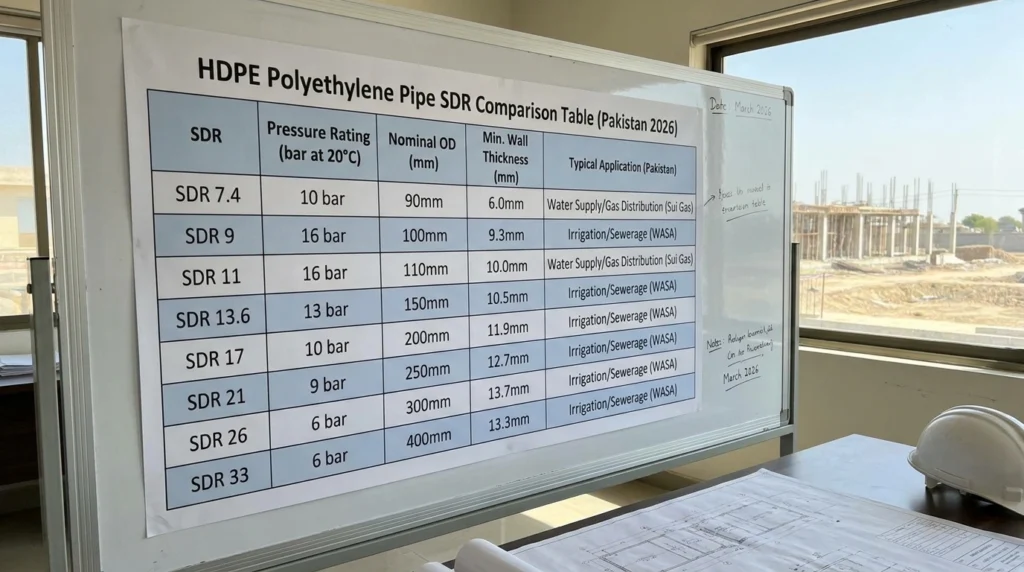
SDR is the ratio of pipe outer diameter to wall thickness. Lower SDR = thicker wall = higher pressure rating = higher cost per meter. The most common SDR selections for Pakistani projects:
- SDR 26 — PN 6.3 bar — low-pressure gravity sewers, irrigation canals
- SDR 17 — PN 10 bar — municipal water mains, tube well rising mains
- SDR 13.6 — PN 12.5 bar — industrial process lines, high-pressure irrigation
- SDR 11 — PN 16 bar — gas distribution (SNGPL/SSGC networks), high-rise buildings
PE80 vs PE100 Grade
PE100 is the current preferred grade globally and required on most WASA, PEC, and donor-funded projects in Pakistan. It delivers higher long-term hydrostatic strength (MRS = 10 MPa vs 8 MPa for PE80), meaning you can use a thinner-walled pipe at the same pressure rating — which partially offsets its higher resin cost. NEWTECH manufactures both grades, with PE100 conforming to ISO 4427 Part 2.
⚙️ Expert Insight from NEWTECH One of the most common mistakes we see on housing society projects in Karachi and Islamabad is contractors specifying PE80 SDR 17 to save cost, then facing failures within 3–4 years on chlorinated water networks. PE100 SDR 17 at the same pressure rating actually has a thinner wall, so the per-meter weight is lower — and the material savings partially cover the resin upgrade. Always check your pressure requirement and service life expectation before selecting grade, not just the unit price per meter.
HDPE Pipe Rate List Pakistan 2026 — Size-Wise Price Table
The table below shows indicative HDPE pipe prices in Pakistan for 2026, based on PE100 grade, SDR 17 (PN 10 bar), per meter supply rate in PKR. Prices vary ±8–12% by city (Karachi tends to run slightly higher due to logistics), and bulk orders above 500 meters typically attract 5–10% volume discounts. Contact NEWTECH directly for project-specific pricing.
| Pipe Size (OD mm) | Approx. Weight (kg/m) | PKR/meter (PE100 SDR17) | PKR/meter (PE100 SDR11) | Common Application |
|---|---|---|---|---|
| 20mm | 0.11 | 120 – 160 | 175 – 230 | Domestic branch, drip irrigation |
| 25mm | 0.17 | 160 – 210 | 230 – 300 | Residential supply, micro-irrigation |
| 32mm | 0.28 | 230 – 290 | 330 – 410 | Courtyard mains, garden supply |
| 40mm | 0.43 | 340 – 420 | 490 – 600 | Small commercial, tube well laterals |
| 50mm | 0.67 | 510 – 620 | 730 – 890 | Agricultural irrigation, DHA laterals |
| 63mm | 1.07 | 790 – 960 | 1,140 – 1,380 | Municipal branch mains, housing intake |
| 75mm | 1.51 | 1,100 – 1,340 | 1,590 – 1,930 | Tube well rising main (3–5 cusec) |
| 90mm | 2.18 | 1,590 – 1,930 | 2,290 – 2,780 | WASA distribution main, factory supply |
| 110mm | 3.25 | 2,370 – 2,880 | 3,410 – 4,140 | Housing society trunk main |
| 125mm | 4.21 | 3,070 – 3,730 | 4,420 – 5,370 | Bahria Town/DHA transmission |
| 160mm | 6.91 | 5,040 – 6,120 | 7,260 – 8,820 | Canal offtake, industrial supply |
| 200mm | 10.79 | 7,870 – 9,560 | 11,330 – 13,760 | Large housing society trunk |
| 250mm | 16.85 | 12,290 – 14,930 | 17,700 – 21,490 | Municipal sub-transmission |
| 315mm | 26.76 | 19,530 – 23,720 | 28,120 – 34,160 | Main transmission pipeline |
| 400mm | 43.14 | 31,490 – 38,240 | 45,340 – 55,090 | Large industrial / city feeder main |
| 500mm | 67.40 | 49,200 – 59,760 | — | Municipal transmission |
| 630mm | 107.00 | 78,110 – 94,920 | — | Major city trunk mains |
Prices are indicative Ex-Factory (Islamabad region), exclusive of GST, transportation, and fittings. PE100 grade, ISO 4427 compliant. Rates updated Q1 2026. Request confirmed pricing from NEWTECH’s sales team.
HDPE Pipe Prices in Lahore, Karachi, and Islamabad — Are They Different?
Yes — HDPE pipe rates vary by 6–14% across Pakistani cities, primarily due to transportation cost and local competition. Lahore and Islamabad/Rawalpindi are closest to most manufacturers, so prices there tend to be the reference point. Karachi, Peshawar, Multan, and Faisalabad add freight surcharges. In remote areas like Bahawalpur or Dera Ismail Khan, transportation can add 8–12% to the base rate.
Here’s what drives city-level price differences in 2026:
Lahore & Islamabad/Rawalpindi
These markets are closest to the Lahore-Islamabad corridor where most major pipe manufacturers — including NEWTECH’s Islamabad-region operations — are based. Prices here are typically at or near ex-factory rates plus minimal freight. For projects like DHA Phase 9, Bahria Town Islamabad, or Green Gulberg Lahore, buyers can often arrange direct factory pickup or minimal freight deliveries.
Karachi
Pakistan’s largest port city has its own pipe manufacturing base, but large-diameter HDPE and specialized grades (PE100 SDR 11 for gas) often come from Punjab-based manufacturers. Expect 8–12% freight premium on large-diameter pipes. NEWTECH has supplied projects in Karachi’s industrial zones and has established distributor relationships there — contact the team for Karachi-specific rates.
Multan, Faisalabad, Bahawalpur
Agricultural regions where irrigation pipe demand is highest. 63mm–200mm SDR 17 PE100 pipes for tube wells and canal distribution networks are the most common requirement here. Prices here sit 6–10% above Lahore/Islamabad reference rates. MDPE pipes (20mm–160mm) for underground gas networks per SNGPL specification are also common in Faisalabad and Multan.
According to the Pakistan Agricultural Research Council, Pakistan operates over 1.3 million tube wells — one of the highest concentrations globally — making agricultural-grade HDPE pipe among the fastest-moving product segments in Punjab and Sindh.
Which HDPE Pipe Grade Should Your Project Specify — PE80 or PE100?
For any new project in Pakistan in 2026, specify PE100 as your default unless your budget is tightly constrained and your operating pressure is below 6 bar. PE100 meets ISO 4427 and PSQCA requirements, is accepted by PEC and WASA, and delivers better chemical resistance, faster fusion speed, and higher long-term strength. PE80 remains viable for low-pressure irrigation and non-critical drainage applications.
The specification decision has direct consequences for your HDPE pipe price in Pakistan because PE100 allows thinner walls at the same working pressure — so the cost gap is narrower than it appears.
PE100 in Practice
At SDR 17 (PN 10 bar), a PE100 110mm pipe weighs 3.25 kg/m. The PE80 equivalent at the same pressure rating needs SDR 13.6, weighing 3.97 kg/m — costing more in material despite being a lower grade. This is the key insight most procurement teams miss: PE100 is not always more expensive on a like-for-like pressure basis.
NEWTECH’s DuraPE range in PE100 conforms to ISO 9001:2015 manufacturing standards and ISO 4427 product standards, with third-party PSQCA certification. This certification is now required on WASA contracts across Lahore, Karachi, and Islamabad — projects using non-PSQCA pipes risk rejection at inspection.
PE80 — When It Still Makes Sense
PE80 SDR 26 (PN 6.3 bar) remains the economical choice for gravity irrigation distribution laterals, subsurface drainage, and low-pressure agricultural supply lines where inspection requirements are limited. For a 10-hectare drip irrigation project in Bahawalpur, specifying PE80 SDR 26 in 63mm–110mm diameters can reduce pipe cost by 22–28% versus PE100 SDR 17 with minimal performance compromise.
For product details, visit NEWTECH’s HDPE Pipes & Fittings page.
HDPE Pipe vs uPVC Pipe — Which Costs Less Over 20 Years in Pakistan?
Over a 20-year lifecycle, HDPE pipe consistently outperforms uPVC on total cost in Pakistani conditions. Initial HDPE pipe rates are 15–30% higher than comparable uPVC for the same diameter, but HDPE eliminates joint leakage (no solvent cement joints, butt fusion only), resists UV and soil movement, and survives the temperature swings common in Pakistani climates (−20°C to +60°C surface conditions) without cracking. uPVC becomes brittle in exposed runs above 40°C.
This comparison matters because most contractors in Pakistan still default to uPVC for buried water supply lines 63mm–160mm. Here’s why that calculus is shifting:
Installation and Joint Integrity
HDPE pipes ≥63mm use butt fusion or electrofusion welding — creating a monolithic joint that is as strong as the pipe body. uPVC relies on solvent cement or rubber ring joints, which are the #1 source of leakage in Pakistan’s municipal networks. The World Bank’s Pakistan Water Supply Sector Assessment (2022) noted that joint failure accounts for 38% of non-revenue water losses in urban distribution networks — virtually all from non-PE piping systems.
Ground Movement Resistance
Karachi’s expansive soils, Lahore’s high groundwater zones, and the seismically active Islamabad/Rawalpindi belt all impose significant ground movement stress on buried pipes. HDPE’s elongation at break exceeds 600% (ISO 6259), versus uPVC’s 80–100%. For any buried infrastructure in seismic zones or unstable soils, the material comparison is not close.
NEWTECH supplies both uPVC pipes (Class B through E, ½” to 24″) and HDPE in the DuraPE series — the right product depends on your specific project type, and NEWTECH’s technical team can advise on a case-by-case basis.
HDPE Pipe Fittings Price in Pakistan — What to Budget Beyond the Pipe
HDPE fittings — elbows, tees, reducers, end caps, and flanges — typically add 15–35% to your overall pipeline material budget, depending on the number of connections and the fitting type. Butt-fusion fittings are more economical at large diameters (63mm–630mm); compression fittings dominate at small diameters (20mm–63mm). Factor fittings into your bill of quantities from day one.
Many project budgets are blown on fittings because the pipe rate is quoted but fittings are forgotten until the job starts.
Butt-Fusion Fittings (63mm–630mm)
NEWTECH manufactures HDPE butt-fusion fittings under the PLAST-1 brand — elbows (45°, 90°), equal tees, reducing tees, reducers, end caps, and stub flanges — across the full size range 63mm–630mm. These are manufactured to ISO 4427 and DIN 8075 standards.
Indicative 2026 pricing for PE100 butt-fusion fittings:
| Fitting Type | Size | PKR/piece (approx.) |
|---|---|---|
| 90° Elbow | 63mm | 950 – 1,300 |
| 90° Elbow | 110mm | 2,800 – 3,600 |
| 90° Elbow | 160mm | 7,500 – 9,500 |
| Equal Tee | 63mm | 1,400 – 1,800 |
| Equal Tee | 110mm | 4,200 – 5,400 |
| Equal Tee | 160mm | 11,000 – 14,000 |
| Reducer | 110×63mm | 2,200 – 2,900 |
| Stub Flange | 110mm | 2,800 – 3,600 |
Compression Fittings (20mm–63mm)
For small-diameter connections — meter connections, household branch takeoffs, drip irrigation laterals — compression fittings require no heat equipment and are faster to install. NEWTECH supplies compression fittings compatible with HDPE and MDPE pipes per ISO 4437. At 32mm, a standard coupling runs PKR 280–380; a 63mm equal tee runs PKR 900–1,200.
Explore the full fittings range on NEWTECH’s HDPE Fittings page and the Compression Fittings page.
How to Verify HDPE Pipe Quality Before Accepting Delivery in Pakistan
Before accepting any HDPE pipe delivery on a Pakistan project, check four things: the PSQCA certification mark embossed on the pipe body, the pipe identification stripe (blue for water, yellow for gas), the wall thickness at the cut end against the stated SDR, and the batch/heat number linking the pipe to the manufacturer’s test certificate. Substandard pipe without these marks should be rejected immediately.
Pakistan’s market has a persistent problem with substandard polyethylene pipe — especially in the 63mm–200mm agricultural segment. The Pakistan Standards and Quality Control Authority (PSQCA) has issued multiple market surveillance alerts in the past three years covering HDPE pipes failing minimum wall thickness requirements.
Pipe Marking — What to Look For
A compliant HDPE pipe should show continuous marking every 1–2 meters including: manufacturer name, pipe size (OD in mm), SDR rating, pressure rating (PN), material grade (PE100 or PE80), production date/batch number, and the relevant standard (ISO 4427 or PS 3580:1994 for Pakistan Standard).
NEWTECH pipes carry all mandatory markings and include batch-traceable test certificates (hydrostatic, OIT, MFI, carbon black content) on request. For WASA and PEC-approved projects, submit these certificates to your supervising engineer before backfilling.
Site Checks Without a Lab
You can catch many quality issues on-site with a steel ruler: measure wall thickness at the pipe end and compare to the published table for that SDR. An SDR 17 pipe at 110mm OD must have a minimum wall of 6.3mm. If you’re consistently measuring 5.8mm, the pipe is off-spec regardless of what the box says. This single check has saved contractors from multi-million-rupee rework claims.
For bulk procurement and project tendering, request NEWTECH’s technical datasheet and certification documents before finalizing your bill of quantities.
Conclusion
Choosing the right HDPE pipe for a project in Pakistan is a technical and financial decision — and the two are inseparable. Here’s what to take away from this guide:
Four actionable points for your next project:
- Specify PE100 as your default grade. On a pressure-for-pressure comparison, it’s not always more expensive than PE80, and it’s the only grade accepted by WASA, PEC, and most donor-funded infrastructure programs.
- Select SDR based on your actual working pressure — not just what’s cheapest. Undersizing SDR on a 10-bar municipal main is a failure waiting to happen. Oversizing on a 3-bar gravity canal network wastes budget.
- Budget fittings from day one. Add 20–30% to your pipe-only material cost for a realistic fittings budget, particularly if your design has multiple directional changes or branch connections.
- Accept only PSQCA-marked pipe on site. Check embossed markings and request batch test certificates. In 2026, the cost of project failure due to substandard pipe far exceeds the savings from buying cheap.
FAQ SECTION
1: What is the current HDPE pipe price per meter in Lahore in 2026?
In Lahore, HDPE pipe price in Pakistan 2026 ranges from PKR 120–160 per meter for 20mm PE100 SDR 17 up to PKR 78,000–95,000 per meter for 630mm large-diameter mains. Most common sizes for housing society projects — 90mm to 160mm PE100 SDR 17 — run PKR 1,590 to PKR 6,120 per meter, ex-freight. Request a firm quote from your supplier before finalizing BOQ.
2: How long does HDPE pipe last underground in Pakistani conditions?
PE100 HDPE pipe certified to ISO 4427 has a design service life of 50 years at rated pressure and 20°C reference temperature. In Pakistan’s typical buried conditions (ground temperatures 15–25°C), this life expectancy is fully achievable. The pipe’s resistance to soil chemicals, chlorinated water, and ground movement means it outlasts uPVC and GI alternatives by two to three decades with zero maintenance.
3: Is PSQCA certification mandatory for HDPE pipes on WASA projects in Pakistan?
Yes. WASA authorities in Lahore, Karachi, and Islamabad require PSQCA-certified HDPE pipe conforming to Pakistan Standard PS 3580:1994 or ISO 4427 on all funded projects. PEC-supervised projects carry the same requirement. Non-certified pipe is grounds for rejection at inspection. Always obtain and retain the manufacturer’s batch test certificate alongside the PSQCA mark confirmation.
4: What is the difference between SDR 11 and SDR 17 HDPE pipe — and which should I use?
SDR 11 pipe has a thicker wall and a higher pressure rating (PN 16 bar), making it required for gas distribution (SNGPL/SSGC networks) and high-pressure industrial lines. SDR 17 (PN 10 bar) covers the majority of municipal water supply and irrigation projects in Pakistan. Using SDR 11 where SDR 17 suffices adds unnecessary cost; using SDR 17 where the system pressure exceeds 10 bar is a serious engineering error.
5: What is the HDPE pipe price in Pakistan for agricultural tube well connections?
For tube well rising mains in Punjab and Sindh, the most common size is 75mm–110mm PE100 SDR 17. Prices in 2026 range from PKR 1,100–1,340 per meter (75mm) to PKR 2,370–2,880 per meter (110mm), ex-factory. For deep tube wells operating above 8 bar, upgrade to SDR 13.6. Always match pipe pressure rating to your pump’s shutoff head, not just operating head.
6: Which HDPE pipe brand is best in Pakistan for housing society projects?
Look for brands that hold ISO 9001:2015 manufacturing certification, PSQCA product certification, and PEC approval — these are the baseline requirements for any housing society supplying WASA or utility connections. NEWTECH Industries’ DuraPE series meets all three, covers 20mm to 630mm in PE80 and PE100, and has supplied Bahria Town, DHA, and Green Gulberg projects. Certification documents and batch test reports are available on request.