On the morning of 8 October 2005, the ground in northern Pakistan moved, and tens of thousands of lives were lost. The first headlines were about buildings. But in the days that followed, a quieter question dominated relief camps and rebuilt towns: where will the water come from?
Earthquakes do two kinds of damage. The first is what we see: collapsed walls and cracked roads. The second is buried. Water mains snap, gas lines leak, and a city that survived the shaking can still be left without drinking water or safe fuel for weeks. In cold winters or hot summers, that second wave of damage can be as hard on families as the first.
The good news is that part of this risk is a choice. The pipe in the ground, and how it is joined, can make a measurable difference. This guide explains what the evidence says, why flexibility matters, and what contractors, housing societies and homeowners in Pakistan can do about it.
Why Pakistan Needs to Think About Pipes and Earthquakes
Pakistan sits where tectonic plates meet, and seismic hazard is not evenly spread. The national Building Code of Pakistan (Seismic Provisions, 2007) divides the country into zones, from low to high, with design factors rising from 0.075 to 0.4. It was introduced after the 2005 Kashmir earthquake. A hazard study for the code found that seismic hazard is highest in the central and northern parts of the country, with severe hazard around Quetta.
Recent events show that this is not only history. The October 2021 Harnai earthquake in Balochistan, a magnitude 5.9 quake at about 15 km depth, killed at least 22 people and injured more than 300. A Dawn commentary afterwards noted that many water sources were damaged and urgently needed repair, and that 18 water supply schemes had to be rehabilitated.
Note that these are building-code zones for design, not predictions. If you are planning a project, check the zone for your tehsil in the code and ask your engineer how it applies to buried utilities.
How Earthquakes Break Pipes
Underground pipes are rarely damaged by shaking alone. They fail when the ground around them moves. Engineers describe three main mechanisms:
- Wave passage. Seismic waves stretch and compress the soil, and the pipe is dragged with it.
- Permanent ground deformation. Landslides, lateral spreading and settlement shift one section of ground relative to another.
- Saturated sandy soil loses strength and flows like a liquid, so pipes can float, bend or pull apart.
A study of Christchurch, New Zealand, after the 2010 and 2011 earthquakes found that liquefaction caused far more pipe damage than ground shaking alone. That matters for Pakistan, where many towns sit on river plains with high groundwater.
Rigid pipes with short sections and push-in or caulked joints have little room to give. A joint that opens by a few centimetres can leak badly, and the pipe wall can crack. Flexible, continuous pipe can stretch and bend with the ground instead of resisting it.
What the Evidence Shows
Quick answer: for earthquake zones, PE (polyethylene) pipe with fused joints has the strongest track record in field evidence from Japan and New Zealand. It is flexible, its fused joints are as strong as the pipe, and it has performed far better than older brittle pipe in major earthquakes. It is not earthquake-proof, but it is among the most forgiving options for water and gas.
Kobe, 1995
After the 1995 Kobe earthquake, Japanese research found that most gas pipeline damage came from ruptured joints in screw-jointed steel pipes, while no damage was observed in polyethylene pipes. The share of PE pipe installed in Japan has increased since. Japanese water utilities also began adopting PE for water distribution because of that performance. One paper to the Plastic Pipes Conference reports about 31,700 km of PE water distribution pipe installed by 2015.
Christchurch, 2010 and 2011
Researchers studying the Canterbury earthquake sequence concluded that the excellent performance of the gas distribution network was the result of highly ductile polyethylene pipelines. In the same studies, PVC was found to be markedly more resilient than other segmental pipe types in the water system, and a University of Canterbury student study found that older brittle materials (asbestos cement, cast iron, earthenware and reinforced concrete) suffered more damage than PVC and PE in the wastewater network.
Japan survey
A Kubota paper that surveyed PE pipelines after Japanese earthquakes, including the 2003 Tokachi-oki quake of magnitude 8.0, reported no damage to the lengths surveyed. Its conclusion was that PE pipe shows high earthquake resistance except in extreme cases such as tsunami and ground collapse.
Industry view
The Plastics Pipe Institute’s director of engineering has said HDPE is well suited to water and gas lines in areas of regular seismic activity, and pointed to a 2012 Water Research Foundation report that looked at the earthquakes in Chile (2010), Christchurch (2010) and Japan (2011).
A fair caution: much of this evidence comes from manufacturers, trade bodies and utility case studies. It is strong and consistent, but it is not a guarantee. When a fault physically ruptures through the pipe line, or a slope collapses, no pipe will cope without special design.
Why Flexibility Matters: The Engineering in Plain Language
Three properties explain most of PE’s seismic behaviour.
- PE can stretch a long way before it fails. Where brittle pipe cracks, PE deforms.
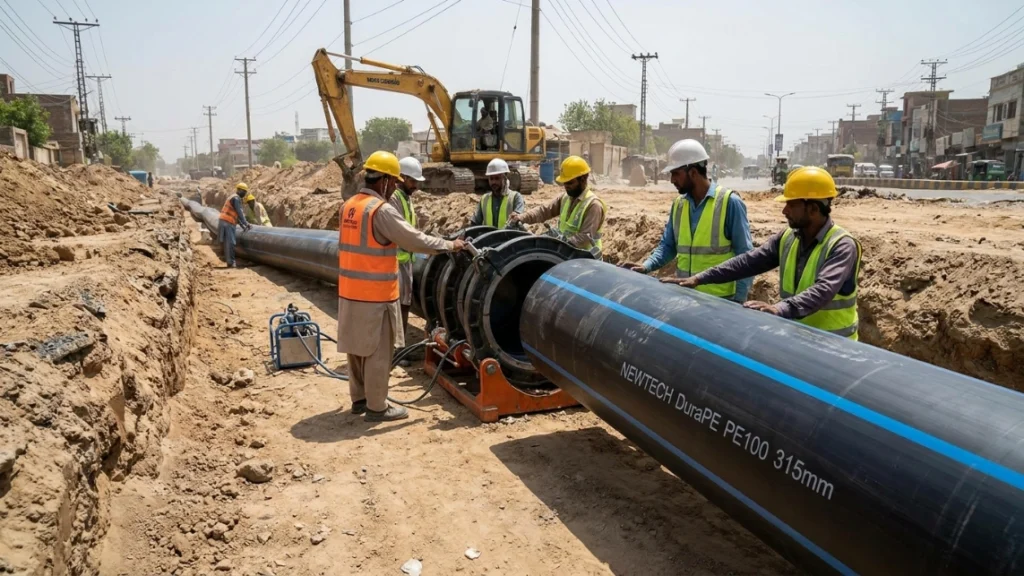
- Fused joints. HDPE butt-fusion welding machines a joint as strong as the pipe, so the line behaves like one continuous tube. There is no spigot to pull out of a socket. Read more in our butt-fusion guide.
- Light weight and long lengths. Fewer joints mean fewer weak points, and a lighter pipe puts less load on the soil around it.
PVC pipe with well-made joints also performs better than old rigid pipe in the Christchurch data, but a rigid line is more dependent on joint design. Where you must use rigid pipe or mix materials, pay close attention to the joints and connections.
PE100 HDPE for Water Mains
NewTech Pipes · HDPE Piping Systems
Planning a water main in a seismic zone? Read NewTech’s guide to PE100 HDPE for municipal supply, from pressure class to fused joints.
Water Lines vs Gas Lines: What Is Different?
Water lines. A broken main means no water, and low pressure can let contamination in. For housing societies and towns, the aim is to keep the main intact and allow quick repair. HDPE mains with fused joints suit this, and mechanical or electrofusion repair is straightforward. See pipe leak repair methods.
Gas lines. A broken gas line is a fire and explosion hazard, so the priority is to stop the leak fast. Gas work in Pakistan is controlled by the utility companies and must be done to their specifications by authorised contractors, so this article is a guide to the principles, not a how-to. Our overview of MDPE pipes for gas and water networks
Two important points on gas:
- Automatic seismic shut-off valves close the gas supply to a building when shaking passes a set level. A US city guide describes the typical trigger as roughly a magnitude 5.2 earthquake, and says the valve needs a manual reset after inspection. These valves can also trip again with aftershocks.
- Excess flow valves do not sense shaking. They close when flow suddenly becomes too high, as it would with a broken pipe. ASCE 25-2006 is an example of a standard for earthquake-actuated gas shut-off devices.
If you manage a hotel, school or hospital in a high-hazard zone, ask your gas utility or a qualified engineer whether such devices are permitted and suitable.
The Weak Points Nobody Talks About
Most earthquake damage to otherwise good pipelines happens at transitions, where flexible pipe meets something rigid. These need as much attention as the pipe itself:
- Building entries. The building and the soil move differently. A rigid pipe through a wall can shear off. Use a flexible connection or sleeve with room to move.
- Tanks and chambers. The pipe leaving a reservoir or valve chamber is a common break point. Allow flexibility or a flexible coupling at the wall.
- Valves and hydrants. Heavy fittings are anchored and do not move with the pipe. Support them separately, so the pipe is not carrying their weight.
- Change of material. Where PE joins a stiffer pipe, a stress concentration forms. Use appropriate transition fittings.
- Heavy water heaters and gas appliances can topple and break rigid connections. Anchor them and use flexible connectors, as gas safety guidance recommends.
These points are general engineering practice. Your project engineer should detail them for your site.
Practical Design Checklist for Seismic Zones
- Know your zone and soil. Ask for a geotechnical report where liquefaction is possible.
- Prefer fused joints (butt fusion or electrofusion) for mains. Compare options in compression vs butt-fusion fittings.
- Use certified pipe. Weak or recycled material undermines the ductility you are paying for. See our guide to identifying fake or substandard pipes and pipe standards.
- Bed the pipe properly on sand or fine soil, with no sharp stones.
- Add flexibility at transitions: building entries, tanks, valve chambers.
- Sectionalise the network with isolation valves so a break can be shut off quickly.
- Avoid crossing known active faults where possible. If you must cross, get specialist design.
- Keep emergency repair stock: electrofusion couplers, repair clamps and a trained crew.
- Record the route. Keep an as-built drawing with valve locations.
- Test after any major shaking. Pressure-test and inspect critical lines.
Smarter Lifelines: Technology That Helps
Technology is useful here when it is simple and maintained:
- Seismic and excess-flow shut-off devices at building level, as described above.
- Ground-deformation mapping. The Christchurch studies used high-resolution LiDAR surveys taken before and after the quakes to link pipe damage to ground movement. The same tools can help identify risky corridors for new lines.
- Pressure and flow monitoring. Sudden pressure drop in a district can reveal a break within minutes and speed isolation.
- Digital records. GIS maps of pipe routes and valves make post-earthquake repair faster, which matters when roads are blocked and crews are few.
It is a good idea to start small: a valve map and a repair kit cost very little compared to a week without water.
What This Means for Everyday Life
After an earthquake, people need three things quickly: safety, water and fuel. A building can be intact, but if the supply line has failed, it is unusable. For hospitals, schools and hotels, resilient piping is part of continuity. For a housing society, it is part of a promise to residents.
For a homeowner, the practical steps are modest: use certified pipe, ask your plumber for flexible connections at the water tank and the heater, anchor heavy appliances, and know where your main water and gas valves are.
Conclusion
You cannot choose where the earth moves, but you can choose what is buried in it. The evidence from Kobe, Christchurch and Japan points the same way: flexible, fused polyethylene lines have survived earthquakes that broke older, more rigid systems. Combine that with good bedding, flexible connections at the weak points, sectionalising valves and a ready repair kit, and a town can come through the shaking with its water and gas still flowing.
If you are planning a water or gas project in a high-hazard zone, speak to our team about pipe class, jointing and fittings. Browse our HDPE pipes range or contact NEWTECH-Pipes.