Every WASA distribution main that fails in Karachi or Lahore during the summer peak demand period costs the utility tens of millions in emergency repair, lost water, and contractor mobilisation. According to the Pakistan Council of Research in Water Resources (PCRWR), non-revenue water losses in Pakistani urban systems averaged 35–40% in 2022 — a significant share of which trace directly to aging, corrosion-prone metallic and rigid PVC mains.
The question civil engineers and procurement managers on municipal projects face is not whether to replace aging infrastructure — it’s what to replace it with. Specify the wrong material and you rebuild the same problem in ten years. Specify PE100 HDPE pipe for municipal water supply and you’re looking at a 50-year buried asset that resists corrosion, handles ground settlement, and requires zero joint maintenance.
This post breaks down exactly why PE100 has become the specification standard on WASA-funded, PEC-registered, and donor-financed water supply projects across Pakistan — covering pressure ratings, SDR selection, installation requirements, lifecycle cost, and the common procurement mistakes that undermine long-term performance.
What Makes PE100 HDPE Pipe the Right Choice for Municipal Water Supply?
PE100 HDPE pipe qualifies for municipal water supply because its minimum required strength (MRS) of 10 MPa at 20°C — the highest classification for polyethylene — delivers superior pressure capacity, crack resistance, and long-term hydrostatic strength. It meets ISO 4427 and WASA standards, handles surge pressures without joint failure, and carries potable water safely with no risk of corrosion or biofilm leaching.
The PE100 designation is not a marketing label — it is a material performance classification governed by ISO 9080, which specifies that the material must demonstrate an extrapolated 50-year hydrostatic strength of no less than 10 MPa. PE80, the older generation, reaches only 8 MPa. That 25% strength differential translates directly into either thinner pipe walls at the same pressure (reducing material cost) or higher pressure capacity at the same wall thickness.
For a WASA distribution main in Rawalpindi or Islamabad running at 8–10 bar working pressure with pump surge reaching 13–14 bar, this matters enormously. PE100 SDR 11 (PN16 at 20°C) carries a safety factor that absorbs typical surge events without joint distress. PE80 SDR 11 at the same surge condition is operating close to its design envelope.
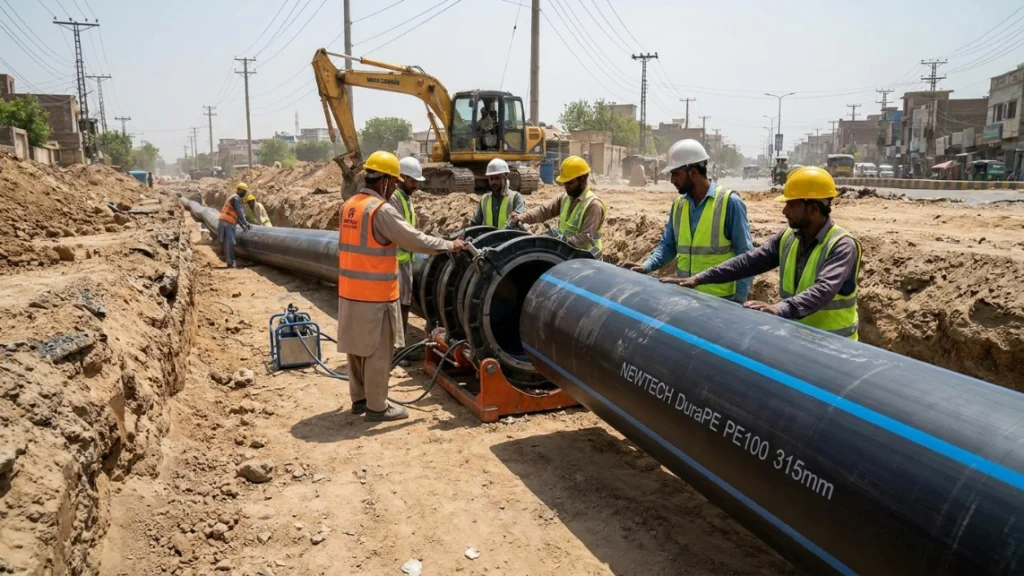
NEWTECH’s DuraPE series HDPE pipes are manufactured from certified PE100 compound, produced to ISO 4427 with lot traceability and MRS designation on every pipe length. The DuraPE range covers 20mm to 630mm, making it a single-source solution from service connections through trunk mains on any municipal project.
Beyond strength, PE100’s fully fused butt-joint system eliminates the mechanical joint failure mode that plagues ductile iron and older PVC systems. A correctly executed butt-fusion joint per ISO 4427 is monolithic — it achieves 100% of the pipe’s tensile strength with zero gaskets, bolts, or couplings to corrode, loosen, or leak.
PE100 HDPE Pipe Pressure Ratings and SDR Selection for Water Distribution Networks
PE100 HDPE pipe pressure ratings depend on the SDR (Standard Dimension Ratio) — the ratio of pipe outer diameter to wall thickness. Lower SDR means thicker walls and higher pressure capacity. For water distribution networks, SDR 11 (PN16) is the most widely specified grade; SDR 17 (PN10) suits gravity-fed or low-pressure zones; SDR 7.4 (PN25) serves high-rise or high-head pumped mains.
The table below shows the full SDR-to-pressure mapping for PE100 at standard operating temperatures:
| SDR Class | Wall Thickness Ratio | PN Rating at 20°C | PN Rating at 40°C | Typical Application |
|---|---|---|---|---|
| SDR 7.4 | D/7.4 | PN 25 | PN 16 | High-pressure pump mains, high-rise supply |
| SDR 9 | D/9 | PN 20 | PN 12.5 | Industrial process, elevated tank feeds |
| SDR 11 | D/11 | PN 16 | PN 10 | Primary WASA distribution mains |
| SDR 13.6 | D/13.6 | PN 12.5 | PN 8 | Secondary distribution, housing society mains |
| SDR 17 | D/17 | PN 10 | PN 6 | Low-pressure gravity networks, rural supply |
| SDR 21 | D/21 | PN 8 | PN 5 | Gravity drainage, low-head irrigation |
| SDR 26 | D/26 | PN 6.3 | PN 4 | Gravity only, non-pressure applications |
One specification error to avoid: many engineers specify SDR class against static working pressure only, ignoring surge. On any pumped main — which covers most urban distribution networks in Lahore, Faisalabad, Karachi, and Multan — the design pressure must account for water hammer. The standard practice under ISO 4427 Annex A is to add a 1.5× surge multiplier to static working pressure and select SDR class accordingly. Specifying SDR 17 on a 7-bar pumped main that surges to 11 bar is a common and costly mistake.
For projects being submitted under PEC registration or to WASA engineering departments, the SDR class must appear explicitly in the pipe schedule with its corresponding PN rating — not just a nominal pipe size. Reviewers on PSDP-funded water schemes increasingly reject submittals that omit this detail.
Why Pakistan’s Municipal Water Projects Are Shifting to PE100 HDPE Mains
Pakistan’s WASA authorities in Lahore, Karachi, and Islamabad have progressively adopted PE100 HDPE pipe for municipal water pipeline replacement and new schemes because it eliminates corrosion failures, reduces non-revenue water losses, and meets both ISO 4427 and PSQCA certification requirements. World Bank and ADB-financed water sector projects in Pakistan now routinely specify PE100 HDPE as the baseline material for buried distribution mains above 63mm.
Pakistan’s urban water infrastructure is largely built on ductile iron and asbestos cement mains installed in the 1960s–1980s, with uPVC supplementing from the 1990s onward. All three materials share a common failure pattern over a 20–30 year buried life: corrosion (metallic mains), joint leakage (push-fit uPVC), and brittleness under ground movement (rigid PVC). Each failure mode contributes to the PCRWR-cited 35–40% non-revenue water loss rate.
PE100 HDPE eliminates all three. It carries no metallic component to corrode. Its butt-fused joints have no gaskets to age or bolts to corrode. And its elongation at break (≥350% per ISO 6259) means it deforms rather than cracks under soil subsidence, seismic movement, or heavy traffic load — a critical property for mains running under Lahore’s high-traffic arterial roads or Karachi’s coastal zones where ground conditions are variable.
The Asian Development Bank’s Pakistan water sector programme — which has financed urban water schemes in Multan, Bahawalpur, and Hyderabad — specifies HDPE PE100 as the mandatory material for new distribution mains in its technical annexures. This is not preference; it is a condition of financing.
For contractors and project managers working on PSDP-funded, ADB-financed, or World Bank-supported water supply schemes, specifying anything other than ISO 4427-compliant PE100 HDPE on the main distribution network is a specification risk that your project engineer’s insurance does not cover.
⚙️ Expert Insight from NEWTECH A recurring issue on municipal projects in Punjab is contractors substituting PE80 pipe for specified PE100 mid-project — citing “equivalent performance” to the site engineer. The two grades are not equivalent under ISO 9080. PE80 SDR 11 at 40°C drops to PN8, while PE100 SDR 11 holds PN10 at the same temperature. In a sun-exposed above-ground section of a distribution main in Multan during summer — where ambient soil temperatures at shallow burial depths can reach 35–40°C — this difference is real and measurable. Always verify PE100 compound certification on the pipe’s extruded marking before accepting delivery.
PE100 Pipe vs Ductile Iron vs uPVC: The Water Main Comparison Every Municipal Engineer Needs
PE100 HDPE pipe outperforms ductile iron and uPVC for buried municipal water mains on corrosion resistance, joint integrity, installation speed, and 50-year whole-life cost. Ductile iron offers higher stiffness for certain trench conditions but corrodes in aggressive soils and requires cathodic protection. uPVC suits low-pressure gravity mains but is brittle under impact and cannot handle surge pressures above PN12.5 reliably.
| Attribute | PE100 HDPE | Ductile Iron | uPVC (Class C/D) |
|---|---|---|---|
| Design Life | 50+ years | 20–30 years (with CP) | 20–25 years |
| Corrosion Resistance | Fully immune | Requires cathodic protection | Moderate (joint degradation) |
| Surge/Water Hammer | Excellent (flexible) | Good (rigid, dampened) | Poor (brittle failure risk) |
| Joint Type | Butt-fusion (monolithic) | Mechanical/flanged | Push-fit or solvent cement |
| Installation Speed | Fast (coils ≤110mm) | Slow (heavy, jointed) | Medium |
| Weight (110mm, per metre) | ~2.1 kg | ~12–15 kg | ~1.8 kg |
| Seismic/Settlement Tolerance | Excellent | Poor (joint separation) | Poor (cracking) |
| PSQCA/ISO Compliance | ISO 4427, PS 3580 | ISO 2531 | PS 3580, ISO 1452 |
| 2026 Approx. Cost (per metre) | PKR 850–2,200 (63–160mm) | PKR 2,500–8,000 | PKR 420–1,100 |
The cost comparison above requires context. Ductile iron’s higher unit cost, combined with its need for cathodic protection installation and the 20–30 year replacement cycle, makes its whole-life cost approximately 2.3× that of PE100 HDPE over a 50-year asset horizon — per the UK Water Industry Research (UKWIR) buried asset lifecycle cost model, which is widely referenced in international water sector procurement.
uPVC’s lower purchase price is similarly deceptive on pressurised mains. Its push-fit joint system — even with rubber ring seals — degrades at seal interfaces within 15–20 years in Pakistan’s chlorinated potable water conditions. The PCRWR’s 2022 field survey of rural water schemes documented uPVC push-fit joint failure as the primary failure mode in 41% of surveyed systems under 10 years old.
For trunk mains above 110mm diameter on WASA or municipal supply projects, PE100 HDPE is the specification that protects your project budget, your maintenance costs, and your asset register for the next half-century.
How to Specify and Procure PE100 HDPE Pipe Correctly for Municipal Projects in Pakistan
To correctly specify PE100 HDPE pipe for a municipal water supply project in Pakistan, your BOQ must state: material designation (PE100), SDR class, outer diameter in mm, relevant standard (ISO 4427), PSQCA certification requirement, and colour (blue for potable water per WASA convention). Procurement must include manufacturer lot traceability, MRS certification, and third-party test reports — not just visual inspection at delivery.
The materials submittal process on any PEC-registered or WASA-submitted project has specific documentation requirements. Contractors who treat HDPE procurement as a commodity purchase — specifying only nominal diameter and ordering from the lowest bidder — expose themselves to material rejection at site inspection and potential structural defects that only appear under sustained pressure.
What your pipe schedule must include:
- Pipe outer diameter (OD) in mm — not nominal bore (NB), which is ambiguous across standards
- SDR class with corresponding PN rating at 20°C
- Material designation: PE100 (not just “HDPE” — PE80 and PE100 are both “HDPE”)
- Applicable standard: ISO 4427-2 for pressure pipes
- PSQCA certification requirement stated explicitly
- Colour and stripe specification: blue for potable water (blue stripe or solid blue)
- Lot traceability requirement: pipe lengths must carry printed OD, SDR, standard, manufacturer, and production date
What manufacturer documentation to require:
- ISO 4427 compliance certificate
- PE100 compound certification from resin supplier (certifying MRS ≥10 MPa)
- PSQCA license number with validity date
- Hydrostatic pressure test results per ISO 1167 (minimum burst pressure at 20°C)
- Third-party test report from PCSIR, NTU, or accredited lab if required by project specification
NEWTECH’s DuraPE HDPE pipes carry all of the above documentation as standard supply. For municipal projects above PKR 5 million in pipe value, NEWTECH provides a project-specific quality plan on request.
Installation of PE100 HDPE Water Mains: What Pakistani Contractors Must Know
PE100 HDPE pipe installation for municipal water mains requires proper butt-fusion execution per ISO 4427, trench preparation with 150mm sand bedding, backfill in 300mm compacted layers, and pressure testing at 1.5× working pressure for minimum 2 hours. The most common installation failures in Pakistan are improper fusion (wrong bead size, dirty pipe ends) and inadequate bedding in rocky or unstable soil conditions.
Butt-Fusion Quality — The Non-Negotiable
Every butt-fusion joint on a PE100 water main must meet ISO 4427 Annex B joint quality requirements. The fusion bead must be uniform around the full circumference, with no cold fusion zones, scorching, or misalignment exceeding 10% of wall thickness. A misaligned or under-heated joint looks structurally sound at ambient pressure but can fail under a surge event or soil stress within 2–5 years.
NEWTECH supplies HDPE butt-fusion welding machines calibrated to ISO 4427 fusion parameters. For projects in Islamabad, Rawalpindi, or Peshawar where ambient winter temperatures drop below 5°C, fusion parameters must be adjusted — cold conditions require extended heating time. Contractors who use standard summer fusion parameters during December–February jobs in northern Pakistan consistently produce under-fused joints.
Bedding and Backfill
The ISO 4427 installation annex specifies 150mm granular bedding below the pipe and 300mm of selected fill (maximum 20mm particle size) as initial backfill. In rocky ground — common on Islamabad and Rawalpindi distribution projects — every piece of angular rock in the backfill is a point load on the pipe wall during compaction. This does not produce immediate failure; it produces stress concentrations that initiate slow crack growth over 8–12 years and become pinhole leaks.
Pressure Testing
The standard test for a PE100 HDPE water main is 1.5× the design working pressure held for 2 hours minimum, with no allowable pressure drop beyond thermal correction. For a PN16 SDR 11 main, this means testing at 24 bar. Make sure your test pump and pressure gauge are calibrated — under-tested joints are a liability the contractor owns for the project warranty period.
Water Distribution Network Pipe Sizing: How to Match PE100 HDPE to Your Flow Requirements
For a water distribution network pipe selection in PE100 HDPE, flow velocity should stay between 0.5 m/s (minimum to prevent sedimentation) and 3.0 m/s (maximum to limit friction loss and erosion). Trunk mains typically use 160mm–630mm; secondary distribution runs 90mm–200mm; service connections use 20mm–63mm. Pipe sizing must account for peak demand factor — typically 1.8–2.5× average daily demand on Pakistani urban supply systems.
Sizing a PE100 HDPE distribution network without accounting for Pakistan’s demand patterns leads to either under-capacity (low pressure during morning and evening peaks) or over-sizing (velocity too low, sediment deposition, biofilm growth risk in stagnant sections).
Pakistani urban water supply systems — Lahore, Faisalabad, Multan, Karachi — typically run on 8–16 hour supply schedules with peak hour factors of 2.0–2.5×. This means your pipe diameter must carry 2–2.5× the average flow for 3–4 hours per day. Sizing for average flow only guarantees pressure complaints and contractor callbacks.
For a housing society of 500 units with 200 litres/capita/day average demand and 4 persons/unit, average flow = 500 × 4 × 200 / 86,400 = 4.6 litres/second. At peak factor 2.3, peak flow = 10.6 l/s. A 110mm PE100 SDR 11 main at 1.1 m/s average velocity handles this comfortably, with head loss around 8–10 m per km — acceptable for a compact compound layout.
Scale that to a 5,000-unit housing society like those in Bahria Town or DHA Lahore and the trunk main rises to 250mm or 315mm PE100, with laterals at 110mm–160mm and service connections at 32mm–63mm.
For a full product range covering every diameter in this scope, NEWTECH’s HDPE DuraPE series spans 20mm to 630mm with full SDR class availability across the range.
Conclusion
The choice of PE100 HDPE pipe for municipal water supply is not a trend — it’s an engineering standard backed by 50 years of global infrastructure performance data and increasingly enforced by WASA, PEC, and international donor specifications in Pakistan. Contractors, developers, and engineers who still specify alternative materials for buried water mains on cost grounds are making a short-term saving against a long-term structural liability.
Before your next municipal or housing society water supply project goes to tender, confirm these four things:
- PE100 designation is explicit in the BOQ — not just “HDPE.” Material grade determines pressure capacity and 50-year performance.
- SDR class is matched to design pressure plus surge — not just static working pressure. SDR 11 is the correct default for pumped mains in Pakistan.
- PSQCA certification and ISO 4427 compliance are stated as procurement conditions — and you verify the batch number, not just the stamp.
- Fusion operators are trained and your machine is calibrated — the best pipe in the world fails at a bad joint.
Ready to source the right PE100 HDPE pipe for your project? Request a free quote from NEWTECH’s expert team today — we supply the full DuraPE range from 20mm to 630mm to municipal authorities, contractors, and developers across Pakistan.
FAQ SECTION
1. What is the lifespan of PE100 HDPE pipe used in municipal water supply projects?
PE100 HDPE pipe has a certified design life of 50+ years when installed to ISO 4427 in normal buried water supply conditions. This is based on ISO 9080 long-term hydrostatic strength data extrapolated over a 50-year service period. In Pakistan’s urban environments — including aggressive soil conditions in Karachi’s coastal zones — PE100 consistently outperforms ductile iron and uPVC alternatives on burial lifespan.
2. Which SDR class of PE100 HDPE pipe is recommended for WASA water mains in Pakistan?
SDR 11 (PN16 at 20°C) is the most widely specified SDR class for WASA and municipal water mains in Pakistan. It handles working pressures up to 10 bar with an adequate safety margin for surge events on pumped distribution systems. For high-pressure trunk mains in multi-storey development zones or elevated-head pump systems, SDR 9 (PN20) or SDR 7.4 (PN25) should be considered. SDR 17 is suitable for gravity-fed or low-pressure rural supply only.
3. What is the price of PE100 HDPE pipe per metre in Lahore in 2026?
PE100 HDPE pipe in Lahore ranges from approximately PKR 850–1,100 per metre for 63mm SDR 11, PKR 1,800–2,500 for 110mm SDR 11, and PKR 6,500–9,500 for 250mm SDR 11 — depending on manufacturer, order quantity, and certification grade. PSQCA-certified PE100 HDPE pipe municipal water supply grade commands a 10–15% premium over uncertified alternatives, which is fully justified by the reduction in rejection risk on inspected projects.
4. Does PE100 HDPE pipe meet WASA and PSQCA standards for potable water supply in Pakistan?
PE100 HDPE pipe for municipal water supply meets PSQCA requirements under PS 3580 and ISO 4427 compliance. Potable water grade PE100 pipe must use only NSF 61 or WRAS-approved PE100 compound with no harmful leachables into the water column. WASA Lahore, KW&SB Karachi, and CDA Islamabad all accept PE100 HDPE as the primary material for new and replacement buried distribution mains, provided the manufacturer’s PSQCA certification is current and verifiable.
5. Can PE100 HDPE pipe be used for both above-ground and underground water supply lines?
PE100 HDPE pipe is primarily engineered for buried service — its flexible wall structure is optimised for soil load distribution in buried trench conditions. For short above-ground sections (pump stations, valve chambers, bridge crossings), PE100 HDPE pipe can be used with UV-protection provision, as the carbon black pigment in standard black-stripe or solid-black grades provides adequate UV resistance. For long-term above-ground runs in direct sunlight, additional cladding or galvanised steel sleeves are recommended per ISO 4427 installation guidance.
6. How does PE100 HDPE pipe compare to ductile iron for a municipal water pipeline in Pakistan?
PE100 HDPE pipe outperforms ductile iron for municipal water pipeline on whole-life cost, corrosion resistance, and installation speed. Ductile iron requires cathodic protection in corrosive soils (prevalent in Karachi, coastal Punjab, and Sindh) and has a 20–30 year service life versus 50+ years for PE100. A UKWIR lifecycle cost model puts ductile iron’s 50-year whole-life cost at approximately 2.3× that of PE100 HDPE for the same diameter buried main.