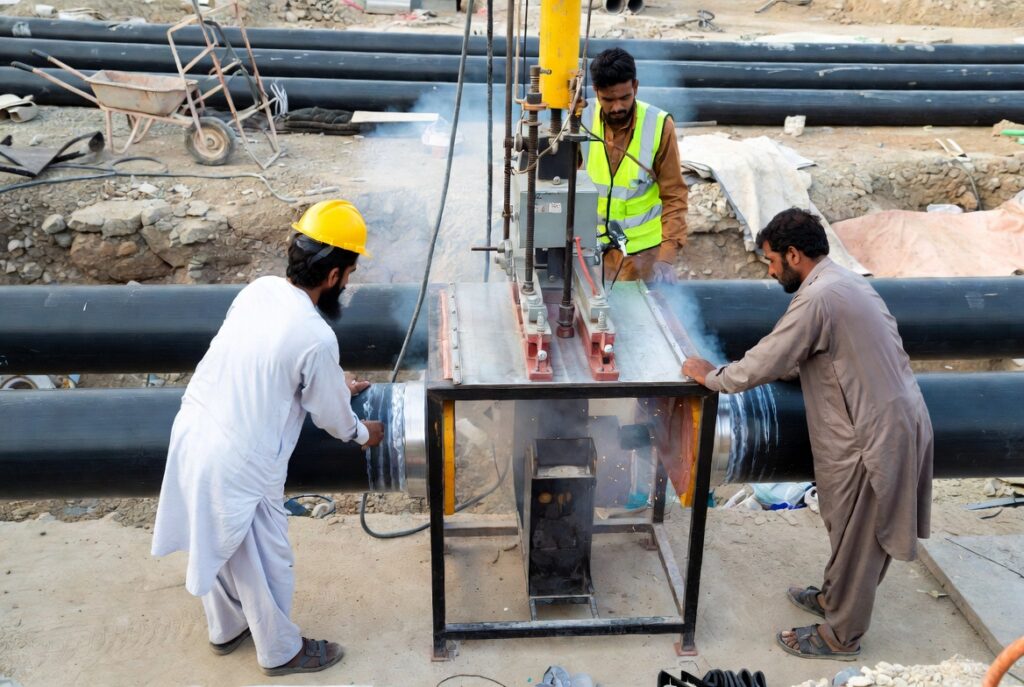
A poorly made HDPE Butt-Fusion Welding joint may not fail immediately—it can develop problems months or even years later, often underground, where repairs may require excavating an entire section of the pipeline. HDPE butt fusion welding is a key reason HDPE pipe systems provide excellent leak resistance, but this reliability depends on performing the process correctly, using the proper machine settings, and maintaining strict operator discipline.
This guide walks through exactly how butt-fusion welding works, the types of machines used in Pakistan, and the specific mistakes that quietly compromise joint strength — so your next HDPE installation performs the way the material is actually capable of.
What Is HDPE Butt-Fusion Welding?
Butt-fusion is a heat-jointing method where two HDPE pipe ends are heated to a molten state and then pressed together under controlled pressure, allowing the material to fuse into a single, continuous piece of pipe as it cools. Unlike solvent-cement or threaded joints, there’s no separate joint material — the pipe and the joint become chemically and structurally identical.
This is why butt-fusion is the standard jointing method for HDPE pipes in pressurized water mains, tube well rising mains, and larger-diameter gas distribution lines — a properly fused joint is, in practical terms, as strong as the parent pipe itself.
The Butt-Fusion Welding Process, Step by Step
Pipe preparation — pipe ends are cut square and clamped into the machine’s alignment clamps, ensuring both ends are centered and free of ovality.
Facing — a rotating cutting tool (planer) trims both pipe ends to create clean, flat, parallel mating surfaces. This step is non-negotiable; any facing debris left on the surface can weaken the joint significantly.
Alignment check — the machine checks that both pipe ends are properly aligned and that there’s no visible gap when brought together unheated.
Heating — a heater plate, held at a controlled temperature (typically in the 200–220°C range for standard HDPE, though exact temperature depends on pipe grade and wall thickness), is inserted between the pipe ends until both surfaces reach a molten “bead” state.
Fusion (joining) — the heater plate is removed, and the two molten ends are pressed together under a specified fusion pressure, forming a visible outer bead as the material fuses.
Cooling — the joint is held under pressure for a specified cooling time before the clamps are released — rushing this step is one of the most common causes of joint failure.
Each of these parameters — heater temperature, fusion pressure, and cooling time — is specific to the pipe’s diameter, wall thickness (SDR), and material grade (PE80 vs PE100), and most modern machines calculate these automatically once the operator inputs the pipe specification.
Butt-Fusion Welding Machine Types Used in Pakistan
A butt fusion welding machine commonly used by contractors in Pakistan is generally available in several categories:
Manual hydraulic machines — the operator manually controls clamping and fusion pressure. Common for smaller diameters and lower-budget projects, but more dependent on operator skill and consistency.
Semi-automatic machines — automate the heating and timing sequence while still requiring manual clamp and pressure control, offering a middle ground between cost and consistency.
Fully automatic (data-logging) machines — automatically control temperature, pressure, and timing based on input pipe specifications, and log each fusion joint’s parameters for quality traceability. These are increasingly required on WASA, PEC-regulated, and utility-linked projects specifically because they provide a verifiable joint-by-joint record.
For larger-diameter transmission mains and any project requiring formal quality documentation, a data-logging machine isn’t just a convenience — it’s often a contractual requirement.
HDPE Pipe Jointing Methods: Butt-Fusion vs Electrofusion
Butt-fusion isn’t the only heat-jointing method for HDPE. Among common HDPE pipe jointing methods:
| Method | How It Works | Best For |
| Butt-fusion | Heated pipe ends pressed directly together | Larger diameters, straight pipe-to-pipe joints |
| Electrofusion | Fitting has embedded heating coil; current melts pipe and fitting together | Smaller diameters, branch connections, repairs |
| Compression fittings | Mechanical clamp, no heat | Small diameter service connections, rapid installation |
Butt-fusion is generally preferred for long, straight runs of larger-diameter pipe since it requires no separate fitting cost, while electrofusion is often more practical for branch connections, tie-ins, and situations where a butt-fusion machine’s size or clamping requirements aren’t practical on-site.
Common Butt-Fusion Mistakes to Avoid
Most joint failures trace back to one of these avoidable errors:
Skipping proper facing — leaving facing debris, oxidation, or an uneven surface on the pipe ends before heating.
Incorrect heater plate temperature — too cold and the material won’t fuse properly; too hot and it can degrade the polymer at the joint.
Rushing the cooling time — releasing clamp pressure before the joint has fully cooled weakens the fusion bond, even if it looks visually fine.
Misaligned pipe ends — even slight misalignment (ovality or offset) creates uneven stress across the joint once pressurized.
Ignoring bead inspection — a properly fused joint produces a consistent, uniform outer bead; an irregular or undersized bead is a visible warning sign that shouldn’t be ignored before backfilling.
Using mismatched pipe grades — fusing PE80 to PE100 pipe without accounting for the different fusion parameters each grade requires.
Working in extreme weather without adjustment — very hot or very cold ambient conditions in parts of Pakistan can affect cooling times, and machine settings should be adjusted accordingly rather than using a fixed default.
Quality Checks Before Backfilling
Before covering a fused joint, verify:
Visible bead uniformity — consistent size and shape around the full circumference of the joint.
No visible misalignment between pipe sections at the joint.
Fusion log data (if using an automatic machine) matches the specified parameters for that pipe’s diameter and grade.
PSQCA and ISO 4427/4437 conformance of the pipe itself, since even a perfect fusion joint can’t compensate for uncertified or underweight pipe.
You can review NewTech-Pipes’ quality control standards as a reference for the documentation a certified manufacturer and installation process should maintain.
Choosing the Right Approach for Your Project
Large-diameter, long, straight runs (transmission mains, tube well risings) → butt-fusion with a data-logging machine where possible.
Branch connections, tie-ins, or repairs → electrofusion fittings.
Small household service connections → compression fittings, often faster and sufficient for the pressure and diameter involved.
WASA, PEC, or utility-regulated projects → confirm in advance whether a data-logging fusion machine is a contractual requirement before starting work..
Conclusion
HDPE butt fusion welding is what gives HDPE pipe systems their reputation for long-term, leak-free performance — but that reputation depends entirely on correct facing, heating, alignment, and cooling at every single joint. Skipping any one of these steps quietly weakens a joint that looks fine on the surface. NewTech-Pipes manufactures HDPE butt-fusion welding machines alongside its HDPE pipes and fittings, giving contractors a matched, certified system for reliable, leak-resistant installations.
Frequently Asked Question's
HDPE butt fusion welding is a heat-jointing process where two pipe ends are heated to a molten state and pressed together, fusing into a single continuous piece of pipe as they cool. It produces a joint that is structurally as strong as the parent pipe itself.
Heater plate temperature typically falls in the 200–220°C range for standard HDPE pipe, though the exact figure depends on pipe grade and wall thickness. Always follow the specific machine and pipe manufacturer’s recommended settings rather than a fixed generic number.
Butt-fusion joins two pipe ends directly using a heater plate and is common for larger-diameter, straight runs. Electrofusion uses a fitting with an embedded heating coil to join pipe and fitting, and is more practical for smaller diameters, branch connections, and repairs.
Most failures come from installation errors rather than material defects — poor facing, incorrect heater temperature, rushed cooling time, or misaligned pipe ends are the most common causes. Using a data-logging machine and following manufacturer parameters significantly reduces this risk.
Yes, ideally. Butt-fusion quality depends heavily on correct machine operation and parameter selection, and many utility and WASA-regulated projects specifically require trained, certified operators along with data-logging equipment for quality traceability