Ordering the wrong casing pipe can be one of the most costly mistakes on a tube well project, and the problem often goes unnoticed until the drilling rig is already on site. Buyers looking for Borewell casing pipe Pakistan suppliers may assume that casing is simply another type of water pipe, but it serves a completely different purpose. Choosing the wrong size, wall class, or joint type can lead to borehole collapse, a stuck pump, or even the need to re-drill the well within a few years.
This guide covers what casing pipe does, how to select the right tube well casing pipe size, which standards to consider before purchasing, and the key factors that help prevent early failure of a properly specified casing string.
What Is Borewell Casing Pipe (and How It’s Different from the Rising Main)
A borewell or tube well has two separate pipe systems that are easy to confuse:
- Casing pipe lines the drilled hole itself. It stops the surrounding soil and rock from caving into the well, keeps out surface contamination, and gives the borehole a stable, permanent structure. Once installed, it stays in the ground for the life of the well.
- Rising main (or column pipe) carries water from the submersible pump, inside the casing, up to the surface. It’s selected for pressure rating and flow, not structural support.
The two are not interchangeable, and pricing them as if they were the same product is a common sourcing error. If you’re also selecting a rising main for the same project, it’s worth reviewing pipe choices for tube wells and irrigation systems separately, since the rising main follows pressure-rating logic rather than the structural logic covered here.
Materials Used for Casing Pipe in Pakistan
Three materials are used for borewell casing in the Pakistani market, each with a different failure mode over time:
UPVC (Unplasticized PVC) has become the standard choice for most agricultural and domestic tube wells. It doesn’t rust, resists the mildly corrosive salts common in Punjab and Sindh groundwater, and is light enough that a two- or three-person crew can lower long casing strings without machinery.
Galvanized Iron (GI) was the traditional choice and is still used in some deep or high-load installations. It offers high mechanical strength but corrodes over time, especially in saline or acidic groundwater, which can eventually contaminate the well or weaken the casing wall.
Mild steel casing appears on larger industrial or municipal boreholes where very high external loads are expected, but it comes with the same long-term corrosion exposure as GI, plus a higher upfront cost.
For the vast majority of agricultural and residential tube wells across Pakistan, UPVC casing pipe now offers the best balance of corrosion resistance, cost, and ease of installation — which is why demand for agriculture HDPE pipe systems and UPVC casing solutions has grown together in recent years, even though the two materials serve different parts of the same well.
Standard Tube Well Casing Pipe Sizes
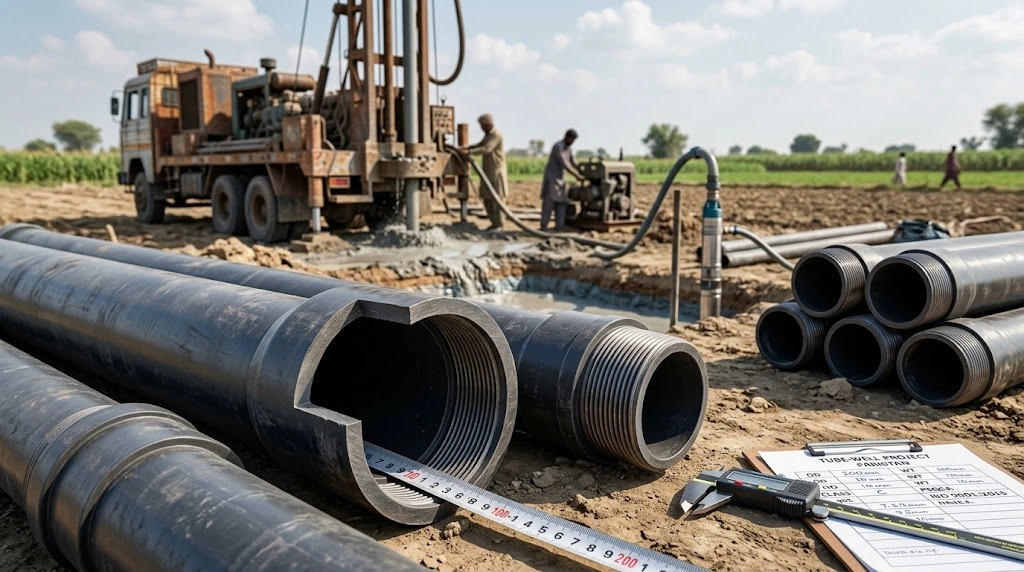
Casing pipe is sized by outer diameter, and the right size depends on two things: the diameter of the drilling bit used and the outer diameter of the pump and rising main that will sit inside the casing.
Well Type | Typical Casing OD Range | Common Use |
Small domestic/agricultural tube well | Roughly 100mm–150mm | Small submersible pumps, shallow depth |
Medium agricultural tube well | Roughly 150mm–200mm | Standard irrigation pumps, moderate depth |
Large agricultural / light industrial well | Roughly 200mm–300mm | High-discharge pumps, deeper wells |
These ranges are typical of the Pakistani market rather than fixed figures — always confirm the exact size against the drilling contractor’s bit diameter and the pump manufacturer’s outer-casing clearance requirement before ordering, since a casing pipe that’s even slightly undersized for the pump assembly cannot be corrected after drilling.
Casing Pipe Classes: Shallow, Medium, and Deep Wells
Unlike the rising main, which is rated by pressure (SDR), casing pipe is generally classified by the external load it needs to withstand — which increases with depth and with how loose or unstable the surrounding soil is.
- Shallow well casing is specified for wells where the surrounding soil is relatively stable and the casing mainly needs to keep the hole open, not resist major external pressure.
- Medium and deep well casing uses a thicker wall to resist the greater soil and hydrostatic pressure at depth, particularly in loose, sandy, or waterlogged strata common in parts of Punjab and Sindh.
A practical example: a shallow domestic tube well drilled in firm soil can often use a lighter casing class, while a deeper agricultural well drilled through loose or waterlogged sand needs a heavier wall class to prevent the casing from collapsing under soil pressure before the well is even put into service. Your drilling contractor’s assessment of the strata should always guide this choice, not a generic size chart alone.
Joint Types for Casing Pipe
How casing pipe sections are joined affects both installation speed and long-term reliability:
- Threaded (screwed) joints — male and female threaded ends that screw together; this is the most common jointing method for UPVC casing pipe in Pakistan because it needs no solvent cement or curing time before the string can be lowered.
- Solvent-cement joints — used less often for casing than for pressure pipe, since solvent joints need time to cure and aren’t always practical for long casing strings assembled on site.
- Socket-and-spigot (push-fit) joints — a plain end pushed into a socketed end, sometimes with a rubber seal; quick to assemble but generally reserved for shallower, lower-load installations.
For most tube well casing work, threaded joints remain the practical default because they let the drilling crew lower and support the casing string section by section without waiting for adhesive to set.
Standards and Certification to Check Before Buying
Before ordering casing pipe for a tube well or borewell project, verify:
- PSQCA certification mark on the pipe, confirming it meets the relevant Pakistan Standard for the material grade.
- Wall thickness and OD stamped on the pipe, matched to your drilling contractor’s bit size and depth requirement, not just a nominal size name.
- Manufacturer’s ISO 9001:2015 certification, which reflects consistent quality control across production batches — particularly important since casing pipe is usually bought in bulk lengths for a single well and any batch inconsistency is hard to spot until the string is already down the hole.
- PEC recognition where the supplier is involved in larger institutional or municipal drilling programs.
Installation Tips That Prevent Early Failure
- Match casing OD to the actual drilling bit diameter used, with enough annular clearance for grouting or gravel-packing around the casing — not just the nominal well diameter quoted by the contractor.
- Inspect every joint before lowering the string; a marginal thread connection is far cheaper to fix at ground level than after the casing is already down the hole.
- Support the casing string properly during lowering to avoid excessive tensile load on the lower joints, especially on deeper wells.
- Keep the top of the casing properly capped and sealed at surface level to prevent surface runoff and debris from entering the well — a leading cause of long-term water contamination.
- Where the well may need re-drilling, deepening, or pump replacement later, document the casing size and depth at installation so future contractors don’t have to guess.
How to Choose the Right Casing Pipe Supplier
Price-per-length is the easiest thing to compare between suppliers and the least useful one on its own. Before ordering, ask any supplier to confirm the exact wall class for your well depth and soil type, provide PSQCA certification documentation for the specific product batch, and confirm lead time for the full length required — a mismatched partial order midway through drilling causes far more delay than a short wait upfront.
Conclusion
Getting casing pipe right comes down to two decisions: sizing it correctly against your drilling bit and pump clearance, and choosing a wall class suited to your well’s depth and soil conditions — not simply picking the cheapest length available. Getting either wrong is far more expensive to fix once drilling has started than it is to specify correctly beforehand. Newtech Pipes, an ISO 9001:2015-certified and PSQCA-registered manufacturer of UPVC and PVC piping systems in Pakistan since 2000, is a resource for contractors and drilling teams who need casing pipe specified correctly the first time.
Frequently Asked Question's
Casing pipe lines the drilled borehole to prevent collapse and contamination and stays permanently in place. The rising main carries water from the pump to the surface inside the casing. They serve different structural purposes and are selected using different criteria — casing by external load and depth, the rising main by pressure rating.
Casing size depends on your drilling bit diameter and the pump’s outer clearance requirement, typically falling in the 100mm–300mm range for agricultural wells in Pakistan. Always confirm the exact figure with your drilling contractor and pump supplier before ordering, since undersized casing cannot be corrected after drilling.
For most agricultural and domestic tube wells, UPVC is generally preferred because it resists corrosion from saline or mineral-heavy groundwater and is easier to handle on site. GI or steel casing is still used on some high-load or deep industrial boreholes where mechanical strength requirements are higher.
UPVC casing is used across shallow to moderately deep agricultural and domestic wells in Pakistan, with wall class increased for greater depth and looser soil conditions. For very deep or high-load industrial boreholes, consult your drilling contractor on whether a heavier-class UPVC or an alternative material is more appropriate.
Look for the PSQCA certification mark on the pipe itself, confirming compliance with the relevant Pakistan Standard, along with the manufacturer’s ISO 9001:2015 certification for consistent quality control. Always confirm the wall thickness and OD stamped on the pipe match your project’s drilling specification.