Wrong pipe selection doesn’t show up on Day 1 — it shows up two years later in a burst line under a Lahore housing society road, a failed WASA inspection in Karachi, or a leaking riser in a Islamabad high-rise that nobody budgeted to fix. And in most of those cases, the root cause is the same: the contractor or developer picked a uPVC pipe without understanding pressure classes.
Pakistan’s urban water supply network is expanding fast. According to the Pakistan Bureau of Statistics (PBS) 2023 Housing Census, over 63% of urban households now access piped water — and that percentage keeps climbing as housing societies in Rawalpindi, Multan, and Bahawalpur add thousands of connections annually. Every one of those connections runs on pipe, and most of that pipe is uPVC.
The decision you face — Class C vs Class D, which wall thickness, which SDR, which standard — directly affects whether your project passes a pressure test, lasts 30+ years, or fails in the first monsoon season. This guide covers everything you need: pressure class definitions, applicable Pakistani standards, real-world application mapping, and a comparison table you can reference on-site today.
Let’s cut through the confusion.
What Is uPVC Pressure Pipe and Why Does It Dominate Pakistan’s Water Supply Market?
Unplasticized Polyvinyl Chloride (uPVC) pressure pipe is a rigid thermoplastic pipe manufactured without plasticizers, making it stiffer, stronger, and more chemically resistant than regular PVC. Unlike flexible PVC, uPVC holds its shape under pressure and temperature fluctuations — a critical requirement for water supply systems exposed to Pakistan’s climate extremes, from 45°C summers in Sindh to sub-zero winters in KPK.
The dominance of uPVC pressure pipe for water supply in Pakistan is driven by four practical factors. First, cost: uPVC is significantly more economical than ductile iron or GRP pipes at the same pressure rating. Second, ease of installation — solvent-cement jointing requires basic tools and no specialized welding equipment. Third, chemical resistance: uPVC doesn’t corrode, tuberculate, or leach contaminants into potable water, making it compatible with WASA’s treated water standards. Fourth, availability: pipe sizes from ½” to 24″ (15mm to 600mm) are manufactured locally, including at NEWTECH’s production facility.
According to the Pakistan Plastic Manufacturers Association (PPMA) 2022 sector report, uPVC accounts for approximately 55% of all pressure pipe volume consumed in Pakistan’s construction and infrastructure sector — outpacing HDPE and all metallic alternatives combined in the residential segment.
For most residential, agricultural, and light municipal applications, uPVC pressure pipe is simply the right tool. The question is which class you need.
Understanding uPVC Pipe Pressure Ratings: Classes B, C, D, and E Explained
Pakistan’s uPVC pressure pipe classification follows PS 3580:1994 — the Pakistan Standard for uPVC pressure pipes for water supply — which aligns with ISO 1452. The classification system uses “Class” designations tied directly to maximum allowable working pressure at 20°C:
| Pressure Class | Max Working Pressure | Typical SDR | Common Applications |
|---|---|---|---|
| Class B | 2.5 bar (36 psi) | SDR 51 | Gravity-fed irrigation, low-head systems |
| Class C | 4 bar (58 psi) | SDR 34 | Residential supply, agriculture, tube wells |
| Class D | 6 bar (87 psi) | SDR 21 | High-rise, WASA mains, municipal networks |
| Class E | 10 bar (145 psi) | SDR 13.6 | Industrial, high-pressure pumping systems |
SDR (Standard Dimension Ratio) = pipe outside diameter ÷ minimum wall thickness. A lower SDR means thicker walls and higher pressure capacity. Class D pipe at SDR 21 carries a significantly heavier wall than Class C at SDR 34 — visually, you can see the difference when you pick up the same nominal diameter in both classes side by side.
Temperature matters here. PS 3580 and ISO 1452 pressure ratings are stated at 20°C. At 30°C, derate by 15%; at 40°C (common in Karachi and Multan during summer), derate by 25–30%. In exposed above-ground installations, always choose one class higher than your calculated requirement to maintain safety margins year-round.
NEWTECH manufactures uPVC pressure pipes in Class B through Class E, in sizes from ½” up to 24″, all manufactured under ISO 9001:2015 quality management and PSQCA certification. View the NEWTECH uPVC Pipe range for current specifications.
Class C vs Class D uPVC Pipe: Which One Does Your Project Actually Need?
This is the question contractors in Faisalabad and Gujranwala ask most often — and the wrong answer costs money in both directions. Specifying Class D where Class C suffices inflates material costs unnecessarily. Specifying Class C where Class D is required means a failed hydraulic pressure test and potential pipe failure in service.
When Class C (4 bar) Is the Right Choice
Class C uPVC pipe is suitable when your system operating pressure stays below 4 bar (roughly 40 metres of water head). That covers:
- Single-storey and double-storey residential supply lines fed from an overhead tank
- Agricultural tube well distribution networks in Punjab and Sindh where pump heads are typically 20–35 metres
- Irrigation laterals and sub-mains in drip and sprinkler systems
- Low-rise housing society internal networks (B+G+2 or lower)
In these applications, Class C delivers the required pressure capacity at lower wall thickness and lower cost. NEWTECH’s Class C uPVC pipes conform to PS 3580:1994 and are stocked in 6-metre lengths from ½” to 12″.
When Class D (6 bar) Is the Non-Negotiable Minimum
Switch to Class D when any of these conditions apply:
- High-rise buildings (G+4 and above): Ground-floor pressure in a 6-storey building with a header tank can approach or exceed 4 bar. Class C is simply not rated for this.
- WASA or municipal main supply lines: WASA Lahore and WASA Karachi specifications typically mandate Class D or higher for trunk mains operating at 4–6 bar.
- Pump-fed pressurised systems: Any direct pump connection where surge pressure (water hammer) can momentarily spike above operating pressure.
- Deep basement supply risers: Hydrostatic pressure at depth demands higher class ratings.
DHA Islamabad and Bahria Town Rawalpindi standard specifications both reference Class D uPVC as the minimum for internal water supply distribution networks in their housing projects — a detail that catches contractors off guard if they’ve been habitually sourcing Class C for residential work.
One of the most common — and expensive — mistakes we see in the field is contractors using Class C uPVC pipe in pump-pressurised systems without accounting for water hammer. When a pump starts or stops abruptly, pressure surges can be 1.5 to 2× the normal operating pressure. A 3-bar system can briefly see 5–6 bar of surge pressure. Class C rated at 4 bar fails under those conditions. For any pump-connected system, NEWTECH always recommends Class D as the minimum, and the inclusion of surge arrestors at pump discharge points. This is standard practice in our supply to WASA-contracted projects in Lahore and Karachi.
uPVC Pressure Pipe Sizes and Specifications: What the Numbers Mean for Your Project
Nominal pipe sizes for uPVC pressure pipes in Pakistan run from 15mm (½”) to 600mm (24″), though the most commonly used range for residential and commercial projects sits between 25mm (1″) and 160mm (6″). Here’s what you need to know about how size, class, and wall thickness interact:
Technical Comparison: NEWTECH uPVC Pressure Pipe Specifications
| Nominal Size | OD (mm) | Class C Wall (mm) | Class D Wall (mm) | Class E Wall (mm) |
|---|---|---|---|---|
| 1″ (25mm) | 33.4 | 1.0 | 1.6 | 2.5 |
| 1½” (40mm) | 48.3 | 1.4 | 2.3 | 3.6 |
| 2″ (63mm) | 75.0 | 2.2 | 3.6 | 5.5 |
| 3″ (90mm) | 110.0 | 3.2 | 5.2 | 8.1 |
| 4″ (110mm) | 125.0 | 3.7 | 6.0 | 9.2 |
| 6″ (160mm) | 180.0 | 5.3 | 8.6 | 13.3 |
| 8″ (200mm) | 225.0 | 6.6 | 10.7 | 16.5 |
Wall thicknesses based on PS 3580:1994 / ISO 1452. Actual values subject to manufacturing tolerances.
The practical takeaway from this table: as you move from Class C to Class D to Class E, wall thickness increases substantially — and so does weight per metre and material cost. For a 160mm (6″) pipe, the Class E wall is 2.5× the Class C wall. That weight difference adds up in large projects: a 100-metre run of 6″ Class E weighs roughly 40% more than the equivalent Class C, affecting both transport costs and installation effort.
For drainage and non-pressure applications (sewerage, rainwater), use NEWTECH’s uPVC drainage pipe range — pressure-class pipe should never be substituted downward for drainage to cut costs, and drainage pipe should never be used in pressure service.
Pakistani Standards and Certifications: What to Check Before You Buy
Specifying the right pressure class means nothing if the pipe itself doesn’t meet the standard. Pakistan’s construction and water supply sector has a documented problem with substandard pipes — pipes marked as Class D that have wall thicknesses closer to Class C, or pipes sold as PSQCA-certified that carry fake certification marks.
The mandatory standard for uPVC pressure pipes in Pakistan is PS 3580:1994, maintained by the Pakistan Standards and Quality Control Authority (PSQCA). For projects funded through WASA or other government utilities, compliance with PS 3580 is contractually mandatory. For private housing society projects in DHA, Bahria Town, or LDA-approved schemes, the engineer of record will typically specify PSQCA-certified pipe.
What to verify before accepting a delivery:
- PSQCA certification mark on the pipe surface — verify the licence number on PSQCA’s online registry
- Pipe marking: nominal size, pressure class, manufacturing standard (PS 3580), manufacturer name, and date of manufacture should all be clearly printed on every pipe length
- Wall thickness check: carry a digital calliper on-site. Measure at three points around the circumference. Minimum wall thickness per PS 3580 must be met at every point.
- Material verification: uPVC should produce a clean, brittle fracture under impact, not a ductile bend like flexible PVC
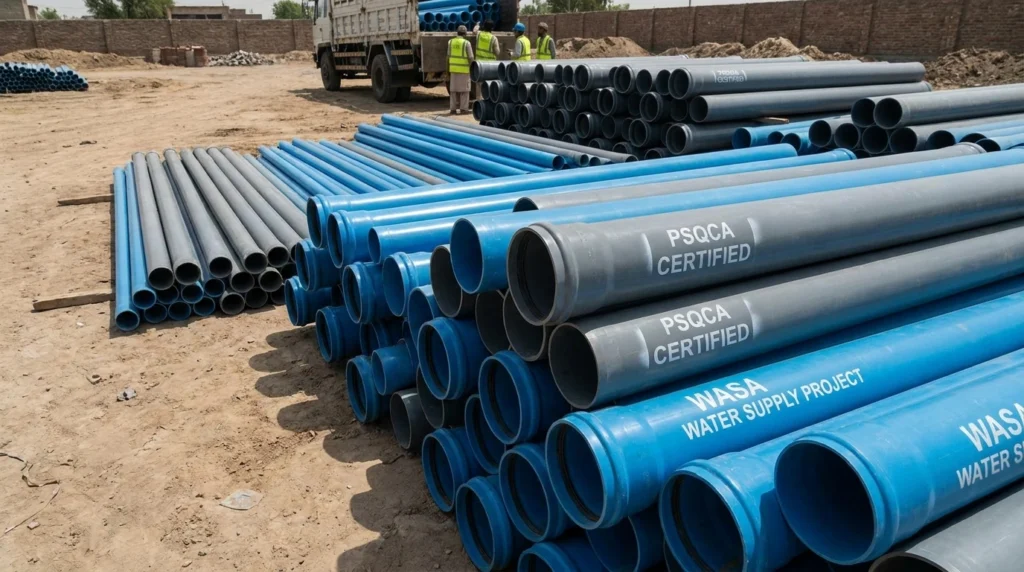
NEWTECH’s uPVC pressure pipes carry PSQCA certification and full PS 3580:1994 compliance across all pressure classes. Each pipe length is marked with size, class, standard reference, and batch code for full traceability. For PEC-registered projects, NEWTECH can provide material test certificates on request.
According to PSQCA’s 2021–22 annual report, their surveillance testing found non-conformance in over 28% of uPVC pipe samples collected from the open market — a figure that underscores why certification verification is not a bureaucratic formality but a structural safeguard.
Applications of uPVC Pressure Pipe for Water Supply Across Pakistan’s Sectors
uPVC pressure pipe for water supply in Pakistan spans an enormous range of applications. Understanding which class maps to which sector helps you specify correctly from the design stage.
Residential and Housing Society Projects
Lahore’s housing corridor — from Johar Town to DHA Phase 9, from Bahria Town to Green Gulberg — runs millions of metres of uPVC pressure pipe. Standard residential internal distribution uses Class C (½” to 2″) for branch lines and Class D (2″ to 6″) for risers and mains. NEWTECH has supplied uPVC pipe to major developments including Bahria Town Lahore, Green Gulberg, and DHA Islamabad across multiple development phases.
Municipal and WASA Water Supply Networks
WASA Lahore, WASA Karachi, and WASA Rawalpindi all use uPVC pressure pipe for distribution main replacements, typically Class D in 4″–12″ sizes. Municipal networks operate under higher sustained pressure and require pipes with consistent wall thickness and reliable joint performance. Solvent-cement socketed joints are standard for smaller diameters; rubber ring joints (RRJ) are used for 6″ and larger for easier field jointing.
Agricultural and Tube Well Irrigation
Punjab’s agricultural belt — Faisalabad, Multan, Bahawalpur — relies heavily on tube well-fed irrigation. Class C uPVC pipe in 2″–4″ sizes is the standard for tube well discharge headers and field distribution mainlines. The pressure requirements are modest (typically 2–4 bar), and Class C delivers the necessary performance at the lowest possible cost per metre. Farmers and agricultural contractors represent a major segment of NEWTECH’s uPVC pipe distribution network in Southern and Central Punjab.
Industrial and Factory Applications
Textile mills in Faisalabad, pharmaceutical plants in Karachi, and food processing units across Punjab use uPVC pressure pipe for process water supply, cooling water distribution, and non-chemical utility lines. Industrial applications frequently specify Class D or Class E where pumped systems operate at higher pressures. For chemical-contact lines, confirm chemical compatibility of uPVC against the specific fluid — some solvents and concentrated acids are not compatible.
For industrial process piping with hot water requirements (above 60°C), shift to NEWTECH’s PPRC pipe range — uPVC is not rated for sustained elevated temperatures.
How to Select the Right uPVC Pressure Pipe: A Step-by-Step Decision Framework
You don’t need a hydraulic engineering degree to make the right pipe selection. Work through this framework before placing your order:
Step 1 — Determine your system operating pressure. Calculate the static head pressure (water column height in metres ÷ 10.2 = pressure in bar) plus any pump pressure. Add a 25% safety margin.
Step 2 — Select your pressure class. Your calculated pressure (with safety margin) must fall below the class’s maximum working pressure. At temperatures above 25°C, apply the temperature derating factor per ISO 1452 Annex A.
Step 3 — Select pipe size. Based on your flow rate requirements and acceptable velocity (recommended: 0.6–1.5 m/s for water supply). Under-sized pipe increases friction losses and pump energy costs; over-sized pipe adds unnecessary material cost.
Step 4 — Confirm standard compliance. Specify PS 3580:1994 and PSQCA certification in your purchase order. Request test certificates if required by your project’s engineer of record or client.
Step 5 — Confirm jointing method. Solvent cement for diameters up to 4″–6″; rubber ring joint (RRJ) for larger diameters or where future disassembly may be needed.
Step 6 — Calculate quantities accurately. Include 10% wastage factor for fittings and cutting, plus all bends, tees, reducers, and end caps. NEWTECH’s technical team can assist with quantity take-off for large projects — contact us with your layout drawings.
Conclusion
The right uPVC pressure pipe for water supply in Pakistan is not the cheapest pipe on the market — it’s the pipe correctly specified for your system pressure, compliant with PS 3580:1994, carrying valid PSQCA certification, and supplied by a manufacturer with verifiable quality documentation.
Four things to take away from this guide:
- Match the class to your pressure: Class C (4 bar) for residential and agricultural gravity/low-pressure systems; Class D (6 bar) for WASA networks, high-rise buildings, and pump-fed systems; Class E (10 bar) for industrial high-pressure applications.
- Temperature matters: Derate pressure ratings above 25°C — always specify one class higher for exposed or climate-stressed installations.
- Verify certification on-site: Measure wall thickness with a calliper; confirm PSQCA licence numbers before accepting delivery.
- Never substitute downward: Using drainage pipe in pressure service or under-classing your pipe to save cost creates liability that far exceeds the savings.
FAQ SECTION
1: What is the difference between Class C and Class D uPVC pipe for water supply in Pakistan?
Class C uPVC pipe is rated for 4 bar (58 psi) maximum working pressure and uses SDR 34 wall thickness — suitable for residential supply, tube wells, and agricultural irrigation in Pakistan. Class D is rated for 6 bar (87 psi) with SDR 21 walls, required for WASA mains, high-rise buildings G+4 and above, and any pump-pressurised water supply system.
2: Which uPVC pressure pipe standard applies to water supply projects in Pakistan?
The primary standard is PS 3580:1994, issued by PSQCA (Pakistan Standards and Quality Control Authority), which aligns with ISO 1452. All uPVC pressure pipes for government, WASA, and PEC-registered projects in Pakistan must conform to PS 3580:1994 and carry a valid PSQCA certification mark. Always verify the licence number on the PSQCA online registry before accepting delivery.
3: What is the lifespan of uPVC pressure pipe water supply systems in Pakistan?
Properly installed and PSQCA-certified uPVC pressure pipe for water supply in Pakistan has a design service life of 50 years under normal operating conditions per ISO 1452 guidelines. Actual lifespan depends on correct pressure class selection, protection from UV exposure for above-ground runs, and installation quality — particularly proper solvent-cement jointing technique.
4: Can uPVC pipe be used for hot water supply in Pakistan’s industrial or residential applications?
No. Standard uPVC pressure pipe is rated for cold water supply up to a continuous service temperature of 20°C (derated above that), with a maximum limit of around 60°C for very short durations only. For hot water supply — solar systems, central heating, or industrial process lines above 60°C — use PPRC pipes, which are rated for continuous service at 70–95°C depending on pressure class.
5: How do I verify that uPVC pipe supplied to my project in Lahore or Karachi is genuinely PSQCA certified?
Check three things on delivery: the PSQCA certification mark printed on the pipe surface with a licence number; the pipe marking showing size, pressure class, and PS 3580 reference; and wall thickness measured by digital calliper at three circumference points — it must meet the minimum per PS 3580. Verify the licence number on PSQCA’s official website before accepting bulk quantities.
6: What size uPVC pressure pipe is typically used for WASA water supply main lines in Pakistan?
WASA distribution mains in cities like Lahore, Karachi, Rawalpindi, and Multan typically use Class D uPVC pressure pipe in diameters ranging from 4″ (110mm) to 12″ (315mm) for secondary and tertiary distribution networks. Trunk mains above 12″ often use ductile iron or HDPE. Class D is the WASA minimum specification for pressurised distribution lines in most municipal water supply projects across Pakistan.