Choosing the Wrong Pipe for a Hot Water System Is an Expensive Mistake
Thousands of housing projects across Pakistan have had to rip out and replace hot water pipework within five years of installation — not because of poor workmanship, but because the wrong pipe material was specified from the start. According to the Pakistan Engineering Council, plumbing-related defects account for a significant share of post-construction remediation costs in residential buildings, and hot water system failures top the list.
If you are specifying a PPRC pipe hot water system in Pakistan — whether for a private residence in Islamabad, a commercial building in Karachi, or a central heating installation in a housing society in Lahore — getting the material selection, temperature rating, and installation method right from day one is the difference between a 50-year system and a 5-year headache.
This guide covers everything you need to make that decision correctly: how PPRC pipes perform under hot water conditions, what the temperature and pressure ratings actually mean in field conditions, which sizes to specify for different applications, and the installation practices that determine whether the system performs as designed.
What Makes PPRC Pipe Suitable for Hot Water Systems?
PPRC, or Polypropylene Random Copolymer, is engineered specifically for hot and cold water distribution. Its molecular structure gives it high thermal stability, chemical resistance, and creep resistance under sustained pressure — properties that standard PVC and CPVC cannot match at temperatures above 60°C.
Polypropylene Random Copolymer differs from standard PP in how its polymer chains are arranged. The random copolymer structure distributes stress more evenly through the pipe wall, which is critical when a pipe is simultaneously carrying internal pressure and thermal expansion loads — exactly the conditions in any hot water or central heating system.
The key performance characteristics that make PPRC the standard choice for PPRC pipe hot water systems in Pakistan are:
Thermal Stability
PPRC retains its mechanical properties through repeated thermal cycling — the heating and cooling cycles that occur every time a hot water system operates. This is where uPVC fails: at temperatures above 60°C, uPVC begins to soften, distort, and lose pressure rating. PPRC handles this range without degradation across decades of service.
Corrosion and Scale Immunity
Unlike galvanised steel pipes — still widely used in older Pakistani residential construction — PPRC does not corrode, pit, or scale. The inner bore remains smooth throughout the pipe’s service life, maintaining flow rates and eliminating the brownish water discolouration that signals deteriorating steel pipework. This makes PPRC particularly valuable in Lahore and Faisalabad, where municipal water supply often carries mineral content that accelerates scaling in metal pipes.
Heat Fusion Joining
PPRC pipes are joined by heat fusion — the pipe and fitting are simultaneously heated to approximately 260°C using a socket fusion tool, then pressed together. The molten polypropylene fuses into a single continuous material. There are no solvents, no mechanical joints, and no potential leak points from fitting degradation. A correctly made fusion joint is actually stronger than the pipe wall itself.
What Temperature Rating Do You Actually Need for Your Application?
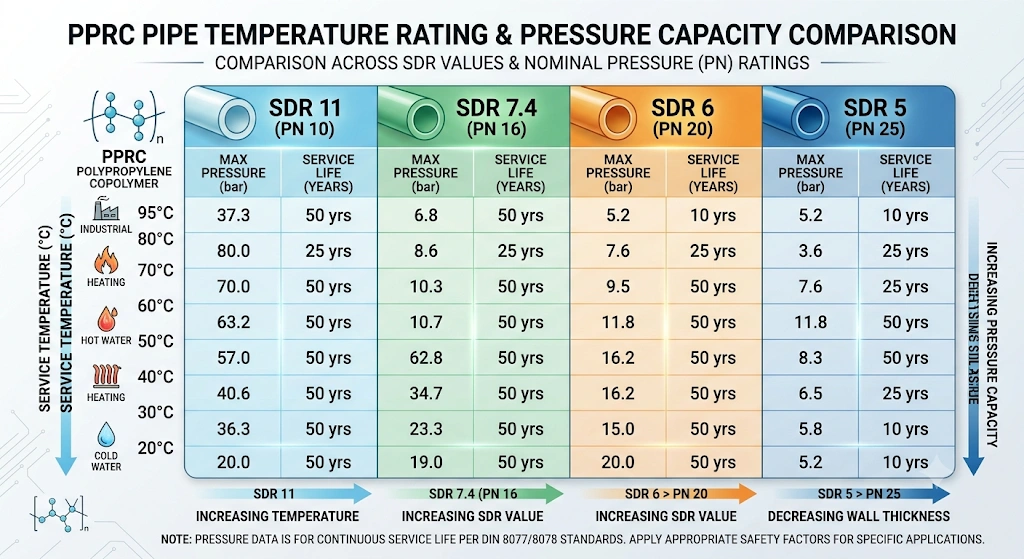
PPRC pipes are rated by temperature-pressure combinations, not by a single temperature figure. For standard domestic hot water at 60°C, a PN20 pipe runs comfortably at 10 bar. For central heating systems reaching 70°C continuous, specify PN20 or PN25 and derate the working pressure accordingly. Never apply the cold-water pressure rating to a hot water application.
The temperature rating of a PPRC pipe is inseparable from its pressure rating — and this is where many Pakistani contractors make errors that only become apparent years later when fittings begin to weep or pipes develop micro-fractures.
PPRC pipes are classified by Pressure Nominal, expressed as PN, which corresponds to the maximum working pressure in bar at 20°C cold water. The same pipe at 70°C operates at a significantly lower safe working pressure. Here is how the relationship works in practice:
Polypropylene hot water pipe temperature-pressure derating
A PN20 PPRC pipe rated for 20 bar at 20°C will have an effective safe working pressure of approximately 6.3 bar at 70°C and 3.2 bar at 95°C. For a domestic hot water system in a mid-rise residential building in Islamabad or Rawalpindi — where working pressures typically run between 3 and 6 bar — a PN20 pipe at 60°C system temperature operates with a comfortable safety margin.
For central heating systems running at higher temperatures — underfloor heating systems in DHA or Bahria Town villa projects, for instance, where flow temperatures commonly reach 70–80°C — the correct specification is PN25, which gives a thicker wall and higher baseline pressure rating, maintaining adequate safety margin after temperature derating.
The relevant standard for PPRC pipe in Pakistan is DIN 8077/8078 and ISO 15874, which define the material, dimensional tolerances, and long-term pressure performance requirements. PSQCA-certified product must meet these dimensional standards — always verify certification before purchase.
PPRC Pipe Sizes and Wall Thickness: What to Specify and When
PPRC pipes for hot water systems in Pakistan are available from 20mm to 110mm outside diameter. Residential hot water distribution typically uses 20mm to 32mm. Building risers and commercial distribution headers use 40mm to 63mm. Central heating main circuits and large commercial projects use 75mm to 110mm. Wall thickness increases with the PN rating.
The table below covers the standard PPRC hot water pipe sizes available from NEWTECH (link: /pprc-pipes-and-fittings-in-pakistan/) with indicative pressure ratings:
| Outside Diameter | Common PN Rating | Typical Wall Thickness | Suitable Application |
|---|---|---|---|
| 20mm | PN20 | 3.4mm | Domestic tap connections, individual fixture feeds |
| 25mm | PN20 | 4.2mm | Domestic hot water branch lines |
| 32mm | PN20 | 5.4mm | Residential hot water distribution mains |
| 40mm | PN20 | 6.7mm | Small commercial building distribution |
| 50mm | PN20 | 8.3mm | Building risers, commercial hot water |
| 63mm | PN20 | 10.5mm | Large commercial headers, ground floor mains |
| 75mm | PN20 | 12.5mm | Central heating primary circuits |
| 90mm | PN20 | 15.0mm | Large central heating, apartment block mains |
| 110mm | PN20 | 18.4mm | District heating connections, commercial boiler loops |
For standard domestic hot water in a 3 to 5 bedroom house, a 25mm main line feeding 20mm branch pipes to each fixture is the typical design. For a mid-rise residential building with 8 to 12 floors — common in Gulberg Lahore or Clifton Karachi — a 63mm riser with 32mm floor-level distribution branches is the standard approach.
NEWTECH’s PPRC pipe and fittings range (link: /pprc-pipes-and-fittings-in-pakistan/) covers 63mm to 110mm in its primary catalogue, with the full residential range from 20mm to 63mm also available. Specifying from a single manufacturer for both pipes and fittings ensures dimensional compatibility — a critical factor in heat fusion joining.
How to Install a PPRC Hot Water System Correctly — Step by Step
PPRC hot water pipe installation requires a calibrated socket fusion machine, correct heating time for each pipe diameter, and immediate connection after heating before the plastic cools. Joints must never be rotated or disturbed after fusion. A correctly fused PPRC joint requires no testing beyond the system pressure test — it is not the failure point in a correctly installed system.
Installation errors are responsible for the majority of PPRC system failures in Pakistan — not material defects. The following protocol reflects current best practice for hot water system installation.
Installation checklist: PPRC hot water pipe system
| Step | Action | Key Notes |
|---|---|---|
| 1 | Pipe sizing and layout | Design to minimise direction changes; account for 1.5% thermal expansion per 10°C temperature rise |
| 2 | Pipe cutting | Use a pipe cutter, not a saw; cut must be clean, square, and perpendicular |
| 3 | Deburring | Remove burrs from cut end; inspect for ovality |
| 4 | Fusion machine setup | Set temperature to 260°C; allow 5–8 minutes for machine to reach operating temperature |
| 5 | Heating time by diameter | 20mm: 5 sec, 32mm: 8 sec, 50mm: 18 sec, 63mm: 24 sec, 90mm: 40 sec |
| 6 | Fusion connection | Push pipe and fitting onto heating tools simultaneously; remove and immediately join without rotation |
| 7 | Cooling time | Hold joint motionless: 20mm for 2 min, 50mm for 4 min, 90mm for 6 min before handling |
| 8 | Support and clipping | Support horizontal runs every 10–12 pipe diameters; allow for expansion loops on runs over 3 metres |
| 9 | Pressure testing | Fill system with cold water; test at 1.5× working pressure for 30 minutes minimum |
| 10 | Commissioning | Flush system before connecting to fixtures; check all fusion joints visually for bead uniformity |
Thermal expansion is the most commonly underestimated factor in PPRC hot water installations in Pakistan. A 10-metre straight run of PPRC pipe will expand by approximately 15mm when transitioning from ambient temperature to 70°C operating temperature. Failing to account for this with expansion loops or offset connections places sustained stress on joints and fixings — the origin of many leaks that appear 2 to 3 years post-installation.
PPRC for Central Heating Systems in Pakistan: What Is Different
Central heating systems run PPRC pipes at higher sustained temperatures and cyclic pressure loads than domestic hot water systems. This demands PN25 rated pipe, correct expansion allowance for the full operating temperature range, and insulated pipework to maintain system efficiency. Central heating PPRC installations must also account for oxygen diffusion into the system — specify oxygen barrier PPRC where the system includes a boiler and metal components.
Central heating pipe in Pakistan has grown significantly as a specification requirement, particularly in upscale residential developments in Islamabad, Lahore’s DHA and Bahria Town projects, and commercial buildings requiring zoned heating. According to the Pakistan Meteorological Department, winter temperatures in Islamabad and Rawalpindi regularly reach 2–5°C, creating genuine heating demand that underfloor and radiator heating systems address more effectively than room heaters.
Key differences from standard hot water specification
For central heating, the design temperature is typically 70–80°C on the flow line and 60°C on the return. This sustained high-temperature operation means:
PN25 pipe throughout the primary circuit — not PN20. The thicker wall maintains the required safety factor at 70–80°C operating temperature.
Oxygen barrier PPRC — where the system includes a boiler and steel or cast iron radiators, oxygen diffusion through plain PPRC pipe walls can cause internal corrosion of the metal components. Oxygen barrier PPRC incorporates an EVOH layer that reduces oxygen diffusion to negligible levels. This is standard specification in European central heating and should be adopted for Pakistani projects using radiators.
Expansion vessel sizing — central heating systems require a correctly sized expansion vessel to accommodate the volume increase of heated water. This is a system design element, not a pipe specification, but undersizing it is one of the most common commissioning errors in Pakistani central heating installations.
Pipe insulation — all exposed pipework in central heating systems must be insulated to reduce heat loss and maintain system efficiency. In un-insulated systems, heat loss from distribution pipework can account for 15–25% of total boiler output — a significant efficiency penalty.
NEWTECH’s engineering team (link: /contact-us/) can provide pipe specification support for central heating projects on request.
Common Mistakes Pakistani Contractors Make with PPRC Hot Water Pipe
The three most damaging installation errors in PPRC hot water systems are using domestic PN16 pipe at hot water pressures, insufficient fusion heating time on large-diameter pipes, and failing to allow for thermal expansion on straight runs. Each of these is invisible during initial commissioning but causes failures within 2 to 5 years of operation.
The PPRC pipe market in Pakistan has expanded rapidly, and with that growth has come a significant quantity of uncertified, underweight pipe being sold as equivalent to PSQCA-compliant product. Pakistan Bureau of Statistics data shows significant growth in plastic pipe imports over the past five years — much of it low-cost product that does not meet DIN 8077 dimensional and material standards.
The four errors NEWTECH’s technical team sees most frequently
Specifying PN16 for hot water. PN16 is a cold water rating. On a hot water system running at 60–70°C, a PN16 pipe is operating at its thermal-mechanical limit, not within its safe design envelope. Always specify minimum PN20 for any hot water application.
Under-heating during fusion. Contractors under time pressure often reduce heating time on large-diameter pipes to speed up the installation. A 63mm joint that received 15 seconds of heating instead of the required 24 seconds has an incomplete fusion zone — it will hold pressure initially but fail under thermal cycling.
No expansion allowance on long straight runs. A 6-metre run of 32mm PPRC pipe between two fixed points will develop significant stress when the system heats up. Without an expansion loop or offset, that stress is absorbed by the junction points.
Buying non-PSQCA pipe. Some distributors in Karachi and Lahore stock uncertified pipe that is dimensionally close to standard but uses recycled polypropylene content that significantly reduces long-term performance. Always request the PSQCA certificate for the specific batch.
Why PPRC Pipe Outperforms Steel and CPVC in Pakistan’s Hot Water Applications
Compared to galvanised steel, PPRC pipe eliminates corrosion, scaling, and water discolouration — problems that affect most steel hot water systems in Pakistan within 10–15 years. Compared to CPVC, PPRC offers better long-term performance above 70°C, easier installation with fusion joining rather than solvent cement, and superior resistance to water hammer under pressure surges.
This is a direct material comparison relevant to anyone replacing an existing hot water system or specifying a new one:
| Performance Attribute | Galvanised Steel | CPVC | PPRC PN20 |
|---|---|---|---|
| Maximum continuous temperature | 120°C (with corrosion risk) | 93°C | 70°C |
| Corrosion resistance | Poor — corrodes within 10–15 years | Excellent | Excellent |
| Scaling and mineral buildup | High — reduces bore over time | Low | None |
| Joining method | Threaded or welded | Solvent cement | Heat fusion |
| Thermal expansion coefficient | Low | Medium | High — design for expansion |
| Typical installed lifespan in Pakistan | 10–20 years | 20–30 years | 50+ years at rated conditions |
| Chemical resistance | Poor to moderate | Good | Excellent |
| Installation speed for trained installer | Slow | Medium | Fast |
| Relative installed cost (per metre) | High | Medium | Medium |
| PSQCA-certified product available in Pakistan | Yes | Limited | Yes |
The lifespan advantage of PPRC is significant in Pakistan’s context. A textile mill in Faisalabad or a pharmaceutical plant in Karachi replacing a corroded steel hot water distribution system with PPRC is making a capital investment that should outlast the building’s next two major refurbishment cycles. That lifecycle cost calculation is why specifying engineers on major projects — DHA Islamabad, Green Gulberg Lahore — consistently prefer PPRC for hot water systems.
⚙️ Expert Insight from NEWTECH
One of the most consistent observations from NEWTECH’s technical team across 25+ years of supplying pipe to Pakistani construction projects: contractors frequently undersize the hot water supply line and oversize the fittings — or the reverse. On a residential hot water system, a 20mm supply main feeding a 32mm manifold creates a velocity problem; on a commercial building, using PN20 fittings on a PN25 pipe run defeats the purpose of the higher-rated pipe. The pipe and fitting pressure rating must match throughout the system — you cannot mix PN ratings across the same circuit and maintain the pressure safety factor.
Conclusion
Specifying PPRC correctly for a hot water system is not complicated — but it requires getting three things right before a joint is ever fused: the correct PN rating for your operating temperature, the correct size for your flow demand, and the correct installation protocol for the diameter you are working with.
The four takeaways from this guide that will directly improve your next project: always specify PN20 as your minimum for any hot water application, derate the pressure rating before finalising your design at operating temperature, design expansion relief into every straight run over 3 metres, and verify PSQCA certification on every batch of pipe before it goes into the ground.
A PPRC pipe hot water system in Pakistan, correctly specified and installed, will serve a building for 50 years without corrosion, scaling, or pressure degradation. Getting those decisions right at specification stage costs nothing. Getting them wrong costs everything downstream.
FAQ SECTION
1. What is the maximum temperature rating for PPRC pipe used in hot water systems in Pakistan?
PPRC pipe is rated for continuous service at 70°C and short-term peaks up to 95°C in hot water applications. At operating temperature, the working pressure rating is lower than the cold-water PN rating — a PN20 pipe at 70°C has an effective safe working pressure of approximately 6.3 bar. Always select PN20 as a minimum for any PPRC pipe hot water system in Pakistan.
2. Which PPRC pipe size should I use for a residential hot water system in Pakistan?
For a standard 3 to 5 bedroom house, use 25mm PPRC as the main hot water supply line and 20mm branch pipes feeding individual fixtures. For multi-storey residential buildings, use a 50mm to 63mm riser with 32mm floor-level distribution. Your exact sizing depends on fixture count, floor levels, and the available supply pressure at the inlet.
3. Can PPRC pipes be used for central heating systems in Pakistan?
Yes. PPRC is widely used for central heating pipe in Pakistan, particularly in Islamabad and Lahore’s DHA and Bahria Town developments. Central heating applications require PN25 rated pipe to maintain adequate safety margins at 70–80°C flow temperatures, and oxygen barrier PPRC is recommended where the system includes metal radiators or boiler components to prevent internal corrosion.
4. How long do polypropylene hot water pipes last in Pakistani climatic conditions?
PPRC pipes correctly specified at the right PN rating for their operating temperature are designed for 50 years of service life at rated conditions, per ISO 15874. In Pakistan’s climate — including the high summer ambient temperatures experienced in Karachi, Multan, and Faisalabad — exposed pipework should be insulated to prevent UV degradation and maintain design performance across the full service life.
5. What is the correct fusion temperature and time for PPRC pipe installation?
Heat fusion for PPRC pipe requires a socket fusion tool set to 260°C. Heating time depends on diameter: 5 seconds for 20mm, 8 seconds for 32mm, 18 seconds for 50mm, and 24 seconds for 63mm pipe. After heating, pipe and fitting must be joined immediately and held motionless during cooling — 2 minutes for 20mm, 4 minutes for 50mm. Insufficient heating time is the leading cause of joint failure.
6. How do I verify that PPRC pipe purchased in Pakistan is genuinely PSQCA certified?
Request the PSQCA batch certificate from your supplier before accepting delivery. The certificate should reference the specific production batch, not a general company approval. Check the pipe barrel markings against the certificate — diameter, PN rating, and manufacturer name must match. NEWTECH’s PPRC pipes and fittings carry PSQCA certification and ISO 9001:2015 quality management backing. Purchasing from uncertified sources is the primary cause of premature hot water pipe system failures in Pakistan.