Pakistan loses an estimated 12–15% of distributed gas to leaks and ageing infrastructure annually, according to SNGPL’s own operational reports. Much of that loss traces directly to corroded steel pipes installed decades ago — pipes that PE-grade HDPE technology was specifically designed to replace. If you’re bidding on a housing society gas network, a factory connection in Faisalabad, or a residential distribution line extension in Rawalpindi, the material decision you make at the planning stage determines whether you pass SNGPL approval and whether that pipeline is still performing at zero-leak tolerance in 2075.
HDPE pipes for gas distribution in Pakistan have become the specification of choice for utility contractors and developers precisely because they eliminate the two biggest field problems: corrosion and joint failure. But not every HDPE pipe on the market meets gas-grade requirements — and confusing pressure class, SDR rating, or fusion technique on a gas job carries consequences that a water supply job simply doesn’t. This guide covers the full picture: which grades qualify, what the standards demand, how installation actually works on-site, and where contractors in Lahore, Karachi, and Islamabad most commonly go wrong.
What Makes an HDPE Pipe Suitable for Gas Distribution?
HDPE is not a single product — it’s a family. For gas distribution, only two grades are accepted under Pakistani utility standards: PE80 and PE100, with PE100 now dominant for all new networks designed above 4 bar operating pressure.
PE80 vs PE100 — the practical difference: PE80 achieves a Minimum Required Strength (MRS) of 8 MPa at 20°C over 50 years. PE100 achieves 10 MPa under the same conditions. In field terms, PE100 allows smaller wall thicknesses for the same pressure rating — meaning lower material cost per meter and better flow capacity at identical outer diameters.
SDR Values That Matter for Gas Lines
The Standard Dimension Ratio (SDR) defines wall thickness relative to pipe outer diameter. For gas applications in Pakistan:
- SDR 11 — suitable for operating pressures up to 10 bar (PE100) or 8 bar (PE80)
- SDR 17.6 — suitable for pressures up to 6 bar (PE100), used in medium-pressure distribution mains
- SDR 21 — used only in low-pressure networks below 4 bar
SNGPL and SSGC specifications mandate SDR 11 PE100 as the minimum for all medium-pressure gas mains. Contractors sourcing pipes for these projects must confirm SDR stamping on every pipe length — this is a mandatory field check during SNGPL inspections.
NEWTECH’s DuraPE PE100 series (20mm–630mm) is manufactured to SDR 11 and SDR 17.6 specifications, conforming to ISO 4437 and ASTM D2513 — both reference standards cited in SNGPL’s approved material specifications.
Which Standards Apply to HDPE Gas Pipes in Pakistan?
Pakistan’s gas utilities — SNGPL serving the north and SSGC covering Sindh and Balochistan — do not operate in a regulatory vacuum. They mandate compliance with a specific set of international and local standards before any HDPE pipe can be approved for gas service.
Primary standards for gas-grade HDPE pipe in Pakistan:
- ISO 4437 — Plastics piping systems for the supply of gaseous fuels; specifies PE80 and PE100 compounds, dimensions, and test requirements
- ASTM D2513 — Standard specification for polyethylene (PE) gas pressure pipe, tubing, and fittings
- DIN 8075 — German standard widely cross-referenced for HDPE pipe mechanical testing; often cited alongside ISO 4437 in Pakistani project specifications
- PS 3580:1994 — Pakistan Standard for polyethylene pipes for water and gas supply (PSQCA-issued); required for PSQCA certification
In addition, the Pakistan Engineering Council (PEC) requires that all pipeline contractors on gas utility projects hold valid PEC registration, and that materials bear PSQCA certification. NEWTECH holds PSQCA certification and ISO 9001:2015 accreditation — both verifiable on-site during SNGPL material inspections.
⚙️ Expert Insight from NEWTECH One of the most common errors NEWTECH’s technical team sees on Pakistani gas projects is contractors presenting ISO 4427-certified pipe (the water supply standard) in place of ISO 4437 (gas supply standard). Both look identical on the surface. The difference lies in compound specification and pressure testing protocol. SNGPL inspectors catch this during batch audits — and the resulting material rejection can delay a project by 6–8 weeks. Always verify the standard stamped on the pipe spigot, not just the manufacturer’s data sheet.
HDPE Gas Pipe Installation: Step-by-Step for Pakistan Field Conditions
Installation quality on a gas pipeline is more critical than on any water or drainage application. A joint failure at 6 bar on a buried gas main is a safety incident — not a maintenance call. The following process is what SNGPL-approved contractors follow on medium-pressure distribution networks.
Trench Preparation
Minimum trench depth for gas mains in residential areas (per SNGPL field manuals):
- 900mm cover for PE mains up to 110mm OD
- 1,000mm cover for mains 110mm–315mm OD
- 1,200mm minimum where vehicle crossings are present
Bedding material must be clean sand or fine gravel, 150mm bed below the pipe and 300mm surround above before backfilling with native soil. In rocky ground (common in Islamabad, Rawalpindi, and Khyber-Pakhtunkhwa regions), a sand-cement slurry protective wrap is required before backfilling.
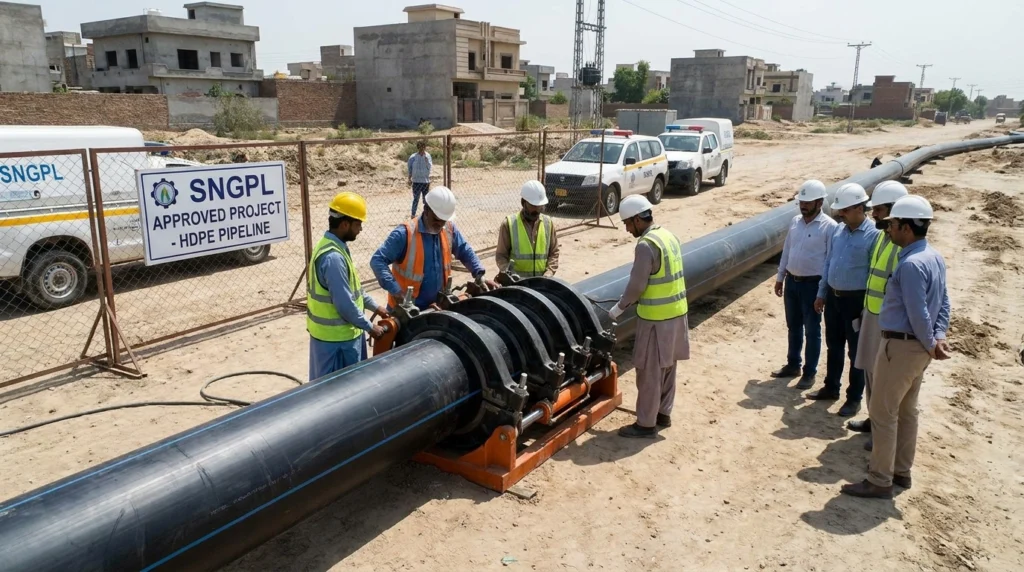
Butt Fusion Welding — The Non-Negotiable Joint Method
All pressure joints on PE gas mains must be made by butt fusion or electrofusion. Compression fittings are restricted to service connections below 63mm OD at pressures under 2 bar.
Butt fusion sequence for gas-grade PE100 pipe:
- Clamp pipe ends aligned in fusion machine — misalignment tolerance ≤0.1× wall thickness
- Face/plane both ends until continuous, clean shavings are produced
- Check heater plate temperature: 200–220°C for PE100 (verify with contact thermometer)
- Heat soak time: calculated as 10 seconds per mm of wall thickness
- Remove heater plate — drag-out time must not exceed 5 seconds
- Apply fusion pressure: 150kPa ± 15kPa for SDR 11
- Cooling time: minimum 10 minutes per mm of wall thickness under fusion pressure — never force-cool with water
NEWTECH supplies HDPE Butt-Fusion Welding Machines calibrated for PE100 parameters, used on projects including DHA Islamabad and Bahria Town pipeline networks.
Pressure Testing Before Backfill
No gas pipeline may be backfilled before a pneumatic pressure test at 1.5× maximum operating pressure (MOP) for a minimum 1-hour hold. Any pressure drop exceeding 1% during the test period requires full joint inspection before retest.
Installation Checklist Table: HDPE Gas Pipeline — Site Verification
| Step | Action | Tool/Standard | Pass Criterion |
|---|---|---|---|
| 1 | Verify pipe grade & SDR marking | Visual inspection | PE100, SDR 11 or SDR 17.6 stamped |
| 2 | Confirm ISO 4437 / ASTM D2513 compliance | Certification documents | Both standards cited on batch certificate |
| 3 | Trench depth measurement | Tape measure | ≥900mm cover (residential); ≥1,200mm at crossings |
| 4 | Sand bedding depth | Tape measure | 150mm below pipe, 300mm surround above |
| 5 | Heater plate temperature | Contact thermometer | 200–220°C before each fusion |
| 6 | Fusion bead profile | Visual inspection | Uniform, symmetrical bead; no cold lap |
| 7 | Pneumatic pressure test | Pressure gauge + data logger | 1.5× MOP, 1-hour hold, <1% pressure drop |
| 8 | Marker tape installation | Yellow gas warning tape | 300mm above pipe crown, continuous |
| 9 | Joint log completion | Site register | All joint numbers, welder ID, fusion parameters |
| 10 | SNGPL/SSGC inspection | Utility engineer sign-off | Required before backfill authorisation |
MDPE vs HDPE for Gas Distribution — Which Should You Specify?
This question comes up constantly on service connection jobs, and the answer depends on operating pressure and pipe diameter.
MDPE (Medium Density Polyethylene) — typically PE80 compound — is used for low-pressure service connections (under 2 bar, diameters 20mm–160mm). It’s more flexible than PE100, making it easier to coil and route through congested areas. SNGPL uses MDPE extensively for the last 50–100 meters of residential service connections.
PE100 HDPE is specified for distribution mains — the backbone pipelines running at 4–10 bar from pressure reduction stations to the residential/commercial grid.
The confusion arises when contractors specify MDPE for medium-pressure mains to save cost. A PE80 SDR 11 pipe at 6 bar operating pressure has a significantly narrower safety margin than PE100 SDR 11 at the same pressure — and SNGPL’s material audits target this exact substitution.
NEWTECH manufactures both MDPE pipes (20mm–160mm, PE80 compound) and PE100 HDPE pipes (20mm–630mm, DuraPE series) — so your project can be supplied from a single certified source regardless of whether the specification calls for service connection flex-pipe or main line pressure pipe. See NEWTECH’s MDPE Pipes & Fittings and HDPE Pipes product pages for full technical data.
Common Installation Mistakes That Fail SNGPL Inspections in Pakistan
Over 25 years supplying pipe to contractors across Lahore, Multan, Karachi, Faisalabad, and Bahawalpur, NEWTECH’s technical team has documented the failure patterns that repeatedly stall project approvals. Here are the top four:
Mistake 1: Using non-gas-grade HDPE Water supply PE pipes (ISO 4427 certified) are sometimes used on gas service connections because they’re cheaper and available from local traders. SNGPL batch tests detect compound differences. Material substitution on a gas project is grounds for rejection of the entire installed section.
Mistake 2: Cold fusion joints Pakistan’s winters — particularly in Islamabad, Rawalpindi, and Peshawar — drop ambient temperatures below 10°C. Butt fusion performed without pre-heating the pipe ends in cold conditions produces cold-lap joints that look correct externally but have a fraction of the rated joint strength. The pipe body will fail before the joint shows distress in pull testing — the joint fails in service.
Mistake 3: Wrong marker tape Yellow gas warning tape at 300mm above the pipe is a mandatory requirement. Orange tape (used for electrical conduit) is sometimes substituted. SNGPL inspections flag this as a safety documentation failure.
Mistake 4: Incorrect trench cover depth Contractors in dense urban areas — particularly in Lahore’s older inner-city zones — sometimes reduce cover depth to avoid conflict with existing services. Minimum cover requirements exist to protect pipes from load-induced stress and excavation damage. SNGPL will mandate excavation and re-laying at the contractor’s cost.
HDPE Gas Pipe Specifications & Cost Reference (Pakistan, 2025–2026)
Material pricing for HDPE gas-grade pipe fluctuates with polymer feedstock (linked to international petrochemical markets) and PKR exchange rates. The figures below reflect indicative market rates for PE100 SDR 11 pipe in Pakistan as of Q4 2025 — actual rates require a confirmed quotation.
| OD (mm) | SDR | Grade | Wall Thickness (mm) | Approx. Price Range (PKR/meter) |
|---|---|---|---|---|
| 32mm | SDR 11 | PE100 | 2.9 | 180 – 240 |
| 63mm | SDR 11 | PE100 | 5.8 | 520 – 680 |
| 90mm | SDR 11 | PE100 | 8.2 | 980 – 1,250 |
| 110mm | SDR 11 | PE100 | 10.0 | 1,400 – 1,800 |
| 160mm | SDR 11 | PE100 | 14.6 | 2,800 – 3,500 |
| 200mm | SDR 11 | PE100 | 18.2 | 4,200 – 5,200 |
| 250mm | SDR 11 | PE100 | 22.7 | 6,400 – 8,000 |
| 315mm | SDR 11 | PE100 | 28.6 | 10,000 – 12,500 |
Prices are indicative. Confirm current rates with NEWTECH’s sales team before finalising your BOQ.
For a firm quotation on gas-grade HDPE pipe for your project, contact NEWTECH at .
Approved Fittings for HDPE Gas Pipelines
Pipe selection alone doesn’t determine system integrity — fittings and jointing systems must be equally gas-grade certified. The following fitting types are used on PE gas distribution systems:
Butt fusion fittings (63mm–630mm): Elbows, tees, reducers, and end caps manufactured from the same PE100 compound as the pipe. All butt fusion fittings must carry ISO 4437 certification and bear the same SDR designation as the pipe they join. NEWTECH’s PLAST-1 brand HDPE butt fusion fittings (63mm–630mm) are manufactured under ISO 9001:2015 and are compatible with PE100 gas mains. See HDPE Butt-Fusion Fittings
Electrofusion fittings: Used where butt fusion machines cannot be deployed — confined spaces, directional drilling entry/exit points, and connection to existing mains under pressure. Electrofusion couplers carry embedded resistance wire; weld parameters are encoded in a barcode read by the control unit. All electrofusion joints must be logged with welder ID, coupler serial number, and machine print-out.
Compression fittings (service connections only): Suitable for 20mm–63mm OD MDPE/HDPE at pressures below 2 bar. Not approved for medium-pressure mains. NEWTECH’s compression fitting range is listed at Compression Fittings.
According to the Gas Infrastructure Development Cess (GIDC) regulatory framework and SNGPL’s technical specification TS-SP-102, all fittings used on approved gas networks must come from manufacturers on SNGPL’s Approved Vendor List — verify your supplier’s approval status before procurement.
Conclusion
Your gas pipeline passes or fails inspection on three things: the right pipe grade (PE100, SDR 11, ISO 4437 certified), correct fusion — with documented joint parameters — and full trench compliance. No shortcut on any of these three delivers a faster project; every shortcut creates a mandatory re-dig.
Actionable takeaways for your next gas pipeline project:
- Specify PE100 SDR 11 conforming to ISO 4437 — not generic HDPE — and require batch certification on delivery
- Verify your fusion machine is calibrated for PE100 parameters (200–220°C heater plate) and document every joint with welder ID and parameters
- Maintain minimum 900mm cover in residential areas and install yellow gas warning tape at 300mm above crown
- Request a pre-installation material audit with SNGPL/SSGC before breaking ground — it eliminates rejection risk on procurement
NEWTECH supplies HDPE pipes for gas distribution in Pakistan with full PSQCA certification, ISO 4437 conformance documentation, and technical support from our engineering team — available for projects in Lahore, Karachi, Islamabad, Rawalpindi, Multan, Faisalabad, and across Pakistan.
FAQ SECTION
1: What grade of HDPE pipe is approved for gas distribution by SNGPL and SSGC in Pakistan?
SNGPL and SSGC both require PE100-grade HDPE pipe conforming to ISO 4437 or ASTM D2513 for gas distribution mains. PE80 (MDPE) is permitted for low-pressure residential service connections below 2 bar. Always request a batch conformance certificate confirming the specific standard, grade, and SDR before accepting material on site.
2: What is the correct SDR rating for HDPE pipes on gas pipelines in Pakistan?
For medium-pressure gas distribution (4–10 bar operating pressure), SDR 11 PE100 is the SNGPL-standard specification. SDR 17.6 is used for lower-pressure networks below 6 bar. SDR 21 is restricted to very low-pressure applications only. The SDR rating must be stamped on the pipe — verify it physically on site, not just on the data sheet.
3: How long do HDPE pipes for gas distribution last underground in Pakistan’s soil conditions?
PE100 HDPE pipes have a certified design life of 50 years under ISO 4437 test conditions, and real-world performance data from European gas utilities shows operational lifespans exceeding 60 years. Pakistani soil conditions — including clay-heavy Punjab soils and coastal Karachi saline ground — do not affect HDPE, which is fully corrosion-resistant and requires no cathodic protection.
4: What fusion method is required for HDPE gas pipeline joints in Pakistan?
Butt fusion is the required joint method for all PE gas mains 63mm and above, following ISO 21307 fusion parameters (200–220°C heater plate for PE100, 10 seconds heat soak per mm wall thickness). Electrofusion is used where butt fusion machines cannot be deployed. Compression fittings are restricted to 20–63mm service connections at pressures below 2 bar only.
5: What is the approximate price of HDPE PE100 gas pipe per meter in Pakistan in 2026?
As of 2025–2026, PE100 SDR 11 HDPE pipe for gas distribution in Pakistan ranges from approximately PKR 180–240/meter for 32mm OD up to PKR 10,000–12,500/meter for 315mm OD. Prices fluctuate with polymer feedstock and exchange rates. Contact NEWTECH directly for a current, project-specific quotation before finalising your bill of quantities.
6: Does NEWTECH supply PSQCA-certified HDPE pipe for SNGPL gas projects in Pakistan?
Yes. NEWTECH Pipes holds PSQCA certification and ISO 9001:2015 accreditation, and manufactures HDPE and MDPE pipes conforming to ISO 4437 and ASTM D2513 — the standards required for SNGPL and SSGC approved gas pipeline projects. NEWTECH has supplied gas-grade pipe to projects across Lahore, Islamabad, Karachi, Rawalpindi, and Multan.