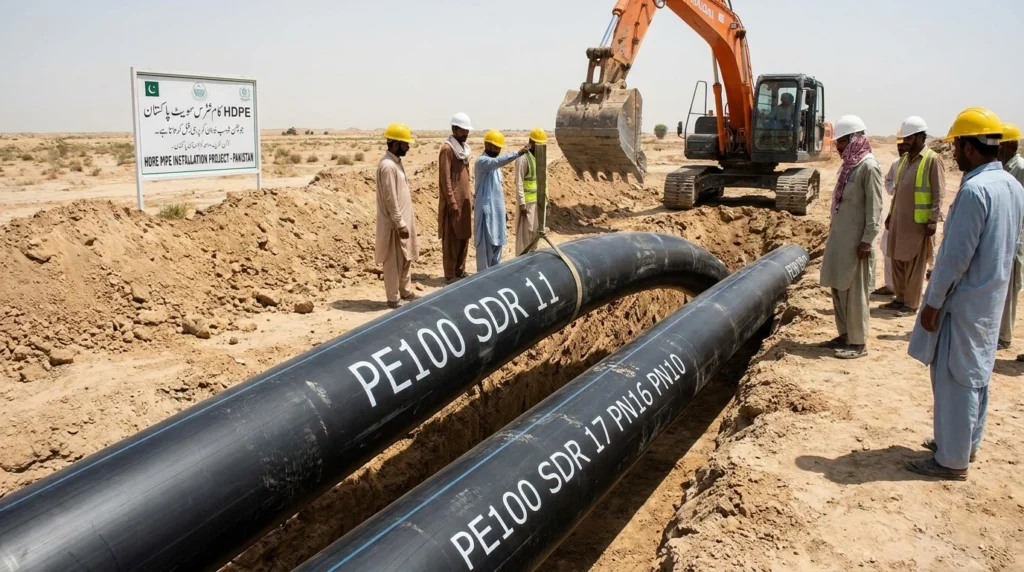
Wrong SDR selection is one of the most expensive mistakes on any pipe project — and it happens far more often than it should. According to the Pakistan Bureau of Statistics (2023), the construction sector contributes over 2.5% to GDP and continues to grow at nearly 6% annually, driving massive demand for water supply infrastructure across housing societies, industrial zones, and agricultural schemes. Yet a significant share of pipe failures on these sites trace directly back to mismatched pressure ratings — not defective material.
If you’re specifying or procuring HDPE pipe for a water system in Lahore, Faisalabad, or anywhere across Pakistan, the SDR rating printed on that pipe determines whether your system runs at full pressure for 50 years — or fails within two monsoon seasons. Understanding SDR is non-negotiable for anyone signing off on a pipe specification, managing a WASA-approved project, or sourcing HDPE compression fittings for a housing society distribution network.
This guide cuts through the confusion. You’ll learn exactly what SDR means, how to match it to your system pressure, which NEWTECH pipe series maps to each rating, and where Pakistani engineers most commonly get it wrong. Let’s get into it.
What Is SDR in HDPE Pipes — and Why Does It Define Your Pressure Rating?
SDR stands for Standard Dimension Ratio. It’s calculated as:
SDR = Outside Diameter ÷ Wall Thickness
A pipe with an outside diameter of 110mm and a wall thickness of 10mm has an SDR of 11. That’s it — it’s a simple ratio, but it carries enormous implications for how much pressure your system can safely handle.
Here’s the key principle: the lower the SDR value, the thicker the wall and the higher the pressure rating. This is because a thicker wall distributes internal pressure stress across more material.
How SDR Translates to Pressure Rating
For PE100 material (the current standard for HDPE pressure pipes, per ISO 4427), the relationship looks like this:
| SDR Rating | Wall Thickness (110mm pipe) | Max Operating Pressure (PE100) |
|---|---|---|
| SDR 7.4 | ~15mm | 25 bar |
| SDR 11 | ~10mm | 16 bar |
| SDR 13.6 | ~8.1mm | 12.5 bar |
| SDR 17 | ~6.5mm | 10 bar |
| SDR 21 | ~5.2mm | 8 bar |
| SDR 26 | ~4.2mm | 6 bar |
These pressure ratings are at 20°C. If your pipeline operates at higher temperatures — common in above-ground sections in Multan or Karachi where ambient temperatures can exceed 45°C in summer — you must apply a temperature derating factor as specified in ISO 4427-2.
NEWTECH’s DuraPE series pipes are available in PE80 and PE100 grades, with SDR ratings from SDR 7.4 through SDR 26 across diameters from 20mm to 630mm — covering everything from a domestic water meter connection to a main transmission line for a housing society.
SDR 11 vs SDR 17 vs SDR 26: Which One Does Your Project Actually Need?
This is the question every procurement manager and contractor in Pakistan should be asking before a single meter of pipe is ordered. Getting it wrong in either direction costs money — over-specified pipe wastes budget; under-specified pipe fails under load.
SDR 11 (16 bar) — High-Pressure Mains and Industrial Supply Lines
SDR 11 is your go-to for:
- Municipal water transmission mains where WASA maintains line pressure of 8–12 bar
- High-rise building risers (above 8 floors), especially in Lahore’s DHA and Bahria Town developments
- Industrial process water at factories in Faisalabad’s textile cluster or Sialkot’s surgical instruments manufacturing zone
- Compressed air distribution (with appropriate system design)
The thicker wall also provides better resistance to external soil loads and point loading from traffic, making it the standard choice for below-road installations in urban environments.
SDR 17 (10 bar) — The Workhorse for Most Distribution Networks
SDR 17 hits the sweet spot for the vast majority of Pakistani water distribution projects. It handles standard WASA supply pressures, agricultural tube well distribution headers, and residential housing society networks — at a noticeably lower material cost than SDR 11.
Most NEWTECH compression fitting installations in housing societies across Rawalpindi, Islamabad, and Lahore’s periphery use SDR 17 pipe as the backbone of their distribution loops.
SDR 26 (6 bar) — Gravity-Fed Systems and Low-Pressure Applications
SDR 26 is appropriate for:
- Gravity-fed irrigation channels and farm distribution lines in Punjab’s agricultural belt
- Drainage force mains with low static head
- Non-pressure conduit and cable protection where mechanical strength matters more than pressure capacity
⚙️ Expert Insight from NEWTECH One of the most common errors we see on housing society projects in Pakistan is contractors using SDR 17 pipe on high-rise connections that actually require SDR 11 — because SDR 17 is cheaper and the price difference seems significant at the time. But a burst riser on the 10th floor of an apartment block costs 40–60 times more to repair than the material saving at procurement. Always match SDR to your maximum operating pressure, not your budget preference.
HDPE Compression Fittings Pakistan: What Rating Must Your Fittings Match?
Your pipe’s SDR rating means nothing if the fittings connecting that pipe are rated lower. This is a fundamental rule that many plumbing installers in Pakistan overlook — particularly on smaller residential and agricultural jobs where fitting selection gets treated as an afterthought.
HDPE compression fittings work by mechanically clamping onto the outer surface of the pipe using a collet and a compression nut, without heat or welding equipment. This makes them ideal for:
- Field repairs on live systems
- Connections in confined spaces or trenches
- Smaller diameter lines (20mm–110mm) where butt fusion is impractical
- Temporary connections during phased project construction
Matching Fitting Pressure Rating to Pipe SDR
Every HDPE compression fitting carries a rated operating pressure — typically expressed in bar or PN (Pressure Nominal) rating. When you’re buying HDPE compression fittings in Pakistan, verify that the fitting’s PN rating equals or exceeds the system’s maximum operating pressure.
NEWTECH’s compression fittings are compatible with PE63, PE80, and PE100 pipes and are rated to handle the pressures corresponding to SDR 11 and SDR 17 systems in typical water supply applications. They are manufactured to dimensional standards that align with ISO 4427 pipe outside diameters, ensuring a leak-free seal across the full operating pressure range.
A key point: never install a compression fitting rated for SDR 17 on a system running at SDR 11 pressures. The fitting body and collet must be specified to match your actual system pressure — not the pipe’s SDR in isolation.
Compression Fitting Types for HDPE — Which One Goes Where?
Understanding compression fitting types for HDPE pipe helps you specify the right connection for every joint in your system. Each type is designed for a specific connection scenario, and mixing them up causes leaks, installation failures, or premature joint fatigue.
The Main HDPE Compression Fitting Types Available in Pakistan
| Fitting Type | Application | Key Feature |
|---|---|---|
| Straight Coupler | Joining two pipes of the same diameter | Most common; used for extensions and repairs |
| Reducer | Connecting different diameter pipes | Available in stepped and bush configurations |
| Elbow (90° / 45°) | Direction changes in buried and surface runs | Compact form factor vs. long-radius bends |
| Tee | Branch connections on distribution loops | Equal or unequal tee configurations |
| End Cap | Sealing pipe terminations | Used at test points and system ends |
| Threaded Adaptor (Male/Female) | Transitioning from HDPE to BSP/NPT threaded fittings | Connects to valves, meters, pump outlets |
| Flange Adaptor | Connection to flanged valves and pump flanges | Used at pump stations and isolation points |
| Saddle Clamp | Branch tapping without cutting the main | Service connections on live mains |
For most water supply projects in Pakistan, the straight coupler, tee, and elbow account for 80–85% of total fitting requirements. Saddle clamps become critical on WASA municipal main connections where a live tap is required.
Polyethylene Pipe Fittings in Pakistan: Butt Fusion vs Compression — When to Use Each
Both butt fusion and compression fitting systems use polyethylene pipe fittings, but they suit fundamentally different installation contexts. Confusing the two leads to either unnecessary cost or inappropriate joint integrity for the application.
Butt Fusion Fittings (NEWTECH PLAST-1 Series, 63mm–630mm)
Butt fusion creates a joint as strong as the pipe itself — the molecular bond between fused pipe ends eliminates any mechanical weak point. This makes it the preferred method for:
- Transmission mains and large-diameter distribution headers (63mm–630mm)
- Buried pipelines where access for future repair is difficult
- High-pressure systems (SDR 11, 16 bar) where joint integrity is critical
- Projects under PEC or WASA specification requiring full pipe-strength joints
NEWTECH manufactures HDPE butt fusion fittings under its PLAST-1 brand, covering elbows, tees, reducers, and stub flanges from 63mm to 630mm. These are manufactured to ISO 4427 dimensional standards and are compatible with NEWTECH DuraPE pipe.
According to the World Bank’s Pakistan Water Supply Program documentation (2022), butt-fused HDPE pipe systems are the recommended specification for new urban water infrastructure projects due to their 50-year design life and near-zero leak rate when correctly installed.
Compression Fittings (20mm–110mm) — Speed and Flexibility
Compression fittings trade joint strength for installation speed and tool independence. They’re the right choice when:
- Working in tight trenches on service connections (20mm–63mm)
- Making field repairs where a fusion machine isn’t on site
- Connecting to galvanised steel or PVC sections during rehabilitation work
- Installing agricultural irrigation laterals at plot level
The trade-off: compression joints require periodic inspection on high-vibration or high-cycle systems, and are generally not specified for mains operating continuously above 10 bar.
Pipe Fitting Installation Pakistan: Common Site Errors That Cause Failures
Pipe fitting installation in Pakistan follows a consistent pattern of errors that NEWTECH’s technical team encounters on sites across Punjab and Sindh. Knowing these in advance saves you from costly rework.
The 5 Most Common HDPE Installation Mistakes on Pakistani Sites
1. Not deburring cut pipe ends A rough or angled cut on the pipe end prevents the compression collet from seating correctly. Every cut pipe end must be deburred with a chamfer tool before fitting insertion. This takes 30 seconds — skipping it causes leaks within weeks.
2. Over-tightening compression nuts Hand-tight plus 1.5 turns with a spanner is the correct installation torque for most HDPE compression fittings. Over-tightening cracks the fitting body, particularly on cheaper non-PSQCA fittings. If you’re using calibrated NEWTECH compression fittings, follow the torque guidance printed on the packaging.
3. Using the wrong pipe outside diameter tolerance HDPE compression fittings seal against the pipe’s outside diameter. PE80 and PE100 pipes of the same nominal size can have slightly different OD tolerances depending on manufacturer. Always confirm OD compatibility before ordering fittings for a mixed-supply project.
4. Ignoring soil bedding requirements An HDPE pipe installed without proper granular bedding in a trench is vulnerable to point loading at fitting locations. Per ISO 10802 and WASA installation specifications, fittings must be supported in compacted granular bedding with minimum 150mm cover on all sides.
5. Pressure testing before backfill on hot days Testing a buried line at noon in Multan in July — when ground surface temperatures exceed 50°C — gives misleading pressure readings. Schedule pressure tests in the early morning for accurate results.
⚙️ Expert Insight from NEWTECH On several WASA-approved projects in Lahore and Rawalpindi, our installation teams have found fittings from non-PSQCA-certified sources that failed pressure tests at just 6 bar — rated for 10 bar on the label. PSQCA certification on fittings is not optional on public water infrastructure — it’s the baseline. Any fitting used on a WASA, NHA, or housing development authority project must carry verifiable certification. NEWTECH’s compression fittings are manufactured under ISO 9001:2015 quality protocols and carry PSQCA certification, with batch traceability.
SDR Selection for Pakistan’s Climate: What Changes in Extreme Heat?
Pakistan’s climate creates pressure-rating challenges that European or North American pipe specifications don’t fully account for. In Sindh and South Punjab, summer ground surface temperatures frequently exceed 50°C, and above-ground pipe surface temperatures can reach 60–70°C during peak heat.
HDPE’s pressure capacity decreases with increasing temperature. This is not a defect — it’s a material property of all thermoplastic pipes. ISO 4427 provides temperature derating factors:
| Operating Temperature | Derating Factor (PE100) |
|---|---|
| 20°C | 1.00 (full rating) |
| 30°C | 0.87 |
| 40°C | 0.74 |
| 50°C | 0.60 |
| 60°C | 0.47 |
Practical example: An SDR 17 pipe rated at 10 bar at 20°C is effectively limited to 6 bar at 50°C operating temperature. If your system pressure is 8 bar and your pipeline runs above ground in a hot climate zone, SDR 17 is no longer safe — you need to move to SDR 13.6 or SDR 11 for that section.
For underground installations at typical Pakistani burial depths (600mm–1200mm), ground temperatures stabilise in the 20–30°C range, and the full pressure rating applies. The concern is specifically for above-ground sections — pump station piping, surface irrigation headers, industrial process lines, and rooftop connections.
NEWTECH’s technical sales team can provide project-specific SDR recommendations based on your operating pressure, burial depth, and regional climate.
Conclusion
Choosing the right SDR rating isn’t a technical formality — it’s the decision that determines whether your water system runs reliably for 50 years or fails under the first load spike. Here’s what you need to take from this guide:
1. Match SDR to actual operating pressure, not pipe diameter. Your system’s maximum continuous pressure — not nominal design pressure — defines your minimum SDR requirement.
2. Temperature derate above-ground sections. Any HDPE pipeline exposed to Pakistani summer temperatures must be re-evaluated using ISO 4427 derating factors, which can reduce effective pressure capacity by 25–40%.
3. Fittings must be rated at least as high as the pipe. When sourcing HDPE compression fittings in Pakistan, confirm the PN rating against your system pressure — not against the pipe’s nominal size.
4. PSQCA certification is the baseline on any public project. Non-certified fittings risk project rejection, rework cost, and — in water supply applications — genuine public health consequences.
FAQ SECTION
Q1: What SDR rating HDPE pipe is required for WASA water supply projects in Pakistan?
WASA specifications in Lahore, Karachi, and Islamabad typically require SDR 11 (PE100, 16 bar) for transmission mains and SDR 17 (PE100, 10 bar) for distribution networks. Always confirm the specific project specification with your WASA district engineer, as requirements vary by zone and project type.
Q2: Are HDPE compression fittings suitable for permanent underground installations in Pakistan?
Yes — HDPE compression fittings rated PN10 or above are suitable for permanent underground installation in standard water supply applications up to 10 bar. Ensure the fitting carries PSQCA certification and that the pipe end is cleanly cut and deburred before installation. Periodic inspection is recommended on high-pressure or high-vibration systems.
Q3: What is the difference between PE80 and PE100 HDPE pipe in terms of pressure rating?
PE100 has a Minimum Required Strength (MRS) of 10 MPa versus 8 MPa for PE80. For the same SDR, PE100 pipe delivers a 25% higher pressure rating. Most new projects in Pakistan now specify PE100 as the standard grade, and NEWTECH’s DuraPE series is available in both grades to match legacy and new system specifications.
Q4: How long do HDPE pipes and polyethylene pipe fittings last in Pakistan’s climate?
Correctly installed HDPE pressure pipes have a design life of 50 years per ISO 4427, even in Pakistan’s high UV and temperature environment — provided buried pipes are not exposed to surface UV. Above-ground sections require UV-stabilised black PE100 pipe. NEWTECH DuraPE pipes use carbon black UV stabilisation conforming to ISO 4427 requirements.
Q5: What compression fitting types are available for HDPE pipe in Pakistan and where can I source them?
Standard compression fitting types available for HDPE pipe in Pakistan include straight couplers, elbows (45° and 90°), equal and reducing tees, end caps, male and female threaded adaptors, flange adaptors, and saddle clamps. NEWTECH supplies a complete range of PE-compatible compression fittings from its manufacturing facility, available through distributors nationwide.
Q6: How do I verify that HDPE pipe fittings meet PSQCA standards for a government project in Pakistan?
Request the PSQCA test certificate and batch number from the supplier. Legitimate PSQCA-certified products carry a certification mark on the pipe or fitting body along with a traceable batch or production code. For PEC-registered projects, the engineer of record can verify certification through PSQCA’s online registry. NEWTECH’s fittings carry batch-traceable PSQCA certification on all production runs.