What Is SDR in HDPE Pipe and Why Does It Control Everything?
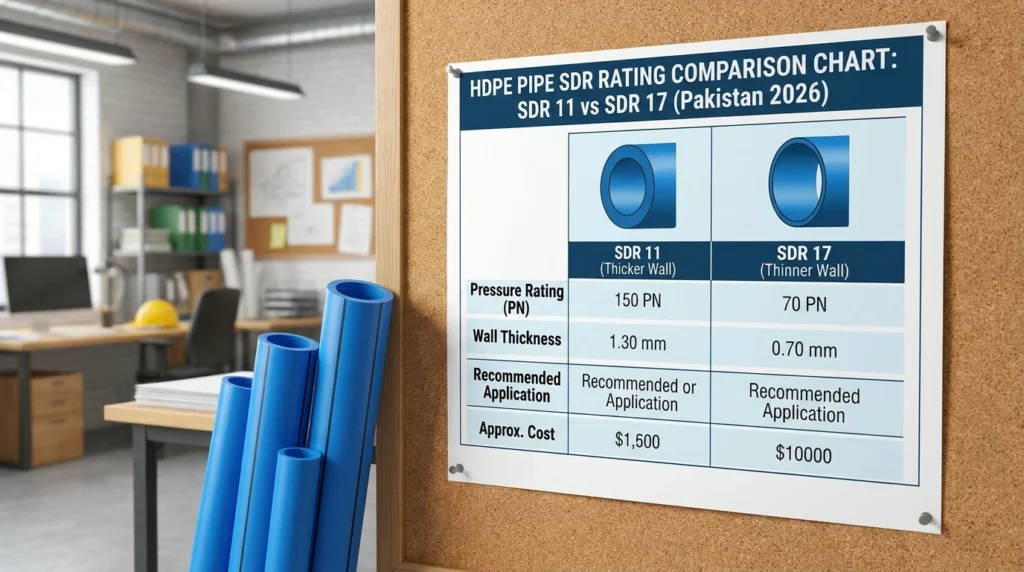
A 110mm outer-diameter pipe with a 10mm wall has an SDR of 11. A 110mm pipe with a 6.5mm wall has an SDR of 17. That single number encodes the pipe’s pressure capacity, weight per metre, and material cost — which is why HDPE pipe SDR rating selection is the most consequential specification decision you make before procurement.
The fundamental rule: lower SDR = thicker wall = higher pressure rating. SDR 11 pipe is stronger than SDR 17 pipe of identical diameter. SDR 26 is used for drainage and low-pressure conduit runs. The relationship between SDR and maximum operating pressure (MOP) is governed by ISO 4427-2, the international standard for HDPE pressure pipes for water supply systems, which Pakistan’s PSQCA references directly under PS 3580:1994.
When a site engineer or WASA inspector asks for your ‘pressure class’ documentation, they want you to demonstrate that your chosen SDR — in combination with the pipe’s material grade — delivers the required MOP with the correct safety factor. NEWTECH’s DuraPE HDPE pipe range is manufactured to ISO 4427 and carries PSQCA certification across all standard SDR classes from SDR 7.4 to SDR 26, in sizes from 20mm to 630mm. See the full range at newtech-pipes.com/products/hdpe-pipes/
SDR 11 vs SDR 17 HDPE Pipe: The Decision That Defines Your System’s Safety
This is the specification decision made incorrectly most often on Pakistani construction sites. Contractors in Faisalabad textile plants, developers in DHA Islamabad, and plumbers in Multan housing projects default to price — and SDR 17 is cheaper per metre. The danger is that price logic ignores pressure reality.
SDR 11 — Maximum Operating Pressure 16 bar (PE100) or 10 bar (PE80)
SDR 11 is the workhorse of municipal water supply, high-pressure industrial loops, and multi-storey building risers. WASA Lahore and WASA Karachi both specify PE100 SDR 11 for primary transmission mains running at operating pressures above 10 bar. If your system uses pump-driven pressure, features frequent valve closures (which generate surge), or serves a building taller than five storeys, SDR 11 is your minimum specification — not a luxury upgrade.
SDR 17 — Maximum Operating Pressure 10 bar (PE100) or 6.3 bar (PE80)
SDR 17 is correctly applied on secondary distribution networks, agricultural irrigation mains operating below 6 bar, gravity-fed rural water schemes, and low-pressure municipal branch lines. In Punjab’s agricultural belt — from Bahawalpur to Sahiwal — SDR 17 PE100 is standard for tube well discharge lines and drip irrigation mains, where operating pressures typically run 3–6 bar. It is not a ‘cheaper version’ of SDR 11 — it is the correctly-rated pipe for lower-pressure applications.
| ⚙️ Expert Insight from NEWTECH
One of the most damaging mistakes we see repeatedly — particularly on housing society projects in Bahria Town Karachi and DHA Lahore — is SDR 17 specified for vertical risers in 8 to 10-storey towers. Static head pressure alone in a 30-metre vertical run hits 3 bar. Add pump pressure and you reach 7–8 bar operating, with surge spikes well beyond that. SDR 17 PE80 has a MOP of just 6.3 bar. That safety margin disappears on the first water hammer event. For any vertical run exceeding five floors, specify SDR 11 PE100 — no exceptions. |
HDPE Pipe Pressure Class Explained: How PE80 and PE100 Change Your SDR Calculation
SDR alone does not give you a pressure rating. You also need the material’s Minimum Required Strength (MRS), which is where the PE80 vs PE100 distinction becomes critical for your HDPE pipe SDR rating selection.
PE100 has an MRS of 10.0 MPa. PE80 has an MRS of 8.0 MPa. At an identical SDR, PE100 delivers 25% higher pressure capacity. That difference is decisive when you are specifying for a WASA project in Islamabad or an industrial process line in a Sialkot sports goods factory.
The table below shows MOP across the seven most common SDR classes for both material grades:
| SDR Rating | PE80 MOP (bar) | PE100 MOP (bar) | Typical Application in Pakistan |
| SDR 7.4 | 16.0 | 20.0 | High-pressure industrial, hydraulic systems |
| SDR 9 | 12.5 | 16.0 | Municipal transmission mains, high-rise risers |
| SDR 11 | 10.0 | 16.0 | Water supply mains, WASA-specified projects |
| SDR 13.6 | 8.0 | 12.5 | Secondary distribution, commercial buildings |
| SDR 17 | 6.3 | 10.0 | Irrigation mains, low-pressure supply networks |
| SDR 21 | 5.0 | 8.0 | Gravity-fed drainage, low-pressure rural supply |
| SDR 26 | 4.0 | 6.3 | Surface drainage, cable conduit runs |
Key takeaway: PE100 SDR 17 gives you the same 10 bar MOP as PE80 SDR 13.6 — with a lighter, thinner pipe and lower installation cost per metre. For any serious infrastructure project in Pakistan, PE100 is the smarter procurement choice. NEWTECH manufactures both PE80 and PE100 grades in the DuraPE series, available from 20mm to 630mm. Request project-specific datasheets at newtech-pipes.com/products/hdpe-pipes/
What PSQCA, WASA, and PEC Require: Pakistan Standards That Fix Your Minimum SDR
Your SDR selection is not always a free engineering decision. Pakistan’s regulatory framework imposes minimum specifications on approved projects, and non-compliance triggers inspection failure regardless of how correctly the pipe was installed.
PSQCA and PS 3580:1994
Pakistan Standards and Quality Control Authority mandates that HDPE pressure pipes for potable water supply carry the PSQCA certification mark, manufactured in compliance with PS 3580:1994 (which references ISO 4427). If your pipe does not carry the PSQCA mark, it will not pass inspection on any government-procured or publicly-funded water project. NEWTECH’s entire DuraPE HDPE range carries full PSQCA certification — documentation available for PEC submissions and WASA tender packages.
WASA City Requirements
WASA Lahore specifies PE100 SDR 11 for primary transmission mains and permits SDR 17 PE80 on secondary branch lines below 6 bar. WASA Karachi’s recent K-IV bulk water supply scheme — one of Pakistan’s largest urban water infrastructure projects — specified PE100 throughout to future-proof against pressure escalation as the network expands. If you are preparing a BoQ for any WASA tender in Lahore, Karachi, Rawalpindi, or Peshawar, verify the SDR specification in the bid documents before procurement. Do not assume it defaults to the cheapest option.
PEC Documentation Requirements
Pakistan Engineering Council registered engineers are required to certify that pipe specifications meet applicable ISO and PS standards. Your SDR selection must be accompanied by pressure calculations including MOP, surge pressure analysis, and a documented safety factor. NEWTECH’s technical team regularly provides project documentation support for PEC submissions — contact us at newtech-pipes.com/contact-us/ to discuss your project requirements.
HDPE Pipe SDR Rating Selection by Project Type: A Pakistan-Specific Field Guide
Pressure profiles differ radically between project types, and your SDR must reflect actual operating conditions — not just the static design pressure from your hydraulic calculation. According to the Pakistan Council of Research in Water Resources (PCRWR Annual Report 2022), more than 40% of urban distribution system water losses in Pakistan are linked to pipe deterioration caused by pressure mismatches and incorrect material specification. Here is the correct SDR for each major project category:
Municipal Water Supply Mains (Lahore, Karachi, Islamabad, Rawalpindi)
Municipal mains experience pump-driven pressure, regular surge events from valve operation, and must deliver a 50-year service life per ISO 4427 design parameters. SDR 11 PE100 is the floor specification, not the premium option. At 16 bar MOP, it carries a full safety margin above typical WASA operating pressures of 8–12 bar.
Agricultural Tube Wells and Irrigation Mains (Punjab, Sindh, KPK)
Tube well discharge lines in Multan, Bahawalpur, and the Sindh canal command area operate at 3–6 bar. SDR 17 PE100 handles this comfortably with a design safety factor above 1.25. PE100 is preferred over PE80 even at these lower pressures because of its superior UV resistance for partially-exposed sections and better fatigue performance across seasonal temperature cycling.
Housing Society Internal Networks (Bahria Town, DHA, Green Gulberg)
The critical error on housing society projects is applying a single SDR across the entire network without pressure zoning. Horizontal distribution mains at ground level may genuinely operate below 4 bar — SDR 17 is fine there. But any riser in a multi-storey block must be calculated from the lowest point of the system, not the pump outlet. Always include surge pressure in your riser specification.
Industrial Process Water (Textile, Pharma, Food Processing, Cement)
Textile mills in Faisalabad and pharmaceutical plants in Karachi run process water at elevated pressures and temperatures. PE100 SDR 9 at 16 bar MOP gives a 60% safety margin above a 10 bar operating system — essential in environments with heat, chemical exposure, and continuous flow. Do not apply irrigation-grade SDR 17 to factory process lines regardless of how low the static pressure looks on paper. Dynamic pressure spikes in industrial systems regularly exceed static design by 30–50%.
Temperature Derating: The HDPE Pipe Pressure Class Factor Pakistan’s Engineers Most Often Miss
ISO 4427 pressure ratings apply at 20°C. Pakistan’s summer ground temperatures do not. Soil temperatures at 300–500mm burial depth in Multan and Jacobabad reach 35–40°C from May through September. Surface-mounted pipes in industrial yards or partially-buried irrigation mains in exposed fields can exceed 50°C during afternoon peaks.
Every 10°C above 20°C reduces your effective MOP. The ISO 4427-2 derating factors are:
- At 30°C: effective MOP = rated MOP × 0.87
- At 40°C: effective MOP = rated MOP × 0.74
- At 50°C: effective MOP = rated MOP × 0.63
Worked example: You specify SDR 13.6, PE100, rated 12.5 bar at 20°C for a partially-exposed irrigation header in Sindh. At 40°C soil temperature, effective MOP drops to 9.25 bar. If your pump delivers 9 bar, that leaves a margin of just 0.25 bar — which disappears the moment any surge pressure occurs. The correct specification for that system is SDR 11 PE100, which derated to 11.8 bar at 40°C and delivers a genuine 2.8 bar margin above pump pressure.
Always complete your SDR selection after derating, not before. For NEWTECH’s full temperature performance data and technical datasheets,
How to Verify HDPE Pipe SDR Rating on Site: Reading the Marking Line Before Installation
Any legitimate HDPE pipe manufactured to ISO 4427 or PS 3580:1994 carries a continuous marking line printed along its length. This marking is your on-site quality check — and your protection against counterfeit or misgraded pipe, which continues to circulate in markets around Gujranwala, Rawalpindi, and interior Sindh.
Here is what each field confirms:
- 110 — Outer diameter in millimetres. Verify this matches your BoQ.
- SDR 11 — The wall thickness ratio. This is your pressure class confirmation.
- PE100 — Material grade. Confirms MRS 10.0 and the higher pressure capacity.
- ISO 4427 — Manufacturing standard. Non-negotiable for WASA and PEC projects.
- PSQCA — Pakistan quality certification mark. Required for public sector projects.
- PN16 — Nominal pressure rating at 20°C. Cross-check against the SDR/PE grade formula.
If any of these fields are missing or inconsistent, reject the delivery before installation. No legitimate ISO 4427 manufacturer omits SDR and material grade from the pipe marking. Substandard pipe found in Pakistani wholesale markets frequently carries an SDR number without a PE grade, or claims PN ratings that do not match the actual SDR. Both are red flags.
For NEWTECH’s butt-fusion fittings, verify fitting SDR matches your pipe SDR exactly before any fusion joint is made. Mismatched SDR between pipe and fitting is a common cause of joint failure on Pakistani construction sites.
Make the Right SDR Call Before the Pipe Goes in the Ground
Your HDPE pipe SDR rating selection locks in your system’s pressure safety for the next 50 years. Get it wrong and you are facing burst mains, failed WASA inspections, and contractual liability. Get it right and your system performs to its full design life without intervention.
Four decisions to make before you procure:
- Match SDR to your actual MOP — include surge pressure in your calculation, not just static design pressure.
- Derate for temperature — if your pipe runs in soil above 20°C, apply the ISO 4427-2 derating factor before finalising SDR.
- Default to PE100 — the cost premium over PE80 is minimal at project scale, and the pressure performance advantage is significant at every SDR class.
- Verify PSQCA certification before installation — check the marking line on site, not just the documentation in the office.
FAQ Section:
Q1: What is the difference between SDR 11 and SDR 17 HDPE pipe for water supply in Pakistan?
SDR 11 has thicker walls and handles up to 16 bar with PE100, making it the correct choice for municipal mains, high-rise risers, and pump-driven systems. SDR 17 handles up to 10 bar with PE100 and suits irrigation mains, low-pressure distribution networks, and gravity-fed rural supply. HDPE pipe SDR rating selection must be based on your actual operating pressure, including surge — not just static design pressure.
Q2: Which SDR does WASA Lahore and WASA Karachi require for water supply projects?
WASA Lahore specifies PE100 SDR 11 for primary transmission mains and permits SDR 17 PE80 on secondary branch lines confirmed below 6 bar. WASA Karachi has specified PE100 for all pipe classes on recent major schemes including K-IV. Always verify the SDR and PE grade specified in your WASA tender’s Bill of Quantities before procurement — assumptions cost projects.
Q3: Can I use SDR 17 HDPE pipe for a housing society water network in Bahria Town or DHA?
SDR 17 is acceptable for horizontal distribution mains where operating pressure is confirmed below 8 bar. However, for vertical risers in buildings above five floors, or any section near pump discharge, SDR 11 PE100 is the minimum safe specification. The most common cause of HDPE pipe failure on Pakistani housing society sites is SDR 17 applied to high-pressure riser zones without pressure zoning analysis.
Q4: Is PE100 significantly better than PE80 for HDPE pipe SDR rating performance in Pakistan?
Yes. PE100 has an MRS of 10.0 MPa versus 8.0 MPa for PE80, delivering 25% higher MOP at any given SDR. PE100 SDR 11 gives 16 bar MOP; PE80 SDR 11 gives only 10 bar. For Pakistan’s high summer temperatures, PE100 also derate more favourably. For any infrastructure project — municipal, industrial, or residential — PE100 is the right specification from both safety and long-term value perspectives.
Q5: How do I account for Pakistan’s summer heat when selecting an HDPE pipe pressure class?
ISO 4427-2 provides temperature derating factors: at 30°C the effective MOP drops to 87% of the rated value; at 40°C it drops to 74%. Soil temperatures at 300–500mm depth in Punjab and Sindh routinely reach 35–40°C from May to September. Always apply the derating factor relevant to your installation depth and region before finalising your SDR selection — particularly for partially-exposed agricultural or industrial pipe runs.
Q6: What is the approximate price difference between SDR 11 and SDR 17 HDPE pipe in Pakistan in 2026?
SDR 11 pipe typically costs 25–35% more per metre than SDR 17 of identical outer diameter, due to the greater wall thickness and increased PE material content. For 110mm pipe, SDR 17 runs approximately PKR 380–460/metre and SDR 11 at PKR 510–640/metre at 2026 market rates — subject to resin price fluctuations. Contact NEWTECH at newtech-pipes.com/contact-us/ for current project pricing on DuraPE HDPE pipes.