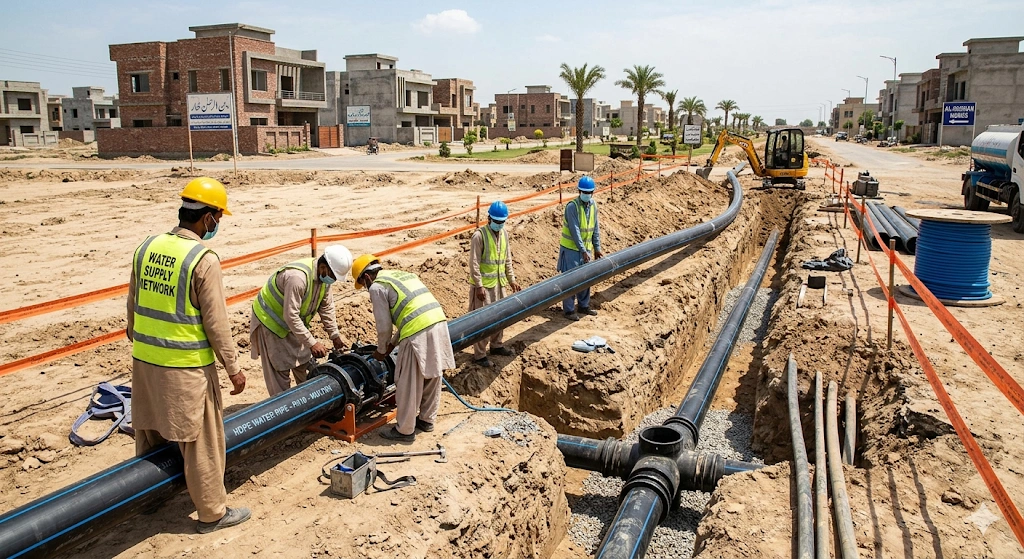
A housing society developer in Rawalpindi recently replaced 4 kilometres of underground water supply pipe — installed less than six years earlier — after repeated main breaks and contamination complaints from residents. The original contractor had used substandard PVC in a pressure application where HDPE pipes for housing society distribution were clearly the correct specification. The replacement cost exceeded the original installation by a factor of three, excluding the reputational damage.
According to the Pakistan Bureau of Statistics, Pakistan’s construction sector has grown at an average of 7.2% annually over the past five years, with housing society development accounting for an increasing share of total construction activity. Demand for reliable underground piping in large residential projects has never been higher — and the consequences of getting the specification wrong have never been more visible.
If you are a developer, civil engineer, or procurement manager working on a housing society project — whether in Bahria Town Lahore, DHA Islamabad, Green Gulberg, or a mid-size development in Multan or Bahawalpur — this guide gives you the technical grounding to specify HDPE pipes correctly, pass WASA and PEC inspections, and avoid the category of mistakes that end careers and generate litigation.
Why HDPE Pipes Are the Default Choice for Housing Society Water Networks in Pakistan
HDPE pipes dominate underground water distribution in Pakistan’s large residential developments for reasons that are technical, not commercial. Their combination of flexibility, pressure performance, chemical resistance, and jointing integrity is unmatched by any alternative material at equivalent cost for buried applications.
The properties that make HDPE the correct choice for housing society networks:
Pressure surge tolerance
PVC pipe fails under water hammer — the pressure spike that occurs when a valve closes rapidly in a pressurised system. In a housing society with hundreds of individual connections and multiple pump stations, water hammer events are frequent. HDPE, classified as a viscoelastic material, absorbs these surges by deflecting slightly rather than fracturing. A PE100 HDPE pipe can tolerate surge pressures 1.5 to 2 times its rated working pressure without failure — a margin that PVC and uPVC cannot match.
Leak-free jointing
HDPE water mains are joined by butt-fusion or electrofusion welding, creating a homogeneous joint with no mechanical connectors, no rubber seals that degrade over time, and no couplings that can work loose under soil movement. The Water Research Centre in the UK has documented leakage rates in HDPE water distribution systems at below 0.1% of throughput — compared to 15 to 30% in older galvanised steel systems still operational across Pakistan’s municipal networks.
Service life exceeding 50 years
ISO 4427, the international standard governing PE pipes for water supply, specifies a minimum design life of 50 years at rated temperature and pressure. This is the lifecycle basis on which WASA and PEC evaluate pipe specifications for approval on housing society projects. Specifying HDPE means the pipe infrastructure you install today will outlast the first two cycles of property ownership in your development.
NEWTECH’s HDPE DuraPE series (link: /hdpe-pipes/) is manufactured to ISO 4427 and PSQCA standards in PE80 and PE100 grades, covering 20mm to 630mm outside diameter — the full range required from individual house connections to housing society trunk mains.
What SDR Rating Should You Specify for a Housing Society Water Main?
The SDR, or Standard Dimension Ratio, determines the wall thickness relative to the outside diameter — and therefore the pressure rating of the pipe. Selecting the wrong SDR for your system’s working pressure is one of the most common technical errors on housing society projects in Pakistan, and it is invisible until a main fails.
SDR is calculated as outside diameter divided by wall thickness. A lower SDR number means a thicker wall and higher pressure rating. Here is how SDR selection maps to housing society applications:
| SDR Rating | PE100 Working Pressure | Typical Application in Housing Society |
|---|---|---|
| SDR 7.4 | 25 bar | High-pressure pump station connections |
| SDR 11 | 16 bar | Trunk mains, primary distribution rings |
| SDR 13.6 | 12.5 bar | Secondary distribution, road crossings |
| SDR 17 | 10 bar | Tertiary distribution, cul-de-sac mains |
| SDR 21 | 8 bar | Low-pressure service connections |
| SDR 26 | 6.3 bar | Surface drainage, gravity sewerage |
| SDR 33 | 5 bar | Non-pressure drainage, cable ducting |
For a typical mid-size housing society in Lahore or Islamabad with a pump station delivering at 8 to 12 bar, SDR17 for the distribution ring main and SDR11 for the pump station connection and primary trunk main is the standard engineering specification. Using SDR26 in a 12 bar system — which happens when procurement teams substitute cheaper, thinner-wall stock without checking — creates a pipe operating beyond its pressure rating from day one.
WASA specifications for approved housing society projects in Lahore and Islamabad require PSQCA certification on all underground water mains. This means the pipe must be tested and certified at the stated SDR and pressure rating — a batch certificate, not a company-level approval.
HDPE Pipe Sizes for Bahria Town, DHA & Large Housing Society Projects
Large housing society developments like Bahria Town and DHA operate at a scale that demands a properly engineered pipe network hierarchy — trunk mains, distribution rings, service connections, and lateral branches — each sized for its hydraulic function, not selected by what was available at the nearest distributor.
Network hierarchy and pipe sizing
Trunk mains connecting the housing society to the municipal supply or bore well pump station typically require 200mm to 630mm HDPE pipe, depending on the total population served. A 5,000-plot housing society in Islamabad or Rawalpindi typically requires a 315mm or 400mm trunk main to deliver adequate peak flow without excessive pressure loss.
Distribution ring mains — the loops that run along primary roads and feed clusters of houses — typically use 110mm to 200mm pipe. Correctly designed ring mains maintain pressure at each connection point regardless of which section is isolated for maintenance.
Individual house service connections use 32mm to 63mm HDPE pipe from the ring main to the property boundary stopcock. Using 25mm or 20mm for service connections in a high-density development creates pressure complaints from residents on the end of the branch — a common issue in developments that undersize individual connections to reduce material cost.
Project-specific sizing considerations
Bahria Town developments in Lahore, Islamabad, and Karachi have benefited from NEWTECH’s HDPE pipe supply across multiple phases. The critical sizing consideration in large phased developments is designing the trunk main for the ultimate population of the scheme, not just Phase 1 occupancy. Undersizing the trunk main at Phase 1 and trying to parallel it later creates an excavation, connection, and operational headache that could have been avoided entirely at specification stage.
HDPE vs uPVC vs GI Pipe: Which Material Should Housing Society Developers Specify?
This is the decision that determines the 50-year maintenance cost of your housing society’s infrastructure — and the answer is not always HDPE for every application within a development.
| Performance Attribute | HDPE PE100 | uPVC Class D | Galvanised Iron |
|---|---|---|---|
| Maximum working pressure | 16 bar at SDR11 | 10 bar at Class D | Variable — degrades with corrosion |
| Service life buried | 50+ years | 25–35 years | 10–20 years |
| Corrosion resistance | Excellent — no degradation | Good — no corrosion | Poor — corrodes progressively |
| Water hammer tolerance | Excellent — absorbs surges | Poor — brittle failure risk | Good but joints leak over time |
| Jointing method | Butt/electrofusion — zero leak | Solvent cement — seal degrades | Threaded/flanged — labour intensive |
| WASA/PEC approval for water mains | Yes — standard specification | Conditional — pressure limits apply | Declining — being phased out |
| PSQCA certification available | Yes | Yes | Yes |
| Approved for Bahria Town/DHA water mains | Yes | Limited to non-pressure | Not for new projects |
| Relative material cost per metre (63mm) | Medium | Low | High |
| Repair ease after failure | Easy — fusion patch or coupling | Moderate | Difficult — corrosion compound |
The practical conclusion from this comparison: HDPE for all underground pressure water mains, HDPE or uPVC for gravity drainage depending on depth and loading, and avoid GI entirely in new housing society construction. The material cost difference between uPVC and HDPE on a pressure main is real, but the lifecycle cost difference — accounting for leakage repair, main replacement, and resident complaints — favours HDPE decisively over any project horizon beyond 15 years.
NEWTECH manufactures both HDPE DuraPE pipe (link: /hdpe-pipes/) and uPVC Class B through E pipe (link: /pvc-construction/), giving housing society developers a single-source option for both pressure mains and drainage networks.
PSQCA and PEC Compliance for Housing Society Pipe Procurement in Pakistan
Getting PSQCA and PEC compliance right is not bureaucratic box-ticking — it is the difference between a project that gets WASA approval and one that requires pipe replacement before handover.
Pakistan’s PSQCA, the Pakistan Standards and Quality Control Authority, mandates conformance testing for HDPE pipes used in municipal and housing society water supply applications. The relevant standard is PS 3580:1994, which aligns with ISO 4427 requirements for dimensions, material designation, and pressure testing. A pipe that passes PSQCA testing at the stated SDR and grade has been independently verified to meet its rated performance — a pipe that lacks this certification has not.
What PSQCA certification actually covers
PSQCA batch certification covers dimensional conformance (wall thickness at or above the SDR minimum, ovality within limits), material designation (PE80 or PE100 — not regrind or blended polypropylene passed off as PE material), and hydrostatic pressure testing at 1.5 times rated working pressure. When you receive a batch delivery, the certificate should reference that specific batch, not a generic company approval issued months earlier.
PEC approval is required for the project’s engineering drawings and specifications — the PE100 HDPE specification must be referenced in the approved structural and services drawings before construction. PEC-approved projects also require that supply records be maintained, creating a clear chain of custody from manufacturer to installed pipe.
On DHA Islamabad projects, this documentation chain is audited at handover. Gaps in supply records have caused significant delays and forced partial replacement of pipework that could not be traced to a certified source.
NEWTECH is PSQCA certified and PEC approved (link: /about/), with batch certification available for every production run. For large housing society projects, NEWTECH’s technical team can provide the documentation package required for WASA submission and PEC approval.
How to Evaluate an HDPE Pipe Supplier for a Housing Society Project in Pakistan
Not every supplier selling HDPE pipes in Lahore, Karachi, or Islamabad is supplying PSQCA-certified, ISO 4427-compliant PE100 product — even when they say they are. The housing society pipe procurement market in Pakistan carries a significant proportion of non-compliant product, and the consequences of purchasing it sit entirely with the developer when the project fails inspection or a main bursts post-handover.
The evaluation framework that protects your project:
Verify certifications independently
Request the PSQCA certificate for the specific pipe grade, SDR rating, and diameter you are purchasing — not a general company certificate. Call PSQCA directly to verify the certificate number if the supplier is new to you. This takes ten minutes and can prevent an expensive mistake.
Check the pipe markings
Every metre of ISO 4427 compliant HDPE pipe must carry continuous markings including manufacturer name, pipe standard, outside diameter, SDR rating, pressure rating, material designation (PE80 or PE100), and production date/batch number. If any of these are missing, the pipe does not meet standard — regardless of what the certificate says.
Assess manufacturing capability
A supplier who manufactures their own pipe and can provide factory audit documentation offers a fundamentally different assurance level from a trader who sources from multiple mills. NEWTECH’s manufacturing operations (link: /technolgy/) produce HDPE pipe from verified PE80 and PE100 compound — not regrind — with in-process quality control at every extrusion run.
Require test certificates for each batch
Large housing society projects receive pipe in multiple deliveries. Each delivery should carry a batch-specific test certificate. Do not accept a single certificate applied across multiple deliveries of different production dates — this is a common documentation shortcut that breaks the quality assurance chain.
According to ISO 9001:2015 quality management principles, documented supplier evaluation is a mandatory element of project quality plans on PEC-registered projects. Applying this evaluation framework before placing your order costs nothing. Applying it after a main failure costs everything.
⚙️ Expert Insight from NEWTECH
One pattern NEWTECH’s technical team sees repeatedly on large housing society projects across Lahore and Islamabad: developers approve HDPE in the engineering drawings, then procurement teams substitute to a cheaper supplier who cannot provide genuine PSQCA batch certification. The substitution looks like a cost saving at PO stage. By the time WASA’s inspection team arrives or a main fails at 8 bar, the saving has multiplied into a liability. On any project where PEC approval and WASA sign-off are required, your pipe supply chain needs to be locked to a PSQCA-certified manufacturer from the first order — not corrected after the first failure.
Installation Best Practices for HDPE Mains in Housing Society Environments
A correctly specified pipe installed incorrectly will still fail. Housing society HDPE pipe installation involves working in congested urban environments with active construction above — conditions that create specific installation risks not present in open-field municipal projects.
Trench preparation and bedding
HDPE pipe in housing society ground conditions — which typically include disturbed fill, construction debris, and variable soil compaction — requires 150mm of clean granular bedding below the pipe and 300mm of compacted granular material above it before backfilling with site material. Skipping bedding to save time is the single most common cause of pipe ovality in service, which reduces the effective pressure rating and creates stress concentrations at joints.
Butt-fusion jointing on site
NEWTECH’s HDPE butt-fusion welding machines (link: /hdpe-pipes/) are calibrated for pipe diameter and wall thickness — not approximated. Common site errors include insufficient fusion pressure, premature joint removal from the machine before cooling is complete, and fusion at ambient temperatures below 5°C without cold-weather protocols. Each of these produces joints that pass visual inspection but fail under pressure cycling within the first heating season.
Pressure testing protocol
HDPE mains in housing society projects should be pressure tested at 1.5 times the design working pressure, held for a minimum of one hour after the initial pressure stabilisation period. HDPE pipe undergoes viscoelastic stress relaxation during the test — pressure will drop by 10 to 15% during the first 30 minutes even in a leak-free system. Failing to account for this causes unnecessary excavation of perfectly sound joints. The correct test protocol is in ISO 4427 and should be referenced in your installation specification.
Conclusion
The pipe decisions you make at specification and procurement stage for a housing society water network will be visible — either positively as an infrastructure asset that works for 50 years, or negatively as a failure that generates warranty claims, regulatory action, and forced replacement at your cost.
Four things to act on from this guide: specify PE100 HDPE at the correct SDR for your system working pressure, require PSQCA batch certification on every delivery, design your trunk main for the ultimate development population not just Phase 1, and verify supplier manufacturing credentials before placing your first order.
HDPE pipes for housing society projects in Pakistan are not a premium option — they are the baseline specification that WASA, PEC, and serious developers regard as standard. The question is whether you source them correctly.
FAQ SECTION
1. Which HDPE pipe grade should be used for housing society water supply mains in Pakistan?
Answer: PE100 grade HDPE is the correct specification for housing society water supply mains in Pakistan. PE100 offers higher long-term hydrostatic strength than PE80, allowing thinner walls at the same pressure rating — which reduces material cost on large-diameter trunk mains without compromising performance. PSQCA-certified PE100 HDPE pipes for housing society projects must meet PS 3580:1994 and ISO 4427 dimensional and pressure requirements.
2. How long do HDPE pipes last when buried in Pakistani soil conditions?
Answer: Correctly specified and installed HDPE pipe has a design service life of 50 years minimum under ISO 4427, which is the standard referenced by WASA and PEC for housing society water infrastructure approval in Pakistan. This lifespan assumes the pipe is installed at the correct SDR for its working pressure, bedded in clean granular material, and joined using butt-fusion or electrofusion welding rather than mechanical connectors.
3. What is the price of HDPE pipe per metre in Lahore for housing society projects?
Answer: HDPE pipe prices in Pakistan vary by diameter, SDR rating, and grade. As a general reference in 2026, 110mm PE100 SDR17 pipe runs approximately PKR 650 to 900 per metre from a PSQCA-certified manufacturer. Larger diameters such as 315mm SDR11 range from PKR 3,500 to 5,500 per metre. Contact NEWTECH directly at /contact-us/ for project-specific pricing on volume orders for housing society applications.
4. Is HDPE pipe approved by WASA for use in housing society water supply projects?
Answer: Yes. WASA in Lahore, Islamabad, and Karachi approves PE100 HDPE pipe to ISO 4427 and PS 3580:1994 as the standard material for underground water supply mains in housing society projects. WASA requires PSQCA batch certification accompanying each delivery. Projects using uncertified pipe risk rejection at inspection, requiring excavation and replacement before WASA sign-off and final handover approvals can be issued.
5. What is the difference between PE80 and PE100 HDPE pipe for residential piping solutions in Pakistan?
Answer: PE100 has a minimum required strength (MRS) of 10 MPa compared to PE80’s 8 MPa at 20°C and 50 years. This means a PE100 pipe at a given SDR rating carries a higher safe working pressure than the same SDR in PE80 — or achieves the same pressure rating with a thinner, lighter wall. For large-diameter housing society trunk mains, PE100 reduces material cost per linear metre while maintaining the pressure safety factor required by WASA and PEC.
6. Which pipe supplier in Pakistan has supplied HDPE pipes for Bahria Town and DHA projects?
Answer: NEWTECH Pipes has supplied HDPE pipe across multiple Bahria Town, DHA Islamabad, and Green Gulberg project phases. NEWTECH is ISO 9001:2015 certified, PSQCA certified, and PEC approved, manufacturing PE80 and PE100 HDPE pipe in its DuraPE series from 20mm to 630mm. As one of Pakistan’s longest-established pipe manufacturers since 1998, NEWTECH provides batch certification, project documentation support, and technical specification assistance for housing society developers and their engineers.