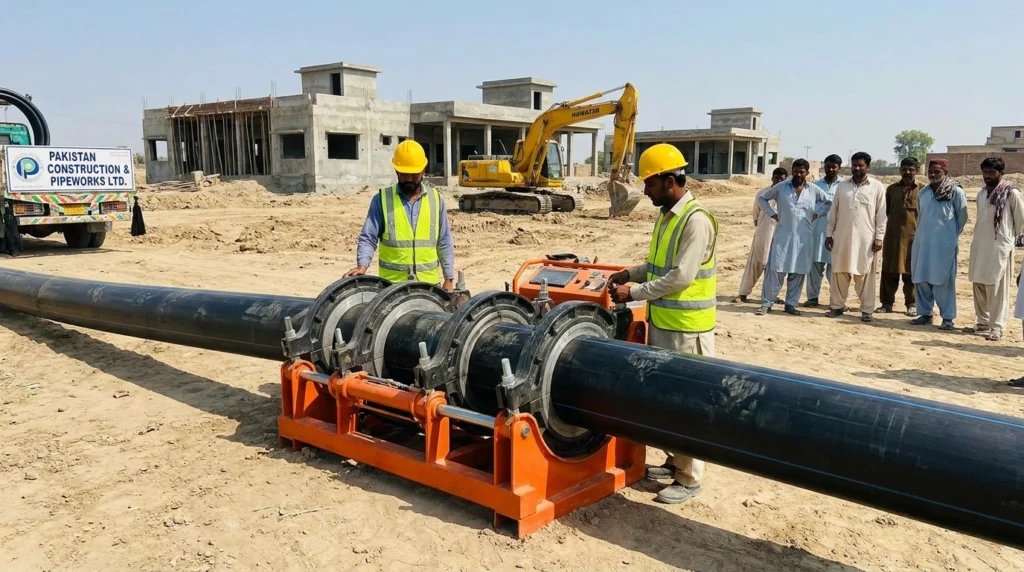
If you’re laying HDPE pipe on a housing society, irrigation network, or industrial facility in Pakistan and your joints are failing pressure tests — the machine, not the pipe, is usually the problem. A substandard or incorrectly operated butt fusion welding machine causes cold welds, inclusions, and joint failures that no amount of rework can reliably fix.
Pakistan’s HDPE pipe market has grown sharply alongside infrastructure demand. According to the Pakistan Bureau of Statistics (PBS), the construction sector grew at 6.1% in FY2023, driving sustained demand for HDPE piping systems in water supply, gas distribution, and industrial applications. With that growth comes a crowded equipment market — Chinese imports, second-hand European machines, and locally assembled units all competing for your procurement budget.
This guide cuts through that noise. You’ll learn exactly how butt fusion welding machines work, which specifications matter for your pipe sizes and project conditions, what realistic 2026 prices in PKR look like, and how to avoid the three most common purchasing mistakes contractors make across Lahore, Karachi, and Islamabad.
How a Butt Fusion Welding Machine Actually Works
Butt fusion is a thermoplastic pipe jointing process defined under ISO 21307 — the international standard for polyethylene pipe welding procedures. The process has four distinct phases, and every phase must be executed within tight tolerance windows for the joint to achieve full pipe rating.
Phase 1 — Clamping & Alignment Both pipe ends are secured in the machine’s clamping shells (also called carriages). Misalignment of more than 10% of pipe wall thickness at this stage will compromise the finished joint. Quality machines feature precision-ground alignment frames; cheaper units flex under load, introducing angular misalignment you cannot see until the joint fails.
Phase 2 — Facing A rotating trimming tool (the facer/planer) machines both pipe ends simultaneously until they are perfectly flat, parallel, and free of oxidation. Proper facing leaves a continuous ribbon of fine shavings — if you see chunks or the facing stops leaving material, your blades need replacing.
Phase 3 — Heating A PTFE-coated heating plate, precisely controlled between 200°C and 220°C for PE100 pipe, is inserted between the prepared faces. Both sides are brought into contact with a low “drag” pressure, just enough to form a uniform bead around the full circumference. Bead height is your quality indicator — ISO 21307 specifies minimum and maximum bead dimensions by pipe wall thickness (SDR). Under-heating produces cold welds; over-heating degrades the polymer and causes carbon inclusions.
Phase 4 — Fusion & Cooling The plate is removed (plate removal time must be under 5 seconds for pipes above 110mm), and both faces are pressed together at the specified fusion pressure. The joint then cools under continuous pressure for a period determined by pipe wall thickness — typically 11 minutes per millimetre of wall thickness at ambient temperature. Cooling too fast by pouring water or applying forced air is one of the most destructive habits on Pakistani job sites.
The resulting joint, when properly executed, achieves 100% of parent pipe tensile strength — a correctly welded HDPE joint will not fail at the weld; it fails in the pipe body.
Types of Butt Fusion Welding Machines Available in Pakistan
The Pakistani market carries three functional categories of butt fusion welding machine, each suited to different pipe diameter ranges and project scales.
Manual Butt Fusion Machines (63mm–250mm)
Manual machines use human force for both the facing and fusion pressure phases. The operator physically closes the carriage using a lever or screw mechanism. These units are appropriate for pipe sizes up to 200mm in lower-pressure applications — agricultural irrigation, residential HDPE distribution lines, and small industrial connections.
Their critical limitation: fusion pressure consistency depends entirely on the operator. For PE100 pipe at SDR 11 (11 bar rated), precise pressure control is non-negotiable. Manual machines on high-pressure lines are a liability.
Hydraulic Butt Fusion Machines (110mm–630mm)
Hydraulic machines use a hand-operated or motorised hydraulic pump to deliver and hold fusion pressure precisely. The pressure is set on a gauge calibrated to the pipe’s cross-sectional area and the required fusion pressure (typically 1.5 bar fusion pressure for PE100 per ISO 21307).
These are the industry standard for pipe sizes above 200mm on WASA, SNGPL, and industrial projects. Every butt fusion welding machine Pakistan-based contractors use on HDPE mains above 315mm should be hydraulic. NEWTECH’s from 250mm to 630mm requires hydraulic equipment — manual machines physically cannot deliver adequate, consistent pressure on large-diameter pipe.
CNC / Programmable Hydraulic Machines (250mm–630mm)
CNC butt fusion machines automate the entire weld cycle — facing pressure, heating time and temperature, plate removal, fusion pressure, and cooling time are all controlled by a programmable logic unit. The machine records each weld parameter in a data log that can be downloaded for project QA/QC documentation.
For DHA, Bahria Town, and municipal WASA projects where third-party inspection requires weld traceability, a CNC machine is not optional — it is the only way to produce defensible documentation. NEWTECH supplies CNC-compatible precisely dimensioned to the tolerances these machines require.
Butt Fusion Welding Machine Price in Pakistan — 2026 Rates
Prices vary significantly based on pipe diameter range, hydraulic vs. manual operation, country of origin, and whether the unit includes data logging. The table below reflects market rates observed in Lahore, Karachi, and Rawalpindi in 2026.
| Machine Type | Pipe Diameter Range | Drive System | Indicative Price Range (PKR) |
|---|---|---|---|
| Manual Butt Fusion Machine | 63mm – 160mm | Manual screw | 85,000 – 175,000 |
| Manual Butt Fusion Machine | 110mm – 250mm | Manual hydraulic | 150,000 – 280,000 |
| Hydraulic Butt Fusion Machine | 63mm – 315mm | Motorised hydraulic | 320,000 – 650,000 |
| Hydraulic Butt Fusion Machine | 160mm – 450mm | Motorised hydraulic | 600,000 – 1,100,000 |
| Hydraulic Butt Fusion Machine | 250mm – 630mm | Motorised hydraulic | 950,000 – 1,500,000 |
| CNC / Programmable Hydraulic | 110mm – 450mm | CNC + data logging | 1,100,000 – 1,800,000 |
| CNC / Programmable Hydraulic | 250mm – 630mm | CNC + data logging | 1,500,000 – 2,500,000+ |
Prices are ex-Lahore/Karachi and exclusive of GST. Import-based machines carry additional customs and freight. Prices as of Q1 2026.
Note: A machine rated “63mm–315mm” does not perform equally across its full range. Verify that the clamping shells (inserts) for your specific pipe diameter are included — these are often sold separately and can add PKR 15,000–45,000 per size set.
Key Technical Specifications to Verify Before You Buy
Purchasing a pipe welding machine in Pakistan without checking these specifications is how contractors end up with equipment that fails on-site or cannot be used on PSQCA-compliant projects.
Heating Plate Temperature Accuracy
The heating plate must maintain ±5°C of set temperature across its entire surface. Cheap units use single-point thermostats — the plate surface 15cm away from the thermocouple may be 30°C cooler. Demand a calibration certificate or test it yourself with an infrared thermometer before accepting delivery.
For PE100 pipe (used in NEWTECH’s at PE100 grade), the ISO 21307 heating temperature is 200–220°C. Below 190°C and you are producing cold welds every time.
Fusion Pressure Control
Hydraulic machines must deliver fusion pressure calculated as: Fusion Pressure (bar) = 1.5 bar × Pipe Cross-Sectional Area (cm²) ÷ Hydraulic Cylinder Area (cm²). This value is machine-specific and must be published in the machine’s technical datasheet. If a supplier cannot provide this calculation for your specific pipe size and SDR, that machine is not fit for ISO 21307 compliance.
Facer Blade Quality
Facer blades are a consumable. Machines using proprietary blade formats lock you into expensive replacements. Before purchasing, confirm that replacement blades are available locally in Pakistan — machines supplied from Europe may use non-standard blade sizes unavailable in Lahore or Karachi markets.
⚙️ Expert Insight from NEWTECH In 25+ years of supplying HDPE pipe systems across Pakistan, the most common jointing failure we see is not pipe quality — it’s incorrect heating time caused by operators rushing the process in cold weather. At ambient temperatures below 10°C (common on Islamabad and Peshawar job sites in December–February), ISO 21307 requires extended heating time and protective shielding against wind. Many contractors apply standard summer parameters year-round. A weld made at 5°C ambient with summer settings will pass visual inspection and fail at the first pressure surge. Always calculate heating time adjustments per ISO 21307 Annex B for cold-weather welding.
HDPE Butt Fusion Machine Price vs. HDPE Pipe Jointing Method: When Is Butt Fusion the Right Choice?
Butt fusion is not always the most economical jointing method — but for specific pipe sizes and applications, it is the only method that delivers the required performance. Understanding the decision boundary saves you both capital cost and installation time.
When Butt Fusion Is Mandatory
Use butt fusion when:
- Pipe diameter exceeds 63mm and operating pressure exceeds 6 bar
- The system will carry potable water (WASA/municipal standards require a continuous, leak-free joint)
- The pipeline is buried and inaccessible for future mechanical joint maintenance
- Project specifications reference ISO 4427 (HDPE water pipes) or ISO 4437 (HDPE gas pipes) — both standards default to butt fusion for mainline joints
For HDPE pipes on SNGPL gas distribution networks, SSGC requirements mandate butt fusion at all mainline joints above 63mm — electrofusion fittings are permitted only at meter connections and branch off-takes.
When Compression or Electrofusion Fittings Are More Practical
Compression fittings (NEWTECH’s [compression fitting range →/compression-fittings/]) are faster for small-bore connections (20mm–63mm) in agricultural irrigation, household connections, and low-pressure distribution. Electrofusion fittings work well in confined spaces — valve pits, connection points where a butt fusion machine physically cannot be positioned — but cost significantly more per joint than butt fusion.
The economic breakeven for a butt fusion machine is roughly 150–200 joints on 110mm+ pipe. Below that threshold, hiring a machine or subcontracting the jointing work typically costs less than purchasing equipment outright.
Where to Buy a Butt Fusion Welding Machine in Pakistan
The Pakistani market for pipe welding machines in Pakistan has three distinct supply channels, each with different risk profiles for the buyer.
Direct Importers (Lahore, Karachi)
Several Lahore-based trading companies import machines directly from Chinese manufacturers (Wuhan Suote, Riyang, Georg Fischer clones) and European brands (Ritmo, Rothenberger, McElroy — genuine units). Genuine European machines carry 2–3 year warranties and full calibration documentation; Chinese imports vary enormously in quality. Ask for ISO 4427 or DVS 2207 compliance documentation — legitimate suppliers will provide it.
Pipe Manufacturer Supply (NEWTECH’s Approach)
NEWTECH Industries supplies butt fusion welding machines calibrated and validated specifically for use with our [HDPE pipe and fittings range →/hdpe-pipes/]. When you source the machine and the pipe from the same supplier, the machine parameters (heating temperature, fusion pressure tables) are pre-set for NEWTECH’s specific pipe wall dimensions and material grade. This eliminates the most common source of field welding errors: using generic machine parameters on actual pipe dimensions.
This is particularly relevant for NEWTECH’s [PLAST-1 HDPE butt fusion fittings →/hdpe-butt-fusion-fittings/] in sizes 63mm–630mm, where fitting geometry is tolerance-matched to our pipe outside diameters.
Second-Hand Market (Proceed With Caution)
A used butt fusion machine with an unknown service history is a significant risk on a WASA or DHA project. The heating plate coating degrades, causing pipe sticking and inconsistent heat transfer. Hydraulic seals fail, causing pressure drop during the cooling phase. Before purchasing any used machine, require: a heating plate surface temperature test across 6 measurement points (maximum 5°C variance), a hydraulic pressure hold test at fusion pressure for 10 minutes (zero pressure drop acceptable), and a full set of facing inserts for your target pipe sizes.
Butt Fusion Welding Standards Applicable in Pakistan
If your project falls under PSQCA, PEC, or WASA jurisdiction — and most commercial and municipal HDPE piping projects in Pakistan do — your jointing procedure must comply with recognisable international standards. Citing “we used a machine” is not a quality record. These are the standards that matter:
ISO 21307 — Plastics piping systems: procedures for fusion jointing of polyethylene pipe. The primary procedural standard covering all four fusion phases, parameter tables, and operator qualification requirements.
DVS 2207-1 — German welding standard for thermoplastic pipes, widely referenced by European machine manufacturers and recognised by PEC-registered consultants on industrial projects.
ASTM F2620 — Standard practice for heat fusion joining of HDPE pipe and fittings. Referenced on projects with American design consultants, common in pharma and food processing plants in Faisalabad, Sialkot, and Gujranwala industrial zones.
PS 3580:1994 / ISO 4427 — Pakistan Standard for HDPE water pipes, maintained by PSQCA. Projects under WASA jurisdiction in Lahore, Karachi, Rawalpindi, and Multan reference this standard. Your pipe must be PSQCA-certified; your jointing procedure must produce joints meeting PS 3580 pressure test requirements.
According to PSQCA’s 2022 certification data, fewer than 40% of HDPE pipe products tested in the Pakistani market fully comply with PS 3580 dimensional and pressure requirements. Choosing NEWTECH’s PSQCA-certified [HDPE pipes →/hdpe-pipes/] eliminates this compliance risk from the outset.
Conclusion
Your butt fusion welding machine is as critical to project success as the pipe itself — and in Pakistan’s market, the difference between a quality machine and a cheap import shows up not at purchase, but at the hydrostatic pressure test six months later.
Here are the four decisions that matter most:
- Match machine capacity to your pipe size range — buying a 250mm machine for a 450mm project means hiring another unit mid-project.
- Verify heating plate temperature uniformity — the leading cause of cold-weld failures on Pakistani job sites.
- Use hydraulic machines for all pipes above 200mm — manual fusion on high-pressure HDPE is not a cost saving; it is a liability.
- Source machine and pipe from the same supplier where possible — parameter matching eliminates the most common field welding errors.
For your next butt fusion welding machine Pakistan procurement, NEWTECH Industries supplies machines calibrated for our full HDPE pipe range (20mm–630mm), backed by 25+ years of manufacturing and field application experience across Lahore, Karachi, Islamabad, Multan, and Bahawalpur.
FAQ SECTION
1. What is the price of a butt fusion welding machine in Pakistan in 2026?
In 2026, butt fusion welding machine prices in Pakistan range from approximately PKR 85,000 for manual units handling 63mm–160mm pipe, to PKR 1,800,000 or more for CNC hydraulic machines capable of joining pipe up to 630mm. Price depends on diameter range, drive system (manual vs. hydraulic), and whether data logging for project QA is included.
2. Which butt fusion welding machine is best for HDPE pipe in Pakistan?
For HDPE pipe above 200mm on pressurised systems — WASA water mains, SNGPL gas lines, or industrial process pipelines — a hydraulic butt fusion welding machine is the minimum requirement. CNC programmable machines are mandatory on projects requiring weld traceability records (DHA, Bahria Town, municipal contracts). For small-bore irrigation lines (63mm–160mm), manual hydraulic units are sufficient.
3. How long does a butt fusion weld take on HDPE pipe in Pakistan?
Total cycle time per joint depends on pipe wall thickness and ambient temperature. For 110mm SDR 11 HDPE pipe at 20°C ambient, expect approximately 20–25 minutes including facing, heating (roughly 7–8 minutes), and the mandatory cooling-under-pressure phase. Larger pipes take proportionally longer — 315mm SDR 11 requires 45–60 minutes per joint at standard conditions.
4. Can I use a butt fusion welding machine on PPRC or uPVC pipe?
No. Butt fusion welding machines are designed specifically for polyethylene (HDPE, MDPE, PE80, PE100) and polypropylene (PP) pipe at specific fusion temperatures. PPRC pipe uses socket or butt fusion at different temperatures (260°C for PP-R). uPVC pipe cannot be butt fusion welded at all — it uses solvent cement jointing. Using an HDPE-calibrated machine on uPVC will destroy the pipe end.
5. What certifications should a butt fusion welding machine comply with for WASA or PEC projects in Pakistan?
For WASA and PEC-registered projects, the welding procedure should comply with ISO 21307 (polyethylene pipe fusion jointing standard). The pipe being welded must carry PSQCA certification under PS 3580:1994 / ISO 4427. On projects requiring documented weld records, a CNC machine producing a downloadable weld log is the accepted standard for third-party inspection acceptance.
6. What is the difference between butt fusion and electrofusion jointing for HDPE pipe?
Butt fusion uses a heated plate and controlled pressure to fuse two pipe ends directly — no fittings required, making it the most economical method for long mainline runs above 110mm. Electrofusion uses a fitting with embedded resistance wire that melts the pipe and fitting interface when energised. Electrofusion costs more per joint but works in confined spaces where a butt fusion welding machine cannot be positioned. Both methods, correctly executed, achieve full pipe rating.