These are not just three names for “plastic pipe.” Each material has a distinct molecular structure that determines how it performs under pressure, heat, chemical exposure, and mechanical stress.
HDPE (High-Density Polyethylene) is a semi-crystalline thermoplastic with high molecular weight chains, giving it exceptional impact resistance and flexibility. It can bend without cracking, which is critical in seismic zones and areas with unstable soil — conditions common in Khyber Pakhtunkhwa and parts of Balochistan. HDPE pipe is rated under ISO 4427 and SDR (Standard Dimension Ratio) classifications, with SDR 11 carrying the highest pressure ratings in common use.
PPRC (Polypropylene Random Copolymer) is a rigid thermoplastic designed to handle both hot and cold water up to 95°C continuously. Its random copolymer structure — three types of polypropylene chains interlocked — gives it lower thermal expansion than standard PP, making it suitable for hot-water plumbing and central heating systems. PPRC is joined by heat fusion (socket welding), creating a joint stronger than the pipe body itself.
uPVC (Unplasticised Polyvinyl Chloride) is the most chemically stable of the three — resistant to acids, alkalis, and most solvents. Its rigid structure handles compressive loads well, making it the dominant material for gravity sewers, drainage stacks, and conduit. However, uPVC becomes brittle below 0°C and softens above 60°C, which limits its pressure applications in hot-water systems.
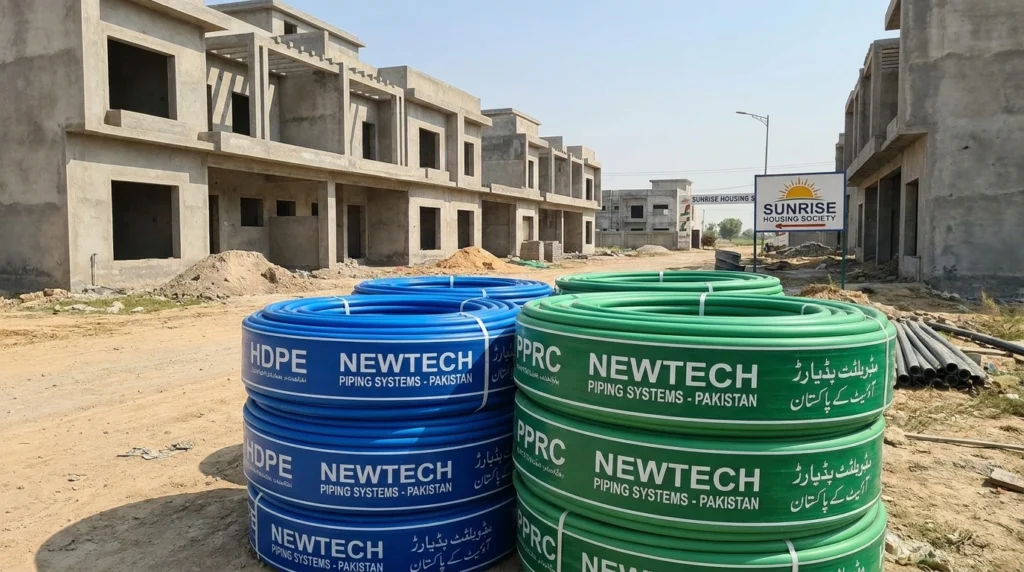
NEWTECH manufactures all three — HDPE DuraPE series (PE80 & PE100, 20mm–630mm), PPRC pipes and fittings (63mm–110mm), and uPVC pipes (Class B through E, ½” to 24″). Each is PSQCA certified and ISO 9001:2015 compliant, so you are covered across all three specifications with a single supplier relationship.
HDPE vs PPRC vs PVC Pipes Pakistan: Full Technical Comparison
The table below is your go-to reference for any spec sheet comparison, tender submission, or procurement decision. All figures align with ISO 4427, DIN 8075, and PS 3580:1994 (Pakistan Standard) unless otherwise noted.
| Attribute | HDPE (PE100) | PPRC (PN20) | uPVC (Class D) |
|---|---|---|---|
| Max Operating Pressure | Up to 25 bar (SDR 7.4) | 20 bar at 20°C | 12.5 bar at 20°C |
| Max Temperature | 60°C continuous | 95°C continuous | 60°C (pressure drops above 40°C) |
| Min Temperature | -40°C (flexible) | -10°C | 0°C (brittle fracture risk) |
| Lifespan (design life) | 50+ years (ISO 4427) | 50 years | 30–50 years |
| Jointing Method | Butt fusion / electrofusion / compression | Socket heat fusion | Solvent cement / rubber ring |
| UV Resistance | Carbon black grade required | Needs UV-stable grade | Good (standard grade) |
| Chemical Resistance | Excellent | Excellent | Excellent |
| Flexibility | High (no cracking on bending) | Rigid | Rigid (brittle below 0°C) |
| Best For | Underground mains, irrigation, gas | Hot & cold plumbing, HVAC | Drainage, sewerage, cold supply |
| PSQCA Standard | PS 3576 / ISO 4427 | PS 4437 equivalent | PS 3580:1994 |
| Approximate Price (PKR/meter, 63mm) | Rs. 850–1,100 | Rs. 950–1,250 | Rs. 280–420 |
Prices are indicative market ranges as of Q1 2026. Contact NEWTECH for current project-rate quotations.
Which Pipe Is Best for Underground Water Supply in Pakistan?
For any buried water main — whether it is serving a housing society like Bahria Town Islamabad, a WASA municipal line, or a tube-well distribution network in Faisalabad — HDPE PE100 is the correct answer, and it is not close.
Why HDPE Dominates Underground Applications
HDPE’s flexibility is the defining advantage. When soil shifts — due to traffic load, seasonal moisture changes, or minor seismic activity — an HDPE pipe flexes rather than fractures. This is why WASA Lahore and WASA Karachi have both specified HDPE for trunk main replacements in congested urban corridors where excavation is expensive and disruption is politically costly.
The butt-fusion joint eliminates mechanical weak points entirely. A properly fused HDPE joint is stronger than the pipe wall — pull tests confirm the pipe body fails before the joint separates. This is impossible with solvent-cement PVC joints and irrelevant for PPRC, which is not used underground at scale.
SDR selection matters here. For a 10-bar distribution main, SDR 11 (PE100) gives you a comfortable pressure factor of safety above 2.0. For a 6-bar irrigation network, SDR 17 reduces material cost significantly without compromising safety margins. NEWTECH’s DuraPE series is available in SDR 7.4 through SDR 17.6, giving project engineers the flexibility to optimize cost against pressure class.
According to the Pakistan Council of Research in Water Resources (PCRWR, 2022), non-revenue water losses in Pakistani cities average 35–40%, much of it attributable to aging asbestos-cement and unplasticised PVC pipes with failing joints. Every replacement project that specifies HDPE PE100 addresses this at the source.
NEWTECH DuraPE HDPE Pipes — sizes 20mm to 630mm, PE80 and PE100 grades, available in straight lengths and coils. Explore HDPE Pipes & Fittings →
When to Specify PPRC: Hot Water, HVAC, and Building Services
PPRC is purpose-built for one scenario where neither HDPE nor PVC can compete: pressurized hot-water service inside a building. If your project has a gas geyser system, solar thermal loop, central heating, or any hot-water distribution above 40°C, PPRC is mandatory — not optional.
PPRC Performance in Pakistani Climate Conditions
Pakistan’s extreme summer temperatures — ambient air reaching 48°C in Multan and Jacobabad — push hot-water systems hard. A standard uPVC pipe under continuous 60°C service will deform within months, losing its pressure rating and shape. PPRC handles 70°C at PN20 working pressure and 95°C at reduced pressure (PN10), making it compliant with Pakistani building services requirements across all climate zones.
PPRC Installation: The Heat Fusion Advantage
The socket fusion joint for PPRC pipes takes 5–30 seconds of heating at 260°C, followed by a push-and-hold assembly. Done correctly, the joint creates a monolithic homopolymer bond — no glue, no gasket, no potential leak point. This is critical in concealed installations inside walls and screeds, where a leaking solvent-cement PVC joint would require demolition to access.
Common mistake on Pakistani construction sites: installers set the fusion tool temperature too low or rush the heating cycle to save time. The result is a cold-fusion joint that looks correct but fails within 2–3 years under thermal cycling. Always verify tool temperature with a contact thermometer before the first joint of the day.
NEWTECH’s PPRC range covers 63mm to 110mm pipe with a complete fitting range — elbows, tees, reducers, ball valves, and transition fittings for connecting to HDPE or copper systems. All fittings are manufactured in-house under the same PSQCA quality controls as the pipe.
NEWTECH PPRC Pipes & Fittings — 63mm to 110mm, PN10/PN20 rated, for hot and cold water systems. View PPRC Product Range →
⚙️ Expert Insight from NEWTECH
In 25+ years of supplying pipe systems across Pakistan, the most expensive mistakes we have seen are not material failures — they are wrong-material selections. The most common: a developer in Rawalpindi specifying Class B uPVC for a 6-bar water supply line because “it is what the plumber always uses.” Class B uPVC has a maximum pressure rating of 6 bar — leaving zero safety margin, and failing at the first water-hammer event. For any water supply line above 4 bar working pressure, specify HDPE or at minimum Class D/E uPVC. The price difference over 1,000 meters is Rs. 60,000–80,000. The cost of excavating a failed main in a paved road is multiples of that.
High-Quality Pipes & Fittings – Built to Last
uPVC and PVC Pipes: Where They Win and Where They Do Not
PVC remains the dominant material for drainage, sewerage, and low-pressure cold supply in Pakistan — and for good reason. It is the most cost-effective option where pressure and temperature demands are modest, and its rigidity makes it ideal for gravity-flow applications where HDPE’s flexibility is actually a disadvantage.
Pressure Classes in Pakistan: What Class B, C, D, E Mean
Pakistan’s uPVC market uses a Class system (PS 3580:1994) that many contractors misread. Here is the breakdown:
Class B — 6 bar maximum operating pressure at 20°C. Suitable for low-pressure cold supply only. Class C — 9 bar. Medium-pressure distribution. Class D — 12 bar. High-pressure municipal supply, commonly WASA-specified. Class E — 15 bar. Highest pressure class for main transmission lines.
Selecting the wrong class is common — and dangerous. Always check the project tender specification and WASA approval criteria before ordering. NEWTECH supplies Class B through E in sizes from ½” to 24″.
Where uPVC Wins: Drainage, Sewerage, and Conduit
For any gravity application — building drainage stacks, soil pipes, stormwater drainage, or underground sewer reticulation — uPVC is the most economical and technically correct choice. Its rigidity resists soil pressure without deformation, it handles the chemical environment of sewage without degradation, and its rubber-ring push-fit joint (for larger sizes) allows thermal movement without stress cracking.
In industrial estates in Gujranwala and Sialkot — where textile, leather, and light engineering plants generate mixed effluent — uPVC drainage systems rated for pH 2–12 service handle the chemical load that would degrade cast iron within years.
NEWTECH uPVC Pipes — drainage and pressure grades, ½” to 24″, PSQCA certified. Explore uPVC / PVC Range →
Pipe Material Comparison for Pakistan’s Specific Project Types
Different sectors in Pakistan have distinct pipe requirements shaped by their operating conditions, regulatory approvals, and local supply chains.
Housing Societies (DHA, Bahria Town, Green Gulberg)
The standard approach used across DHA Islamabad, Bahria Town Rawalpindi, and Green Gulberg Lahore is a three-material system: HDPE PE100 for underground distribution mains (typically 110mm–315mm), PPRC for building risers and internal hot/cold supply, and uPVC Class D for underground sewer laterals and stormwater. This combination maximizes lifespan at every layer of the system.
Agricultural Irrigation (Punjab Canal Command Area)
Irrigation systems in the Punjab canal command area — serving farms in Multan, Bahawalpur, and Sahiwal districts — use HDPE almost exclusively for underground drip and sprinkler mainlines. The reason: HDPE’s flexibility survives the mechanical stress of agricultural machinery running over buried lines, where rigid PVC would fracture. The PCRWR estimates that drip irrigation systems using HDPE mains reduce water consumption by 40–50% versus flood irrigation.
Industrial Process Piping (Faisalabad Textile / Pharma)
Textile plants in Faisalabad processing 1,000+ tonnes of fabric per month need chemical dosing and process water lines that resist a wide range of compounds. HDPE and PPRC both perform here, but the choice depends on temperature: PPRC for hot condensate return lines (up to 90°C), HDPE for chemical transfer and cooling water (ambient). uPVC handles the acid and effluent drainage.
Gas Distribution (SNGPL / SSGC Networks)
This is a specialized application outside the scope of water pipes. MDPE (Medium-Density Polyethylene) pipes conforming to ASTM D2513 and ISO 4437 are the standard for gas distribution. NEWTECH also manufactures MDPE pipes (20mm–160mm) for this application — never substitute HDPE water pipe for gas service without confirming the correct material designation and standard.
HDPE vs PPRC vs PVC Pipes Pakistan: Cost vs Lifespan Analysis
Price per meter gets quoted. Lifecycle cost per year gets ignored. Here is why that matters on a 50-year infrastructure timeline.
A 110mm HDPE PE100 pipe costs approximately Rs. 1,000–1,300 per meter installed. A 110mm Class D uPVC pipe costs Rs. 350–500 per meter installed. The HDPE pipe appears 2.5× more expensive upfront.
But over 50 years:
- HDPE has a design life of 50+ years (ISO 4427) with zero joints to maintain on a fused system
- Class D uPVC has a design life of 30–40 years with solvent-cement joints that can fail under UV exposure or ground movement
- A single re-excavation and pipe replacement in an urban road costs Rs. 800,000–1,500,000 per 100 meters (source: WASA Lahore internal cost schedules, 2023)
The math is not complicated. On any buried infrastructure with a 25-year or longer service expectation, HDPE’s higher unit cost is recovered in avoided maintenance within 10–15 years in most Pakistani soil conditions.
Explore our HDPE Butt-Fusion Welding Machines and Compression Fittings for complete jointing solutions. View Fittings & Equipment →
PSQCA and PEC Compliance: What Pakistani Contractors Must Know
On any government project, WASA tender, or PEC-registered contractor’s scope, pipe specifications must reference PSQCA-certified products. This is not optional — failure to supply certified pipe can void your contract and expose you to liability if a system fails.
What PSQCA Certification Means for Pipe Procurement
PSQCA (Pakistan Standards and Quality Control Authority) certification means the manufacturer’s product has been tested against the relevant Pakistan Standard (PS) and meets minimum quality thresholds. For pipes, the relevant standards are:
- HDPE Water Pipes: ISO 4427 / PS 3576
- uPVC Pressure Pipes: PS 3580:1994
- PPRC Pipes: Equivalent to ISO 15874
When you purchase NEWTECH pipes, you receive products manufactured under ISO 9001:2015 quality management, PSQCA certified, and PEC approved — which satisfies specification requirements on WASA, NHA, and most provincial infrastructure tenders without further documentation.
Always request the batch certificate and PSQCA marking confirmation at the time of supply. Non-certified pipe from unverified sources routinely fails at 60–70% of its stated pressure rating in third-party testing — a finding reported by the Pakistan Council of Engineering (PCE) in its 2021 pipe quality audit.
CONCLUSION
Your pipe choice is a 30-to-50-year decision disguised as a procurement line item. Get it right, and your project delivers without callbacks, repair costs, or failed inspections. Get it wrong, and someone else pays to dig it up.
Here are your four takeaways:
1. HDPE PE100 is the correct material for any buried pressure main above 4 bar — whether it is a housing society trunk main, an agricultural irrigation header, or a municipal water supply line. Specify the right SDR for your pressure class.
2. PPRC is the only sensible choice for hot-water service inside buildings — geysers, solar thermal, HVAC, and underfloor heating. Never substitute uPVC on a hot-water system.
3. uPVC wins on drainage, gravity sewers, stormwater, and low-pressure cold supply where cost optimization matters and pressure and temperature demands are modest. Confirm your pressure class (B through E) against your working pressure before ordering.
4. Always specify PSQCA-certified pipe. Unverified pipe from unknown manufacturers routinely fails at 60–70% of stated pressure ratings — a risk no contractor or developer should take on any HDPE vs PPRC vs PVC pipes Pakistan procurement.
FAQ SECTION
1: Which is better for underground water supply in Pakistan — HDPE or PVC pipe?
HDPE PE100 is better for underground water supply in Pakistan. It is flexible, preventing fracture under soil movement, and butt-fusion joints create a leak-free system with a 50+ year design life under ISO 4427. uPVC Class D is suitable for lower pressures and shorter service expectations, but HDPE is the WASA-preferred specification for trunk mains.
2: What is the price difference between HDPE, PPRC, and PVC pipes in Pakistan in 2026?
For 63mm pipe, indicative 2026 market prices are: uPVC Class D at Rs. 280–420/meter, HDPE PE100 at Rs. 850–1,100/meter, and PPRC PN20 at Rs. 950–1,250/meter. HDPE and PPRC cost more per meter but deliver significantly longer service life and lower lifecycle maintenance costs, particularly for buried systems.
3: Can PPRC pipes be used for hot water in Pakistan’s climate?
Yes. PPRC pipes rated PN20 handle continuous service at 70°C and peak temperatures up to 95°C — well within the demands of gas geyser systems, solar thermal loops, and HVAC heating circuits common in Pakistani buildings. The heat-fusion joint creates a monolithic bond stronger than the pipe body, eliminating leak points in concealed installations.
4: Which pipe material meets PSQCA and WASA standards in Pakistan?
For WASA-specified projects, you need PSQCA-certified pipes conforming to PS 3580:1994 (uPVC) or ISO 4427 / PS 3576 (HDPE). NEWTECH manufactures HDPE vs PPRC vs PVC pipes Pakistan contractors need for WASA tender compliance — all ISO 9001:2015 certified, PSQCA approved, and PEC recognized. Always request the batch certificate at the time of supply.
5: How long do HDPE pipes last compared to PVC pipes in Pakistan?
HDPE PE100 pipes carry a design life of 50+ years under ISO 4427 when correctly installed and pressure-rated. uPVC pipes have a design life of 30–40 years under PS 3580:1994, with solvent-cement joints typically being the first failure point. In Pakistan’s alkaline soil conditions common in the Punjab plains, HDPE’s chemical inertness gives it a further advantage over long-term buried service.
6: What pipe should I use for a housing society water supply in Lahore or Islamabad?
The industry-standard specification for housing societies like DHA Islamabad or Bahria Town uses HDPE PE100 for underground distribution mains (110mm–315mm, SDR 11 or 17 depending on pressure class), PPRC PN20 for building internal hot and cold supply, and uPVC Class D for underground sewers and stormwater drainage. NEWTECH supplies all three with full PSQCA documentation for project sign-off.