Steel Gas Pipes Are Failing Across Pakistan — and the Replacement Material Is Already the Standard
Sui Northern Gas Pipelines Limited estimates that corrosion-related failures account for a significant share of gas distribution network incidents across its service territory, which spans Lahore, Islamabad, Rawalpindi, Faisalabad, and most of northern Pakistan. Every corrosion failure in a buried steel gas main requires excavation, section replacement, and cathodic protection upgrade — a maintenance cycle that repeats indefinitely because the underlying problem, steel in reactive soil, never resolves.
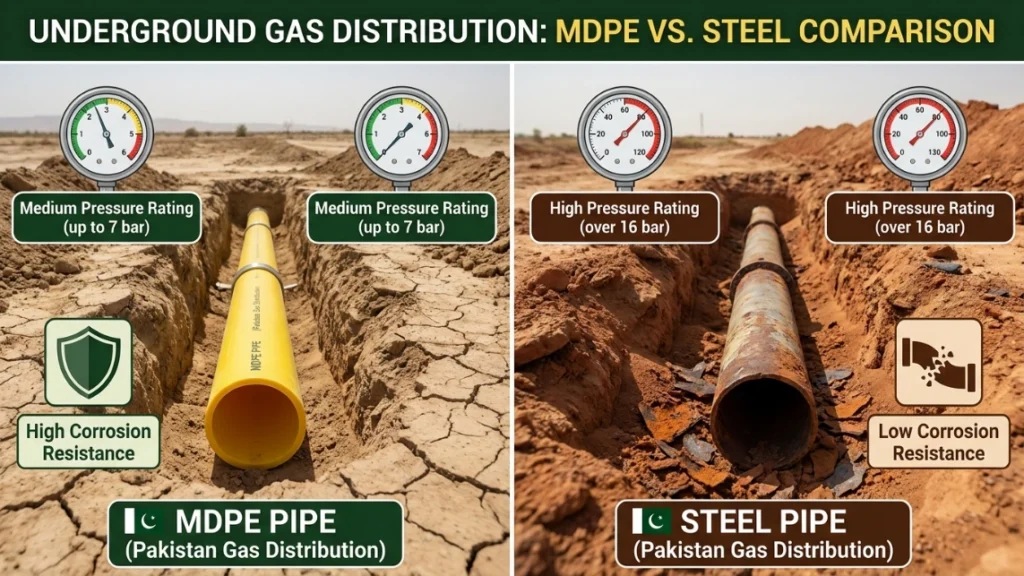
The switch to MDPE pipe underground gas line installation in Pakistan has been underway for over two decades in SNGPL and SSGC networks, and for good reason. Medium density polyethylene does not corrode, does not require cathodic protection, joints without a leak path, and achieves a 50-year design life under the operating conditions present in Pakistan’s gas distribution infrastructure.
If you are specifying, procuring, or contracting gas pipeline work — whether for a housing society connection in Bahria Town, an industrial gas supply in Faisalabad, or a new distribution spur in Multan — this guide gives you the technical and compliance foundation to make the right material decision and avoid the category of errors that generate SNGPL or SSGC rejection at inspection.
What Is MDPE Pipe and Why Is It Approved for Gas Distribution in Pakistan?
Medium Density Polyethylene, classified as MDPE, is a PE80 grade polyethylene with a density between 0.930 and 0.940 g/cm³. This density range gives MDPE a balance of flexibility, impact resistance, and pressure performance that makes it the globally recognised standard material for buried low-pressure and medium-pressure gas distribution — the exact application that defines Pakistan’s urban and peri-urban gas networks.
MDPE for gas applications is manufactured in yellow — the internationally standardised colour coding for gas service pipework — to differentiate it visually from blue or black HDPE used in water applications during installation and any future excavation. This colour coding is mandated by ASTM D2513, the standard that governs thermoplastic gas pressure pipe and fittings, which is referenced by both SNGPL and SSGC in their technical specifications for approved materials.
The material properties that qualify MDPE specifically for gas service include resistance to slow crack growth — the mechanism by which polyethylene pipe can develop long-term fissures under sustained stress — and resistance to rapid crack propagation, which is critical in any pressurised gas application. These properties are tested and certified under ISO 4437, the international standard for polyethylene pipes for gas distribution systems.
NEWTECH’s MDPE pipe range covers 20mm to 160mm outside diameter in PE80 grade, manufactured to ISO 4437 and ASTM D2513 requirements, with PSQCA certification for use on SNGPL and SSGC approved projects.
How Pakistan’s Soil Conditions Accelerate Steel Gas Pipe Corrosion
Steel corrodes in soil when electrochemical cells form between the pipe surface and the surrounding ground. Pakistan’s urban soils create particularly aggressive corrosion environments — and this is the technical core of why MDPE pipe underground gas line installation has displaced steel across every modern gas distribution project in the country.
Soil chemistry across Pakistan’s major cities
Lahore’s canal irrigation belt creates high-moisture, high-chloride soil conditions in many residential and commercial zones — exactly the chemistry that drives pitting corrosion in buried steel. Karachi’s coastal proximity means many areas have saline groundwater within 2 to 5 metres of surface, creating a corrosive electrolyte directly in contact with buried pipework. Faisalabad’s industrial zones carry elevated sulphate concentrations from decades of textile and chemical processing discharge into soil and groundwater, and sulphate-reducing bacteria in these soils accelerate microbiologically-induced corrosion in steel pipes.
The cathodic protection burden
Steel gas mains buried without cathodic protection corrode to failure within 15 to 25 years in Pakistan’s more aggressive soil zones. With cathodic protection — impressed current systems or sacrificial anodes — service life extends, but the protection system itself requires ongoing maintenance, annual inspection, and periodic replacement of anode beds. This maintenance burden has no equivalent in an MDPE network. Once an MDPE pipe is installed and fused, there is no corrosion mechanism to manage.
The Gas Research Institute documented that polyethylene gas pipe systems in North America show near-zero corrosion-related failures across networks now exceeding 40 years of service. Pakistan’s SNGPL has recorded similar performance advantages in PE replacement programmes across its northern network.
MDPE vs Steel Pipe Underground: A Direct Technical Comparison
The case for MDPE over steel for underground gas distribution is not marginal — it is decisive across every attribute that determines the 30-year cost and performance of a gas network.
| Performance Attribute | Steel Pipe | MDPE PE80 |
|---|---|---|
| Corrosion resistance | Poor — requires cathodic protection | Excellent — completely immune |
| Cathodic protection required | Yes — ongoing cost and maintenance | No |
| Jointing method | Welded or threaded — leak risk at connections | Electrofusion or butt-fusion — homogeneous joint |
| Leak frequency per km per year | High in older networks | Near-zero in correctly installed systems |
| Flexibility in ground movement | Low — rigid, fractures at stress concentrations | High — absorbs settlement and seismic movement |
| Installation speed | Slow — requires welding certification, NDT | Fast — electrofusion jointing is rapid and reliable |
| SNGPL/SSGC approval for new installations | Declining — being phased out for distribution | Yes — standard specification for new networks |
| PSQCA certification available | Yes | Yes — required for gas distribution applications |
| Operating pressure range | High — suitable for transmission at high pressure | Up to 4 bar for distribution networks |
| Design service life | 20–30 years in Pakistan soil conditions | 50 years at rated conditions per ISO 4437 |
| Relative installed cost per metre (63mm) | High — material plus protection plus NDT | Medium — lower total installed cost |
| Soil contamination risk on failure | High — fuel and soil contamination | Lower — smaller failure events, easier containment |
The total installed cost comparison deserves particular attention. Steel pipe appears cheaper per metre at purchase. When you add welding labour, non-destructive testing of welds, cathodic protection installation, and the lifecycle maintenance cost of that protection system, MDPE installed cost over a 30-year horizon is lower in every documented Pakistani gas utility project where both materials have been life-cycle costed.
MDPE Pipe Sizes, SDR Ratings, and Pressure Classes for Gas Distribution in Pakistan
Selecting the correct MDPE pipe size and SDR rating for your gas distribution project determines whether the network delivers adequate pressure at the point of use and whether it passes SNGPL or SSGC approval at commissioning.
MDPE gas distribution pipe in Pakistan operates across two pressure tiers: low pressure (LP) at below 0.075 bar and medium pressure (MP) at 0.075 to 4 bar. Housing society distribution networks and individual property service connections typically operate at LP or low MP. Industrial connections and trunk distribution mains in growing urban areas like Gujranwala and Sialkot often operate at higher MP levels requiring specifically rated SDR selections.
SDR ratings for MDPE gas pipe
SDR11 MDPE (PE80) has a maximum allowable operating pressure (MAOP) of 4 bar and is the standard specification for medium pressure gas distribution mains in Pakistan. This is the SDR specified on SNGPL and SSGC approved design drawings for trunk distribution spurs feeding housing societies and industrial estates.
SDR17.6 MDPE has a MAOP of 2.5 bar and is appropriate for secondary distribution within housing society internal networks where operating pressure is stepped down at a district regulator station.
SDR21 is used for low-pressure service connections feeding individual properties from the distribution main — the 20mm to 32mm pipes that run from the street main to each house or commercial unit.
| Outside Diameter | Common SDR | MAOP (PE80) | Typical Application |
|---|---|---|---|
| 20mm | SDR21 | 2.5 bar LP | Individual property service connections |
| 25mm | SDR17.6 | 2.5 bar | Small commercial service connections |
| 32mm | SDR17.6 | 2.5 bar | Multi-unit building connections |
| 40mm | SDR11 | 4 bar | Small distribution mains |
| 50mm | SDR11 | 4 bar | Estate distribution mains |
| 63mm | SDR11 | 4 bar | Primary estate mains, road crossings |
| 90mm | SDR11 | 4 bar | Trunk distribution, major road mains |
| 110mm | SDR11 | 4 bar | Sub-transmission, large estate supply |
| 160mm | SDR11 | 4 bar | Zone supply mains, industrial feeds |
NEWTECH’s MDPE pipe range (link: /mdpe-pipes/) covers 20mm to 160mm in both SDR11 and SDR17.6 configurations, with the complete technical data sheet available through NEWTECH’s pipe catalogue (link: /pipe-catalogue-pakistan/).
SNGPL and SSGC Compliance: What Your MDPE Gas Pipe Supply Must Demonstrate
Getting SNGPL or SSGC approval on a gas distribution project requires your pipe supply to meet a specific documentation and certification package — not just a visual check of the pipe material. Understanding what the gas utilities require protects your project from the delays and forced replacements that follow a failed supply audit.
Material certification requirements
Both SNGPL and SSGC require MDPE gas pipe to be certified to ASTM D2513 and ISO 4437. The pipe must be manufactured from virgin PE80 compound — no regrind, no blended or extended material. This is non-negotiable and is verified through material traceability documentation that tracks compound from the base resin supplier through the pipe manufacturing process.
The pipe must carry continuous markings on the barrel: manufacturer name, outside diameter, SDR rating, material designation (PE80), standard reference (ASTM D2513 or ISO 4437), operating pressure, production date and batch number. Missing any of these markings means the pipe fails inspection regardless of how good the underlying material is.
PSQCA certification for gas distribution pipe
PSQCA certifies MDPE gas pipe to a specific Pakistani standard that aligns with ASTM D2513. The certification covers dimensional conformance (wall thickness at or above SDR minimum across the full circumference, not just at one point), hydrostatic pressure testing at 1.5 times rated pressure, and material designation verification. Batch certification — not company-level approval — is required by SNGPL for each supply consignment.
NEWTECH is PSQCA certified (link: /about/) for MDPE gas distribution pipe, with batch documentation available for every production run. For large housing society or industrial gas connection projects, NEWTECH’s technical team can prepare the complete supply documentation package for SNGPL or SSGC submission.
Installing MDPE Gas Pipe Correctly: The Steps That Determine Whether Your Network Passes Commissioning
Correct installation of MDPE gas pipe requires discipline at four specific stages. Errors at any of these stages are invisible on the day of installation and only become apparent at pressure testing or — in the worst case — in service.
Trench preparation and pipe handling
MDPE gas pipe must be laid in a trench with a minimum cover of 600mm in non-trafficked ground and 900mm in trafficked road crossings, per SNGPL installation standards. The trench bottom must be free of stones larger than 20mm — sharp stone contact on a gas pipe is a slow crack growth initiation point. A 100mm sand or fine granular bedding layer under the pipe is mandatory, with 300mm of selected backfill above before returning road or garden material.
Electrofusion jointing protocol
Electrofusion is the dominant jointing method for MDPE gas pipe in Pakistan’s housing society and urban distribution work because it is faster than butt-fusion for small-diameter pipe and does not require a welding machine positioned at each joint location. The electrofusion protocol requires: clean pipe ends with no oxidation layer (scraping is mandatory, not optional), dry joint surfaces (no moisture at the fusion zone), correct voltage supply to the coupler controller, and an undisturbed joint during the cooling period specified on the coupler packaging.
The most common electrofusion failure in Pakistani gas work is moisture contamination of the joint surface — a pipe end cleaned and then left in a damp trench overnight before jointing. SNGPL’s commissioning teams see this regularly in third-party contractor work. It produces a joint that holds pressure during the commissioning test and leaks within the first two years of thermal cycling.
Pressure testing and purging
MDPE gas mains in housing society projects must be pressure tested at 1.5 times MAOP (typically 6 bar for an SDR11 system rated at 4 bar) for a minimum of one hour after the 30-minute stabilisation period. The test medium must be air or nitrogen — never water, as water in a gas main creates a contamination and corrosion issue at the first steel service valve it contacts. Purging before commissioning follows SNGPL’s standard purging procedure using natural gas to displace the test medium progressively from one end of the system.
⚙️ Expert Insight from NEWTECH
The single most damaging procurement mistake NEWTECH’s technical team encounters on MDPE gas projects in Pakistan is accepting HDPE pipe — sometimes marketed as suitable for gas — as a substitute for certified PE80 MDPE yellow gas pipe. HDPE in black or blue is not rated for gas service under ASTM D2513 or ISO 4437, lacks the slow crack growth resistance certification for gas application, and will fail SNGPL and SSGC supply audits on sight. Yellow colour coding exists for exactly this reason — it is the first check before any other documentation. If the pipe is not yellow, it is not gas pipe, regardless of what the invoice says.
Why NEWTECH MDPE Pipe Is Specified for Gas Distribution Projects Across Pakistan
NEWTECH has manufactured MDPE gas distribution pipe since the company’s establishment in 1998 — through the period when SNGPL and SSGC were actively transitioning from steel to polyethylene across their distribution networks. This manufacturing history means NEWTECH’s production processes, quality controls, and certification documentation are aligned with exactly what Pakistan’s gas utilities require at supply audit.
NEWTECH’s MDPE pipe (link: /mdpe-pipes/) is manufactured from virgin PE80 compound under ISO 9001:2015 quality management, with in-process dimensional checks and hydrostatic pressure testing on each production batch. The manufacturing technology (link: /technolgy/) includes continuous extruder control systems that maintain wall thickness consistency across the full pipe length — eliminating the thin-wall sections that can occur in less controlled production environments and that represent the weak points in a pressurised gas network.
For contractors and developers working on SNGPL-connected projects in Lahore, Faisalabad, or Islamabad — or SSGC-connected projects in Karachi and Multan — NEWTECH provides the complete supply package: PSQCA batch certification, ASTM D2513 test reports, material traceability documentation, and technical support for the commissioning documentation package that gas utilities require at network handover.
NEWTECH’s engineering team (link: /contact-us/) can advise on SDR selection, jointing method, and installation specification for specific project conditions on request.
Conclusion
The transition from steel to MDPE gas distribution pipe in Pakistan is not a trend — it is an engineering decision already made by SNGPL and SSGC based on 20 years of field performance data. What remains is ensuring that every contractor and developer working on new gas connections, housing society networks, and industrial feeds specifies and sources MDPE correctly.
Four things to act on from this guide: confirm your pipe is yellow PE80 certified to ASTM D2513 and ISO 4437 before accepting any delivery, match SDR rating to your MAOP with a proper safety margin, require PSQCA batch certificates on every consignment, and build the electrofusion joint quality protocol into your installation contract rather than leaving it to site judgment.
Correctly installed MDPE pipe underground gas line infrastructure in Pakistan delivers a 50-year service life with no corrosion maintenance — the most cost-effective gas distribution investment any developer or utility engineer can make.
FAQ SECTION
1. What is MDPE pipe and is it approved for underground gas lines in Pakistan?
MDPE stands for Medium Density Polyethylene, a PE80 grade plastic pipe manufactured in yellow for gas distribution applications. It is approved by both SNGPL and SSGC for underground gas distribution networks in Pakistan when certified to ASTM D2513 and ISO 4437. MDPE pipe handles operating pressures up to 4 bar at SDR11 and carries a 50-year design life in buried conditions.
2. Why does MDPE pipe outperform steel for underground gas distribution in Pakistan’s soil?
Pakistan’s urban soils — particularly in Lahore, Karachi, and Faisalabad — contain high chloride, sulphate, and moisture levels that cause progressive pitting and microbiological corrosion in steel gas mains within 15 to 25 years. MDPE pipe underground gas line installations in Pakistan are completely immune to soil corrosion, require no cathodic protection, and maintain leak-free performance through fusion jointing across the full 50-year design life.
3. What SDR rating should I specify for MDPE gas pipe on a housing society project in Pakistan?
SDR11 PE80 MDPE is the correct specification for housing society gas distribution mains operating at medium pressure up to 4 bar — the standard SNGPL operating pressure for estate distribution networks. SDR17.6 is used for secondary distribution within the estate at lower operating pressures. Individual property service connections from 20mm to 32mm typically use SDR21 for low-pressure service at 2.5 bar.
4. How long do MDPE gas pipes last when buried in Pakistani ground conditions?
MDPE gas pipe certified to ISO 4437 and ASTM D2513 carries a minimum design service life of 50 years at rated operating pressure and temperature. This lifespan assumes correct installation — proper trench bedding, fusion jointing to protocol, and minimum burial depth of 600mm in non-trafficked ground and 900mm under roads. Unlike steel, MDPE does not degrade progressively with soil moisture or chemical exposure, so the 50-year rating holds across Pakistan’s variable soil conditions.
5. What documentation does SNGPL require for MDPE pipe supply on approved gas projects?
SNGPL requires PSQCA batch certification specific to the supplied consignment, ASTM D2513 and ISO 4437 test reports for the production batch, material traceability documentation confirming virgin PE80 compound, and pipe barrel markings confirming manufacturer, diameter, SDR, material designation, standard reference, and batch number. Company-level certifications issued months earlier are not accepted as batch-level supply documentation. NEWTECH provides the complete documentation package for SNGPL-approved projects.
6. Can HDPE pipe be used instead of MDPE for underground gas distribution in Pakistan?
No. HDPE pipe — typically PE100 grade in black or blue — is not certified for gas service under ASTM D2513 or ISO 4437 and will fail SNGPL and SSGC supply audits. Gas distribution pipe must be yellow PE80 MDPE meeting specific slow crack growth and rapid crack propagation resistance requirements that distinguish it from water supply HDPE. Using HDPE on a gas project creates a safety risk and a compliance failure that results in mandatory pipe replacement before commissioning approval.